Features

The age of the Skype Dad

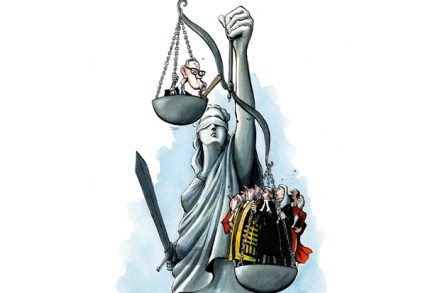
Could you be a useful and loving father to your children if you only ever saw them on a computer screen? Most of us would say no. So much of being a parent is about being physically there. It’s curious then that our courts seem to think the opposite — that a chat via Skype or on an iPad is all a father needs to bond with and care for his child. British judges, like American ones, have to deal with increasingly complicated custody cases every year. We travel more these days, and so we meet our partners abroad. When these marriages break up (as four in ten marriages do), a foreign wife often longs to take the kids and head back home.

Hell on wheels

How many of the people driving mobility scooters these days actually need a mobility scooter? The invention of the vehicle was a great move forward (literally) for those who genuinely needed it: the disabled and the infirm. But then another group of users appeared. Rather slowly, admittedly, and wheezing as they did so, before settling their vast backsides into the soothing embrace of the scooter’s seat. Once there they sighed happily, popped another Kit Kat into their gob and contemplated a life where movement from A to B required a mere flick of the wrist, rather than all that tedious leg business. This supersized scooter squadron has conquered Britain with an ease that the Romans in their chariots could only have dreamed of.

The Catholic crack-up

[audioplayer src="http://rss.acast.com/viewfrom22/edcouldstillwin/media.mp3" title="Freddy Gray and Damian Thompson discuss the Catholic crack-up" startat=1403] Listen [/audioplayer]A scurrilous rumour recently swept Rome: the Pope had summoned the Vatican’s finance czar over his expenses. When Cardinal George Pell admitted spending more than £3,000 on a designer kitchen unit, Francis quipped: ‘What, is it made of solid gold?’ That never happened, of course, but the tittle-tattle served a purpose. The story appeared in an Italian magazine just as Francis was deciding how much power to give Cardinal Pell over the curial accounts. Influential figures wanted to keep their money away from the cardinal’s prying eyes.

In defence of Christianity

Jeremy Paxman was on great form last week, reminding us that when it comes to being rude to prime ministers he has no peers. Jeremy’s rudeness is, of course, magnificently bipartisan. However elegant the sneer he displayed when asking David Cameron about Stephen Green, it was as nothing compared to the pointed disdain with which he once asked Tony Blair about his faith. Was it true, Jeremy inquired, that he had prayed together with his fellow Christian George W. Bush? The question was asked in a tone of Old Malvernian hauteur which implied that spending time in religious contemplation was clearly deviant behaviour of the most disgusting kind.

‘The truth is hard’: an interview with Roger Scruton

To the extent that Britain has philosophers, we do not expect them to address issues of any relevance to the rest of us. They may pursue some hermeneutic byway perhaps, but not the urgent or profound issues of our time. Roger Scruton has always been an exception in this regard, as in many others. He has spent his adult life thinking and writing about the nature of love, the nation state, belonging, alienation, beauty, home and England. But even his closest readers may gulp at the relevance of his latest subject matter. His new novel, The Disappeared, is set in the north of England and centres on the recent rape-gang cases. It’s a gripping, disturbing narrative dealing with abduction and abuse but also love, escape and a type of redemption.

The populist outsider who really could beat Hillary Clinton (clue: it’s not Elizabeth Warren)

 Washington DC   Bored American reporters are pining for a Democratic primary challenger to step up against Hillary Clinton in 2016. We don’t like coronations. It’s not just cynical Republicans who cheered at ‘emailgate’ — the crisis Clinton faced after it emerged she had used a private account for her emails as Secretary of State. It makes matters more interesting, and moves the spotlight on to other, less celebrated politicians. The media is consequently obsessed with the idea that Elizabeth Warren, a Massachusetts Democrat admired by Occupy Wall Street, can take on Hillary. The more logical opponent is Joe Biden, the Vice President. There’s also Bernie Sanders, self-described socialist senator from Vermont.

‘I will call the police!’: My close encounter with ‘revenue protection’

‘Make yourself a happy bunny this Easter with cheap tickets and egg-cellent deals!’ chirped the Abellio train company advert. I use Abellio’s Greater Anglia service regularly from London and was looking forward to a nice fluffy ride to Norwich. I was late for the 9 a.m. train but the Liverpool Street station Abellio assistant smilingly informed me I wouldn’t need to pay extra for the later train. I bought a cup of coffee and presented my ticket to the barrier staff at platform 11. A dignified-looking man of African origin with ritually scarred cheeks seemed to be unusually officious. Tapping my ticket with the sharp end of a pencil he said: ‘This will not do. Show me your ID. Please.’ I fished out my University of East Anglia lecturer card.

Alex Salmond sets out his terms for Ed Miliband

‘Would you like a glass of pink champagne?’ asks Alex Salmond at 3.30 p.m., sounding very much like a man settling down for the afternoon. It’s Monday and Scotland’s former first minister has cause to celebrate. He spent the previous day musing on television about the price he’d demand for the SNP supporting Ed Miliband in the Commons, and his thoughts dominate the front pages. There’s plenty of outrage at the idea of the SNP toying with England, and outrage is just what he wanted. So champagne it is. He has found himself an unlikely star of the Tory election campaign; the party this week released a cartoon showing him playing a whistle while Miliband dances.

Sweden’s feminist foreign minister has dared to tell the truth about Saudi Arabia. What happens now concerns us all

If the cries of ‘Je suis Charlie’ were sincere, the western world would be convulsed with worry and anger about the Wallström affair. It has all the ingredients for a clash-of-civilisations confrontation. A few weeks ago Margot Wallström, the Swedish foreign minister, denounced the subjugation of women in Saudi Arabia. As the theocratic kingdom prevents women from travelling, conducting official business or marrying without the permission of male guardians, and as girls can be forced into child marriages where they are effectively raped by old men, she was telling no more than the truth.

He’ll never admit it, but David Cameron is already plotting another deal with Nick Clegg

David Cameron is honest to a fault — or so he told us this week. While cooking lunch in the kitchen of his Oxfordshire home, he was asked, in terms, whether this is the last election he’ll fight as party leader. Yes, he said, it was. He was then kind enough to name three potential successors. And when shortly afterwards broadcast journalists grew greatly excited by this, he said he had done nothing more than give a ‘very straight answer to a very straight question’. But there is another question to which he will not give a straight answer: is he preparing for another coalition? The Prime Minister knows the official response: of course not, he’s fighting for a majority.

Lord Freud: the man who saved the welfare system

It was mid-October and Downing Street was in a panic. Lord Freud, the welfare minister, had been secretly recorded suggesting that disabled people could be paid less than the minimum wage. Labour demanded Freud should go. The No. 10 press office was briefing journalists that he would be out within hours. Craig Oliver, excitable Downing Street director of communications, advised the Prime Minister that Freud was finished. There was talk of the return of the nasty party, and days of dreadful headlines. In the end David Cameron stayed loyal. Within 48 hours the story was forgotten. Welfare reform is the coalition’s most important achievement. Universal Credit is at the heart of welfare reform.

Belle Gibson and the pernicious cult of ‘wellness’

Belle Gibson was a publicist’s dream: a ‘wellness guru’ and young mother with a wholesome blonde beauty, a wide white smile, and just enough tattoos to look modern. She had already encountered appalling adversity for one barely into her twenties: in 2009, she revealed, doctors had diagnosed her with malignant brain cancer and told her bluntly: ‘You’re dying. You have six weeks. Four months tops.’ Sickened by two months of chemotherapy and radiotherapy, Gibson said, she had abandoned conventional treatment in favour of a range of holistic treatments, including Ayurvedic medicine and oxygen therapies. She embarked, too, on a gluten-free, refined sugar-free diet which she detailed on her 2013 Instagram blog @healing_belle.

In praise of messy old kitchens

‘I love my new kitchen heart of the home let’s fill it with friends happy.’ So says the thought bubble in the current ad for the estate agents Rightmove, part of their ‘Find your happy’ campaign. Don’t even get me started on the lack of punctuation — or the use of ‘happy’ as a noun. What I’m worrying about is the kitchen itself. Glimpsing Ed Miliband’s second kitchen last week, we came face to face with the drabness of today’s hyper-hygienic kitchen. Is the kitchen really ‘the heart of the home’ in Rightmove’s imaginary domestic paradise, or is it in fact one of those spotless, minimalist, metallic kitchens, all hard surfaces and sharp corners?

The return of the fountain pen

Every working day before I start pounding the keyboard of my ridiculously flashy 27-inch iMac, I perform a little ritual. I straighten the fountain pens I keep on my desk, and make sure they are fully inked. Though I always have an eye for my next acquisition, I currently have just six pens, which are fuelled by four bottles of ink I keep next to them — Waterman black and serenity blue, Pelikan turquoise and Parker red. Three of the pens are Parkers, and my clear favourite is the greatest mass-produced pen of all time, the sleek Parker 51, with the distinctive hooded nib which first appeared in 1941, yet looks like the front end of a futuristic high-speed train. I have a particular reason to love this pen as it belonged to the great W.F. Deedes.

That’s not a ‘sharing economy’: that’s an invitation to sell your whole life

Technology businesses have a genius for inflicting indignities on us and spinning them as virtues. When they don’t want to respect copyright, they talk about the ‘democratisation of content’. When they want to truffle through our contact lists and browsing histories, they talk about ‘openness’ and ‘personalisation’. A hundred years ago, when a widow had to take in lodgers to pay the bills, it was called misfortune. Today, when an underemployed photographer has to rent out a room in his house or turn his car into a taxi, it’s called the ‘sharing economy’. First Google took his job. Now Airbnb wants his house. Next they’ll be after his pets. In fact, they already are.

A jobs miracle is happening in Britain, thanks to tax cuts. Why don’t the Tories say so?

Feeling the genitals of freshly hatched chickens may not be the most glamorous job in the world but at £40,000 a year it’s not badly paid. It requires some stamina: you pick up hundreds of chicks a day and check their ‘vent’ for boy parts. If it’s a baby hen, then she’s sent off for a life of corn and egg-laying. If it’s a baby rooster — well, best not to ask. Almost nobody in Britain wants to do it, so vacancies go unfilled. The poultry industry, in desperation, has asked the government to add ‘chicken sexer’ to its growing list of seemingly unfillable jobs. This fits a trend. In five short years, Britain has gone from having mass unemployment to jobs galore.

How we drive our children mad

Mental health is a slippery concept at best and according to the annual prevalence rates given in the latest Diagnostic and Statistical Manual of the American Psychiatric Association, people in north America and Europe suffer from an average of about two-and-a-half psychiatric conditions a year. This suggests that either we are all mad or the American Psychiatric Association is mad (though with a shrewd eye to the main chance). It is hardly surprising then, since the child is father to the adult, that at least 10 per cent of children in Britain suffer from ‘diagnosable mental disorders’, to use a phrase much favoured in the press. Given the way that mental disorders are diagnosed, more or less by checklist, I am surprised that it is so few.

A lesson in bias on private schools

What’s wrong with low-cost education in poor countries? Quite a lot, you might think, if you read a new report from the Department for International Development. Low-cost private schools serve around 70 per cent of children in poor urban areas and nearly a third of rural children too. But the issue raises controversy among academics and experts, not least because it goes against 65 years of development dogma that the only way to help the poor is through government education, with big dollops of aid thrown in. Every aid agency and government has gone along with that. The only fly in the ointment is that poor parents disagree, which is why low-cost private schools are burgeoning wherever you look.