Spectator Life

Spectator Life

An intelligent mix of culture, style, travel, food and property, as well as where to go and what to see.

The Terry Venables I knew

You didn’t have to like football to feel some sort of affinity with Terry Venables. He had bags of East London charm, oodles of enthusiasm and glossy good looks (as long as you didn’t mind the gold medallion around his permanently tanned neck). As it happens, I like football very much – so it was an easy decision when, six years ago, El Tel’s wife, Yvette, invited me to stay in their Spanish hotel, La Escondida, in the Font Roja National Park, about 45 minutes inland from Alicante. The idea was that I would write about it in the Daily Mail. Sailing close to the wind was in Venables' DNA – one of the many reasons why footie fans loved him My wife came, too – and she hates football. Flamenco was the theme on the first night.


The despair of Deliveroo

Self-pity and Deliveroo go hand in hand. You can’t have the latter without the former. It’s impossible to watch a rain-drenched driver fight with his moped’s side stand – while you sit torpidly in your pants by the window – without the heavy feeling of self-loathing. There’s something shameful about it, something pathetic. If Dante were alive now, he’d add another layer to hell: Deliveroo users. And I’m one of them. If using Deliveroo is a sin, call me Hester Prynne. I too have tasted the nectar. I too have dribbled over a box of tungsten nuggets and a semifluid dipping sauce. I’m not anti-technology. I’m anti-technology that makes us a worse version of ourselves We know it’s not a good idea.

I found peace at the gun range

I like ice hockey, 7-Eleven Big Gulps and the choice of six lanes on the Interstate. I like almost everything about America except the guns, which is why I decided to challenge my prejudices at a pistol range in Fresno, California. Walking in, I was welcomed by ‘Don't tread on me!’ stickers and signs in military stencil fonts. I had anticipated hearing gunshots, but the irregular, endless bangs were worse than I’d expected.  I loaded the magazine with five bullets, pulled back the slide and felt an unnatural sense of gallantry ‘We’re from Britain and would like to try a gun,’ explained my friend. We signed some waivers and a friendly assistant called Tom reached back to the pistol rack behind him and replaced one of the handguns with my driving licence.

For one night only, I was back on the DJ decks

Hard to imagine now but I was once a hot club DJ. I now need to go to bed on the same day I got up but once upon a time – in fact, hundreds of times upon a time – I dropped big tunes at famous clubs including Le Beat Route, the Camden Palace and Stringfellows. I was knee-deep in cocaine and hookers but had no interest in either. My only interest was the glory I gleaned from filling a dancefloor with shiny, happy people. Being irredeemably shallow and easily flattered, I faux-reluctantly agreed Playing clubs was relatively easy. Revellers were keen to dance, especially those who arrived, shall we just say, ready-stimulated.

Why Russell Norman was a restaurant genius

Polpo, Russell Norman’s celebrated and original Italian restaurant in Soho, was in full flow when I visited for the first time: busy, loud, glasses full and meatballs rolling. I had returned to London after some years away in my early twenties, and had little money. Polpo welcomed diners with its buoyancy and affordability. It was a good restaurant for everyone. Importantly, it was one that we could afford. There is much to say about Norman, a pioneering and visionary restaurateur who died suddenly at the age of 57 on Thursday. I’ll leave the more personal and intimate conversation to those who knew him well. What I want to say is that it is a rare and fine cause to open restaurants that are quite so approachable.

The Museum of London’s dubious ‘race research’

I don’t know about you, but I love a bit of topical reading when I go abroad. That’s why, in my last week of travelling between lush, green, untouched Cambodian islands, I’ve been immersed in apposite books like Julia Lovell’s Maoism: a Global History, and Frank Dikotter’s The Cultural Revolution. So far, I’ve been pleased with my choices. First, they are properly appropriate: one of the reasons Cambodia’s islands are so untainted by tourism, or even inhabitants, is because the ultra-Maoist, Chinese-funded Khmer Rouge evacuated all the occupants and forced them into deadly labour on the mainland. Also, the books are truly astonishing, perhaps in a consoling way.

Tips for the Coral Gold Cup and Becher Chase

There are two high-class chases taking place tomorrow – one at Haydock and the other at Ascot. They will have a bearing on the betting markets for the Ladbrokes King George VI at Kempton on Boxing Day and the Cheltenham Festival. However, neither race this weekend is now an attractive betting proposition because each has attracted just four runners. I suggested a bet a week ago in the Grade 1 Betfair Chase (Haydock 3 p.m.) at a time when most bookmakers were still offering three places. So I am pleased to see that Corach Rambler, put up each way at 14-1, now only has three rivals tomorrow. However, I am fully aware that he is the lowest rated horse in the race and it is perfectly possible that he could still finish fourth (or indeed not finish at all).

Introducing my manic Christmas tradition

It is a truth universally acknowledged – at least by anyone with a developed frontal lobe – that seasonal enjoyment and growing up are inversely proportional. As the stranglehold of middle age tightens, I am incapable of conjuring the Christmas excitement I felt as a child. And it seems to have been replaced with intense festive angst.  The mood is less holy and more fisticuffs, as it presents an excellent opportunity to ratchet up the festive stress Samuel Johnson was talking about second marriages when hatching his aphorism about hope over experience, rather than what Americans refer to as ‘readying the home’, yet every year I still try to summon those seasonal spirits of childhood.

Was the Emperor Elagabalus really trans?

The North Hertfordshire Museum in Hitchin has made the remarkable discovery, known to historians only since the 9th century AD, that the Roman emperor Elagabalus was a sexual pervert who liked to be called ‘she’ and offered vast sums to any doctor who could kit him out with female sex organs. In celebration of such a visionary, the museum has decided to describe him as a ‘transgender woman’ in their display of a coin minted during his reign (AD 218-222). The museum had better be careful what it wishes for.

How to date a widower

When is it acceptable to consider dating a widower? How do you know if they are still grieving and not ready to move on? According to statistics, men die earlier than women, so I was surprised this year to meet several whose wives had died before them. Divorced since the early 1990s, I had no intention of remarrying, but thought of striking up some sort of liaison with a widower. I had heard of women behaving in a desperate and undignified way, charging round with casseroles I had rejected two non-widowers, whom my grandmother would have described as ‘cast-offs’, meaning exes one mustn’t go back to.

‘The potential for jeopardy’: Pullman Dining on the Great Western Railway, reviewed

I am lazy and nosy, and so I spend a lot of time on the GWR service from Penzance to London Paddington. Each journey is a play with a unique atmosphere. Some are seething, particularly in summer when an eight-carriage train cannot fit everyone who wants to swim in the ocean but dine in west London that same night. Some are non-committal; some restful. I rage at usual things: luggage in the disabled space, which is almost always occupied by the non-disabled, though they may be fat; videos played without headphones; young people swearing at older people because they grapple with a rage they cannot understand. You can measure the social contract on any long train journey, and I have. It’s broken.

How Vegas became a sporting hotspot

Anyone know the Hindi for schadenfreude? Who could have seen that coming: certainly not your correspondent, who had invested some time ago in India to win the Cricket World Cup. Not to be, sadly, and the red-hot favourites were given an absolute pasting in their own backyard by a team of unfancied Aussies who had lost both their opening games of the tournament. It certainly disproves the Samson theory of sporting excellence: in days of yore a sportsman’s luxurious mullet (look at rugby’s Mickey Skinner, or football’s Frank Worthington and Stan Bowles) often meant a similar lush on-field display.

Why have we forgotten David Cassidy?

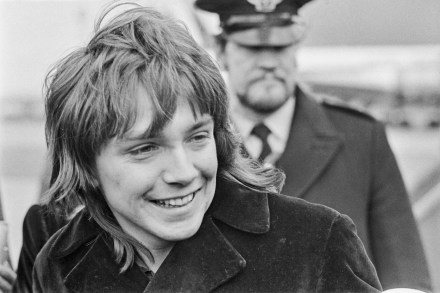
Everyone has a guilty pleasure. Some have several. One of mine is David Cassidy who died six years ago from liver failure at the age of 67, an event that barely made more than a back-of-the-book page lead in many newspapers. Which is a shame. For at his peak, he had a fanbase on a par with Elvis and The Beatles, looks that sent young girls into delirium, a rich and textured voice that was tailor-made for the three-minute pop single and a charisma, not to mention a personal life, that in its prime gave showbiz reporters round the clock bylines.

At last, Hollywood mocks cancel culture

Dream Scenario is a film about modern celebrity culture and the terror of losing yourself to the internet’s virtual mob. It’s the story of evolutionary biology professor Paul Matthews, a balding, befuddled, bespectacled everyman who is the walking embodiment of anonymity – played by Nicholas Cage, the face that launched a thousand memes. At the start of the film, he gives a lecture on how zebras have adapted to avoid the mortal danger of standing out from the herd. Suddenly, in a supernatural, psychopathological epidemic, anorak-clad Paul finds himself appearing in everyone’s dreams. At first, he is just a benign bystander; in one dream, he stands there admiring a mushroom while his student is stabbed by a serial killer.

JFK’s assassination and the landscape of loss

It has become a commonplace to observe that, 60 years ago, when President John F. Kennedy was assassinated in Dealey Plaza, Dallas, America lost its innocence – or at least the myth of its innocence. Certainly, the event has left a stubborn impression on history and culture; something to do with the power, grandeur and grubbiness of US politics, with Vietnam, civil rights and the sixties. But I have always sensed that there was something else; something that also formed part of the loss-of-innocence narrative somehow. I have finally realised what it is. It is Dealey Plaza itself.

Why women still love Twilight

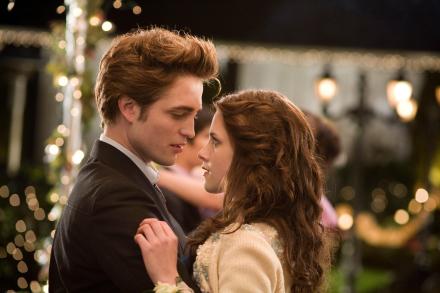
Anybody who has been a teenage girl will know how dark and swampy the sexual imagination of that demographic can be. At 14 and 15, after watching Baz Luhrmann's Romeo and Juliet (1996), and then James Cameron's Titanic (1997), I became so obsessed with Leonardo DiCaprio that I’d lie for hours on my bed hatching feverish plans for going to New York and meeting him; comparing fictional fling Kate Winslet to me (similar body type, I told myself) and broodingly calculating my chances. It wasn’t a funny light-hearted thing, but deadly serious, awash in life or death longing. The same quality applied to Will, Pete, Travis, Chris, and the other boys at school on whom I developed all-consuming crushes.

What Ridley Scott gets wrong about history

The film director Ridley Scott says that those who worry about the historical inaccuracies in his new biopic of Napoleon should ‘get a life’. Or as the told The Sunday Times last week: ‘When I have issues with historians, I ask: “Excuse me, mate, were you there? No? Well, shut the fuck up, then.’ If you’re not careful you can end up changing history You don’t need to be Alan Bennett to cock an eyebrow at that. While I’ve not yet seen Napoleon – and I will because I’m sure it’ll be a cracker (it’s Ridley Scott, after all, and Joaquin Phoenix) – I have read about its various delusions, not least Scott’s decision to have Bony present at the execution of Marie Antoinette or ­his army firing their cannon at the Pyramids which they did not.

How to travel India by steamboat

‘The road to hell is paved with good intentions’. Nowhere is this so true as in the streets of Calcutta, departing point of our cruise. The legacy of Mother Teresa has placed a stigma on the ancient capital of the British Raj, now forever considered a city of the dying and destitute. Unsurprisingly, Calcutta does not feature all that much in tourist guides, which is a mistake, because from my experience, it is the most friendly, cultivated and humane among all of the Indian megacities. A visit should be planned sooner than later since, if nothing is done, the beautiful palaces will hardly survive another decade. They are quickly crumbling under the embrace of vegetation which has turned the city into a kind of living Angkor Wat.

In praise of the pickle

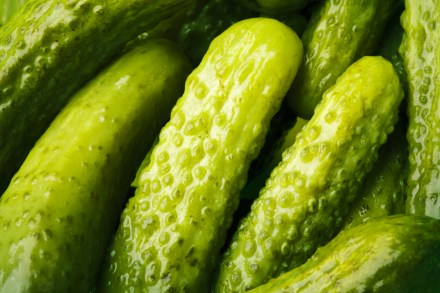
Have you taken the pickle pill? Pickles and the liquid in which they often come are proliferating across western cuisine. They have been praised for their health qualities, with gut-pleasing, sodium-rich pickle juice becoming a post-workout favourite in Britain and America. It’s even being incorporated into cocktails and beer. ‘Putting a pickle in cheap beer makes it taste better’ claims one food website in what may or may not be a prank on its readership. If your friend is organised and generous, you may find a jar of pickled peppers or pickled mushrooms A fad? To some extent, I’m sure. But in Poland, where I live, the qualities of pickles will come as no surprise. They could hardly come into fashion in a country where they’ve never been out of style.

Is Napoleon anti-French?

The English director Ridley Scott has certainly produced a massive irritation to French amour-propre. Over the weekend, he said that criticism of his film Napoleon proved that the French ‘don’t even like themselves’. Whether Napoleon is a masterpiece is yet to be determined (it isn’t released until Wednesday) but opinion is already divided. As if the French were ever likely to appreciate the Anglo-Saxon appropriation of a French national hero. Doubtless some of the French outrage is contrived. The relationship of France to the Emperor is complicated and hard to explain as an interlude in the glorious republic Scott, who will be 86 this week, has created an epic row, as well as an epic film.

Finding my family roots in Spain

The sun had sunk behind the mountains that surrounded the harbour of Cudillero, a small fishing town in Asturias. My hair was still wet from the sea. Two old men were sitting next to us, chatting loudly in Spanish while my husband, father, and I ate bonito pate. Despite being a shy child, my grandfather was keen to prove his masculinity as a shepherd ‘It’s full of English and Germans with their caravans,’ said the man with a baby-blue jumper slung over his shoulders. ‘Yes,’ replied the other, ‘always the same.’ My father turned to the men smiling and said in Spanish, ‘I live in Spain, in Extremadura, and my grandmother was Asturian.’ That’s why we were there.

Will the Las Vegas Grand Prix survive?

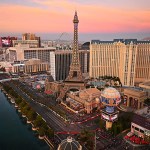
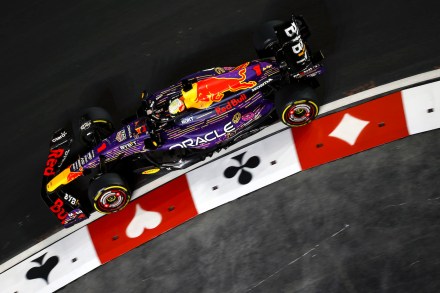
Equal parts hype and horsepower, this weekend’s Las Vegas Grand Prix is the most talked about sporting event of the year. For the first time, Formula One will take to the strip, with 20 cars screaming past the floodlit Venetian Caesar’s Palace and the faux Eiffel Tower at 200mph. Certainly, it lost its shirt on Thursday when a loose drain cover damaged the Ferrari of Carlos Sainz and the Alpine of Esteban Ocon. The first practice session was cancelled after just eight minutes while someone went to fetch some fresh concrete. The second and final of the night’s practice sessions was delayed and extended, finishing at 3.30 a.m. on Friday and waking up anyone who wasn’t in a nightclub or at a card table.

Flat-footed: welcome to the floorboard wars

Jarndyce vs Jarndyce, this wasn’t – at least not yet – and it probably passed much of the country by, especially given the rival distractions of recent weeks. It was nonetheless a lawsuit that will have been followed in compulsive detail by at least two groups of people: those who own their own flats – who are technically leaseholders but prefer to think of themselves as owner-occupiers – and the freeholders and managers of their blocks. Oh, and never forget the lawyers.

Four tips for upcoming big races

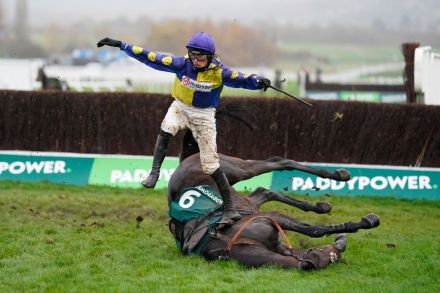
Cheltenham’s November meeting is, as usual, a meeting to savour and I am looking forward to my first visit to the Cotswold track this season when I attend tomorrow’s seven-race card. I put up two tips for tomorrow’s big race, the Paddy Power Gold Cup (2.20 p.m.), last week and I was pleased to see that both horses were declared yesterday. There are dangers aplenty but I have nothing to add other than it’s a question of the more rain the better for Fugitif and that would suit Notlongtillmay well enough too. I was sorely tempted to put up an old favourite of mine, Gin Coco, for the Unibet Greatwood Hurdle on Sunday (3.30 p.m.).

Why I’ll always love Big Brother

I’ve always been a Big Brother fan; I was hooked from the very first series way back in the year 2000, which featured Nasty Nick, Anna the lesbian nun and the winner, charming Scouse builder Craig Phillips who took the prize of £70,000 and promptly gave it all to his friend Joanne Harris for a heart and lung transplant. That first season – shown on Channel 4, as were the next ten – seems so wholesome now; the weekly shopping challenges included making mugs using a potter's wheel, and learning semaphore, as though the housemates were overgrown guides and scouts excitedly vying for badges.

How to give gifts

1. Don’t try to compete with a super-rich host. You may have to sing for your supper but you are not expected to pay for it. Their ‘people’ will have ensured that everything they need for the purposes of entertaining you is already in place. Your 360g of Marrons Glacés (£64, Fortnum & Mason) will be surplus to requirements and will probably be given directly on by them to a member of staff.  Any herb in a pot bought from a petrol station when your host already has a greenhouse full. Chocolate penises. Just don’t 2. To broke students and underprivileged friends, of course bring wine – particularly if you are worried about being made ill by low-quality stuff they are likely to serve.  3.

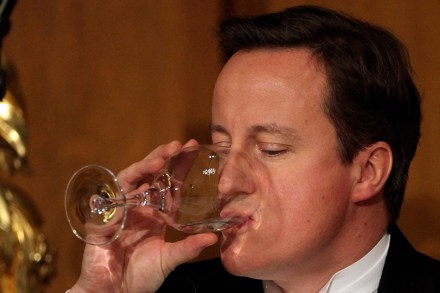
I hope David Cameron will find time to drink the odd good bottle

Back in 1989, a most unsatisfactory fellow called General Aoun started a civil war around Beirut in the hope of seizing control of the Maronite Christian portions of Lebanon. He ended up with political wreckage, which has endured. Château Berliquet 2015 is a fruity St Emilion that deserves to be better known During the fighting, I spent a few days cut off in the British ambassador’s summer residence, watching the battle going on below. We felt safer than we probably were, partly because Pauline Ramsay, the ambassador’s enchanting wife, tried to turn the crisis into a house party. So British: so best of British. We watched, helpless, as one block of flats was regularly hit by shells.

How to get rid of your saggy tattoo

Sagging angels, wilting lilies, drooping lines from love sonnets, withered swallows, flaccid snakes, limp dragons, shrivelled babies’ names: this will be the view inside the British bathroom, and at the British seaside, and in British hospital beds and morgues, in 2060, when today’s tattoo-wearers now in their prime will be in their seventies and eighties.  None of us thinks we’re going to grow old, but (as happened so cruelly to 1960s rock stars) age will creep up, and the skin will stretch, even that of the handsomest, healthiest tattoo trendsetters with the best body art money can buy.

Why I love terrible towns

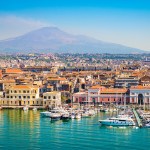
There are plenty of reasons to visit Catania in Sicily, and some of them are positive. The town is impressively ancient – dating back to the 8th century bc. It boasts a handsome, lavishly voluted Baroque core. A few steps from that main piazza you can find the picturesque fish market, the Pescheria, which sequins the black tufa cobbles with silvery fish scales, and has been selling inky squid for centuries. What else? The city has a striking location, with Mount Etna squatting on the horizon, apparently benign, but occasionally sending out chuffs of smoke to remind you of its menace, like a volcanic version of Tony Benn, puffing his pipe at the edge of British politics.