Culture

Culture

The good, the bad and the ugly in books, exhibitions, cinema, TV, dance, music, podcasts and theatre.

Into battle

Exhibitions

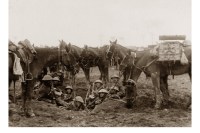
The charge of the Scots Greys at Waterloo: you’ll know it from the Risk board game. Hundreds of soldiers on lustrous white horses, manes billowing as they gallop straight at the viewer. A magnificent sight, but the stuff of nonsense: the horses probably weren’t all greys and they definitely weren’t turned out as if for Ascot. This is one fact to emerge from War Horse: Fact or Fiction?, the exhibition now showing at the National Army Museum in Chelsea (until August). Other myths are dispelled. Contrary to popular opinion, the history of British cavalry is not one of heroic failure. Even the bloodiest charges succeeded in their military aims. To adapt Tennyson, the Light Brigade did and died in the valley of death.

Back to the future | 19 November 2011

Exhibitions

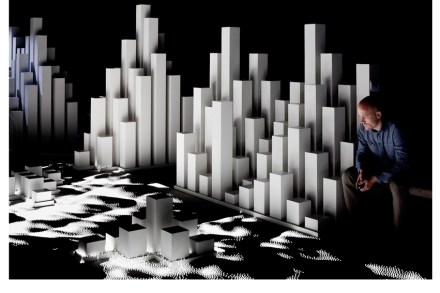
High Arctic, the inaugural exhibition in the newly opened Sammy Ofer wing at the National Maritime Museum, Greenwich (until 13 January), brings a thoroughly 21st-century, technology-driven museum experience to this historic site. It’s an exhibition, Jim, but not as we know it. In 2010 Matt Clark, creative director of the art and design practice UVA, joined an expedition of artists and scientists to the Arctic archipelago of Svalbard. High Arctic, which he describes as ‘a monument to an Arctic past set 100 years into the future’, is a response to this trip; an attempt to address, in a non-preachy way, the issue of man’s impact on the environment.

Intelligent design | 12 November 2011

Exhibitions

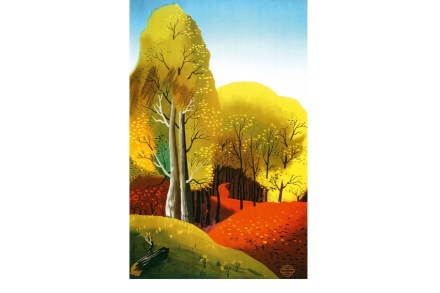
In 1935, Paul Nash observed that Edward McKnight Kauffer (1890–1954) was responsible for the change in attitude towards commercial art in this country. An American, Kauffer arrived in England in 1914 during a period of European study. He liked it and decided to stay, enabled to do so by his remarkable ability to design posters. In 1915 Frank Pick commissioned him to produce the first of what became a remarkable stream of some 140 posters for London Transport. Hugely impressed by Vorticism, Kauffer became a friend and ally of Wyndham Lewis and introduced the Modernist sensibility into commercial art.

Bird watching | 12 November 2011

Exhibitions

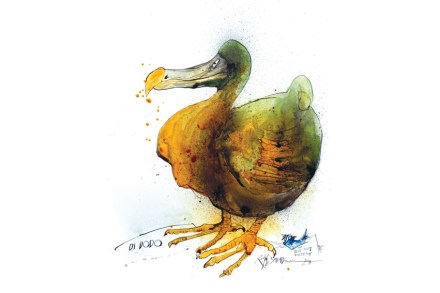
The setting is appropriate: Rochelle School is on Arnold Circus in Shoreditch, at the end of Club Row, once famous for its pet market, where, until it was closed down in 1983, you could buy caged birds from around the world. Now the school is hosting an exhibition entitled Ghosts of Gone Birds (till 23 November), a wide-ranging and stylistically eclectic show with a single emotive theme: extinct birds. More than 100 artists, musicians and writers, including Peter Blake, Margaret Atwood and Ralph Steadman, have made work in aid of BirdLife International’s Preventing Extinction scheme. Steadman did one picture and then found himself gripped by the theme, and went on to produce 100 witty, poignant and highly original bird portraits (‘Dodo’, above).

Sensation seeker

Exhibitions

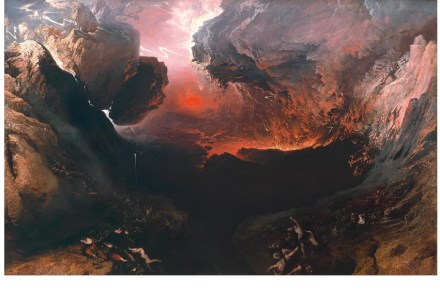
For far too long, John Martin (1789–1854) has been dismissed as ‘Mad’ Martin, the prophet of doom. In the eyes of many, this unacademic painter was a grotesque curiosity, producing colossal pictures of apocalyptic destruction, crude dramas of catastrophe and tumult, much to the delight of the populace. The mere fact that he was so popular an image-maker made him irredeemably vulgar (rather like Lowry today), and the cognoscenti looked for faults rather than appreciating his strengths. In fact, Martin was a reforming inventor as well as a painter, much concerned with draining the marshes around London and ensuring a pure water supply for the capital, simply because he wanted, as he says in his ‘autobiography’, to improve the condition of the people.

Landscapes of grief

Exhibitions

The caption on the photograph (above) makes a difference: ‘A young boy grieves at the funeral of his father who died of Aids at Ndola, Zambia, 2000.’ There were two million Aids orphans in Zambia alone. ‘I care about not letting this tragedy go unseen,’ Don McCullin said. Shaped by War: Photographs by Don McCullin, at the Imperial War Museum (until 15 April 2012), shows 250 items from the long career of a man best known for his photojournalism, from Vietnam onwards. The boy at Ndola looks straight at the lens, if he is looking outwards and not into the empty future, or back into the life with his father that has gone. Light from one side catches tears that have coalesced in the valley by his left nostril.

Ford Madox Brown: Pre-Raphaelite Pioneer

Exhibitions

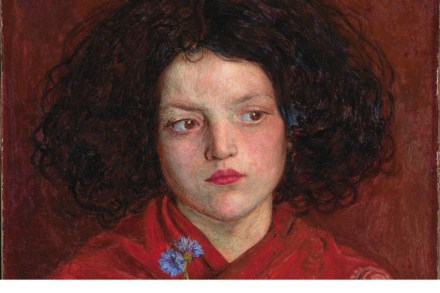
Photographs of roadworks feature regularly in the Hampstead Village Voice but, even with the postmodern fashion for grungy subjects, no contemporary residents have made paintings of them. Yet that, astonishingly, was what Ford Madox Brown did in the 1850s, lugging his two-metre canvas on to The Mount, off Heath Street, to do it. Brown’s unlikely masterwork ‘Work’ was the first ‘Pre-Raphaelite’ painting bought by Manchester Art Gallery, where it is now the centrepiece of a major exhibition dedicated to the artist. I put ‘Pre-Raphaelite’ in inverted commas because Brown — a prickly individual with a deep distrust of all ‘Bodies, Institutions, Art unions & academies’ — was never strictly a member of the Brotherhood.

Fra Angelico and the Masters of Light

Exhibitions

Fra Angelico (1395–1455), Il Beato (‘the Blessed One’) to his contemporaries as well as to John Paul II, who beatified him in 1982, is probably best known today for his frescoes in Florence’s San Marco, the Dominican convent where he lived as a monk. Perhaps fearing that some art-lovers will question the wisdom of mounting a Fra Angelico exhibition without the San Marco frescoes, the show’s curators have included a video of them. They need not have worried. Even without the frescoes, the 25 Fra Angelicos at the Musée Jacquemart-André, together with a well-chosen assortment of pictures by the friar’s colleagues working in the same religious vein, are more than enough to make this a rich exhibition.

Claude Lorrain: The Enchanted Landscape

Exhibitions

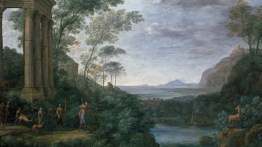
Claude Gellée (c.1600–1682), known as Claude Lorrain, started life as a pastry cook and despite turning his attentions from pies and patisserie to painting he never lost his love for confection. Although he is revered as the father of the landscape tradition and was hailed by Constable as ‘the most perfect landscape painter the world ever saw’ there is precious little that is natural in his paintings. Claude instead mixed his pictorial ingredients — a tree, a ruin, a river — just as he had his butter, flour and eggs and whisked up poetry-frosted views that delighted the delicate palates of his noble patrons.

The only way is up | 22 October 2011

Exhibitions

Homes may continue to lose value, the euro becomes shakier by the day, the unemployed stay unemployed and even the Chinese economy shows signs of overheating, but the international art market seems to know only one direction: up. For the first half of 2011, Christie’s sold $3.2 billion in fine and decorative art (an improvement of 25 per cent on 2010), while its rival Sotheby’s auctioned items worth $3.4 billion (up 38 per cent on the previous year). The bubble appears to be far from bursting, and the autumn sales promise to provide plenty of entertainment for those who like to see big prices on both sides of the Atlantic.

Melancholic visions

Exhibitions

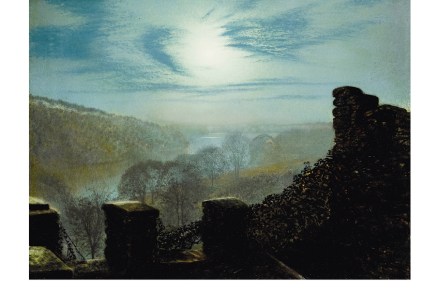
At the less than enticing Guildhall Art Gallery, a purpose-built museum that manages immediately to depress the spirits by its utterly unsympathetic design, is a major exhibition of John Atkinson Grimshaw (1836–93), the celebrated Victorian painter of moonlight. The show is the brainchild of Jane Sellars, director of the Mercer Art Gallery, Harrogate, where it was on view before coming to London. I wish I’d had the time and energy to see it in Harrogate, where I’m sure it looked entirely at home in the very particular spaces of the Mercer. Exhibiting in the Guildhall is an uphill battle with the architecture. Even Grimshaw, chock-full of atmosphere and drama, has a hard time of it here.

Blots on the cityscape

Exhibitions

As the 414 bus swings left from the Edgware Road at Marble Arch you avert your eyes, hoping you won’t have to look at the thing looming up in front of you for a single second longer than you have to. Even so, you know it’s there — a blot on the sky, a gulp of polluted air. I’m talking about a 33-ft-high bronze sculpture in the form of a decapitated horse, muzzle pointed downwards, in the middle of Marble Arch. The epitome of ghastly good taste, it looks like an expensive knick-knack from Harrods blown up to a size that would have appealed to Saddam Hussein. When the thing arrived, the Evening Standard assured us that it would be on view for only one month.

Pictorial intelligence

Exhibitions

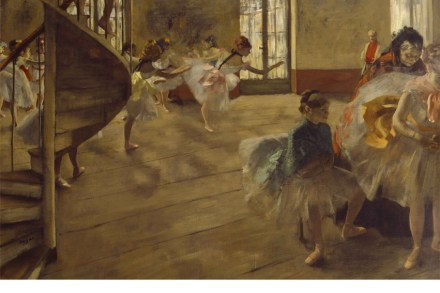
Edgar Degas (1834–1917) was born into a banking family, always knew he wanted to be a painter and was fortunate enough to be encouraged in his enthusiasm by his parents. After a classical training he began to paint portraits and history subjects, before seeing the relevance of real life and developing ways in which to depict it. Influenced by Manet and allied to the Impressionists, he was nevertheless not a committed member of the group and was impatient at its definition of painting. He remained classical in his approach to picture-making but fused this with a keen interest in colour and texture, and an awareness of how photography and Japanese prints had influenced ideas of space and vision.

Unfit for purpose

Exhibitions

In recent months, two new museums have opened to much acclaim: The Hepworth in Wakefield and Turner Contemporary in Margate. Now Colchester is receiving the dubious benison of a new building. What is this assertive new generation of museums in England supposed to be about? Leisure, business or art? There’s precious little of the last in the much delayed Firstsite gallery in Colchester, a long pavilion by Rafael Viñoly Architects clad in gold-coloured metal which looks wonderfully out of place in the Roman city of Camulodunum (the name also chosen for its inaugural exhibition). Don’t get me wrong: I live in East Anglia and would welcome a great new museum in Colchester, as a centre for excellence and a potentially worldwide audience.

Medieval frescoes

Exhibitions

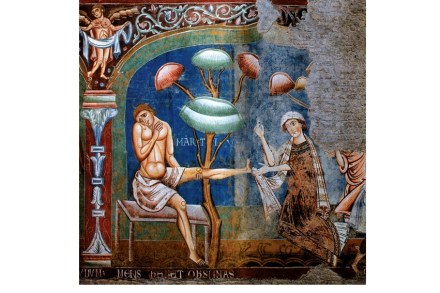
Rome contains many hidden treasures, but the most remarkable of the lot is concealed on the Caelian Hill, above the Colosseum, in the medieval monastery of Santi Quattro Coronati. It’s a cycle of frescoes dating from around 1250. It is extremely rare for painting from this period to survive anywhere, but it’s even rarer in Rome, where the rebuilding of the city by the Counter-Reformation popes destroyed almost all medieval painting. The paintings are in a vast vaulted gothic hall, the walls of which — about 800 square metres of them — were originally completely covered in frescoes. About half the original paintings remain: an earthquake, and the construction of additional windows, have destroyed the rest.

Going private

Exhibitions

One of the greatest Renaissance paintings remaining in private hands, Hans Holbein the Younger’s ‘The Darmstadt Madonna’, was sold discreetly this summer. It was not offered at auction but sold by private treaty sale — auction-speak for a negotiated private sale rather than a public auction — in a deal brokered by the art consultant and former head of Sotheby’s Germany, Dr Christoph Graf Douglas. This seminal panel painting, begun in 1526, was commissioned by Jakob Meyer zum Hasen, Mayor of Basel, who is portrayed alongside his family praying at the feet of the Virgin and sheltered by her cloak. It is the artist’s first major altarpiece to represent a new and Italianate form of ideal beauty.

‘An obsolete romantic’

Exhibitions

In 1982 Sven Berlin placed a sealed wallet labelled ‘Testament’ on top of a rafter in his studio with instructions for it not to be opened before his 100th birthday on 14 September 2011. Inside was a key to the identities of the characters in his notorious roman à clef about post-war St Ives, The Dark Monarch, published 20 years earlier and immediately withdrawn after four of those characters sued for libel. None of them was a major artistic figure and by today’s standards the libels were laughable, but Berlin’s exposure of the petty politics behind the St Ives idyll — which he later compared to ‘going for a bathe and swimming into a shoal of barracudas’ — caused permanent damage to his artistic career.

Battle lines | 17 September 2011

Exhibitions

The introductory room to Women War Artists at the Imperial War Museum confronts the visitor with a large canvas of a women’s canteen in 1918 by the little-known Flora Lion. It’s an honest painting, workmanlike but dull. Hanging to its left is Laura Knight’s famous ‘Ruby Loftus Screwing a Breech-ring’ (1943), and in between is a monitor playing a wonderful film clip of Dame Laura and Ruby going to see the painting at the Royal Academy. Ruby, overcome by emotion, kisses Dame Laura; Dame Laura bobs about, smoking furiously. Of course, Laura Knight on film and in paint grabs the attention; Flora Lion is inevitably sidelined. And that sets the tenor of the show, which is rather a shame, as there is work of real interest among the more obscure names.

Spirit of place | 10 September 2011

Exhibitions

In the Weston Rooms of the Royal Academy’s main suite of galleries is the third of a series of exhibitions designed to show the processes by which artists arrive at their work. In the Weston Rooms of the Royal Academy’s main suite of galleries is the third of a series of exhibitions designed to show the processes by which artists arrive at their work. Nigel Hall (born 1943) is an internationally celebrated abstract sculptor, known for his restrained purist forms, exquisitely balanced combinations of cone, ellipse, circle and wedge, executed in bronze, steel or polished wood. He also exhibits tautly rhythmic charcoal and gouache drawings of twisting ribands or other flat geometric shapes.

Something old, something new

Exhibitions

Very last chance to see the inaugural exhibition at the magnificently revamped Holburne Museum — a selection from the collections of Peter Blake, together with some of his own work. If, as Geoffrey Grigson suggested, the mind is an anthology, and the museum case or exhibition is a map of that mind, then what a remarkably diverse but ordered person Mr Blake must be. The new temporary exhibition gallery at the top of the Holburne’s new wing is filled with images of fantasy, dream and even nightmare, but everything is calmly laid out with great clarity and precision. The result is obsessional but intriguing.

Beyond belief | 27 August 2011

Exhibitions

The subtitle of Treasures of Heaven is ‘saints, relics and devotion in medieval Europe’. The key words here are medieval and Europe. The subtitle of Treasures of Heaven is ‘saints, relics and devotion in medieval Europe’. The key words here are medieval and Europe. There’s not much from England because we suffered the autocratic cleansing of the Reformation in the 16th century, and much of our native tradition of what was then dubbed idolatry was destroyed or swept away. And because our Church was reformed in this way, those of a C of E persuasion tend to be suspicious of relics and devotional aids.

View finder

Exhibitions

Bold Tendencies is a seasonal sculpture exhibition, events venue and bar — in overall effect, a sort of hipster adventure playground — concealed in the disused upper levels of the multistorey car park opposite Peckham Rye railway station. Bold Tendencies is a seasonal sculpture exhibition, events venue and bar — in overall effect, a sort of hipster adventure playground — concealed in the disused upper levels of the multistorey car park opposite Peckham Rye railway station. It recently opened for its fifth year, and it has become one of the regular joys and oddities of the metropolitan summer.

Collector’s eye

Exhibitions

To celebrate Elizabeth Blackadder’s 80th birthday, the Scottish National Gallery is staging a landmark retrospective (until 2 January 2012) spanning the last six decades of the artist’s career. To celebrate Elizabeth Blackadder’s 80th birthday, the Scottish National Gallery is staging a landmark retrospective (until 2 January 2012) spanning the last six decades of the artist’s career. Blackadder is best known for her vibrant still-lives of the Sixties, a time when most of her contemporaries were experimenting with Pop and Abstract Expressionism. Influenced by her passion for collecting and for fastidious attention to detail, she has spent a lifetime popularising and successfully re-inventing the genre.

Pastoral perfection

Exhibitions

One of the highlights of the Royal Collection is Gainsborough’s ‘Diana and Actaeon’, a painting I always make a point of visiting when I am viewing a new temporary exhibition in the Queen’s Gallery One of the highlights of the Royal Collection is Gainsborough’s ‘Diana and Actaeon’, a painting I always make a point of visiting when I am viewing a new temporary exhibition in the Queen’s Gallery. An unusual picture, it is Gainsborough’s only mythological subject with an identifiable classical literary subject. Best-known for his portraits, Suffolk-born Thomas Gainsborough (1727–88) would have preferred to spend his time painting landscapes, but couldn’t make a living at that.

Hungarian photography, Richard Long, Thomas Struth

Exhibitions

As regular readers of this column will know, I am not a great admirer of photography exhibitions, but the current show in the RA’s Sackler Galleries is more enjoyable than most. I have long loved the work of André Kertész and Brassaï, and besides presenting a lavish selection of their photographs, this show offers the context of their fellow Hungarians to further illuminate their achievement. The effect is interesting, if not entirely happy. Nothing seems to diminish Brassaï, but Kertész suffers by comparison. In the company of such relatively unknown photographers as Imre Kinszki, Rudolf Balogh and Erno Vadas, Kertész looks less strikingly original.

Cy Twombly and Poussin

Exhibitions

When a major artist dies while an exhibition of his or her work is up and running, there is inevitably a surge in visitor numbers. Consequently, the death of Cy Twombly at the beginning of last month has sent along to Dulwich a number of people who didn’t know his work to find out what all the fuss was about. Others, the long-standing admirers of Twombly, will visit Dulwich with sadness in their hearts that this delightful and surprising artist, this genius of the wayward mark, will make no more new work. Dulwich is not the easiest of London galleries to get to, but I recommend this show, not just for its quota of Twomblys, but also for the added bonus of Poussin, seen here in great glory. Their juxtaposition is a stimulating one.

John Hoyland – an appreciation

Exhibitions

It’s difficult to believe that John Hoyland is dead. He was a man so full of life, with such appetite for living, that his absence from our midst makes no sense. Even when grievously ill in the past months, he was more likely to engage in anecdote and tell jokes than complain of his increasingly frail condition. The spirit of the man continued to shine brilliantly despite the adverse circumstances. His last exhibition, all new paintings, opened at the Beaux Arts Gallery in Cork Street in April. At the private view, Hoyland, although already much reduced physically, sat in the midst of his vividly coloured and exhilarating work, and accepted the homage of friends and admirers.

Show of wonders

Exhibitions

One of the art books purchased in recent months that I’ve most enjoyed has been Arthur Boyd: Etchings and Lithographs, published in 1971. Boyd was an Australian painter, potter and printmaker, born in 1920 in Melbourne, who came to England in 1959 and made his home in this country. A deeply interesting image-maker, he came from a dynasty of artists, was largely self-taught, and evolved a powerful style that owed much to surrealism and expressionism, but was entirely his own vision. Boyd created a beguiling world of mythical beasts and figures, many of them involved in events of unusually potent religious or sexual drama. At one point we saw a lot of his work in this country, and it was a great enlivening force.

Sublime timelessness

Exhibitions

The Fry Art Gallery is housed in a Victorian Gentleman’s Gallery of two main rooms, built in 1856 for the Quaker banker Francis Gibson. The Fry Art Gallery is housed in a Victorian Gentleman’s Gallery of two main rooms, built in 1856 for the Quaker banker Francis Gibson. It was first intended to accommodate his own collection, but was always open to the public, and in 1985 it was taken over by the Fry Art Gallery Society, a charity set up to create the North West Essex Collection, of work by artists of the locality. The focus is primarily on the remarkable group of painters and printmakers who settled in nearby Great Bardfield from the 1930s to the 1970s, and which included Edward Bawden and Eric Ravilious, John Aldridge, Michael Rothenstein and Kenneth Rowntree.