Culture

Culture

The good, the bad and the ugly in books, exhibitions, cinema, TV, dance, music, podcasts and theatre.

Geometry in the 20th and 21st centuries was adventurous – and apocalyptic

Exhibitions

Almost a decade ago, David Cameron informed Tony Blair, unkindly but accurately, ‘You were the future once.’ A visitor to the Whitechapel Gallery’s exhibition, Adventures of the Black Square, might mutter the same words in front of the first exhibits. It is now a century since Kazimir Malevich painted the starkest abstractions in the history of art: one simple geometric shape painted on a background of another colour. It was not, one might have thought, an idea with much mileage. Yet those early geometric abstractions had the compressed power of revolutionary manifestos. For good or ill, there has followed 100 years of modernist, post-modernist, and now post-post-modernist geometry in art. This is the theme of the exhibition.

The tragic tale of the Two Roberts is a story of two artists cut off in their prime

Exhibitions

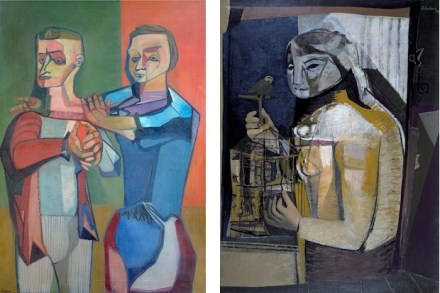
In 1933, two new students met on their first day at Glasgow School of Art. From then on they were inseparable. They lived and worked together. They became lovers. They stayed together throughout their lives. They shone at art school, then came to London, where their robust paintings soon became very fashionable. Yet a few years later, just as quickly, their work fell out of favour. They became increasingly impoverished, dependent on friends for bed and board, but they never stopped painting — or loving one another. They were both prolific drinkers. By 1966, they were both dead.

The death of the life class

Exhibitions

‘Love of the human form’, writes the painter John Lessore, ‘must be the origin of that peculiar concept, the Life Room.’ Then he goes on to exclaim on the loveliness of that name. It is indeed a venerable institution with a delightful description: a place devoted to looking at life — or, at any rate, to earnest attempts to depict people without a stitch of clothing. Currently two exhibitions in Norwich — at Norwich Castle Museum and Norwich University of the Arts — by Lessore and another distinguished painter, John Wonnacott, focus attention on this time-honoured practice, apparently remote from the contemporary art world of video, installation and performance.

We must never again let this 19th century Norwegian master slip into oblivion

Exhibitions

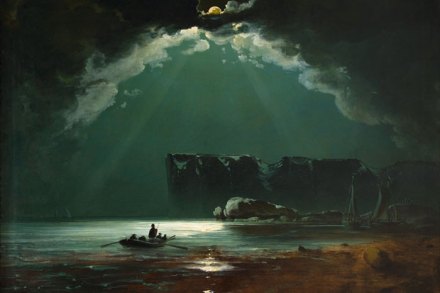
You won’t have heard of Peder Balke. Yet this long-neglected painter from 19th-century Norway is now the subject of a solo show at the National Gallery. And it’s an absolute revelation. Walking around, I marvelled at the intensity of a man obsessed with revealing the frozen grandeur and elemental drama dominating his country’s northernmost shores. Like Turner, he was driven by a restless urge to travel, discovering landscapes that enlarged and transformed his vision of the world. In 1832 he took an arduous sea journey to the far north of Norway, ceaselessly sketching the rugged coast and mountains along the way. His excitement grew as he passed the primal North Cape, and the onset of a hurricane only increased Balke’s avid involvement.

Does Allen Jones deserve a retrospective at the Royal Academy?

Exhibitions

It has been a vintage season for mannequins. At the Fitzwilliam Museum in Cambridge, an exhibition called Silent Partners looks at the relationship between artist and mannequin, from function to fetish. In London, the Royal Academy is hosting a retrospective of the work of British artist and Academician Allen Jones. Jones, who is now 77, became obsessed with mass-produced imagery of eroticised women. As the show makes clear, he never really got over it. During the 1960s, Jones emerged as a leading pop artist. His contemporaries at the Royal College of Art included Patrick Caulfield and David Hockney, but he was expelled after a year. His big break came in 1969 with his trio of fibreglass sculptures that portrayed women as pieces of furniture.

Are the British too polite to be any good at surrealism?

Exhibitions

The Paris World’s Fair of 1937 was more than a testing ground for artistic innovation; it was a battleground for political ideologies. The Imperial eagle spread its wings over the German Pavilion; the Soviet hammer swung above the Russian Pavilion; and the Spanish Pavilion unveiled Picasso’s shocking monument to the civilian dead of the bombed city of Guernica, raising the clenched fist of the Spanish Republic in the capital of non-interventionist France. Not everyone was convinced by ‘Guernica’ as art. Anthony Blunt in The Spectator commended Picasso’s political gesture but dismissed the painting as ‘the expression of a private brainstorm’.

Without a model, Moroni could be stunningly dull. With one, he was peerless…

Exhibitions

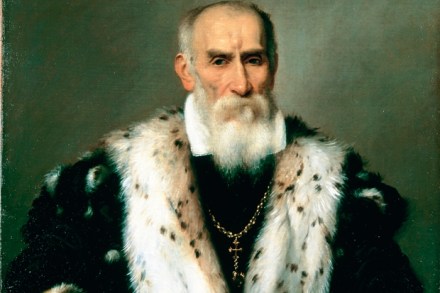
Giovanni Battista Moroni, wrote Bernard Berenson, was ‘the only mere portrait painter that Italy has ever produced’. Indeed, Berenson continued, warming to his theme, ‘even in later times, and in periods of miserable decline, that country, Mother of the arts, never had a son so uninventive, nay, so palsied, directly the model failed him’. It was a harsh judgment, but the great connoisseur inadvertently managed to put his finger on exactly what was so marvellous about his victim. A splendid exhibition at the Royal Academy triumphantly demonstrates that when Moroni actually did have a model in front of him, he was one of the most remarkable painters of later 16th-century Europe. He was, however, one who does not seem to fit easily into his time and place.

Egon Schiele at the Courtauld: a one-note samba of spindly limbs, nipples and pudenda

Exhibitions

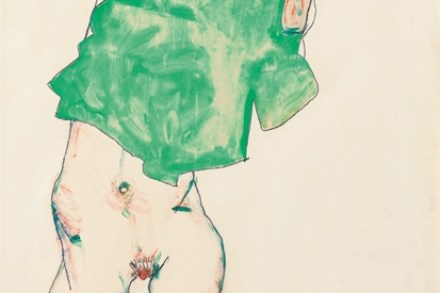
One day, as a student — or so the story goes — Egon Schiele called on Gustav Klimt, a celebrated older artist, and showed him a portfolio of drawings with the abrupt query, ‘Do I have talent?’ Klimt looked at them, then answered, ‘Much too much!’ One gets an inkling of what Klimt was getting at from the feverishly intense work on show in Egon Schiele: The Radical Nude. From childhood, Schiele drew with manic fluency. His father, a syphilitic stationmaster, was irritated to discover that a sketchbook, a gift to the boy intended to last for months, had been filled in less than a day.

The secret world of the artist’s mannequin

Exhibitions

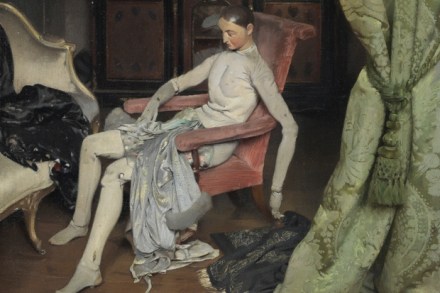
A 19th-century London artists’ supplier named Charles Roberson offered imitation human beings for sale or rent, with papier-mâché heads, soft leather skin and flexible, jointed limbs. The top-of-the-range article — described in Roberson’s catalogue as ‘Parisian stuffed’ — was pricey. Nonetheless, painters often felt they just had to have one whatever the cost. Many such creatures inhabit Silent Partners: Artist & Mannequin from Function to Fetish, a pioneering exhibition at the Fitz-william Museum, Cambridge. There are also distinguished paintings on view. But it is the figures themselves — slightly comic, a touch eerie, hard to classify — that are the real stars of the show.

Russians made the theatre space the most liberating imaginative device ever invented

Exhibitions

You have to hand it to the Russians. They beat us into space, beat us to sexual equality, and a small display of early Soviet avant-garde theatre and film design, tucked away in the V&A’s ‘Performance’ area, proves that they beat us hollow in matters of the dressing-up box too. When you arrive (that is, if you arrive — it is a labyrinthine trek to find it) at Russian Avant-Garde Theatre, you should make straight for the little screen. It shows the amazing 1924 sci-fi film Aelita, in which an engineer living under ‘Military Communism’ builds a spaceship and flies to Mars where he falls for Aelita, Queen of Martians.

How Rothko become the mythic superman of mystical abstraction

Exhibitions

Mark Rothko was an abstract artist who didn’t see himself as an abstract artist — or at least not in any ‘formalist’ sense. If a critic called him a ‘colourist’, he would bristle; if they admired his sense of composition, he would complain that this was not what he was about at all. His was an art of deep content, his subject an invocation of the religious, the tragic, the mythic. ‘The people who weep before my pictures are having the same religious experience I had when I painted them,’ he once famously said. ‘And if you, as you say, are moved only by their colour relationships, then you miss the point.

Tate Modern’s latest show feels like it’s from another planet

Exhibitions

‘Some day we shall no longer need pictures: we shall just be happy.’ — Sigmar Polke and Gerhard Richter, 1966 Who says Germans have no sense of humour? OK, so their writers tend to be a pretty gloomy bunch — but like loads of other German artists, from Otto Dix to Georg Baselitz, Sigmar Polke’s paintings are illuminated by a dry, mordant wit. It’s encapsulated in an early doodle called ‘Mona Lisa’ (1963), which hangs near the entrance to this hugely enjoyable retrospective — the first comprehensive survey of his eclectic, eccentric work. ‘Original value $1,000,000,’ reads the handwritten caption. ‘Now only 99c, including frame.’ That Polke’s pictures now sell for many millions (with or without frames) adds another layer of meaning to this student jape.

All my doubts about Anselm Kiefer are blown away by his Royal Academy show

Exhibitions

In the Royal Academy’s courtyard are two large glass cases or vitrines containing model submarines. In one the sea has receded, dried up, and the tin fish are stranded on the cracked mud of the ocean floor. In the other, the elegantly rusted subs are mostly suspended like sharks in an aquarium: a fleet in fact, all pointed in the same direction. These works are the visitor’s first sight of the vast and glorious exhibition by Anselm Kiefer (born Germany, 1945) currently occupying the main galleries of Burlington House, and they are apparently related to his interest in the Russian poet and futurist Velimir Khlebnikov. At once we are confronted by several Kiefer themes: war, poetry (he says poems are ‘like buoys in the sea. I swim to them, from one to the next ...

Curator-driven ambitions mar this Constable show at the V&A

Exhibitions

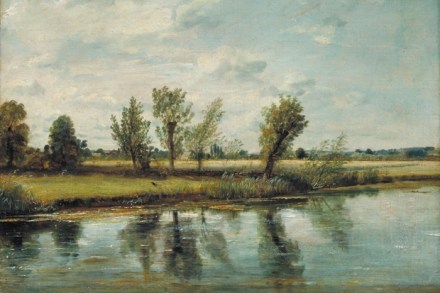
The V&A has an unparalleled collection of hundreds of works by John Constable (1776–1837), but hardly anyone seems to know about them. This is perhaps because they’re usually kept on an upper floor of the Henry Cole Wing, rather off the beaten track for most visitors. This new exhibition gives us the chance to examine the V&A’s treasures, but because it has been installed in the extensive suite of galleries usually reserved for big survey shows, such as Art Deco or Modernism, a great deal of other material is also required to fill the space. So, instead of an exhibition devoted to the genius of Constable, we have an intensely art-historical display intended to demonstrate how much he owed to the masters of the past.

Tate Britain’s Turner show reveals an old master – though the Spectator didn’t think so at the time

Exhibitions

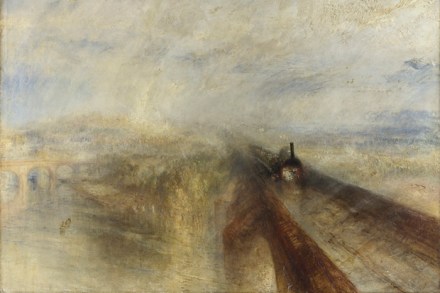
Juvenilia is the work produced during an artist’s youth. It would seem logical to think, therefore, that an artist’s output during their old age would be classified as ‘senilia’. Yet no such word exists. But how else to classify the three blockbuster exhibitions this year that deal with Matisse, Turner and Rembrandt’s late work? These titans produced some of their finest art during old age. The exuberance of Matisse’s cut-outs are all the more astonishing given that they were produced not in the first bloom of life but rather in the dying embers of it. Rembrandt’s late works — on display at the National Gallery from October and discussed by Martin Gayford on p64 — will include some of his most soulful paintings. Late Turner at Tate Britain has a similar narrative.

‘Likes’, lacquered cherry pies and Anselm Kiefer: the weird world of post-internet art

Exhibitions

In the mid-1990s the art world got excited about internet art (or ‘net.art’, as those involved styled it). This new way of making art would harness the world wide web, take the form of exciting online projects, bypass traditional galleries and be accessible to all with a dial-up connection. ‘Net.artists’ were self-styled radicals particularly fond of that most modernist of tropes, the manifesto, which they distributed via electronic mailing lists or electronic bulletin boards. These artists adopted funky, web-style names such as ‘Irational.org’ and ‘VNS Matrix’ and showed their work online at similarly funkily named websites like Rhizome, Suck and Echo. But there was, alas, a gap in the Matrix, to paraphrase Keanu Reeves’s finest film.

Why everyone loves Rembrandt

Exhibitions

Talking of Rembrandt’s ‘The Jewish Bride’ to a friend, Vincent van Gogh went — characteristically — over the top. ‘I should be happy to give ten years of my life,’ he exclaimed, ‘if I could go on sitting here in front of this picture for a fortnight, with only a crust of dry bread for food.’ Without undergoing such rigours, visitors to Rembrandt: the Late Works at the National Gallery next month will be able to see the picture that drove Vincent to such a paroxysm of enthusiasm, along with many other masterpieces from the artist’s last years.

The man who brought Cubism to New York

Exhibitions

The American Jewish artist Max Weber (1881–1961) was born in Belostok in Russia (now Bialystok in Poland), and although he visited this country twice (he came to London in 1906 and 1908), it was the experience of continental Europe — and particularly Paris — that was crucial for his development. The title of this exhibition is thus rather misleading: Weber never lived in England, and his ‘presence’ here is based upon a collection of his work made by his friend Alvin Langdon Coburn. Coburn (1882–1966), a boldly experimental photographer attached to the Vorticist group, was another American, but one who opted to settle in England in 1912.

The Imperial War Museum finds a deadly place to display first world war masterpieces

Exhibitions

The Imperial War Museum has reopened after a major refit and looks pretty dapper, even though it was overrun by hordes when I visited (it was still the school holidays). There’s a new and effective restaurant, inevitably, but also a new sense of spaciousness. I am not concerned here with weapons of mass destruction, merely with the record of the damage they inflict. They keep the art up on the third floor of the museum, and currently have a major display devoted to the first world war, which they claim is the largest of its type for nearly a century. It’s full of expected names, shown in some detail. But the ambience is wrong: there is something utterly deadly about those third-floor galleries (appropriate in a war museum, I suppose), which kills exhibitions stone-dead.

The Bloomsbury painters bore me

Exhibitions

Virginia Woolf (1882–1941) claimed that nothing has really happened until it has been recorded, so this new exhibition at the NPG devoted to her life can only now be said to have happened — for here I am recording it. Of course it is a truism that an exhibition only exists while it is on. Afterwards it remains in (some of) the memories of those people who visited it, and in photographic records or a catalogue of the exhibits.

Agitprop, love trucks and leaflet bombs: the art of protest

Exhibitions

Titles can be misleading, and in case you have visions of microwave ovens running amok or washing machines crunching up the parquet, be reassured — or disappointed. Disobedient Objects, the new free display in the V&A’s Porter Gallery, is about objects as tools of social change. It’s a highly politicised exhibition and contains a great deal of fascinating material, from films to how-to guides (not quite ‘how to make a bomb’, but nearly). The gallery was packed when I went along. An admission charge might have made a difference. However, this is the kind of exhibition that should be free in a democratic country — if only to remind as many of us as possible what repressive regimes elsewhere impose on their luckless populations.

Futurism’s escape to the country

Exhibitions

Futurism, with its populist mix of explosive rhetoric (burn all the museums!) and resolutely urban experience and emphasis on speed, was a force to be reckoned with (at least in Italy) for longer than one might imagine. It was launched in Paris in 1909 by Filippo Tommaso Marinetti, poet and performer, a superb propagandist for the movement he effectively founded, and it managed to survive the upheavals of the first world war, continuing into the 1920s. (Some say it lasted until Marinetti’s death in 1944.) Besides the core figures of Boccioni, Carrà, Balla and Severini, there were a number of other artists closely involved in Futurism, one of whom was Gerardo Dottori (1884–1977).

The perfect excuse to get out all the best Ravilious china

Exhibitions

A day trip to the Towner Art Gallery in Eastbourne is a summer pleasure, and two concurrent shows are proving a considerable draw, with their focus on design and applied art. Designing the Everyday is in some ways just an excuse to get out all the best Ravilious china and show it with his working drawings, but where’s the harm in that? Ravilious continues to be one of the most popular of 20th-century British artists, and his applied art is not as well known as his pellucid watercolours, so here’s a chance to remedy that. And to put it in context, the surrounding rooms examine work from both earlier and later periods: a light-hearted and enjoyable selection by guest curator Nathaniel Hepburn.

How Richard Wilson made Wales beautiful

Exhibitions

‘I recollect nothing so much as a solemn — bright — warm — fresh landscape by Wilson, which swims in my brain like a delicious dream,’ wrote Constable of his encounter with the Welsh artist’s ‘Tabley House, Cheshire’ after he visited the gallery of that house owned by Sir John Leicester. Recalling this epiphany, Constable went on to say of Richard Wilson: ‘He was one of the great appointments to shew to the world what exists in nature but which was not known till his time.

A lost opportunity to show John Nash at his best

Exhibitions

John Northcote Nash (1893–1977) was the younger brother of Paul Nash (1889–1946), and has been long overshadowed by Paul, though they started their careers on a relatively even footing. The crucible of WW1 changed them: afterwards Paul became an art-world figure, cultivating possible patrons, quietly forceful and ambitious, deeply involved in the theory and practice of Modernism. John retreated into his love of nature (in particular gardening and fishing) but continued to paint with an almost classical refinement and orderliness. His art stayed close to nature yet stood back from it, while the Romantic Paul was consciously experimental, adopting a poetic approach that was unexpectedly graphic until the great paintings of his final years.

Why did it take so long to recognise the worth of British folk art?

Exhibitions

British folk art has been shamefully neglected in the land of its origin, as if the popular handiwork of past generations is an embarrassment to our cultural gurus and the kind of supposedly hip commentators who sneer at morris dancing. Last May I reviewed the archive display at the Whitechapel Gallery of Black Eyes and Lemonade, which re-visited the 1951 Whitechapel exhibition of the same name, a survey of vernacular art in Britain curated by the artist Barbara Jones; but that show, more than 60 years ago now, was probably the only specifically folk art exhibition in a major museum or public gallery to take place in recent years.

Malevich: Are Tate visitors ready for this master of modernism?

Exhibitions

Kazimir Malevich (1879–1935) is one of the founding fathers of Modernism, and as such entirely deserves the in-depth treatment with which this massive new Tate show honours him. But it should be recognised from the start that this is a difficult exhibition, making serious intellectual and emotional demands on visitors, as art enters the realm of pure thought, utterly divorced from the comforting world of appearances. Malevich was one of the first great revolutionary practitioners of abstract art, a pioneer who made work of singular beauty and resonance, but his path is not always easy to follow. Perhaps with this in mind, the exhibition starts with a room of early, mostly figurative work, in which Malevich is shown experimenting with different ways of depicting.

Had Hollywood not lured him away, Dennis Hopper could have made his name as a photographer

Exhibitions

In an age when photographs have swollen out of all proportion to their significance, and are mounted on wall-sized light boxes the better to show off their high-resolution colour, it’s a relief to see an exhibition of small photographic prints in good old black and white. Dennis Hopper (1936–2010) is best known as an actor and hell-raiser, but he was also an artist who worked in various media. ‘I am an Abstract Expressionist and an Action Painter by nature,’ he insisted, but in the Sixties he took thousands of photographs, a group of 400 of which are now on display in the Academy’s Burlington Gardens galleries. Because they are relatively small, they are arranged in blocks on the walls of these spacious rooms.

Painted, sculpted and stuffed: a history of the bird in art

Exhibitions

These days, as the sparrows and starlings so common in my youth are growing scarce, there’s less need for a rarity like the osprey or butcher bird (the red-backed shrike) to raise awareness of the plight of birds, and with Radio 4’s Tweet of the Day you might say that birds are in (or on) the air — but then they would be. The flightless varieties, such as the dodo, have always been in greater danger, unless they could run very fast. Birds are synonymous with flight, and as such are a potent symbol and embodiment of many of humanity’s hopes and dreams. They connote both the human and the divine spirit through their soaring freedom of movement, and their linking of earth and sky (often also water).