Culture

Culture

The good, the bad and the ugly in books, exhibitions, cinema, TV, dance, music, podcasts and theatre.

The best exhibition of architecture I have ever experienced

Exhibitions

Curtain walls, dreaming spires, crockets, finials, cantilevers, bush-hammered concrete, vermiculated rustication, heroic steel and delicate Cosmati work are all diverse parts of the architect’s vocabulary. But while Gothic, Classical, Baroque and Modern are well-thumbed volumes in his library of style, the architect’s real language is profound and prehistoric. Or, at least, it consists of prehistoric-style labels. So much of the ‘debate’ about architecture has been crudely adversarial with tweedy historicists, conservationists and pseudo-classicists supposedly lined up against antagonising, pitiless and chromium-plated technocrats, futurologists, social engineers and ditsy dreamers.

Who knew that Cézanne had a sense of humour?

Exhibitions

Tourists are attracted to queues, art lovers to quietude. So while the mass of Monet fans visiting Paris line up outside the Musée d’Orsay and the Orangerie, connoisseurs head to the Musée Marmottan, an institution so surprisingly little known that it had to rename itself the Musée Marmottan Monet to flag up the fact that it owns the world’s largest collection of Monets. Even so, it remains a haven of peace. Now, on its 80th anniversary, this discreet museum in a charmingly furnished mansion overlooking the Jardins du Ranelagh is making another bid for attention with an exhibition of 100 rarely seen Impressionist works borrowed from 50 private lenders.

Hannah Höch – from Dada firebrand to poet of collage

Exhibitions

I suspect I am not alone in finding it surprising to encounter at the close of this exhibition an unexpected Hannah Höch — a gently spoken elderly lady filmed wandering among the overgrown flowers in her garden, talking of beauty. A far cry from the radical firebrand and Dada collagiste of interwar Berlin whose works epitomised the edgy fragmentation of Weimar life and culture. It was a long journey, and one traced with admirable even-handedness by this first and welcome UK survey of Höch’s works on paper, at the Whitechapel.

Four artists you ought to know — and a famous one you can know better

Exhibitions

In this round-up of exhibitions in London’s commercial galleries, I feature three shows of little-known but mature contemporary British artists. There is a great deal of interesting and worthwhile art being made out there, but not enough of it comes to public attention. Most museums won’t show it, and there are only a handful of commercial gallerists who are prepared to back quality over proven popularity. In such a world, the quieter talents tend to get overlooked, so it is a particular pleasure to be able to draw your attention to the subtle small paintings of Liam Hanley (born 1933). Hanley paints in oil and draws in pencil on linen laid down on to paper.

‘Castiglione: Lost Genius’ loses his genius in a sea of brown

Exhibitions

Giovanni Benedetto Castiglione (1609–64) was, I must admit, unknown to me until I visited this show, the only Castiglione I was properly aware of being the one who wrote The Book of the Courtier published in 1528; clearly not the same man. The artist Castiglione was a tempestuous character, always losing his temper and getting into fights. He tried to throw his sister off a roof and is said to have committed murder; perhaps more importantly for his artistic career, when he was at the height of his popularity in Genoa, he slashed to shreds a painting commissioned for the Doge of Venice, and fled the city in which he was born and trained.

‘Uproar!’ The Ben Uri gallery punches above its weight

Exhibitions

Last year saw the centenary of the London Group, a broad-based exhibiting body set up in a time of stylistic ferment in the art world as an independent alternative to the closed shops of the academies. Formed from the amalgamation of the Allied Artists’ Association and the Camden Town Group, it boasted such notable founder members as Lucien Pissarro and Walter Sickert, while Jacob Epstein is credited with naming it. Inevitably, the London Group has gone through innumerable highs and lows in its 100-year history, yet the mere fact that it still exists is testament to the enduring need for such an independent collective.

John Craxton was more gifted than the Fitzwilliam show suggests

Exhibitions

It is often said of John Craxton (1922–2009) that he knew how to live well and considered this more important than art. Perhaps there is a certain truth in this, but if he really believed it, did he have any business in being an artist? And an artist he undoubtedly was, by temperament and sensibility, as well as by the rich endowment of natural talent. Of course, letting it be known that you think life more important than art is a very good cover for that most debilitating (and paradoxically productive) of besetting fears: self-doubt. Craxton had it in large measure, and it is probably this quality that accounted both for his originality and for the painter’s block he periodically suffered.

Painting Now doesn’t represent painting now. Thank goodness

Exhibitions

The death of painting has been so often foretold — almost as frequently as its renaissance — that any such prediction today is nothing short of foolhardy. Of course, painting is alive and well and living in London, but you wouldn’t know that from the current exhibition of five artists at Tate Millbank. (By the way, this is a paying display, the regular admission fee being £10. Not surprisingly, it was deserted when I visited. This sort of show, to do its job properly and communicate to the public at large, should be free.) According to the press release, each of the five artists ‘has adopted an approach to painting that both exploits and subverts its conventions’. I wish.

Alan Sorrell, oddly original and shamefully neglected (till now)

Exhibitions

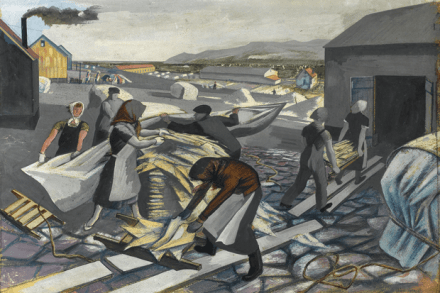
Rediscovering the unduly neglected is one of the chief excitements of those who curate exhibitions and write books. And there’s nothing I enjoy more than saluting the achievement of those who bring back to our attention an artist who – for one reason or another – has slipped off the art world radar. Before this exhibition and, more importantly, the book accompanying it, Alan Sorrell was only a name to me, with a few rather vague visual connotations. Now I can put definite images to the name and begin to build a context for his work. For anyone interested in the broader picture of 20th-century British art, the current Sorrell initiative is of real interest and value.

When soldiers have golden helmets and the wounded have wings

Exhibitions

‘If I go to war, I go on condition I can have Giotto, the Basilica of Assisi book, Fra Angelico in one pocket, and Masaccio, Masolino and Giorgione in the other,’ Stanley Spencer wrote to the artist Henry Lamb in 1914. The sixpenny Gowans & Gray edition of the Masterpieces of Giotto now in a glass case in Somerset House’s exhibition Stanley Spencer: Heaven in a Hell of War is the one that travelled with him two years later to the Macedonian front, where its imagery fused with his memories of war.

Turner’s seafaring ways — and his blazingly competitive art

Exhibitions

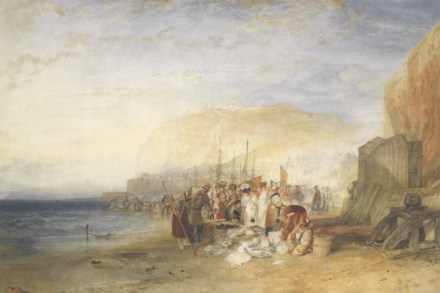
Turner’s contemporaries regarded him primarily as a marine painter. This perception extended to his persona, with many who met him commenting on his nautical gait, manner of speaking and other salty characteristics. He frequented ports and coastal parts, relished sailing in storms, was immune to seasickness and famously had himself lashed to the mast to experience the full force of the gale before painting one of his most controversially ‘indistinct’ canvases ‘Snow Storm’.

Daumier’s paintings show he is at heart a sculptor

Exhibitions

There hasn’t been a decent Daumier exhibition in this country for more than half a century, so art lovers have had to be content with the handful of pictures in national collections and books of reproductions. This works all right for the lithographs, which were after all made to be reproduced, and it is on his high status as a satirical printmaker that Daumier’s fame principally rests. And yet he is frequently lauded by artists who talk about him as a major draughtsman, sculptor and painter, not just as a political and social cartoonist, however fine. The chance to see a show of all aspects of his work is thus very welcome: how does the Academy acquit itself of the responsibility? The first thing that must be said is that there are rather too many lithographs on display.

In the National Gallery’s Vienna show, it’s Oscar Kokoschka who’s the real revelation

Exhibitions

The current exhibition in the Sainsbury Wing claims to be a portrait of Vienna in 1900, but in fact offers rather an interesting survey of portraits made there from the 1830s to 1918. The gallery layout has been usefully adapted to display the work thematically rather than chronologically, which is more dynamic but stylistically confusing. The only way to enjoy the show is to wander at will and pick out the paintings that appeal. There are some horrors here (I wouldn’t linger over Broncia Koller), but plenty of good things as well.

Where’s the fun, Barbican? 

Exhibitions

Pop Art Design, curated by the Vitra Design Museum and currently at the Barbican, opens with Richard Hamilton’s 1956 ‘Just what makes today’s homes so different, so appealing?’. Made as a poster for the Whitechapel show This is Tomorrow, it’s a witty collage of consumer fantasies scissored out of magazines, reminding us that interest in popular culture among British artists operated as a humorous, semi-anthropological collegiate research project. In part, British Pop was a riposte to the lushness of American consumerism from a small island that had won the war but had lost the peace. Pop Art in the United States got under way later and many American Pop artists had had first-hand experience of commercial art.

The Lisson show is so hermetic, sometimes we flounder for meaning

Exhibitions

The title of the Lisson Gallery’s new show, Nostalgic for the Future, could sum up the gallery’s whole raison d’être. From its inception in 1967, the Lisson has championed the cutting edge, providing a British and European platform for the major conceptual and minimal artists from the States — Sol LeWitt, Carl Andre and Dan Flavin among them — and following that in the 1980s with its promotion of New British Sculptors such as Anish Kapoor and Tony Cragg. While this generation wittily subverted the material world to question our position within it, their heirs in turn seem more interested in querying the position of art in the world — still subversive, but more hermetically so.

‘Squiggle, squiggle, ooh, good…’ Tate St Ives shows how sexy the octopus can be

Exhibitions

One of the more exotic attractions at the 1939–40 World’s Fair in New York was Salvador Dalí’s ‘Dream of Venus Pavilion’, which behind its surreal façade — an architectural marriage between Antoni Gaudí and a coral reef — catered to the public’s aquatic fantasies of spume-born goddesses and topless sirens. Something similar is going on behind the cool modernist exterior of Tate St Ives. Aquatopia: The Imaginary of the Ocean Deep is a bottom-trawler of an exhibition that dredges the depths of the human psyche for fishy fantasies.

The painter of poetry

Exhibitions

The famous court case in which Ruskin accused Whistler of ‘flinging a pot of paint in the public’s face’ continues to rumble through the public response to art in this country. The man in the street, the man on the Clapham Omnibus and most of the men who drive black cabs all like their art to be recognisable. (Perhaps women are less hidebound.) Their definition of skill is the ability to paint with photographic fidelity, and they prefer art to tell a story. James Abbott McNeill Whistler (1834–1903), leading exponent of ‘art for art’s sake’, painted pure visual poetry rather than the hard facts of detailed realism. His paintings are supremely atmospheric: subtle and allusive, they suggest rather than state, evoke rather than describe.

How China’s Bayeux Tapestry differs from ours

Exhibitions

The V&A’s remarkable survey of Chinese painting begins quietly with a beautiful scroll depicting ‘Court Ladies Preparing Newly Woven Silk’, from the early 12th century, which, with its bright colours, shallow space and lack of setting, invites comparison with a western masterpiece of a similar date, the Bayeux Tapestry. The crowded urgencies and narrative drive of the English/French embroidered cloth couldn’t be further from the refined intervals and sophisticated relationships of the Chinese scroll, and yet both tell much about the cultures that produced them. However, neither should be read simply as historical documents: both offer rare aesthetic pleasures of quite different distillations.

What my addiction to Chinese painting made me do

Exhibitions

My addiction to Chinese landscape painting began in 1965 at the V&A, in a travelling exhibition of the Crawford Collection from America. The catalogue entries were supplied by the doyen of Chinese art historians in Britain, Michael Sullivan, who died aged 97 just a month before the opening of this latest exhibition of Chinese painting at the V&A. His particularly well-written and stimulating books on Chinese art, especially Symbols of Eternity, published in 1980, kept my addiction smouldering until at last I felt I had to do something about it and wrote a novel, The Ten Thousand Things. Its central character is a 14th-century Chinese landscape-painter, Wang Meng, whose ‘total absorption in the language of painting’ reminded Sullivan of Cézanne.

Is Paul Klee really a great modern master?

Exhibitions

There is a school of thought that sees Paul Klee (1879–1940) as more of a Swiss watchmaker than an artist, his paintings and drawings too perfect, too contrived. Viewing this new exhibition at Tate Modern, one might add that they are also too mannered and precious. I had been looking forward to this show, but going round it I found myself all too frequently impatient and disappointed. Yet Klee is a great modern master, you say; can he be dismissed so easily? Perhaps it is all in the selection of work, for Klee was prolific even though he died young, with a total output of about 10,000 paintings, drawings and works on paper, more than a thousand of which he made in the last year of his life.

The master of living, breathing landscapes

Exhibitions

One sometimes forgets when looking at French 19th-century art that the painting revolution that produced Impressionism coincided with a political one. This is because most French painters, Delacroix and Manet excepted, chose to ignore it — none more completely than Camille Corot, who, as a travelling view painter, had every excuse to get out of Paris when the musket balls started to fly. The July Revolution of 1830 found the 34-year-old artist heading north to Pas de Calais, where he painted a ‘Windmill near St Omer’ and two foreground cows with a bucolic breeziness worthy of Cuyp; the Paris Commune of 1871 found him back in the north, painting the peaceful countryside around Arras.

Braque in full flight

Exhibitions

Towards the end of his life, Georges Braque described his vision in the following terms: ‘No object can be tied down to any one sort of reality; a stone may be part of a wall, a piece of sculpture, a lethal weapon, a pebble on a beach… Everything is subject to metamorphoses.’ Since then, set ideas of Braque’s oeuvre have crusted over like dry impasto: Braque the cubist, Braque the inventor of the papier-collé, Braque whose blue birds soar on the ceiling of the Louvre. The Grand Palais now hosts the first retrospective of the artist’s work to be held in Paris for 40 years, setting those metamorphoses back in flux. A retrospective demands a narrative of progression.

The big tease

Exhibitions

Perhaps the greatest irony of many in this first solo London show of Sarah Lucas is that it is sponsored by Louis Vuitton. ‘Symbolising French elegance and joie de vivre, the Maison LV has always collaborated with the best engineers, decorators and artists,’ it claims. Well, welcome to a new world. Soiled mattresses provocatively pierced by fruit’n’veg, two dessicated hams shoved into a pair of knickers, a mechanical ‘wanking’ machine, a primeval soup of penises — you get the drift. It is of course vintage Lucas, a retrospective of work drawn from two decades of artistic confrontation, and the site she has chosen for this engagement is the human body. And how cleverly she articulates it.

Andrew Lambirth: Emilio Greco’s early work is undeniably his best

Exhibitions

Emilio Greco (1913–95) is considered to be one of Italy’s most important modern sculptors, and certainly he was a successful one, enjoying considerable popularity and renown with his deliberately mannered re-interpretations of classical subjects. A figurative sculptor, Greco went in for elongated limbs and awkward yet dynamic poses that often have a surprising elegance and no little wit. His most celebrated work is ‘Monument to Pinocchio’ (1953) in the Tuscan hill town of Collodi, and one of the highlights of this new exhibition at the Estorick — no doubt intended to revive Greco’s reputation (on the wane since the 1970s) — is a bronze study for it.

Frank Holl: a forgotten talent much admired by van Gogh

Exhibitions

The Watts Gallery, just outside Guildford off the Hog’s Back, is a delightful place to visit at any season, with its permanent collection of work by G.F. Watts, whose studio it once was, and an ambitious programme of exhibitions on related subjects. But as autumn reaches over the hills a sense of the Victorian past may be even more closely felt and appreciated, and particularly a life of promise cut short, as was the case with Frank Holl (1845–88). Until this exhibition began to gather a fresh audience, few had heard of Holl or were able to summon an image by him to mind. This show brings together some 30 of his most famous works and offers us the chance to reassess an unfairly forgotten talent.

Is the best Australian art yet to come?

Exhibitions

Astonishingly, the last major survey show of Australian art in this country was mounted more than half-a-century ago. Then it was the innovative writer, critic and museum director Bryan Robertson who staged Recent Australian Painting at the Whitechapel Art Gallery in 1961, a show he consolidated by monographic exhibitions of Sidney Nolan, Roy de Maistre and Arthur Boyd, also at the Whitechapel. Later Robertson also wrote extensively about Brett Whiteley, but his one-man Australian project was not taken up by other curators. Although Nolan and Boyd have had their supporters here (particularly Nolan), Australian art has for far too long remained not just a closed book but an unknown quantity in the UK, too.

Henry van de Velde — the man who invented modernism

Exhibitions

In the Musée du Cinquantenaire, a grand gallery on the green edge of Brussels, those bureaucratic Belgians are welcoming home a prodigal son. Henry van de Velde — Passion, Function, Beauty is a celebration of the 150th birthday of Belgium’s most prolific polymath, yet a lot of people here in Brussels scarcely seem to know his name. While Victor Horta is fêted as the father of Art Nouveau, his great rival, van de Velde, is frequently forgotten. It’s ironic that this prophet of modern design wasn’t honoured in his own country until he’d made his name in Germany, the nation that invaded his homeland twice in the course of his long career.

David Tress: an artist of independent spirit

Exhibitions

Like all artists of independent spirit, David Tress (born 1955) resists categorisation. He has been called a Romantic and a Neo-Romantic, a mixture of Impressionist and Expressionist, a traditionalist and a modernist, yet not one of these labels quite fits. He is all and none, drawing his inspiration from the great traditions of western art but principally from the British landscape that continues to evoke a response in him that can only find outlet through drawing and painting. Tress is a landscape painter and draughtsman of great poignancy, imbuing his dramatically coloured and vigorously constructed works with an emotional intensity that makes them difficult to ignore.

Under the Greenwood Tree – an exhibition worth travelling for

Exhibitions

A mixed exhibition of paintings, drawings and prints devoted to the subject of the tree might sound an unexciting event, filled with what Johnny Cash memorably described as ‘hopeful stars of flickering magnitude’, but actually in this case the reverse is true. The show has been divided into two halves, the first of which deals with a historical survey of the tree in past art, the section which is herewith under review. The sequel, focusing on the tree in contemporary art, will be at the museum from 12 October – 23 November. Readers who have to travel any distance, and may thus be limited to a single visit, should choose with care which portion of the show they think they’d most like to see.