Culture

Culture

The good, the bad and the ugly in books, exhibitions, cinema, TV, dance, music, podcasts and theatre.

The man and the moment

Lead book review

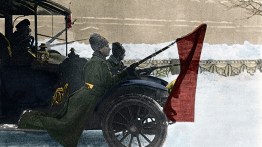
The centenary of the Russian Revolution has arrived right on time, just as the liberal democratic world is getting a taste of what it’s like to feel political gravity give way. In 2017, Lenin lives. ‘In many ways he was a thoroughly modern phenomenon,’ writes Victor Sebestyen in Lenin the Dictator, the kind of demagogue familiar to us in western democracies, as well as in dictatorships. In his quest for power, he promised people anything and everything. He offered simple solutions to complex problems. He lied unashamedly. He identified a scapegoat he could later label ‘enemies of the people’. He justified himself on the basis that winning meant everything….

Holy heroes

More from Books

The Reformation is such a huge, sprawling historical subject that it makes sense, in this the 500th anniversary of Martin Luther producing his 95 Theses, to break it up into bite-size pieces in order to sample its distinctive local flavours. Eamon Duffy, emeritus professor of Christian history at Cambridge, takes England as his territory, and quickly deprecates the very word Reformation as an ‘unsatisfactory designation concealing a battery of value judgments’. Instead, he sets out to investigate what he characterises as largely a series of homegrown reformations and counter-reformations. So far, so sensible, but the process of reduction is then taken a step further.

Beautiful thoughts for all occasions

More from Books

Kahlil Gibran was 40 years old, a short — he was just 5’3” — dapper man with doleful eyes and a Charlie Chaplin moustache, and in the first throes of the alcoholism that would result in his early death, when in 1923 he published The Prophet. A collection of 26 prose-poems, written in quasi-Biblical language, the book takes the form of sermons by a fictional sage named Al Mustapha, on the big questions of life: family, friendship, love, work and death. These range from the profound to the banal. ‘Love gives naught but itself and takes naught but from itself. Love possesses not nor would it be possessed; For love is sufficient unto love.’ And who could argue with that? But then again.

Bear essentials

More from Books

In Yoko Tawada’s surreal and beguiling novel we meet three bears: mother, daughter and grandson. But there will be no porridge or bed-testing here: these are bears with a difference. Tawada has form in animal-linked fiction: The Bridegroom Was a Dog won a major Japanese award. Writing in Japanese and German, she is a prizewinner in both countries. This three-part novel, felicitously translated from the German by Susan Bernofsky, draws us deep into the lives of her ursine trio. Transcending anthropomorphism, her beasts retain their essential ‘bear-ness’ in the human world. Mama bear, an ex-performer in a Moscow circus, is savvy, opinionated and scatty: ‘I hate making small talk about the weather, so I often miss forecasts of major changes.

The best sort of magic realism

More from Books

Michael Fishwick’s new novel tells the story of a young man called Robbie, who has been uprooted from his London home after his mother’s death. He finds himself in rural Dorset, where he inhabits a capacious present that has ample room for the intrusions of the mythic past. Struggling with his loss, Robbie has taken to using arson to express his rage — which is why his father, having rapidly acquired a new partner and a couple of stepdaughters, has moved the family to his old childhood home to make a new start. But it’s an ancient start that this landscape has on offer.

An epic for our times

More from Books

Trailing rave US reviews, fan letters from Yann Martel and Khaled Hosseini and a reputation as ‘Doctor Zhivago for the 21st century’, comes this outstanding historical saga from debut novelist Sana Krasikov. It’s a dazzling and addictive piece of work from an author born in the Soviet Republic of Georgia whose family emigrated to New York when she was eight. Not only is this novel accomplished and packed with believable detail and entertaining dialogue, it also feels curiously relevant, tip-toeing around the complicated relationship between the United States and Russia during and after the Cold War. Raised in 1930s Brooklyn, Florence Fein escapes a stifling existence with a seemingly glamorous job entertaining Soviet dignitaries on business trips to the US.

Mach the Knife

More from Books

The business of banking (from the Italian word banco, meaning ‘counter’) was essentially Italian in origin. The Medici bank, founded in Florence in 1397, operated like a prototype mafia consortium: it rubbed out rivals and spread tentacles into what Niccolò Machiavelli called the alti luoghi (‘high places’) of local power interests. Undoubtedly, Medici money was at its most arrogant under the dictatorship of the merchant-poet Lorenzo de’ Medici, whose supremacy was dramatically challenged in the Pazzi conspiracy of 1478. Amid a fury of dagger blows in Florence’s cathedral (of all places) Lorenzo narrowly escaped assassination by bravos in the pay of the rival Pazzi family.

The road to independence

More from Books

Alone with her father’s dead body, Olive Piper says, ‘I don’t know anything, except what I feel, and how can anyone know more?’ In Susan Hill’s new novel, Olive’s acceptance of the primacy of feeling represents a coming of age. Her maturity is achieved at a cost. As in a number of her recent novels — Black Sheep and A Kind Man — Hill explores with great economy an idea of the ubiquity of differentness. Olive, her very name suggestive of something drab and unobtrusive, is a girl of conventional background: in appearance and, apparently, outlook and ability, she is unremarkable. Her life seems predestined for ordinariness.

Prophesying doom

More from Books

Boualem Sansal’s prophetic novel very clearly derives its lineage from George Orwell’s Nineteen Eighty-Four. A totalitarian surveillance state, a fundamentalist religious autocracy, is portrayed as being totally intolerant of free-thinkers. This is a powerful satire on an Islamist dictatorship. It is unsurprising that Sansal’s writings are censored in his native Algeria. The religious structure of the political state is familiar. The one true god is Yolah and his prophet or ‘Delegate’ is Abi. Abi’s book, the Gkabul, is the foundation of the religion; it is sacrosanct and immutable. Places of worship are mockbas and the nation is named Abistan after the true disciple. There are nine calls to prayer each day.

A genial green guide to 2000 AD

More from Books

I can recall exactly where I was 40 years ago when I didn’t buy the first issue — or ‘prog’ —of 2000 AD. The just-launched sci-fi comic, featuring ‘space-age dinosaurs’, ‘the new Dan Dare’ and a ‘FREE SPACE SPINNER’, i.e. a mini frisbee, looked quite exciting and, at 8p, good value for pocket money; but, as a regular nine-year old consumer of Whizzer and Chips etc., I stuck with my usual comedy fare and opted for a copy of Buster instead. It was a decision I soon came to regret (eh readers?) I can also recall exactly where I was when I bought the most recent issue of 2000 AD — in Gosh! Comics in Soho a fortnight ago. Times may have changed but the future has not. ‘BORAG THUNGG, EARTHLETS!

Forbidden love and the beautiful game

More from Books

Nowadays, most of us living in the liberal West agree that there can never be anything morally wrong with love between consenting adults. This is good for society but bad for novelists. The tale of the grand passion that runs foul of societal mores is a staple of literature. What is Madame Bovary if Emma can slam divorce papers on Charles’s desk after her first few sexts with Rodolphe? Writers who want to do the love versus society theme have to get creative. Ross Raisin has hit on the sterling idea of heading for the world of professional football. Not a single one of Britain’s 5,000 full-time players is openly gay — though statistically about 500 of them must be. Tom, the hero of Raisin’s new novel, is one of them.

According to Luke

More from Books

This is an odd one, not least because it claims to be a novel, which it isn’t. Emmanuel Carrère, writer and film-maker, looks back on an earlier self when, as a young man, he had a phase of being a devout Catholic, going to Mass daily, making his confession, the whole caboodle. He decides to marry his girlfriend, who is called Anne. We do not hear much about her. He later marries Hélène Devynck. Like the ‘real’ Carrère, the narrator has a house on the island of Patmos, where much of this book was written — appropriately, since it is a (sort of) commentary on the New Testament.

The mysteries of colour

More from Books

When Australia imposed generic packaging in its war on cigarettes, there was consumer research into the most deterrent colour. Pantone 448 was chosen, a sort of sludgy green-brown. When it was described as ‘olive’, Oz’s federation of olive growers formally complained. Certainly, colours move us. Interior designers know that yellow makes people angry, while in the US Naval Correctional Center in Seattle, what’s known as Baker-Miller Pink (after the officers who created it) has been found to pacify stroppy recidivists. Additionally, as Diana Vreeland averred, pink is the navy blue of India. Racing drivers think green unlucky, even if it is the British national colour in motorsport. We sometimes see red and that means we are angry, but red is also the colour of love.

Reason and faith

More from Books

Roy Hattersley would never have been born had it not been that his mother ran away with the parish priest who instructed her in the Catholic faith before her marriage to a collier — the priest conducted the wedding; a fortnight later they eloped. This deplorable episode had one happy consequence: the birth of Roy, who never knew the reason for his father’s ease with Latin until after he died. So Roy is in a way a small part of his latest book, The Catholics, a history of the church and its people in Britain since the Reformation. He is an atheist but says, ‘Religion in general — belief in the unbelievable — fascinates me.

Secrets of the secretaries

More from Books

The minister’s private secretary wrote to another cabinet minister about the previous day’s cabinet meeting: They cannot agree about what occurred. There must have been some decision, as Bright’s resignation shows. My chief has told me to ask you what the devil was decided, for he be damned if he knows. Will you ask Mr G. [Gladstone] in more conventional and less pungent terms? That was in 1882. Twenty years later, the fog still reigned. Sir Robert Morant, the driving force behind Balfour’s 1902 Education Act, wrote: Impossible to find out after a cabinet meeting what has actually been the decision. Salisbury does not seem to know or care, and the various ministers who do care give me contradictory versions.

Speckled Footman and Maiden’s Blush

Lead book review

Last year, I attempted to pass through security in an American airport carrying a small black box, containing eight batteries and a visible circuit board. If the switch was flipped, the display counted down in red flashing numbers. Unsuprisingly, the officer in Salt Lake City pulled it out of my hand baggage. ‘What’s this?’ ‘It’s to attract moths,’ I said; then, thinking this sounded feeble, added rather grandly, ‘I’m a lepidopterist.’ ‘Say that again.’ So I did, and a huge grin lit up the face of my interrogator. ‘Hey, y’all,’ he called out to his colleagues. ‘C’mon on over, listen to this… Say it again.

Descent into hell

More from Books

In my work as a reviewer, a small, steady proportion of all the books publishers send me concern the Holocaust. With middle age has come a curious foreshortening of my perspective on modern history so that, paradoxically, the Nazis’ inhumanity has begun to seem less distant in time and, therefore, more horrible still. Fortunately I can reassure myself that, objectively, it happened long ago and that even the atrocities of eastern Europe and Rwanda are now a couple of decades safely in the past. Such consolations vanish when confronted by The Raqqa Diaries, which is shockingly of the present. It is a terrible reminder that we are unwise to impute any kind of teleology to history.

Light in the East | 9 March 2017

More from Books

Christopher de Bellaigue, a journalist who has spent much of his working life in the Middle East, has grown tired of people throwing up their hands in horror at Isis, Erdogan and Islamic terror, and declaring that the region is backward and in need of a thorough western-style reformation. As he argues in this timely book, the Islamic world has been coming to terms with modernity in its own often turbulent way for more than two centuries. And we’d better understand it, because it’s an interesting story, and often a positive one — the way vast crowds streamed onto the streets of Cairo, Istanbul and Tehran in demonstrations against authoritarian rule over the past decade, for example. Western-style participatory democracy remains the dream of the man and woman in the souk.

Night of the living dead

More from Books

On 5 February 1862, the night Abraham Lincoln and his wife gave a lavish reception in the White House, with the civil war swelling outside and their 11-year-old son Willie dying of typhoid fever upstairs, what was the state of the moon? Was it a ‘fat green crescent’? Or was it ‘yellow-red, as if reflecting the light of some earthly fire’? According to George Saunders’s hugely ambitious Lincoln in the Bardo, his first novel after four peerless collections of short stories, neither of the above descriptions might be true, but when read in their tragic context, either can impart symbolic meaning. And meaning, as this novel so cleverly demonstrates, is not the same as truth. Lincoln takes place on a single night, 17 days after the party.

Father, son and holy ghost

More from Books

No disrespect to any of the present incumbents, but Karl Miller (1931–2014) was a literary editor in an age when such jobs mattered. Between the late 1950s and the early 1970s he not only ran the books pages of two weekly magazines — The Spectator, and the Paul Johnson-era New Statesman — before moving on to edit the Listener, but did so with a conviction that their cultural stance was quite as important as the political material that crowded out the front end. The virus that had propelled him into literary journalism burned away for nearly 60 years, and his last book review appeared in these pages four days before his death.

Comfort the suffering

More from Books

If a single book could help you to be kinder and more compassionate, could expand and deepen your understanding of other people (and possibly yourself) and make you less afraid of dying in the process, you would surely be eager to acquire it at once. Well look no further, for Grief Works is that book. The King Lears among us — whose every third thought is the grave — will need no persuading that a collection of essays about surviving bereavement is an enthralling read. For those of a more timid or sunny disposition, ask yourself this: when someone you love dies, how will you manage? The odds of avoiding grief are not in anyone’s favour. In Britain half a million people die each year and it’s estimated that each death affects at least five people.

Nothing matters very much

More from Books

Nothing will come of nothing, said Lear, because he wasn’t familiar with quantum physics. According to our current best theories, a region of space that contains nothing at all is still seething with pairs of virtual particles popping in and out of existence for no good reason. Meanwhile, it is possible to be mathematically sure that an entire universe contains nothing whatsoever, but then if you go looking for stuff in a particular part of this same universe you could find a wheelbarrow. But what did I mean by ‘a region of space’? It turns out that all sorts of assumptions are baked into such a phrase depending on what cosmology I have — and similarly with the ideas of ‘stuff’ and its alleged opposite, ‘nothing’.

Back with a vengeance

Lead book review

One hour in No. 5 Cheyne Row, Virginia Woolf observed, will tell you more about the Carlyles than all the biographies. The house lived in by Thomas and Jane Carlyle from 1834 until their respective deaths, and now owned by the National Trust, was one of the great battlegrounds of domestic history. Here Jane warred against bedbugs and coal dust and her husband’s obsession with the vast and unstoppable Lady Harriet Ashburton (there were three people in her marriage), and Carlyle warred against the intrusions of the outside world.

Spectator competition winners: famous authors on the art of seduction

The call for lessons in the art of seduction in the style of an author of your choice drew a large and stellar field. Henry James — whose labyrinthine sentences would surely bore the objects of his affection into submission — was a popular choice. Here he is, as expertly imagined by John Maddicott: ‘If her defences, imperfectly nurtured by an occasionally burnished but never entirely unshakeable conscience, were to be penetrated — and he allowed the delightful vulgarity of the thought to send a miniature frisson of undeniable pleasure through his diminutive frame — it must be by methods which, though crude in their essaying, combined the subtlety of experiment with the heavy-handed assertiveness of the tried and not infrequently tested.

Worming out the truth

More from Books

In Delmore Schwartz’s story ‘In Dreams Begin Responsibilities’, a young man dreams he is watching his father and mother’s engagement onscreen from a seat in a cinema. Weeping at the certain knowledge of the pain to come, he’s patted on the back by a woman. ‘There, there,’ she says, ‘all of this is just a movie.’ In a way, this moment distils the challenge of all oneiric narratives — it’s a fiction within a fiction, one in which anything can happen, but without real-world consequences. In this dark, brilliantly controlled debut, the Argentinian Samanta Schweblin uses the fabric of a dream to weave a novel in which everything is at stake and at risk: identity, love and existence.

Books podcast: The story of pain

My guest in this week's books podcast is the scholar Joanna Bourke, who's talking about her new book on something we all have in common: suffering. In The Story of Pain: From Prayer to Painkillers she turns much of what we think we know about pain on its head. Here's an experience that's common to all of us, but apparently completely subjective. It is twined into the very roots of our culture -- and yet the stories we tell about it have changed massively over the centuries. What was life like before anaesthesia? Why did we not use painkillers until long after we had them? How is it that until less than 100 years ago people believed that children didn't feel pain at all? And is pain, as Freddy Mercury claimed, really close to pleasure?