Culture

Culture

The good, the bad and the ugly in books, exhibitions, cinema, TV, dance, music, podcasts and theatre.

Women on top | 2 October 2010

Cinema

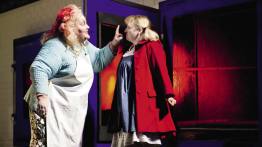
Although Made in Dagenham is far from perfect and has a particular fondness for those impromptu speeches which turn out to be stirringly spot-on, it is so warm-hearted and affectionate it wouldn’t be right to take against it. Although Made in Dagenham is far from perfect and has a particular fondness for those impromptu speeches which turn out to be stirringly spot-on, it is so warm-hearted and affectionate it wouldn’t be right to take against it. It would be like kicking a puppy or, perhaps, randomly plonking a cat in a wheelie bin, of which, I believe, there has even been a recorded incidence.

Coalition wear and tear

Theatre

Let’s talk about Tucker. The Beeb’s mockumentary The Thick of It has been hailed as a brilliantly incisive glimpse into the corridors of power, and its diabolical protagonist, the scheming spin-merchant Malcolm Tucker, is regarded as a hilarious portrait of a modern political propagandist. That’s one view, anyway. Maybe I’ve got a blind spot. Maybe my sense of humour’s gone missing. Maybe I romanticise the ideals of public service because my mum and dad worked in Whitehall, but I’ve never understood the praise heaped on this cruel and distorted fantasy. It’s possible to overlook the relentless swearing, the vapid characterisation and the ever-predictable storylines.

Anti-depressant

More from Arts

‘Get inside the creative mind,’ urges the website of Studio 360, an innovative radio programme based in New York. ‘Get inside the creative mind,’ urges the website of Studio 360, an innovative radio programme based in New York. Set up by Kurt Andersen (of Spy magazine), it offers a weekly magazine programme about the arts, a sort of Front Row crossed with Night Waves. It’s intriguing, thought-provoking and just as good as anything produced by the BBC. The trouble is you have to be a wireless genius to work out how to listen to it if you’re driving through New England and don’t have access to a podcast or computer. Listening to radio in the USA is a frustrating business.

House rules | 2 October 2010

More from Arts

The other weekend the Fawn and I were invited to stay at Chilham Castle. Obviously, if you’re Charles Moore, this is no big deal because it’s the kind of thing you do 24/7, 365 days of the year. For us, though — me especially, the Fawn being slightly posher than me — it was a revelation. ‘Bloody hell!’ I thought. ‘This is totally fantastic. Why isn’t my life like this all the time?’ And I found myself wishing dear Hugh Massingberd were still alive. He would have understood perfectly when I rang him up to boast. Private Eye called him ‘Massivesnob’ but as Hugh knew snobbery has little to do with it. You don’t need to be grand to land an invitation to one of the great English (or Scottish) houses. Just interesting.

Blu-ray earns its stripes

More from Arts

Peter Greenaway’s A Zed & Two Noughts, recently released on Blu-ray disc by the BFI, proves that the high-definition format isn’t just for blockbusters: it could have been invented for the British director’s first collaboration with the legendary cinematographer Sacha Vierny, a partnership which made explicit Greenaway’s debt to French auteur Alain Resnais and introduced the meticulous colour-coding that would characterise later films such as The Cook, the Thief, his Wife and her Lover.

Building block

Arts feature

Britain’s architects can produce the best designs in the world, says Amanda Baillieu. So why aren’t any on display at the Venice Architecture Biennale? Something has gone very wrong for the British at the Venice Architecture Biennale. This three-month event may play second fiddle to the older and larger Art Biennale, but for architects it is meant to be the only festival where they can let rip, free from the restraints of budgets, planning and bureaucracy. They come to gossip, to see what their rivals are up to and schmooze clients. Even Norman Foster has dropped by to talk up his firm’s plan for Hong Kong’s new £1.8 billion arts district. Some 30 countries show their wares in national pavilions, slugging it out for punters and prizes.

Friends reunited

More from Arts

Zanzotti’s in Soho: redolent of surreptitious lunches fondly remembered, with its red gingham cloths and crusted tricolore paintwork, its ‘chianti-in-a-basket./ Breadsticks you snap/ with a sneeze of dust...And Massimo himself/ touring the tables / with his fake bonhomie.’ An old haunt, and the setting, in Christopher Reid’s poem ‘The Song of Lunch’, for a reunion between former lovers, ten years on — or could it be 15? Zanzotti’s in Soho: redolent of surreptitious lunches fondly remembered, with its red gingham cloths and crusted tricolore paintwork, its ‘chianti-in-a-basket./ Breadsticks you snap/ with a sneeze of dust...And Massimo himself/ touring the tables / with his fake bonhomie.

Choppers for whoppers

More from Arts

Pakistan. Big problem. Burning issue. Put it on stage so we can find out how we got here. J.T. Rogers’s new play opens in 1981 just after the Soviet invasion of Afghanistan. A young CIA officer, with the exotic and suggestive name of Jim, sets off for the badlands of Waziristan to offer his support to anyone in a headscarf who wants to kill anyone with a red star on his helmet. He strikes up a mutually exploitative relationship with some mountain-dwelling shepherds. He’ll give them military hardware, they’ll give him information (much of it unreliable). Choppers for whoppers. If this sounds crushingly predictable, then don’t slash your wrists just yet because there’s a joke coming. Here it is. The uncouth Muslim rustics love The Eagles.

Crime and punishment

More from Arts

As I descended, then descended again, then again, to get to my seat in the subterranean, uncomfortable Linbury Studio at the Royal Opera House, I thought gloomily of the number of miserable evenings I have spent there, and reflected that Philip Glass’s In the Penal Colony was probably all too apt a name for what I was about to experience. As I descended, then descended again, then again, to get to my seat in the subterranean, uncomfortable Linbury Studio at the Royal Opera House, I thought gloomily of the number of miserable evenings I have spent there, and reflected that Philip Glass’s In the Penal Colony was probably all too apt a name for what I was about to experience.

Hosed down with artificial cream

More from Arts

Highgrove: Alan Meets Prince Charles (BBC2, Thursday) brought us two men who are not quite national treasures, though who would certainly like to be. It’s interesting that ‘Alan’ apparently needs no surname, though ‘Charles’ requires the identifying title. But in spite of the implied matiness this was a deeply old-fashioned BBC royal slathering operation, in which no knee is unbent and no forelock goes untugged. Alan Titchmarsh could not get over how excited he was to be on his way to Highgrove and the prince’s garden: ‘its incomparable beauty and purity of purpose ...by the best royal gardener in history,’ he breathed, even before he’d got there.

Saturday Morning Country: Loretta Lynn

Country music ain't always about cowboys and outlaws; there's the distaff side of strong and righteous ladies too. Notably, in this instance, Loretta Lynn and her warning that You Ain't Woman Enough (To Take My Man)...

Candid camera

More from Arts

A.A. Gill talks to his friend Terry O’Neill, whose iconic photographs captured an entirely new kind of celebrity I remember the first time Terry O’Neill took my photograph: he wore blue; I wore grey and the Great War helmet of the third regiment of Pomeranian Grenadiers. We were at the Imperial War Museum, and the nice curator gave me the tin hat with reverence. ‘They’re surprisingly hard to get hold of in good condition, considering how many were made,’ he said. This one had been lifted from a corpse in Arras. And I can pass on to Spectator readers — because I know how much you love this sort of thing — that the second world war version is slightly smaller than the first, to save steel. I donned the coal scuttle and a Teutonic demeanour.

Liquid gold

More from Arts

William Pye has observed, somewhat wryly, that he’s better known among architects and designers than he is by the art-loving public. William Pye has observed, somewhat wryly, that he’s better known among architects and designers than he is by the art-loving public. There is a simple reason for this: in recent years he has had very few exhibitions in galleries. His work used to be a regular feature of the Royal Academy Summer Exhibition, but he is not an RA, and an artist of his stature does not readily court rejection. After a run of showing at the RA for some 30 seasons, he was turned down twice in the hurly-burly of general submission. The panjandrums of Burlington House missed a trick when they passed over Pye.

Making history | 18 September 2010

More from Arts

No one who has seen The World at War will ever forget it. Thirty-six years on from its original broadcast, it still stands atop a glittering mound of British documentary television. But the great is about to be made better with a new restoration of the series, available on DVD and Blu-ray. The promotional material informs us that every single frame has been individually tweaked and upgraded – and it shows. Even those who own previous DVD versions should consider stumping up for this set. The genius of The World at War was always in how it allowed the second world war and its participants to speak for themselves. And so it treats us to miles of footage shot during the conflict itself, and lengthy interviews with everyone from Hitler’s secretary to concentration camp survivors.

Killing joke

More from Arts

Ira Levin’s name isn’t nearly as well known as his titles. Ira Levin’s name isn’t nearly as well known as his titles. Rosemary’s Baby and The Stepford Wives, both originally novels, are his most celebrated works. He also wrote quite a few Broadway hits. In his 1970s play Deathtrap he tries to imagine how an author of murder mysteries might fare as a real-life killer. This idea is entirely preposterous or, if one were being ungenerous, entirely insane, but never mind. It might be fun. We open with Sidney Bruhl, a famous playwright whose best work is behind him, discovering a great new play by an unknown dramatist. It’s a surefire hit. He feels it in his bones. ‘Even a gifted director couldn’t ruin it.

Reasons to be cheerful

More from Arts

It was being whispered last week at the first of the two Berlin Philharmonic appearances at the Proms that attendance across the board this year has been 94 per cent. If this is true, and is maintained to the end, it is a staggering achievement. Every year for the past 15 or so, the press office at the BBC has put out ever-increasing claims about the number of people who have bought tickets, in such a way that I have never quite believed them. The increase year on year was somehow too reliable. But this would trump them all by far. I wonder why it has happened, if it has.

In search of lost time

More from Arts

My friend Mickie O’Brien, late of 47 and 44 RM Cdo, died the other day. My friend Mickie O’Brien, late of 47 and 44 RM Cdo, died the other day. I’m not sure how old he was — late 80s, I would imagine — but, whatever, it was good going for a man who should have been killed at least twice in the 1940s, once at the Battle of Kangaw when the Japs shot away half his stomach and once when he walked deliberately into a minefield to rescue a French farmer. For one exploit or another Mickie won an MC. The question I used to ask Mickie most often was how he managed to cope with so much fear and horror. He always replied that he had the perfect temperament for wartime soldiering: ‘a strong sense of fatalism and no imagination’.

THEATRE: Review – Bedlam Shakespeare’s Globe

  The Southbank has always been an anarchic place. Shakespeare’s Globe proudly reminds visitors that Elizabethan theatres were considered far too lawless – and, implicitly, too much fun – to be licensed within the city limits. After years of rubbing shoulders with gamblers, pimps, and bear-baiters, by 1815 most theatres had advanced to the semi-respectability of the West End, only to be replaced in Southwark by their natural heirs, the lunatics of Bedlam.

Sunday Morning Country: Johnny Cash

There was almost as much hackery as brilliance in Johnny Cash's career and even his terrific late American albums are pretty uneven. But when he was good he was very good...So here he is lamenting - or celebrating? - those old Folsom Prison Blues...

The art of risk-taking

Arts feature

Despite the economic gloom, ENO’s John Berry is optimistic about the future of opera Opera director David Alden said in a recent interview, ‘Opera is alive, popular — and hot.’ I agree. Opera is very much in the public eye and thriving in UK opera houses, cinemas and performing arts centres. However, as we wait to see the outcome of the coalition’s spending review, the arts community has been vocal about its concerns and fears. London is not Munich or Vienna where public subsidy for the arts is a way of life and debated on the same level of necessity as health and education. Yet Britain is revered worldwide for the energy and quality of its performing arts institutions.

Proms notebook

Features

The world’s greatest festival of music continues to grow under the splendid stewardship of Roger Wright, but there is always plenty of missionary work to do, for the world will never run short of grouches. The world’s greatest festival of music continues to grow under the splendid stewardship of Roger Wright, but there is always plenty of missionary work to do, for the world will never run short of grouches. Perhaps, like Sir Harold Acton in his Tuscan grotto, who loved to ‘hunt philistines’, we should trap the blighters in cages and force them to listen to lashings of Beethoven and Wagner until they recant. Step forward, if you will, Miss Lynsey Hanley.

Out of the ordinary | 11 September 2010

More from Arts

Frederick Cayley Robinson: Acts of Mercy National Gallery, until 17 October The free exhibitions in the Sunley Room offer a programme of meditations on the National Gallery’s permanent collection, either through works of art directly inspired by or related to the old masters, or connected in a more oblique way. Frederick Cayley Robinson (1862–1927) is a little-known early-20th-century English painter in oils, tempera and watercolour who deserves wider recognition: this loan exhibition is the first show of his work for more than 30 years.  A traditionalist with a feeling for the more modern statement, Cayley Robinson was using the same methods and materials as the old masters, but wanted to create something of relevance to his period.

Vexed issues

Theatre

Clybourne Park Royal Court, until 2 October Tiny Kushner Tricycle, until 25 September Bash the bourgeoisie is a game the Royal Court likes playing and I’m always keen to join in. Bruce Norris, a brilliant American satirist, delighted us a few years back with The Pain and the Itch, a hilarious exposure of middle-class hypocrisy. Clybourne Park is a pair of plays set in a house in the prosperous Chicago suburbs. We start in the 1950s when black families are just arriving in the neighbourhood. We then fast-forward 60 years and see prosperous whites returning after decades of poverty and neglect. The earlier play feels very wonky. The dice are overloaded against the whites. As well as their black servants, they have a deaf friend and a kid next door with Down’s syndrome.

House music

Music

When you really want to feel miserable, read a few lifestyle features in a glossy magazine. The other day, in a momentary loss of concentration, I started reading one about a family who were willing to admit publicly that they own five televisions. Obviously I ventured no further, assuming they all have enormous bottoms, brutally compromised digestive systems, failing eyesight, withered musculatures and the brains of ferrets. But then I thought of my own modest north-London flat. We have just the one television, unfashionably small in that it’s only about the size of a small car.

Without harmful intent

Opera

Hänsel und Gretel Royal Albert Hall How frightening an opera is Humperdinck’s Hänsel und Gretel, or how frightening should it be? The answer to the first question, if one had only encountered Hänsel at the Prom performance which Glyndebourne brought to London last week, was ‘not at all’. It was given in a semi-staged version, but virtually nothing of Laurent Pelly’s distinctive production survived.