Culture

Culture

The good, the bad and the ugly in books, exhibitions, cinema, TV, dance, music, podcasts and theatre.

Liberation day

More from Arts

‘We’re women, not ladies,’ the Women’s Libber, still in campaigning mode after 40 years, reminded us sharply. ‘We’re women, not ladies,’ the Women’s Libber, still in campaigning mode after 40 years, reminded us sharply. She was for the first time in the same room as Peter Jolley, who had helped to organise the notorious 1970 Miss World contest. He, too, does not seem to have changed much in the intervening decades. ‘So much work went into it, my dear,’ he insisted, riling his fellow conversationalists, perhaps deliberately.

Sex lives and videotape

Television

Him and Her (BBC 3) is the BBC’s notion of a really edgy sitcom. Him and Her (BBC 3) is the BBC’s notion of a really edgy sitcom. This is not My Family. The first words uttered are from a bloke who is in bed with his girlfriend. ‘You. Are. Very good at blow jobs.’ ‘Thank you,’ she says demurely. ‘And I am brilliant at receiving them.’ Moments later we see her sitting on the loo, and not just for a pee. Then a neighbour drops round to discuss, inter alia, Kate Winslet’s breasts, and how everyone pauses that bit on the Titanic DVD. I found myself wondering what would have happened if an advance tape had been shown to Lord Reith. ‘It is, um, er, director-general, somewhat experimental in tone and content.

THEATRE: How To Be Another Woman

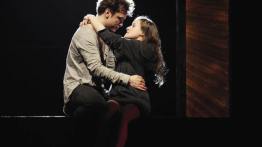
There’s a moment in the Gate Theatre’s new devised play, How To Be Another Woman, when an actress slowly mimes reaching for a book and ostentatiously flipping it open on a crowded bus. She tells her companion that she’s reading Madame Bovary. There’s a moment in the Gate Theatre’s new devised play, How To Be Another Woman, when an actress slowly mimes reaching for a book and ostentatiously flipping it open on a crowded bus. She tells her companion that she’s reading Madame Bovary. The audience isn’t fooled. We can see that she’s posing with a stiff sequined evening bag, the flap held open like the cover of a book.

Saturday Morning Country: George Jones

I've been listening to George Jones a lot, lately. So here's video of a younger Possum singing, in his usual style, Things Have Gonel to Pieces which is, I suppose, a decent-enough summary of an entire school of country music.

Seaside renaissance

More from Arts

Roderick Conway Morris on how Genoa’s glorious Villa del Principe has been brought back to life Palazzo Doria Pamphilj houses the most important private art collection in Rome. But the family possesses another treasure, the Villa del Principe in Genoa. The Doria side of the family moved to Rome in 1760, when they inherited the Pamphilj titles and estates, after which the Villa del Principe suffered a slow decline, punctuated by two major disasters. But after 16 years of work it has now been restored and reopened to the public.

Shared affection

More from Arts

The Switch 12A, Nationwide As a rule, Richard Burton acted stupendously well in stupendously bad films. Jennifer Aniston has mastered half that duality. The Switch, her latest film, is comfort-zone Aniston: a charmless rom-com with a crass attempt at eroticism — Toy Story’s more titillating, to be honest. Cliché is The Switch’s currency. A pallid dawn rises over New York’s landmarks and we are taken back seven years. It is breakfast time. An aging girl-next-door (Aniston) tells her lachrymose friend and former lover Wally (Jason Bateman) that she is seeking a sperm donor. ‘The clock has struck,’ she says, to crown the cliché.

Comfort-zone Aniston

More from Arts

The Switch 12A, Nationwide As a rule, Richard Burton acted stupendously well in stupendously bad films. Jennifer Aniston has mastered half that duality. The Switch, her latest film, is comfort-zone Aniston: a charmless rom-com with a crass attempt at eroticism — Toy Story’s more titillating, to be honest. Cliché is The Switch’s currency. A pallid dawn rises over New York’s landmarks and we are taken back seven years. It is breakfast time. An aging girl-next-door (Aniston) tells her lachrymose friend and former lover Wally (Jason Bateman) that she is seeking a sperm donor. ‘The clock has struck,’ she says, to crown the cliché.

In the steps of Larkin

More from Arts

Last month, when unveiling my all-time top ten favourite albums, I predicted that the list would probably have changed by the autumn. In fact, it changed within days of filing my copy. For along came Larkin’s Jazz, which I think is the finest, most scholarly and above all wonderfully entertaining and affecting CD collection that has come my way since starting this column nine years ago.

Let Hester fester

More from Arts

In the Blood Finborough, until 4 September Zelda Leicester Square Those who oppose state-funded theatre in Britain sometimes imagine that America, with its far smaller subsidised sector, is spared the sort of pious, jokeless, grind-yer-nose-in-it plays which our handout theatres use to punish audiences for the sin of being affluent. But American theatre turns out to be richly contaminated with underclass miserablism too. Suzan-Lori Parks is a supreme purveyor of the goods and, like many second-rate talents from minority backgrounds, she’s been given more prizes than Chekhov. She’s won the Pulitzer. She’s been nominated for a Tony.

Opiate for the masses

More from Arts

One of the few things I respect about mainstream TV is how utterly shallow and addictive it is. In many ways it’s like crack: it doesn’t pretend that it’s good for you but it gets you to where you want to go way more effectively than tofu or wheatgrass juice or organic dolphin-friendly tuna caught with rod and line. Sometimes it achieves high artistic standards too, but this is usually a fluke, which happens despite the medium rather than because of it. TV isn’t like film or opera or theatre or sculpture or any of that poncy stuff. Its main job is to get you out of it as quickly as possible — an opiate for the masses. I got a sense of its true purpose the other day when I ventured up to the Rat’s lair to call him down for supper.

Pick up a Penguin

More from Arts

What must it have been like for Allen Lane to wander into a bookshop in the 1940s and see the serried ranks of pale-blue, cerise, green, yellow, dark-blue and grey Penguins on display, knowing that he was responsible for all of them? His genius idea had in less than a decade transformed not just bookselling but also what everyone in Britain (and soon the English-speaking world) was reading. Penguins were cheap to buy, just 6d a throw, or the price of a packet of cigarettes, yet were literature of the highest quality and broadest range — from Maurois, Hemingway, Marx and Homer to Dorothy L. Sayers, Agatha Christie and Compton Mackenzie. Until 1935, such books had been available only in expensive hardbacks or on temporary loan from the library.

Mourning in America

Arts feature

New York is in the grip of memorial mania, writes Tiffany Jenkins In early 1991, the construction of a federal office building in lower Manhattan was halted after an unexpected discovery. Underneath the ground, covered by a patina of concrete and steel, was the coffin of a colonial-era African. It was not alone. Construction work was halted, archaeologists called in, and it was soon established that the site was a major burial ground from the 17th and 18th centuries. As many as 15,000 to 20,000 black men, women and children were buried there, by the historians’ count, making this one of the most important archaeological finds in all America. The significance was not lost on New York’s people or its authorities.

Well met in Mexico

More from Arts

The Surreal House Barbican Art Gallery, until 12 September Surreal Friends: Leonora Carrington, Remedios Varo and Kati Horna Pallant House Gallery, Chichester, until 12 September It may not come as a surprise to readers to learn that ‘the individual dwelling [is] a place of mystery and wonder’, yet this is the premise of the Barbican’s latest attempt to pull in the punters. A portmanteau surrealism show that tries to blend art, film and architecture, its reach exceeds its grasp, though the designers must have had great fun carving up the space into dark cabins and voids. Some of the best exhibits — apart from fine things by de Chirico, Magritte and Giacometti — are the films.

Bad, good and ugly

More from Arts

Uber Hate Gang Underbelly Little Black Bastard; Stripped Gilded Balloon The Tailor of Inverness Udderbelly Pasture Ginger and Black Pleasance And it’s getting bigger. Amazing as it sounds, the Edinburgh Festival keeps expanding like a slum landlord. Every year half a dozen cobwebbed halls and disused assembly rooms are forced open, spruced up and pressed into service for the ragamuffin hordes of wannabe superstars. It’s getting harder to find your way round, too. Luck was against me when I set off for Uber Hate Gang, an acclaimed masterwork from ‘Britain’s hottest young theatre company’ at the Underbelly. I found it all too easily.

National treasure

More from Arts

Chopin is a difficult composer to celebrate, at least in the festivals of larger format. Countless piano recitals don’t really fit the bill and the music which includes orchestra is not the best of him. He surely was a miniaturist — perhaps the most compelling there has ever been. Which other composer can set a mood so securely in the very first bar, and then sustain it as a single shaft of thought to the end? He is like a painter who with three strokes of the brush has told you all you need to know about what is to follow, so that what does follow already seems like a familiar and longed-for friend. Of course this kind of writing doesn’t work very well in a building the size of the Albert Hall.

The price of fame

More from Arts

The X Factor is back on ITV, and it’s fascinating, being a paradigm of British life. The X Factor is back on ITV, and it’s fascinating, being a paradigm of British life. Persons of little or no talent are assembled to be jeered. Those who have a modicum of ability are praised as if they had just sung Wagner’s Liebestod faultlessly at Covent Garden. This audience would applaud Beachcomber’s Directory of Huntingdonshire Cabmen if whoever was reading it remembered to tear up around the letter B. Rather like in Nineteen Eighty-Four we have the two minutes of hate followed by a great wave of sentimentality, as if a knickerbocker glory packed with cream and raspberry sauce had been laced with castor oil.

No easy answers

More from Arts

An unsettling interview with Moazzam Begg, the British Muslim held prisoner in Guantanamo Bay for three years, and with his father Azmat, began with the haunting cry of the muezzin as it rang out across a cityscape, unnamed and unidentifiable, and the clashing of heavy iron gates being shut. Two sounds that perhaps sum up what’s been happening in the world since the events of September 2001. British Muslims, Father and Son (Radio 4, Monday) gave us a refreshingly frank account of Begg’s life before and after his ‘extrajudicial’ imprisonment.

The Gospel at Colonus

Taking Sophocles' least-known play and reinterpreting via the hymns and songs of gospel music is, damn it, just the sort of thing that you expect from Edinburgh* in August. Thankfully, Lee Breuer's plundering - adaptation is too limited a term - of Oedipus at Colonus is a monumental success. If you ever get the chance to see it in London, New York, DC, Chicago or wherever then for god's sake get yourself a ticket. Most of the reviews of the Gospel at Colonus have focused, understandably, on the music and, unavoidably, on the tensions between Christian and classical Greek theology and you can certainly argue that the production loses some of its force in Act Two as Oedipus prepares for and accepts his end.

Beneath the Fringe

Arts feature

Lloyd Evans joins the hopeful hordes seeking fame and fortune in Edinburgh Wonderful, Edinburgh. Isn’t it magical? The artistic world has descended on Scotland’s magnificent capital for three weeks of self-expression and glorious creativity. Or so everyone wants everyone else to think. When people speak of Edinburgh they reach whoopingly for a peculiar grammatic mode, the puerile tense. Delightful, daring, courageous, uplifting, inventive, risk-taking, inspirational, sublime. Yes, maybe. But take off the kindergarten dolly-goggles and you’ll find other qualities, other adjectives, lurking. Vain, greedy, embittered, jealous, self-obsessed, megalomaniac, drunk, stoned and bankrupt. This is the true Edinburgh.

Rumble in the jumble

Features

Wayne Hemingway — de-signer, trendsetter and fashion watchdog — was interviewed by the Telegraph before his festival ‘Vintage at Goodwood’ took place over the weekend. He made two claims that inspired me, not a natural festival-goer, to dial the booking hotline: ‘There will be attendants for each toilet so that they are as clean on the last day as they were on the first,’ he said, and then, ‘You’ll probably look a bit out of place if you turn up in shorts and sandals.’ These are the kind of bold assertions that have made him an arbiter of taste. Who could resist such a challenge? Mr Hemingway, sir, a ticket please! I ironed my shorts and polished my sandals instanter.

Artistic rumblings

More from Arts

Volcano: Turner to Warhol Compton Verney, until 31 October On my desk is a lump of lava, a memento of Vesuvius. It doesn’t look like much, but neither does the volcano from the cinder track that winds around to its summit. From close to, Vesuvius is a giant ash heap; it’s from across the bay that the magic works. Never does distance lend more enchantment to the view than in the case of volcanoes: when they’re exploding they’re plain dangerous, and when not they’re really rather dull. Their allure is as elusive as a rainbow’s, and it was in rainbow colours that Andy Warhol painted Vesuvius in 1985, making it look like a Neapolitan ice cream blown under pressure through the end of a cone.

Sabotaging Tchaikovsky

More from Arts

Eugene Onegin Bolshoi, Royal Opera House  La bohème Soho Theatre, until 4 September Rule 1 for the sophisticated contemporary opera-goer: complain about the poor diction of singers, especially as compared to 50 years ago, and lay most of the blame on surtitles (actually the connection between the two phenomena is unclear). Rule 2: be astonished at the naïveté of anyone who is bewildered by contradictions between what is said (sung) and what is happening. To judge from the Bolshoi Opera’s production of Tchaikovsky’s Eugene Onegin, Russian directors are cottoning on to modern trends. The whole thing is set in a vast dining room, with a big table round which the chorus sits.

Playing it straight

More from Arts

The Sun Also Rises Royal Lyceum The Cage Pleasance Borderline Racist The Canons’ Gait The Edinburgh International Festival, respectable elder brother of the drop-out Fringe, takes its art very seriously indeed and expects the audience to do the same. It gives us the exotic, the challenging, the eclectic, the mesmeric. It gives us, in a word, the Mickey Finns. Usually we get Palestinian ghost-lore or Slovakian puppet-theatre or sub-Saharan tribal epic or Lesotho revenge drama or Apache creation myth. Sometimes we get all five, in Finnish, with subtitles and video projections, and an on-stage bongo squadron to keep us from our slumbers. But this year, in a stunning reversal of tradition, we’ve got a straight play adaptated from a bestseller by a well-known author.

Steps in time

More from Arts

Cinderella English National Ballet’s 60th birthday London Coliseum The post-second world war decade saw a flourishing of independent ballet companies all over Europe. Those that strove to emulate the Ballets Russes provided an alternative to the companies that aimed at nurturing home-grown talent — such as the Ballet Rambert and what became the Royal Ballet in the UK. It was in this context that English National Ballet (formerly Festival Ballet, London’s Festival Ballet and London Festival Ballet) held its first performance 60 years ago last Saturday. A significant anniversary indeed, particularly because none of the other independent European companies created around the same time has managed to survive so long.