Culture

Culture

The good, the bad and the ugly in books, exhibitions, cinema, TV, dance, music, podcasts and theatre.

Picasso by Picasso

Arts feature

In an upstairs room in an unfrequented corner of Zurich’s Kunsthaus, there is a portrait of one of the unsung heroes of modern art. In an upstairs room in an unfrequented corner of Zurich’s Kunsthaus, there is a portrait of one of the unsung heroes of modern art. Wilhelm Wartmann was the first director of this splendid gallery, and in the autumn of 1932 he mounted the first major retrospective of the work of Pablo Picasso. This autumn, to celebrate its centenary, the Kunsthaus is mounting the same show. It’s a unique chance to see how the world saw Picasso at his peak — and how Picasso saw Picasso — for this groundbreaking exhibition was curated by the artist himself.

Ahead of their time

Arts feature

‘Museum decides against building new extension’ is not the stuff of newspaper headlines, so most of you will be unaware that the National Museum of Wales in Cardiff has been creating a distinct museum of art on the top floor of its existing Edwardian building. A few weeks ago, the Welsh museum relaunched its Impressionist and Modern galleries after an imaginative paint job and a rehang, and next year it will open a new suite of contemporary galleries in its former archaeology wing. For £6.

Illustration: The laws of shadows

Arts feature

In May 1904 a young artist called James McBryde wrote excitedly to his great friend M.R. James. ‘I don’t think I have ever done anything I liked better than illustrating your stories. To begin with I sat down and learned advanced perspective and the laws of shadows...’ In May 1904 a young artist called James McBryde wrote excitedly to his great friend M.R. James. ‘I don’t think I have ever done anything I liked better than illustrating your stories. To begin with I sat down and learned advanced perspective and the laws of shadows...

Silent witness

Arts feature

A new exhibition of paintings and drawings by Leon Kossoff (born 1926) is an event in the art world. Kossoff is an intensely private man and keeps such a low profile that many people react with surprise to the information that he is still very much alive and working. Not for him the carefully calculated public appearance or widely disseminated views; he is reluctant to give interviews and finds it increasingly difficult to say anything at all about his pictures. In fact, he is so reticent about his art, and so much wants it to speak for itself, that he has discouraged several people from writing books about him. To date, there are a number of Kossoff exhibition catalogues, with more or less revealing texts, but no heavyweight monograph.

Stiff competition

Cinema

So, a funny thing happened on the way home from the screening: I bumped into Paul Whitehouse, who has a cameo in Burke and Hare, and congratulated him on an extremely convincing tumble he takes down two flights of stairs (it hits just the right note, somewhere between the pantomime and The Exorcist). He told me that only one flight was given to the stuntman, which must have made his 90-second cameo a painful one. But the truth is, a cameo of any sort strikes an ominous note in a film: it’s nice that someone has been having fun, to be sure, but it doesn’t follow that fun for everyone is now guaranteed.

Family at war

Theatre

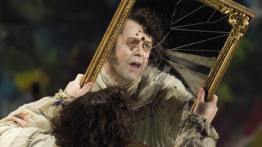
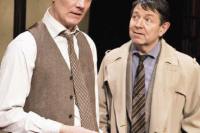
I couldn’t wait for this one. Nina Raine’s debut play Rabbit was a blast. With exquisite scalpel-work she dissected the romantic entanglements of a quartet of posh young professionals. Her new effort, Tribes, opens on similar terrain. A family of bourgeois Londoners are seated around the dinner table punishing each other with rhetorical flick-knives. Dad and Mum are writers. Ruth is a jobless soprano. Dan is wasting his youth smoking skunk and writing an impenetrable thesis on linguistics. I couldn’t wait for this one. Nina Raine’s debut play Rabbit was a blast. With exquisite scalpel-work she dissected the romantic entanglements of a quartet of posh young professionals. Her new effort, Tribes, opens on similar terrain.

Northern lights

Opera

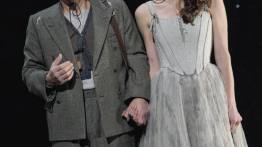
It’s been too long since I saw The Merry Widow. I have been thinking that for some time, and the superb new production of it by Opera North only made me feel that we should be able to go to more performances of it than we get a chance to. It has been newly and wittily translated by Kit Hesketh-Harvey, and the production is in the safe hands of Giles Havergal, with set and costume designs by Leslie Travers. It’s been too long since I saw The Merry Widow. I have been thinking that for some time, and the superb new production of it by Opera North only made me feel that we should be able to go to more performances of it than we get a chance to.

Senses working overtime

More from Arts

Postmodernism must be the key motif of this year’s autumn dance season in London, because almost everything there is to see at the moment abides by the uncertain rules of that much-debated artistic movement. Postmodernism must be the key motif of this year’s autumn dance season in London, because almost everything there is to see at the moment abides by the uncertain rules of that much-debated artistic movement. There is no such thing as a standard aesthetic when it comes to the postmodern dance genre. While vintage American, early-1960s choreography is celebrated by both Dance Umbrella’s retrospective on Trisha Brown and the Hayward Gallery’s exhibition Move: Choreographing You at Sadler’s Wells, the spotlight is on Middle-European postmodernism.

Education in horror

Television

When my brother and I were teenagers growing up in the arse end of nowheresville — Bromsgrove to its friend — we were mainly looked after by Nanny VHS. When my brother and I were teenagers growing up in the arse end of nowheresville — Bromsgrove to its friend — we were mainly looked after by Nanny VHS. Every day, Mummy would take us to the rental store to hire a new video so as to keep us off her back. Sometimes it would be war porn, like The Deerhunter, which I think we must have watched about eight times — and the key Russian Roulette scene about 500 times. Sometimes it would be horror porn like Shivers or the Texas Chainsaw Massacre. I’d quite forgotten I’d seen Shivers until I watched A History of Horror with Mark Gatiss (BBC4, Monday).

Finding a voice

Radio

It’s one of the most haunting sounds I’ve ever heard — the plangent wail of a female Sufi singer from Afghanistan. It’s one of the most haunting sounds I’ve ever heard — the plangent wail of a female Sufi singer from Afghanistan. Her song, ‘Gar konad saheb-e-man’, which translates as ‘If my eyes meet the eyes of the Lord’, was filled with religious longing for the divine; austere and otherworldly, yet also deeply persuasive, engaging, absorbing, taking over the mind. You can hear it on World Routes (Radio 3, today, Saturday), presented by Lucy Duran (and produced by Peter Meanwell). Mahwash is the name of the singer; her song one of the unaccompanied devotional songs that emerged out of the repressive regime of the Taleban.

Dimbleby Fail

I didn't watch Question Time last night, but there seems to be some stushie over David Dimbleby's refusal to allow Nicola Sturgeon to talk about fiscal autonomy. "This is for a UK audience!" squawked our host, shutting down any discussion of a matter that, whatever he may believe (if he knows anything about the subject) is not in fact of merely local, tartan interest.  I don't quite agree with everything Joan McAlpine writes here but many of her points are well-made. Dimbleby's attitude - assuming it has been reported correctly - reflects a London-based parochialism that does neither him nor the Corporation any credit.

THEATRE: Over Gardens Out

Riverside Studios stills owes much of its reputation as one of London’s most daring powerhouses of fringe theatre to Peter Gill.  As its founding Artistic Director, Gill inaugurated the Riverside tradition of high-risk commissions from young, experimental troupes alongside the latest international innovators. So now that Gill has entered his eighth decade still a major force in British theatre, it’s refreshing to see his old haunt reviving two of his earliest plays, showcasing his writing at its most rebellious and raw. Riverside Studios stills owes much of its reputation as one of London’s most daring powerhouses of fringe theatre to Peter Gill.

Venetian Visions

Arts feature

Andrew Lambirth finds the National Gallery’s new exhibition on Canaletto and his contemporaries both illuminating and enjoyable Giovanni Antonio Canal (1697–1768), better known as Canaletto, is a safe bet and a crowd-pleaser, and the weary critic is entitled to ask — not another Canaletto show? What can there be left to say? But note the exhibition title — Venice: Canaletto and his Rivals. Venice comes first, the great tourist trap herself, kingdom of the sea and romance-magnet, and in the placing of the words the unashamed popularism of the show emerges. Or so the cynic might think.

Eastern promise | 23 October 2010

More from Arts

The Singapore Symphony Orchestra is like a teenage athlete just about to hit peak form. This could be one of the great orchestras of the 21st century. So could its rival, the Malaysian Philharmonic. We all know that Asia produces dazzling soloists. But orchestras? I was sceptical until I heard the Singaporeans at the Southbank Centre this month. Accompanying Stephen Hough in Mendelssohn’s First Piano Concerto, they matched his virtuosity with their bouncy brio. The conductor, Lan Shui (above), had the sections swaying like stalks in a gale in Rachmaninov’s Isle of the Dead and Debussy’s La Mer. The encores: Bernstein’s Candide overture, taken at a lick that would have raised even Lenny’s eyebrows, and Stokowski’s arrangement of Air on a G String.

Interview – Tomas Alfredson: outside the frame

Cinema

Without warning, Tomas Alfredson jumps up and starts wading about the room like a water bird treading over lily pads. ‘There’s a famous sketch by a Swedish comedian,’ he explains by way of a voiceover, ‘in which he’s walking through a meadow of tall grass. He’s walking, struggling through this grass that reaches up above his waist.’ Alfredson pushes out at imaginary foliage around his midriff. ‘Then he steps out into a road and you realise that — all that time — he wasn’t wearing any trousers. Completely naked from the waist down.’ The mime stops as suddenly as it started. ‘That is the cinema of paranoia!

Gang of four

Cinema

Red is not a very good film and neither does it try to be. It puts in very little effort and, instead, relies almost entirely on the pulling power of its all-star line up: Bruce Willis, Helen Mirren, John Malkovich, Morgan Freeman, Richard Dreyfuss, Brian Cox and a cameo from Ernest Borgnine, who is now 93. (I put that in because I know you’ll ask yourself, ‘Bloody hell, how old is he now?’ Well, he’s 93. ) It’s billed as an ‘explosive action comedy’ but the ‘explosive action’ and ‘comedy’ are so workaday even Helen Mirren brandishing a machine gun while wearing a sexy white evening dress can’t save it from its own sheer dullness. You’d think it could, but it can’t.

Greek myth

Theatre

Thank God for the critics. All failings can be laid at their door. Robert Lindsay appeared on a telly sofa last week to repudiate the shirtier reviews of Onassis. ‘It’s not a critic play,’ he said. And I wondered if ‘critic’ had changed grammatical species and become an adjective meaning ‘good’. The show has its moments but the script is devoid of dramatic intelligence. Proper plays open with a dilemma that enlists the audience’s sympathies, unifies the action and creates suspense. Plenty of options were available to playwright Martin Sherman. Would Onassis succeed in replacing Maria Callas with Jackie Kennedy? Would he destroy his son Alexander’s romance with an ageing English divorcee?

Healthy competition

Music

The 2010 Gramophone Awards took me by surprise the other day — quite possibly because I took no interest in the 2009 Awards and therefore may have missed out on a trend. The 2010 Gramophone Awards took me by surprise the other day — quite possibly because I took no interest in the 2009 Awards and therefore may have missed out on a trend. It was as if the recording equivalent of the Campaign for Real Ale had come along, swept away the Watney’s Red Barrel, Whitbread’s Trophy Bitter and Worthington ‘E’ of the classical music industry and replaced them with all those myriad micro-breweries with funny names and higher alcohol levels.

Postmodern spirit

More from Arts

Once upon a time, in America, a group of dancers and performance artists gathered in the Judson Church Theater and challenged long-held artistic tenets. The historical significance of their provocative aesthetics led scholars to label their art ‘postmodern dance’, even though there was more to their creations than just dance. A few decades later, their works have not lost their appeal, even though their principles have been regurgitated and tiresomely plagiarised. Take, for instance, Trisha Brown’s Flower of the Forest, the choreographic installation that greeted viewers outside the Queen Elizabeth Hall over the weekend.

Revolting listeners

Radio

A rare but threatened species, in dire need of a campaign to save it from extinction, could be heard on Saturday night. Stages of Independence, showcasing the work of ten African playwrights, is likely to be one of the last-ever original World Service productions when the threatened cut to its budget goes through. Twenty-six BBC reporters and cameramen were rushed off to the Chilean desert to film what was undeniably a fantastically dramatic story. But were that many really needed? Meanwhile, a staple output of the BBC, and part of its Reithian mission — free access (at the touch of a button, and no longer at the cost of a licence) into the mind’s interior, to the interplay of voices, words and the imagination — is under threat.

United Nations

Television

There have been the usual moans about the BBC spending £100,000 on coverage of the Chilean miners. There have been the usual moans about the BBC spending £100,000 on coverage of the Chilean miners. I suppose the figure includes wages that would have been paid whether the people were in South America or Shepherds Bush, and, if accurate (I suspect the real cost was much more), it strikes me as minuscule — around two-thirds of one penny for every person in the country, an astounding bargain. There are some events which, in Bagehot’s phrase, ‘rivet’ the world, both in his sense of binding us together and in the more modern usage of being utterly fascinating; 9/11 is the most obvious example.

Sex and drugs and rock ’n’ roll is a thoroughly conservative philosophy

Columns

The guitarist Keith Richards is perhaps most famous for having constructed a short and very simple rhythmic musical phrase, over the top of which his colleague Mick Jagger expressed an increasing irritation at being unable to acquire, in both general and specific terms, any kind of ‘satisfaction’ — despite, as he proceeded to explain, repeatedly attempting to do so. The guitarist Keith Richards is perhaps most famous for having constructed a short and very simple rhythmic musical phrase, over the top of which his colleague Mick Jagger expressed an increasing irritation at being unable to acquire, in both general and specific terms, any kind of ‘satisfaction’ — despite, as he proceeded to explain, repeatedly attempting to do so.

Across the site | 19 October 2010

Just to point CoffeeHousers in the direction of a trio of delights across the site. First up, is Lloyd Evans’ review of a talk by Kevin Spacey that the Spectator hosted last week, which you can read over at the Spectator Arts Blog. And we also have a web exclusive review, by Lloyd again, of a Spectator debate on faith schools, here.     Then there’s our vote for The Greatest Parliamentarian of the Last 25 Years. There are only a few days left to nominate your choice for the award, which you can do so here. The most persuasive nomination that we receive will win its author a pair of tickets to The Spectator’s Parliamentarian Awards dinner on 17 November.

The politically correct James Delingpole

What’s happened to James Delingpole’s sense of humour? He is one of the funniest writers in the country, acute and truthful and unworried by the constant spite and derision of the faux left libtard bien pensant arseholes who swarm around the internet like sea lice around a sewage outlet pipe. He is also, I ought to add, a good mate of mine, even if politically we are delingpoles apart, most of the time. But there is something which does not quite ring true in his attacks upon a film made by Richard Curtis for the 10:10 climate change movement, exemplified by his piece in this week’s magazine. He has been ranting and raving about this film for ages and I cannot tell if his outrage and lack of humour is real, or post-modern ironic.

ART: Dutch landscapes

The big event this year at the Queen's Gallery in Edinburgh is an exhibition of Dutch Landscapes. Van Gogh fans will be disappointed, as these paintings are exclusively 17th Century – and rightly so, as it is in the work of this period that the art of landscape painting actually originated. Formerly a peripheral element to the action in what were usually either religious or mythical narratives, the landscape would step forward to take centre stage in Dutch art in the immediate aftermath of the Netherlands’ liberation from Spanish rule in 1648. The new Dutch republic became a fertile land for a generation of aspiring artists, the most illustrious of whom are of course Vermeer, Rembrant and Franz Hals.

Mrs Gaskell’s bicentenary: Knutsford’s Amazons

Arts feature

On the southern edge of Manchester, a few miles from the airport, there is a commuter town where the Victorian novel remains very much alive. This year Knutsford celebrates the bicentenary of its most famous daughter, who immortalised this ‘dear little town’ in several of her finest stories. More than 150 years after it first appeared, in weekly instalments in Dickens’s Household Words, Cranford remains Mrs Gaskell’s most enduring creation. And in these streets you can still trace the outline of the world that she created. Elizabeth Gaskell was born in 1810, in Chelsea, the daughter of a Unitarian minister. Her mother died when she was a few months old, and Elizabeth was packed off to an aunt in Knutsford.