Culture

Culture

The good, the bad and the ugly in books, exhibitions, cinema, TV, dance, music, podcasts and theatre.

Manon Lescaut is twerking — should we applaud or shudder? 

Opera

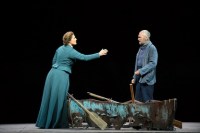
Last seen clambering over the MDF wheelchair ramps of Laurent Pelly’s Royal Opera House production of Jules Massenet’s opéra comique, Manon the minx, the ‘sphinx étonnant’ of Abbé Prévost’s 1731 novel Histoire du Chevalier des Grieux et de Manon Lescaut, reappears in two guises as part of Welsh National Opera’s Fallen Women season; as the heroine of Puccini’s Manon Lescaut and the antiheroine of Hans Werner Henze’s Boulevard Solitude, both directed by Mariusz Trelinski. The connection between her story and La traviata, the third opera in WNO’s season, is deeper than a coincidence of job descriptions.

Putin: ‘Oi, Europe, you’re a bunch of poofs’

Theatre

Sochi 2014 is the least wintry Winter Olympics ever. Yes, there’s a bit of downhill shimmying going on in the slalom. And a few figure skaters are pirouetting around the rink. Midair daredevils, with their feet lashed to planks of bendy plastic, are performing spectacular twirls and somersaults and crashes. And there are speed freaks on tea trays racing down ice-packed gulleys in tribute to the Hadron Collider. But the real action is off-piste and off-chute. It’s a political grudge match. Two implacable foes are angrily denouncing each other as shameful and perverted barbarians. The Hope Theatre’s verbatim drama, Sochi 2014, taps into this febrile mood with a documentary history of gay Russia since the collapse of the Soviet empire. At first all was rosy.

Are hymns dying? 

Music

I love a good hymn, so long as I’m not expected to sing it. Lusty declarations of faith sound ridiculous coming out of my mouth and embarrass the hell out of me, so I pretend that I’ve forgotten to pick up a hymnbook on my way in. If someone shoots me an accusatory glance, then I move my lips like John Redwood singing the Welsh national anthem. (Talking of whom, has it dawned on the jolly self-important Dr Redwood, former Fellow of All Souls, director of Rothschild’s, cabinet minister, etc., that one day he’ll be remembered only for that delicious video clip?) The earliest Christian hymns were chanted — but when we talk about a ‘hymn’ in everyday speech we mean a harmonised sacred song in which every verse uses the same melody.

What Emperor Augustus left us

Arts feature

The symbol engraved on Augustus’ signet ring was a sphinx. Julian the Apostate described him as ‘a chameleon’. He seized power declaring himself the saviour of the Roman Republic, but in the process abolished it. He ruled as an autocrat but maintained the fiction that he was no more than the Republic’s First Citizen — and left as his legacy a new system of imperial government that was to continue for another 400 years in the West and until 1453 in Constantinople in the East. This year marks the 2,000th anniversary of Augustus’ death in 14 AD, on the 19th of the month by then named in his honour.

And the prize for most fatuous awards ceremony goes to…

Features

‘Prizes are for boys,’ said Charles Ives, the American composer, upon receiving the Pulitzer in 1947, ‘and I’ve grown up now.’ He was using humour to make a serious point, but it would be lost on many people today. Never has there been a lusher time for self-congratulation; when all, as in Alice in Wonderland, must have prizes. Not all prizes are bad. Nathan Filer, who collected the Costa last month for his first novel, The Shock of the Fall, was granted the kind of recognition that evades most first-time authors. The Costa, formerly the Whitbread, has a reputable tradition that values quality of writing above commercial considerations. Good for them. There was a time when you could say something similar about the Evening Standard drama awards.

Meeting in the Small Hours

Poems

He was there again in the small hours: not this time in a dream, but in a dream of dreaming. Even so the two of us looked aside, stuck for something to discuss that was not a matter of life and death, so we fell back on football and the elections. Then suddenly he started talking: talking as he’d never talked in his life. He knew it wasn’t wise to take up cigarettes again at the wedding the day before; and driving back the engine misfired once, or twice. And then I started talking too. I told him about two other recurrent dreams: the first that I was smoking again too, but it was all right because I knew I could give up. Stranger than that, my twilight dream of the car headlights failing — but that too was all right because I knew they’d work again.

How to fight back when ‘public art’ is not for the public

More from Arts

In recent years contemporary art and regeneration have gone hand in hand. Works such as Antony Gormley’s ‘Angel of the North’ have been visible and celebrated examples of regeneration. So when, last year, Southwark Council decided to sell Elephant and Castle’s seemingly unloved Heygate Estate (above) to Lend Lease for development into new homes, it seemed inevitable that public art would be utilised. Artangel, the country’s most respected public art commissioning agency, announced plans for a work by the artist Mike Nelson that would take the form of a pyramid made from the estate’s building materials as it was dismantled.

Some things are better heard on radio, than seen

Radio

A double dose of BBC1 drama at the weekend (Silent Witness, Casualty) left me wondering whether there’s a link between the falling crime figures announced last week and the levels of blood and bestiality now showing nightly on TV. With so much violence available at the switch of a button, who needs to create their own? (Bear with me, the connection with radio will soon become apparent.) What surprised me was not just the amount of violence but also the lack of any real motivation. It was all completely unbelievable (in spite of the best efforts of the make-up department) and meaningless, and as a consequence mind-numbingly dull.

How did Colonel Gaddafi get away with such evil for so long?

Television

What a vile piece of work Colonel Gaddafi was. For some of you, perhaps, this will be a statement of the glaringly obvious. But I suspect there will be many others for whom, like me, this week’s Storyville documentary on the barbarity of his regime — Mad Dog: Gaddafi’s Secret World (BBC4, Monday) — was something of a revelation. Sure, we’d all heard about the funny stuff: the time John Simpson went to see him and he farted noisily (Gaddafi, not Simpson) through the interview; the ridiculous outfits; the bullet-proof Bedouin-style tent that he insisted on bringing on his last world tour, complete with live camels to graze decoratively outside.

Prefab Sprout’s comeback gives hope to the over-50s

Music

Every musical career has its own narrative, and most of them include at least one comeback. To come back, you first have to go away; then you have to stay away; and finally, when everyone has forgotten your name, you wander nonchalantly back under the arc-lights and wave modestly to screaming fans and waiting reporters. Well, that’s the plan, anyway. As has been discussed here before, the gaps between record releases for all but the most irresponsibly prolific artists have become so wide that simply making another album becomes a comeback in itself. Thus has the currency of the comeback been devalued. Sometimes it feels as though there’s a different one every day. A few of them could usefully have stayed away a little longer.

Don Giovanni at his unsexiest

Opera

Every time there’s a new production of Mozart’s Don Giovanni I have to ask the same question: why is this opera, which 50 years ago was considered an unqualified masterpiece and an invariable success in the theatre, now always a wretched failure when it is staged? I would hesitate to say that the new production by Kasper Holten is the worst I have seen, since the competition is so intense. But it certainly ranks among the worst, and is all the more infuriating because a mainly excellent cast has been assembled. Anyone who longed for the previous production, by Francesca Zambello, to be supplanted will be saying, ‘Come back, all is forgiven.’ Where Zambello failed to cast any light on the opera, Holten shrouds it in impenetrable darkness, metaphorically speaking.

A World Elsewhere hints it’s about Bill Clinton. But it’s about Al Gore

Theatre

Why, oh why, the producers ask, are the national press so reluctant to cover the London fringe? The snag is that a national paper has to justify a report about a play produced in a Deptford yoga studio, or in a Wandsworth priest hole, to readers living in Liskeard, Inverness, Great Yarmouth and Carlisle. Rather than changing the habits of the newspapers, the producers might change the way they select plays. A few years ago, a modest little venue in Hoxton mounted a satire called The Death of Margaret Thatcher. The national papers dispatched their finest critics and they were joined by political commentators from around the world. The play was rubbish, alas, but as a piece of publicity it remains unsurpassed. Theatre 503 in Battersea seeks to emulate this ploy.

‘Uproar!’ The Ben Uri gallery punches above its weight

Exhibitions

Last year saw the centenary of the London Group, a broad-based exhibiting body set up in a time of stylistic ferment in the art world as an independent alternative to the closed shops of the academies. Formed from the amalgamation of the Allied Artists’ Association and the Camden Town Group, it boasted such notable founder members as Lucien Pissarro and Walter Sickert, while Jacob Epstein is credited with naming it. Inevitably, the London Group has gone through innumerable highs and lows in its 100-year history, yet the mere fact that it still exists is testament to the enduring need for such an independent collective.

If Philip Seymour Hoffman wasn’t happy, what hope is there for us?

Columns

Celebrity deaths have no decorum. From Elvis on his toilet to Whitney face down in her bathtub, their last moments sit alongside their songs, or films, or their drunken stumbles out of nightclubs. Kurt Cobain, my teenage idol, had been dead from a shotgun blast to the mouth for — what? Days? Hours, even? — before the newspapers started running photographs of his Converse-clad feet visible through the doorway of the shed in which he died. Fans would pass them around. Weird, really. If a favourite uncle dies in his bed, you don’t go asking your cousin for a Polaroid, do you?

Zeteticism

Poems

Whatever savants say, the world is flat, not round; the ships that crowd the bay are for its limit bound. Their cargoes likewise, all consigned to one address, at the world’s waterfall plunge into nothingness. The brightwork, the white sails unfurled against the sky, the million knots and nails for such a voyage, why?

Philip Seymour Hoffman found dead in New York

The Oscar-award winning actor Philip Seymour Hoffman has been found dead,  aged just 46, in his New York apartment this evening. According to reports, he appears to have died from a drug overdose. Hoffman was known to have battled  substance abuse for several years. Hoffman was popular with The Spectator's critics. Last April Clarissa Tan wrote that Hoffman gave a 'stellar turn' as Robert Gelbart in A Late Quarter.

How else would one depict conflict between Sunnis and Shias?

I don’t know if you’ve seen this letter to this week’s edition of the magazine, from a person called Chris Doyle. He is a member of the ‘Council for Arab-British Understanding’ and has taken exception to last week’s cover cartoon. He objects that the drawing of ‘two bearded, large hooked nose, weapon-wielding men’ was a stereotypical way of depicting a possible war between Sunni and Shia Muslims. Yes, you utter idiot. That’s what cartoons do. They look for the easily definable, so that they might have a meaning to people. Would you have preferred the cartoon to be of two people with average sized noses dressed in lounge suits and clean shaven and bearing no weapons? Do you think that would have done the job?

All the fun of the fair | 30 January 2014

More from Arts

The Works on Paper annual fair runs from 6 to 9 February at the Science Museum. Its name is a bit of a giveaway: all art must be on paper. There is a huge range of work on display: early, modern and contemporary watercolours, prints, posters and photographs — from the late-15th century to the present day, with prices ranging from £250 to £75,000. So whether you want to buy a Japanese woodblock print, a series of studies by Edward Burne-Jones or one by Stanley Spencer, a drawing by Picasso, Cézanne or Ben Nicholson, South Kensington is the place to go.

Radio 3 needs to stay relevant, and world music is just the ticket

Radio

When my colleague Charles Moore first began accusing Radio 3 of becoming ‘babyish’, and talking down to us as if we’re too ignorant to understand anything complicated, I had to agree. The constant twittering between items, the gimmicky brainteasers and Classical Top Ten are irritating. Those emails and texts from clever-clogs listeners determined to show off what they know, or have performed themselves, or seen on stage are as annoying and pointless as Christmas round-robin letters. But these are all merely sideshows, not the main performance. The real test for the station is whether our musical palates are still being tested, educated, stretched.

Jeremy Paxman’s Great War is great. But is 2,500 hours of WW1 programming too much?

Television

Why are we so fascinated by the first world war? As its 100th anniversary approaches, we’re already mired in arguments about whether for Britain it was a ‘just war’ or a ‘pointless sacrifice’ of millions of lives. I don’t see why it has to be one or the other. Surely this huge and horrific event held elements of both, and more. If ever there was a time when glory ran alongside absurdity, when courage marched lockstep with catastrophe, this was it. We’re looking back at the Great War as if it were a mental exercise — should it or shouldn’t it have happened? But maybe our fascination is emotional as well as intellectual.

John Craxton was more gifted than the Fitzwilliam show suggests

Exhibitions

It is often said of John Craxton (1922–2009) that he knew how to live well and considered this more important than art. Perhaps there is a certain truth in this, but if he really believed it, did he have any business in being an artist? And an artist he undoubtedly was, by temperament and sensibility, as well as by the rich endowment of natural talent. Of course, letting it be known that you think life more important than art is a very good cover for that most debilitating (and paradoxically productive) of besetting fears: self-doubt. Craxton had it in large measure, and it is probably this quality that accounted both for his originality and for the painter’s block he periodically suffered.

Can Lance Armstrong squirm? We don’t know because The Armstrong Lie doesn’t make him

Cinema

Alex Gibney’s The Armstrong Lies is fascinating as far as it goes but it may not go as far as you would like, and may not ask the questions you would like. It’s a documentary portrait of the American cyclist Lance Armstrong: seven-time winner of the Tour de France, worldwide symbol of physical courage (having survived testicular cancer in his twenties), founder of the Livestrong Foundation, which has raised millions for cancer sufferers, and something else. It’ll come to me in a minute. Talk among yourselves. Oh, yes. Cheat. Also, liar. He lived a cheating lie, all day, every day, throughout his sporting career. He lived a cheating lie even as he is pulling on his socks or taking the rubbish out. But Gibney never gets to the heart of him.

Your best YouTube operatic experience ever

Opera

Anyone who frequents the internet will have come across YouTube and soon learned that what may have been planned as a quick information-seeking visit turns into several happy hours, as tempting suggestions are made as to what you might also be interested in seeing; another thing leads to yet another; and that is the afternoon gone. There is no more alluring — and of course, one insists to oneself, educational — primrose path than tapping into how a particular operatic aria has been sung by a variety of performers over the decades, so that what started out as a comparison between, say, Anna Netrebko and Renata Scotto as Mimi turns into a marathon search for the ideal rendering of ‘Si, mi chiamano Mimi’ and then on to other Puccini arias, and so on.

How Claudio Abbado bridged old and new

Music

Not long ago the great conductors of classical music were general practitioners. They expected to give satisfactory interpretations of music written from the beginnings of symphonic composition to the present day, and audiences took it for granted that, if they knew what they were doing with Mozart and Beethoven, they could be trusted with Handel and Stravinsky. Their orchestras adopted the same approach and, within a narrow definition that bespeaks a more innocent age, everyone was content.

The ‘detestable, bombastic, egocentric’ detective — Hercule Poirot lives on

Arts feature

With all the enormous fuss over Sherlock on the telly, David Suchet’s recent retirement from Poirot should not be forgotten. What an incredible innings! The actor finally hung up his patent-leather shoes after a quarter-century of playing the sleuth in 70 stories. The case is not closed for fans, however. Agatha Christie’s Belgian brainbox — to whom a speck of dirt on a cuff is more agonising than a bullet wound — has already returned. He is on stage in the form of Robert Powell, famous for once playing Jesus of Nazareth. The play is Black Coffee, Christie’s first play and the only one with Hercule Poirot in it. Poirot, a Belgian refugee from the first world war, made his début in her first book, The Mysterious Affair at Styles.

Tulips

Poems

My love arrived with tulips, ‘ten for a fiver’, picked up from the supermarket at the end of the street. Fresh off the plane, perhaps he would have preferred to wash his hands but stood in his coat in the kitchen watching me cut through the cellophane and crush the stems with the stainless heel of the bread-knife. All across Holland trucks were going to and fro between the flower farms and distribution facilities rocking their harvest to sleep over good Dutch tarmac so every bunch could be in store before it opened its eyes, and even as I filled the vase, people on nights were dumping crates of slender-headed replacements cut so premature they didn’t know what kind they were in tubs of glucose solution up and down Holloway Road.