Culture

Culture

The good, the bad and the ugly in books, exhibitions, cinema, TV, dance, music, podcasts and theatre.

Zaha Hadid

More from Arts

Zaha Hadid is the most famous woman architect in the world. Would women or, indeed, architecture, be better off without her pushily hard-won, global celebrity? She established her studio in London in 1980. For nearly 14 years Hadid, absurdly, became famous for not having built anything. Her reputation was boosted by a clique of fawning admirers who saw in her uncompromising angles and, later, zoomorphic blobs a fearless repudiation of stuffy tradition. The competition entry for Cardiff Opera House was her celebrated cause. This, with genius, managed to alienate both the left and the right. The former thought it elitist, the latter outrageous. It was, after years of well-publicised struggle, abandoned in 1995. She became a martyr to taste and sexism.

Music to write books by

Music

I have been writing a book this summer, in the usual mad tearing hurry. (Much as I admire those who take four or five years to write one, I have to ask, how do you eat? This isn’t by any means a sensible way of making a living.) Intense workload, though, means music, and lots of it. Many writers simply cannot work with tunes blaring out of nearby speakers; I cannot work without them. Music masks my tinnitus and distracts the part of my brain that would otherwise be trying to distract me from my work. You know, the Facebook part. The videos-of-cats part. The Marks & Spencers chocolate-covered shortbread part.

The Long view

Arts feature

On the green edge of Clifton Downs, high above the city, there is a sculpture that encapsulates the strange magic of Richard Long. ‘Boyhood Line’ is a long line of rough white stones, placed along the route of a faint, narrow footpath. When Long was a boy, this was where he used to play. There are children playing here today. They pay no attention to Long’s new artwork. Already ‘Boyhood Line’ has melted into the scenery. Half a century since he rolled a snowball across these Downs, and photographed the wobbly line it left behind, it feels as though Long has come home. Richard Long was born here, in Bristol, 70 years ago.

Dreams

More from Books

Early August and not yet half past eight, but all along the dual carriageway more than half the cars have headlights showing in the air from which daylight moves away — the summer, not the hour, being late — the shapely boxes streaming and glowing under the sky that was brighter two weeks ago, and two weeks before at this time, the season turning at the speed it must as the cars race or dawdle, and dark leaks through the porous heavens, and the stars climb to visibility in blue August early dusk, the beautiful headlight beams illuminating what leaves. Children. Dreams.

I wish the cult of Frank Sinatra would end

Walking around central London, I’ve been struck by how many shows Frank Sinatra has been performing in town recently. He played a string of concerts in July at the Royal Albert Hall (which as any schoolboy knows was actually named after Sinatra’s middle name), and he is currently performing an extended summer season at the London Palladium. Quite how Frank is going to cope this Friday evening, when this eternal Sinatra séance requires his spirit to put in an appearance as his life and music is celebrated at the Proms, at the same time as he gigs at the Palladium, I’m not sure.

Look at my Fringe

Arts feature

Like everyone performing at the Edinburgh Fringe I’m about to make a lot of mistakes. I’m about to lose a lot of money too. But after ten years covering the festival as a reviewer I’m at least able to predict which errors I can’t avoid blundering into. First, the campaign to attract a crowd will be pointless. This stands to reason. Five or six thousand hopefuls swarm up to Edinburgh each year and they all use the same marketing strategy. Attention-seeking stunts on the Royal Mile. Tiresome afternoons forcing leaflets on unimpressed Americans. Fly-posting after dark, on tiptoe, by torchlight. Desperate texts to friends of friends promising five-for-one discounts.

Watery depths

Exhibitions

I learnt to splash about in watercolour at my grandmother’s knee. Or rather, sitting beside her crouched over a pad of thickly ‘toothed’ paper and a Winsor & Newton paintbox on a wind-swept East Anglian seashore. Now, looking back, I see that what she was doing belonged to a tradition. Her predecessors, idols and reference points are to be seen in an admirable small exhibition at the Fitzwilliam Museum, Cambridge, Watercolour — Elements of nature. This consists of works from the museum’s collection, but is much more full of delightful surprises — even for those who know the Fitzwilliam well — than that description suggests.

Conspiracies, hookers and bombs – welcome to the Odessa Film Festival

Odessa, the pearl of the Black Sea, is one of the most charming port cities you can imagine, the centre of the city mainly 19th-century Italian and French architecture. Like a run-down Riviera, but with the exchange rate gone from 8 grivnas to the pound to 34, it’s fabulously cheap for visitors. At my favourite Azeri restaurant, which doesn’t sell wine, they offered to go to the supermarket and buy me a bottle of red. £1.50 for perfectly drinkable Ukrainian plonk. The rate has dived due to the unrest and war in the East of course. On the surface things are somewhat calmer than last year when a fire killed dozens in a trade union building. There’s enough instability and sporadic bombing, however, to keep people on their toes.

Family matters

Theatre

God, what a title. The Gathered Leaves. It sounds like a tremulous weepie about grief and endurance with a closing scene featuring three anvil-faced spinsters staring through the rectory window at an autumn bonfire. It’s not quite like that. The play opens with some clumsy exposition revealing the political chronology. It’s Easter, 1997, and Labour’s shiny-fanged messiah is about to evict the Brixton mule from Downing Street. We meet the Pennington family, a high Tory clan nestling in a frondy corner of the Thames Valley, who are eager to heal an ancient rift. Their estranged daughter and her mixed-race sprog have been skulking in France for the past 17 years. They’re coming back. But when they return to the bosom of the family they get the bazooka.

Welcome to Bedlam

Opera

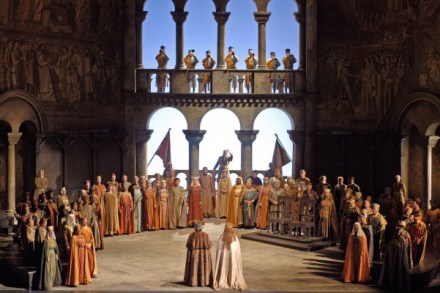
Caius Gabriel Cibber’s statues of ‘Melancholy’ and ‘Raving Madness’, their eyes staring blindly into the void, petrified in torment, once posed on top of the gate to Bedlam. In 1739, when Handel’s dramatic oratorio Saul was first performed, you could pay a modest fee to pass beneath them and gawk at the living spectacles within, victims of ‘arbitrary passions’ including pride, lust and envy. In Barrie Kosky’s Glyndebourne staging of Saul, Cibber’s archetypes are animated and given voice by Christopher Purves as the king driven mad by ‘Envy! Eldest born of Hell!’ Saul was the second of Handel’s great studies of madness.

Pulp fiction

More from Arts

Hot, languorous, sizzling… I was thinking what an ideal show Matthew Bourne’s noir comedy is to watch on a summer’s evening in T-shirt and shorts as you sip a cold beer in a plastic cup and feel all toasty while the garage mechanics are bumping and grinding away at Dino’s Diner. Then the rain started chucking it down outside, the temperature fell, and I found myself ruminating on how a dance show feels different if you’ve just been watching it, rather than feeling it in your skin and body. The great thing about Bourne’s choreographic style is that it feels like something you might have done yourself during some summer in your life.

Matters of life and death

Radio

‘Bait by Cartier,’ she growls as her priceless diamond bracelet is strapped to a piece of rope and dropped overboard in the hope it might lure a fish on to the line. She’s stuck on a boat with a group of survivors after the freighter she was aboard was hit by a German U-boat during the second world war. She was Tallulah Bankhead, playing Connie, heroine of John Steinbeck’s novel-cum-film Lifeboat, for Mystery Theater, the American radio drama series, first broadcast in 1950 and now replayed on Radio 4 Extra (Sunday). They just don’t make voices like that anymore. It had star quality streaked right through it. That deep husky tone, the raucous laugh, the harsh put-down veering almost at once into a sensual come-on.

Orchestral infallibility

Music

Watching the Berlin Philharmonic going into conclave to choose a successor to Simon Rattle — after countless hours of secret discussion they have chosen Kirill Petrenko — reminds one of little less than the election of a pope. In both cases the expectation is the same: the organisations are so iconic that they must continue into the future without a hitch and without question. Whatever sort of job they are doing, or have done, they have become too much a part of normal life to be abolished. Why is it that symphony orchestras of any standing are expected to survive indefinitely, where smaller musical organisations, though they may be just as established, are not? What are the long-term prospects for the Monteverdi Choir after John Eliot Gardiner retires?

Wild things

Arts feature

Mud, timber, junk, fires, splinters, rust, daubed paint… Suddenly people are talking about adventure playgrounds again. With the Turner Prize-nominated collective Assemble constructing a new adventure playground in Glasgow, and their exhibition The Brutalist Playground at Riba, we’re being asked to think again about these ugly but lovable spaces. It was the landscape architect Lady Allen of Hurtwood who saw that in these gloriously chaotic environments — with their dens, walkways, animals, zip wires and cargo nets — children could find a freedom, self-expression and self-determination that is denied to them elsewhere. In 1946, on the way to Norway for a lecture tour, Lady Allen’s plane stopped to refuel in Copenhagen.

Portrait of the artist as a madman

Exhibitions

Charles Dickens’s description of Cobham Park, Kent, in The Pickwick Papers makes it seem a perfect English landscape. Among its ‘long vistas of stately oaks and elms’, he wrote, ‘occasionally a startled hare’ ran with ‘the speed of the shadows thrown by the light clouds’. It was there on the morning of 29 August 1843 that a butcher from Rochester got a nasty surprise. He discovered the corpse of an apothecary named Robert Dadd; he had been battered and stabbed to death by his son Richard. There is no doubt that Richard Dadd was far from sane. On the other hand, his loss of mental balance — though very bad in its consequences for his father — was the making of Dadd as an artist.

Slash at 50: why is this rock god so underappreciated?

Saul Hudson, more commonly known by his childhood nickname 'Slash', turns 50 today. It is safe to say that the next 50 years of his life are unlikely to be quite as hectic as the first. The heroin-addicted lead guitarist of Guns 'n’ Roses has settled into a routine of philanthropy and Angry Birds. He is always mentioned in magazines as one of the greatest guitarists of all time. The opening to 'Sweet Child o’ Mine' is routinely voted the best guitar riff ever. But the true extent of his genius — which stretches far beyond his ability to produce a nice tune — is still not fully recognised. Many in fact think he's overrated.

Kisses of Virtuous Renunciation

Poems

He was checked in under the name Immortality, Mr Immortality — but on the vanity were the little capsules of mouthwash and shampoo, a packet with needle and thread, and letters from his father, who was dead. (And books to write, and letters of instruction, to have read.) He’s a valued guest at the Clarion, at the Shelburn, like others in this inferno though I miss him most. ‘Time is a monster,’ he said before calling down for another hour. He had to spell his name to the woman at the front desk. ‘I am mortality,’ I heard him say between kisses I remember to this day.

Salieri’s revenge

Opera

Magical transformations are a commonplace of opera. We see our heroes turned into animals, trees, statues; witness wild beasts turned suddenly gentle and even the dead brought back to life, with scarcely a raised eyebrow. But opera’s greatest metamorphosis — and one still less remarked upon — is the annual British phenomenon of country house opera. Auditoriums are conjured up in fields and gardens, ruins filled with light and life, and rural silence is exchanged for cosmopolitan croonings and tunings. With little more than a generator and a couple of portaloos, companies like Longborough, Bampton, Iford and Garsington serve up serious music season after season, taking risks the major metropolitan houses could never contemplate.

Sweeney Plod

Cinema

The Legend of Barney Thomson is the directorial debut of actor Robert Carlyle, and it’s one of those black comedies about a serial killer in which, as the bodies pile up, plausibility edges closer and closer to the window until it flies out completely. (No. Wait. Come back! I’ll massage your feet!) This wouldn’t, in fact, matter at all if there were something else to hang onto; if the characters were involving, or the story was told with wit, zip and panache, but it just monotonously drones on. The central figure is a barber so I guess you could say this is Sweeney Plod rather than, you know, that other one.

Space case

Radio

The idea that Radio 2 should be sold off by the BBC to a commercial rival is as nonsensical as BBC1 losing Strictly Come Dancing, or Heinz giving up on baked beans. The station, in its former incarnation as the Light Programme, was a core product of the corporation, the home of the Palm Court Light Orchestra, Kenneth Williams, Semprini, Billy Cotton, Sid James and Edmundo Ros. It gave us ‘light’ entertainment — music to dance, exercise or sing to, comedy shows, magazine programmes, dramas of ordinary life rather than Greek tragedy. The comedy programmes on 2 were siphoned off long ago to 4 and then 4 Extra, as were all the dramas, including The Archers, and Woman’s Hour too.

Wish list

Music

Compilation schompilation. Having been in music for as long as I have you would think I had a good idea how record companies work. I’ve made two compilations before. But it’s a whole new big thing now in the music world. Ministry of Sound have offices of people whose full-time jobs are about clearing tracks and licencing them for compilations. These are usually for dance music albums, very expertly mixed by specialist DJs. Mine was to be a bit different, spanning 50 years of music. We’d agreed on a three CD release. Ministry said just give us a wish list of around 100 or 150 tracks, and we’ll check on what can clear. They expected many tracks would be refused — permission declined. But actually a surprising number were yeses.

Institutional feminism

Television

Some revelations, it seems, are capable of being endlessly repeated while still remaining revelations. Think of all the books, articles and TV programmes over the years which have ‘revealed’ that the Victorians weren’t, after all, mad sexual repressives who had a fit of the vapours at the sight of an uncovered table-leg; or that the 1950s were a lot more fun than the drab conformist decade of popular imagination. Or that Rudyard Kipling was by no means a straightforward imperialist. (Feel free to add examples of your own.) And yet, no matter how many times these things are pointed out, it’s always with a proud flourish — as if what’s being said stands in fearless contradiction to everything we’ve previously heard.

Amanda

More from Books

When I didn’t recognise the number and saw the text with kisses, but no name — ‘Thinking of you: they’re playing Native New Yorker’, I racked my brain and was filled with shame. Was this the divorced father and one-night stand, or was this someone who had heard me sing in hospital when I was bored out of my mind, or was this a teenage flame rekindling? And then I was relieved to realise it was not a blast from the past, but you who heard me play that record in the Seventies when we were small, who shared with me and knew my childhood home, pets, dad and mum, yet lost your own mother, aged so young.

The London ear

Arts feature

The opening bars of Ralph Vaughan Williams’s A London Symphony (1914) are scooped out from the gloopy bedrock of the city. Vaughan Williams was dredging through the same mud, silt, slime and ooze as those scene-setting paragraphs of Our Mutual Friend (1865), where Charles Dickens shows that the real glue binding his book together will be the River Thames. Dickens’s famed ‘boat of dirty and disreputable appearance’ berths Our Mutual Friend in the earth and experience of London. Similarly, Vaughan Williams’s cellos and double basses, which launch his symphony, plod out from the sludge of the river. But, by the time his bucolic Scherzo waddles into view, you could be forgiven for assuming that RVW has taken a genteel amble around the countryside.

Scholarship and folly

Exhibitions

It has often been related how, towards the end of his long life, a critical barb got under J.M.W. Turner’s skin. ‘Soapsuds and whitewash!’ Turner apparently snorted, repeatedly, to himself. However, until now no one has traced the perpetrator of this memorably tart comment. Now we know. It was the scandalous, super-rich patron and novelist William Beckford, who made it in 1831 while taking a visitor on a tour of his collection. They paused in front of a watercolour of Fonthill Abbey, Beckford’s erstwhile house — and folly — that Turner had painted some three decades earlier. The guest remarked that the painter did not paint like that these days. ‘Oh!’, exclaimed Beckford. ‘Gracious God! No!

National Busking Day is an insult to real buskers

This Saturday is National Busking Day, a series of events across the country proving that Britain’s arts establishment just don’t get it. The whole point of busking is that it’s free-spirited, independent, individualistic – exactly the sort of enterprise that doesn’t need or want a national day. ‘Let’s take something that lots of people do spontaneously, without any wish to be organised,’ goes the thinking, ‘and then organise it.’ First prize for Not Getting It goes to Gareth Powell of London Underground. ‘Busking on the Underground network,’ he says, ‘has been a rite of passage for London musicians for generations.’ Yes, Gareth – one that they pursued in spite of the Tube trying to stop them.