Culture

Culture

The good, the bad and the ugly in books, exhibitions, cinema, TV, dance, music, podcasts and theatre.

Dying of the light

More from Arts

It’s a comfort that the creation of a new ballet inspired by French court entertainment can still happen in the amnesiac ballet country that Britain has become. The idea of making a modern-day meditation on the first ballet — Louis XIV’s 12-hour epic Le Ballet de la nuit (1653) — is as intellectual as Wayne McGregor’s roping in of cognitive science as source material. It faces many of the same traps when it comes to capturing that elusive necessity: theatricality. Only David Bintley could do this, deploying his artistic authority as the 20-year director of Birmingham Royal Ballet as any French despot would. The scheme’s theatricality is innate. Le Ballet de la nuit starred the 14-year-old Louis.

Anniversary fatigue

Radio

There’s a part of me that thinks OK, we’ve heard enough now, one year on from the beginning of the centenary commemorations, about the first world war. Do we really need any more programmes (on radio or television) about Ypres, Gallipoli, Akaba, Versailles, and the Western Front? Or are we wallowing in history’s horror stories rather than trying to learn from them? There’s a danger that anniversary fatigue will set in and stop us pausing to think, to really contemplate, the reality of that terrible, catastrophic war and whether there is any way it can be prevented from happening again.

The bankers’ darling

Television

This week’s Imagine... Jeff Koons: Diary of a Seducer (BBC1, Tuesday) began with Koons telling a slightly puzzled-looking Alan Yentob that what spinach was to Popeye, so art is to the rest of us: a way of achieving transcendence and appreciating ‘the vastness of life’. As it turned out, though, not all the claims made in the programme were quite so straightforward. Later, for example, Koons argued that ‘the only thing you really have in life is your interests and when you focus on them it takes you to a connecting place where time really kind of bends’.

Cold-blooded

More from Books

An unidentified lizard, the same size as a Grecian stick, the colour of dirtied sand, holds the dissolving power of invisibility. Only by the abrupt weird- angle turn of the head is its presence revealed; only this and movement swift and soundless as vanished moments, as previous love, here and gone, here and gone, so limbs and friction seem almost never to have been involved.

Boo the knee-jerk reaction to William Tell not the rape scene

'I blame Princess Diana', was my guest’s response to it all. Certainly, there is much we might lay at the feet of our long lamented People’s Princess, but I struggled to see how the current situation was her fault. The situation in question was as follows: a sizeable group of offended opera goers sought, with an extended imitation of disgruntled livestock, to bring the third act of the Royal Opera’s new production of William Tell to its knees. And there they were again, booing and braying their way through the curtain call, making sure the production’s director Damiano Michieletto knew their unease was intended personally. Certainly, something was to blame.

The gang rape was the least offensive thing about Royal Opera’s new William Tell

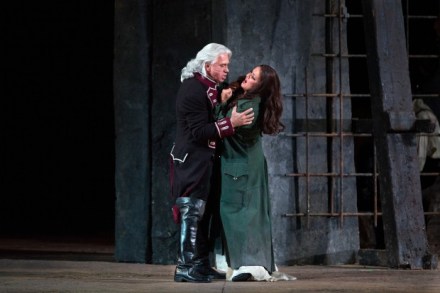
Guillaume Tell Royal Opera House, in rep until 17 July There’s no such thing as a tasteful rape scene — or there certainly shouldn’t be. It’s an act of grossest violation, of primal violence. It’s also a reality — and a growing one at that — of contemporary warfare, a ‘weapon’ increasingly deployed strategically, coolly, by armies rather than individuals. Setting his new production of Rossini’s Guillaume Tell in the Balkan conflict of the 1990s, director Damiano Michieletto puts the issue front and centre in a scene whose music was almost lost on opening night in the extraordinary and unprecedented chorus of boos and catcalls from the audience.

Verse Letter

Poems

In reply to Ann Baer, aged 101, of Richmond-on-Thames.   Your handwriting, so perfect for its style And firmness, made me feel that this must be A brilliant schoolgirl. Hence my knowing smile At your comparing of my maple tree   With Tennyson’s. But further down the page, And seemingly in passing, you revealed The secret of your learning: your great age. In your day, verse was not a special field,   It was a language, so to speak: a tongue For all who read books. No such luck today, Alas. Just look at how it keeps you young, This love for words that time can’t take away   From anyone touched with it early on. No wonder that you write a hand so fair.

Savile exposed

Theatre

Ho hum. Bit icky. Not bad. Hardly dazzling. The lukewarm response to An Audience With Jimmy Savile has astonished me. This is the best docudrama I’ve seen on stage. From the early 1970s, Britain swooned before Savile. Marketing pollsters found him the country’s best-loved celeb (bar the Queen Mum). He enforced his influence by winning over several establishments at once, the royals, the Beeb, the NHS, the media, the charity sector, Westminster. Evidence of his criminality existed but it never affected his reputation. He’s the nearest we’ve come to Hitler. The show takes the format of a TV biography which is intercut with scenes from Savile’s early life and testimony from his victims. Alistair McGowan’s ownership of Savile’s persona is astounding.

Shape-shifter

Exhibitions

In the last two decades of her life, Barbara Hepworth was a big figure in the world of art. A 21-foot bronze of hers stands outside the UN headquarters in New York, emblematic of her friendship with secretary-general Dag Hammarskjöld — a Hepworth collector — and of her international fame. This was how a modern monument looked half a century ago: abstract but organic, romantic but starkly simplified. Since Hepworth’s death, however, her status has become less clear: was she a towering giant of modern sculpture or relatively minor, a slightly dreary relic of post-war Britain? Barbara Hepworth: Sculpture for a Modern World at Tate Britain does not quite supply the answer. But it does throw some revealing sidelights on her art and career.

Better than Bayreuth

Opera

Which of Wagner’s mature dramas is the most challenging, for performers and spectators? The one you’re seeing at the moment, seems to be the answer for me. The better I know them, the more apprehensive I get about whether I can rise to their level, and whether the performers can, and whether we can pace ourselves and not flag at the prospect of the last act, in most of them the greatest and most exhausting. In the end, though, I think Tristan und Isolde takes the biscuit. It’s a matter of gratitude, almost, if the Prelude isn’t as overwhelming as it naturally tends to be. At Longborough this year it wasn’t, and I was duly grateful.

Maestro maker | 25 June 2015

Cinema

The writer and director Peter Bogdanovich has made three of my favourite films of all time (The Last Picture Show, Paper Moon, What’s Up, Doc?) but I don’t think I’ll be adding his latest, She’s Funny That Way, to the list. It’s a screwball comedy of the old school and, although it is slightly intriguing at first, where is all this manic activity going? You get your answer after 96 minutes. The answer is: absolutely nowhere. Set in New York, it stars the British actress Imogen Poots laying on a Brooklyn accent with several trowels and also a spade. (Oh, how one yearns for just the one trowel.) She plays Izzy Patterson, a ‘call girl’ — never ‘prostitute’ in these instances — and straight off I’m in trouble.

Sea sound

Radio

It’s often not visual images that stimulate memory but a smell, a taste, the sound of pebbles crashing on to the beach, ice cream being scooped into a cone, seagulls circling overhead. Where was I when I first heard that sound? That’s why the National Trust (in association with the British Library sound archive) has just announced its Coastal Sounds of our Shores campaign. We are all invited to send in our own audio recordings from the beach: short, five-minute clips, impressions taken outdoors, in real time, which capture what the seaside means to us. Not photos, or postcards, but an online archive of sound memories.

Maestro maker

Music

When Margaret Thatcher imagined perfect power, she thought of the orchestral conductor. ‘She envied me,’ said Herbert von Karajan, ‘that people always did what I requested.’ Power, however, is a mirage that fades as you get close. What Mrs Thatcher saw were the trappings, never the essence. Great conductors might get the glory, but someone else pulled the strings. Behind every power there is a greater force. Behind every conductor, there was Ronald Wilford. It is hard to think of Wilford, who died last week, aged 87, without a sneaking admiration. A self-schooled Machiavellian, a Mandelson of music, he invented a chimera of ‘the great conductor’ and, as president of Columbia Artists (CAMI), sold it at unimaginable profit.

City life

Arts feature

In its pomp, they used to say that what was good for General Motors, Detroit’s Medici, was good for America. Detroit was imperial. Like Rome, it stood for the whole. Michigan Avenue was like something from a Roman urbs: a decumanus maximus of this planned city that created and was enriched by the automobile. Then, like all empires, it began to collapse. By the time of my first visit 30 years ago, there were already clusters of youths on street corners picking their teeth with switchblades. All the signs of decay were present: boarded-up shops and discount stores. The Renaissance Center, a mirror-glass tubular tower whose form suggested a car’s cylinder, had just been built as a rearguard gesture. Its name mocked the encroaching reality.

The Durable Postie

More from Books

(For Karl)  He doesn’t even bother to change out of his uniform, just goes straight to the pub after his walk in his red jacket and stays till late evening. He’s usually drunk by the time I get there — drunk and loud, but always pleased to see you. He must get through a dozen pints, but the next morning he’s out there pushing his trolley and delivering his load in all weathers without a care in the world, or so it seems.

The world belongs to Taylor Swift now. There will be no free-trial period

All hail Taylor Swift. How she must give baby boomers the fear. Not just baby boomers. Also those who came next, the Generation Xers, who seemed to define themselves culturally mainly via goatees, apathy and heroin. And my own rather listless, half-generation thereafter, with our bigger beards and binge-drinking. Taylor Swift makes us all look old. Because we are old and the world will be hers. You will have heard about her victory over Apple this week — you must have heard about it, because an opportunity to put Taylor Swift on the front of a newspaper is an opportunity not to be missed, particularly now that Elizabeth Hurley is getting on a bit and Princess Kate isn’t getting out much.

The new head of the Berlin Philharmonic was no-one’s first choice

Let’s face facts. Kirill Petrenko was no-one’s first choice as music director of the Berlin Philharmonic Orchestra. His name came into the reckoning only after 124 orchestra members split fatally down the middle in an all-day election on May 11, half of them voting for the German favourite Christian Thielemann and the other half for the blazing young Latvian, Andris Nelsons. By nightfall, the players were at each other’s throats and wiser heads knew they had to seek a third candidate, a compromise. But who? The Venezuelan Gustavo Dudamel, who set the orchestra alight last week, had ruled himself out. So had Daniel Barenboim, Mariss Jansons, Yannick Nézet-Séguin and other front-runners.

Charlotte Church takes her anti-austerity message to Glastonbury

Last week festival goers were disappointed to learn that Foo Fighters had cancelled their headline slot at Glastonbury. While bookies were quick to offer odds on the different musical giants who could take their place at the music festival which takes places this weekend, the organisers ended up simply moving Florence and the Machine, who were already performing at the festival, up to the headline slot. However, fans who were keen for a new act can at least take heart that another artist has been added to the line-up. Step forward Charlotte Church. The classical singer turned anti-austerity 'prosecco socialist' will now appear at the festival on Sunday in a Left Field debate to talk about politics.

Elysian fields

Arts feature

There is a phrase that has been fashionable for years in wonkland — places like the upper echelons of the civil service and high-end think tanks. The phrase is ‘evidence-based policy-making’. There, I bet that’s got you going. When I was a citizen of wonkland and heard those words from the Sir Humphreys and Lady Susans I would typically roll my eyes or head for the door, because you can generally gather whatever evidence you want to justify whatever policy you want. In the end, you have to believe in something. Have the courage of your convictions and be judged by the results.

Fiuggi

Poems

L’acqua di Bonifazio This spa town sparkles on its hilltop: hydros, park       For ballo liscio; stands For full dress orchestras, where guests remark       On benefits for glands And organs as they feel the waters percolate,       Diuretic. So, to springs Stiff couples waltz off to another date       With porcelain. Dusk brings Relief: cool hands are kissed; pipes play delightfully       On lawns; and you resist Until regretful sighs say there must be       Another fox trot missed.

Country house opera

Notes on...

I stole a blanket last night. Rather a nice one, in fact. I feel bad about it, of course, but guilt is less inconvenient than pneumonia; and after trying to blow-dry my waterlogged dinner jacket with the winds howling through Garsington Opera’s ‘airy’ pavilion, it seemed like pneumonia or the blanket were the options. Forgive the melodramatic, self-justificatory tone. That, too, has its roots in the evening’s diversions, which included a performance of Intermezzo, Richard Strauss’s melodramatic and self-justificatory autobiographical account of a marital misunderstanding. It’s an odd piece, lovely in some ways, trite and misogynistic in others.

Bad robots

Television

You’d think scientists might have realised by now that creating a race of super-robots is about as wise as opening a dinosaur park. Yet in Channel 4’s new sci-fi series Humans (Sunday), the manufacturers of the extremely lifelike cyber-servants known as ‘synths’ were weirdly confident that nothing could go wrong. Nor did it cross their minds that the synths — programmed only to do whatever their owners told them — could possibly develop their own thoughts and emotions... Still, if its premise is almost heroically unoriginal, Humans does look as if it’ll be giving the social, scientific and philosophical implications of advanced artificial intelligence an impressively thorough airing.

Between Kafka and Crossroads

Opera

We opera critics love gazing into crystal balls. We’re particularly good at discovering Ed Milibands and backing them to the hilt. Postwar opera is full of them. Take Hans Werner Henze. He was considered the future his entire life. Yet watching a presentation of two of his chamber operas at the Guildhall School of Music last week, it was hard not to think, how? Why? To be fair Henze never intended his early radio opera Ein Landarzt (1961) to work on stage. Originally conceived as a vehicle for Dietrich Fischer-Dieskau, the piece concedes nothing to dramatic interest (even in this theatrical adaptation). An overwrought Kafka monologue — in which a doctor hallucinates for half an hour — is coolly despatched in an orchestral game of pass-the-parcel.

A sting in the tail

Cinema

Mr Holmes stars Ian McKellen as the great detective in his old age and while it could have proved a touching character study — who are you, not just when your mind starts to fail, but when the mind for which you are famed starts to fail? — it veers off in so many tedious directions that the end product is lumbering and leaden and will require 22 espressos thrown back in quick succession beforehand, along with several Red Bulls, if you are to have any hope of staying awake. (I did not know this beforehand, and therefore dozed quite significantly.) You know, if I were invited to give a talk at some film school, which still hasn’t happened, weirdly, I would say, ‘Kids, before you point a single camera, sit down and ask yourselves: what is this film about?

Own goal

Theatre

For nine years Patrick Marber has grappled with writer’s block (which by some miracle doesn’t affect his screenplay work), but the pipes are now ungummed and wallop! his new bolus of creativity splatters across the Dorfman stage. It’s a wordy three-hander set in the swamp of non-league football. Marber brilliantly captures the grubbiness and despairing optimism of ageing sportsmen who inhabit a golden age that never was. We meet Kidd, a hopeless but garrulous manager, as he tussles with Yates, a lugubrious old kit-man, for a controlling stake in a dazzling young talent, Jordan. The emotional terrain is lifted directly from Pinter and Mamet: male losers fighting over scraps of nothing.

Forward thinking

Music

The award of a knighthood to the composer James MacMillan will have ruined last weekend for lots of unsavoury people: the Guardian arts desk, which decided he’d lost his mojo as soon as he turned his back on the left; Kirsty Wark, whose squawking is mimicked in MacMillan’s Scotch Bestiary; the SNP, which he detests; and, most of all, the Nats’ religious front organisation, the Scottish Catholic Bishops’ Conference. OK, enough point-scoring. MacMillan has been honoured because he turns out glorious music. He’s also rare among living composers in having worked out an answer to the question raised when John Cage pushed sound to the point where nothing short of the soloist defecating on stage could shock audiences: ‘Where do we go from here?