Culture

Culture

The good, the bad and the ugly in books, exhibitions, cinema, TV, dance, music, podcasts and theatre.

Whose opera is it anyway?

Opera

Disguises and mistaken identities are a staple of opera, but usually as part of the onstage, not the offstage, action. So what are we to make this week of a Handel opera that isn’t by Handel at all, and a Mozart opera that was largely composed in 1990? As usual in the opera house, there are good — if complicated — explanations. Every year the London Handel Festival tests the theory that forgotten operas are forgotten for a reason, rooting around the darkest corners of the composer’s output to find some abstruse treasures for their audience. This year they’ve outdone themselves, with a performance by Opera Settecento of Elpidia — an opera not heard since its initial run in 1725. The reason?

Shakespeare400

More from Arts

The feeding frenzy over the 400th anniversary of William Shakespeare’s death has reached its peak. Recently we’ve had Shakespeare’s complete works performed through the puppetry of kitchenware. On books pages, you can read about everything from Edward Wilson-Lee’s Shakespeare in Swahililand (surprisingly beguiling) to Simon Andrew Stirling’s Shakespeare’s Bastard: A Life of Sir William Davenant (he wasn’t). Meanwhile, the Royal Mail is launching a set of stamps emblazoned with snappy quotations. And it’s this glib series that encapsulates the anniversary problem.

Death and the Bard

More from Arts

[audioplayer src="http://feeds.soundcloud.com/stream/260046943-the-spectator-podcast-obamas-eu-intervention-the-pms.mp3" title="Lloyd Evans and Dr Daniel Swift discuss how Shakespeare died" startat=1008] Listen [/audioplayer]How did the Bard kick the bucket? The 400th anniversary of Shakespeare’s death reignites interest in a great literary mystery. All we know for sure is that he was buried on 25 April 1616 in Holy Trinity Church, Stratford, and it’s a fair assumption that he died a couple of days earlier, around his 52nd birthday. A dearth of evidence compels us to sift the plays for clues to his lifestyle, which may, in turn, help with the autopsy. Historians condemn this kind of detective work but their reasons seem pretty unfair.

Nice effort, Don Cheadle, but no film will ever do Miles Davis’s defiant, volatile music justice

There’s an absolute zinger of a joke currently circulating around the London jazz scene. Miles Davis is being celebrated with a new biopic! And anything that spreads the message about jazz is undoubtedly a good thing. But – and now the punch-line – what a pity the film bogs itself down; all that sober analysis of Miles’s evolving concepts of harmony and musical structure diminishes what could otherwise have been a sure-fire commercial hit. In reality, Miles Ahead, directed by and starring Don Cheadle, is centred around a period in Miles Davis’s life between 1975 and 1979 when he was making precisely no music at all and instead spending his time binging on drugs, drink and recreational sex.

Painters triumph at Glasgow International – even though installations dominate

Glasgow International Glasgow, until 25 April 2016 Kelvin Hall is a semi-derelict monument to the fag-end of Glasgow’s great art deco adventure. Built during the city’s industrial prime as an exhibition hall, it is now a building site, undergoing refurbishment. This has not stopped the Glasgow International art festival, the loose theme of which is the legacy of industry, from using it as a venue for two of the 78 exhibitions currently running across the city. Visitors must therefore navigate dilapidated stairwells and boarded up doorways to find the two rooms of art huddled in the front of the building. In the foyer is a show by Australian painter Helen Johnson.

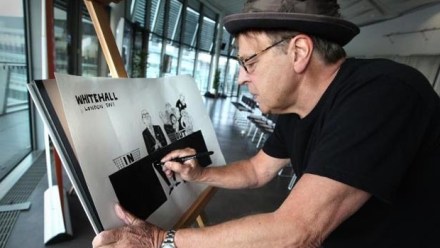
The art of Jonathan Meades

Ape Forgets Medication: Treyfs and Artknacks Londonewcastle Project (28 Redchurch Street, E2), until 23 April Process, means, method: it was these rather than the results which initially fascinated me. There was an unmistakable exhilaration in discovering that I was not merely learning a new language but that I was creating a language peculiar to myself. Given that it was non-verbal the word 'language' is inappropriate. In every instance the words, the capricious titles I have appended to the works (the treyfs and artknacks) came after. Treyf signifies that which is not kosher. Artknack is a neoligism which suggests arts, a knack or facility, a knicknack or cheap bling, arnaque (French for a scam).

‘Do black movies really not sell?’

Arts feature

The musical biopic is a staple of the Hollywood economy. Like an Airfix model kit it comes with the necessary parts presupplied: sex, drugs and a soundtrack. All the director need do is glue them together. Actors are keen too, as portraying musicians is like prospecting for Oscars: in recent years the lives of Edith Piaf, Ray Charles and Johnny Cash’s wife June Carter have all won statuettes for their stars. The life of Miles Davis, with its giant musical peaks and deep personal troughs, is tailor-made for the big screen. But for years he couldn’t be captured in a bottle. It hasn’t been for want of trying on the part of Don Cheadle, who stars in, directed, produced and took a co-writing credit on Miles Ahead.

A trip down Mammary Lane

Exhibitions

The V&A is selling £35 Agent Provocateur pants. This is, of course, a business deal because Agent Provocateur — along with Revlon — is sponsoring the museum’s new exhibition Undressed or, as I would have called it, if I were a curator with a gun to my head: Important Artefacts from the Ancient Kingdom of Boob; or A Trip Down Mammary Lane. The atmosphere is vague and vapid, for this is fashion-land, where anger, if it even exists, is buried deep. But no matter; this is what I am here for. I can now tell you that, in the 19th century, women wore cages on their legs (a metaphor?), and that most women in history panicked as to what to do with their boobs because they were the most interesting thing about them, and still are.

In defence of conceptual art

Exhibitions

At the tail end of last year, an artist called Peter Goodfellow mounted an exhibition of paintings titled Treason of the Scholars. The works were a garish parody of the signature styles of blue-chip artists including Jeff Koons, Damien Hirst and Joseph Beuys — not so much satire as aggravated assault. In terms of nuance, it made the giant inflatable butt plug artist Paul McCarthy had installed in Paris’s Place Vendôme in 2014 look subtle. But that, Goodfellow stressed, was precisely the point. His complaint, he wrote in an accompanying essay, was that the ‘charlatans’ of the contemporary art establishment had come to neglect his medium in favour of figures possessed of ‘no ability, no technique, no intellectual gravity’.

Fresh and wild | 14 April 2016

Cinema

This Jungle Book is Disney’s remake of its animated classic of 1967, as beloved by all generations thereafter. Warner Bros also has a remake in the pipeline, directed by Andy Serkis, and due for release in 2018, so it looks as though we’ve reached peak Jungle Book remake, although I personally won’t be happy until Quentin Tarantino has a shot: ‘I’ve reached the top, but had to stop and that’s what’s bothering me ...mother fucker!’ Many are scornful of these ‘reimaginings’, as they’re called, saying it indicates that Hollywood lacks original ideas.

Death watch | 14 April 2016

Radio

All this week Radio Five Live has been giving us an insight into what it is like not just to confront death every day but also to know that a minor error on your part might end a person’s life. In Junior Doctors’ Diaries on Sunday night, Habiba, Andrew and Jeremy took us inside their daily round, followed by updates throughout the week on Phil Williams’s night-time show. It’s been a timely reminder (politically motivated or not) of how much we need good doctors, and how sad it is that so many of them have felt driven to go on strike. Sad because it’s actually a reflection of how undervalued they have become, and of how little we understand about what they do.

There will be blood | 14 April 2016

Opera

Lucia di Lammermoor is one of the two or three Donizetti operas that have never fallen out of the repertoire, and the more of his operas it’s possible to see, or at least to hear on CD, the less explicable that becomes. The late and rightly venerated Rodney Milnes called Lucia ‘a blazing masterpiece’, but that does seem to be overdoing it, and in fact several of his other works are more worthy of that accolade. Throughout much of its history Lucia was prized primarily for its glorious sextet, and for the maddest of all mad scenes, added to by generations of sopranos until it became the ultimate coloratura showpiece.

Deluded continent

Theatre

Les Blancs had a troubled birth. In 1965 several unfinished drafts of the play were entrusted by its dying author, Lorraine Hansberry, to her ex-husband, Robert Nemiroff, who mounted a debut production in New York in 1970. Nemiroff has created a fresh version with the help of a ‘dramaturg’ (or ‘colleague’, in English) named Drew Lichtenberg who believes not only that this ramshackle script is a masterpiece but also that Hansberry belongs in the first rank of dramatists alongside Ibsen, Sophocles and Aeschylus. This does not bode well. But the result is surprisingly good. Or good-ish.

The Rolling Stones’s Saatchi show is clearly a money-spinner – what’s wrong with that?

The most restless, resilient, rapacious rock & roll group in the world is on the move again. Less than two weeks after finishing a routinely Herculean tour of Latin America with an epochal show in Cuba, the Rolling Stones were back in their London hometown, disrupting traffic on the King's Road as Mick Jagger, Keith Richards, Charlie Watts and Ronnie Wood glad-handed a media scrum at a red carpet event to mark the opening of their latest project, Exhibitionism at the Saatchi Gallery. Towards the start of this 'immersive' odyssey, you find yourself in a room that looks like the set of a Harold Pinter play. Grease-plastered dishes are piled up in a blocked sink; overflowing ashtrays spill over the mantelpiece; a lingering smell of stale fish and chips permeates the air.

The rise and fall of Sicily

Arts feature

A few weeks ago, I looked out on the Cathedral of Monreale from the platform on which once stood the throne of William II, King of Sicily. From there nearly two acres of richly coloured mosaics were visible, glittering with gold. In the apse behind was the majestic figure of Christ Pantocrator — that is, almighty. The walls of the aisles and nave were lined with scenes from the Bible. In another panel, just above, Christ himself crowned King William. It was a prospect of the greatest opulence and sophistication stretching in every direction from this regal vantage point. The mosaics are in the manner of Byzantium, and probably executed by Greek artists, but the architectural plan and inlaid floors are derived from medieval Italy.

Sound and fury | 7 April 2016

Exhibitions

There was a genteel brouhaha last year — leaders in the Times, letters to the Telegraph, tutting in the galleries — about the British Museum’s decision to play Pan-pipe music into its exhibition Celts: Art and Identity. Did the gold torcs and coin hoards sparkle the more for the looped song of Pan-pipes? Not really, and it didn’t half annoy visitors. Not put off by the British Museum’s Pan-pipe complaints, Compton Verney in Warwickshire has been at the jukebox for its Shakespeare in Art: Tempests, Tyrants and Tragedy.

Singing Ireland into being

Television

In recent years there’s been a fashion for arts documentaries presented by celebs rather than boring old experts — presumably on the grounds that knowledge and insight are no match for vague enthusiasm and a touch of showbiz glamour. (In a particularly gruesome episode of ITV’s Perspectives, Pop Idol winner Will Young established his credentials for discussing the life and works of René Magritte with the words, ‘I’ve been collecting bowler hats for 12 years now.’) Even so, one channel you might have expected to hold out against such frivolity is BBC4, the natural home of resolutely untelegenic academics telling us stuff they really know about. But then on Sunday came Bob Geldof on W.B.

Intolerable cruelty

Radio

It was a toss-up on Sunday between the atmosphere in the Radio Five Live Sports Extra studio in Kolkata for the last over of the cricket world cup (England versus West Indies) and the high-velocity drama of that evening’s episode of The Archers. Which was the more dramatic? In one room my husband was shouting at the radio, ‘Go on, Stokes!’ In another, an hour later, I was staggering towards an armchair, all thought of cooking dinner quite beyond me, after listening to the dénouement of the Helen and Rob story. Who would have thought radio could be so dangerous to the blood pressure? In the heat of the moment, as the Eden Gardens stadium erupted, the exhilaration, and dismay, of Jonathan Agnew and co.

An American in Paris

More from Arts

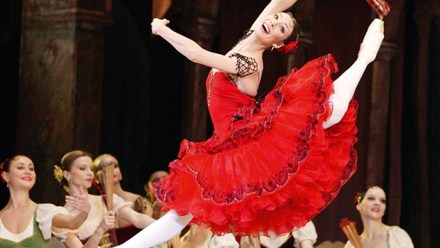
Paris Opera Ballet plays hard to get. It doesn’t deign to travel all the way over here, thanks to a combination of exorbitant expense and a languid disdain for the little Britons with their Johnny-come-lately ballet tradition (not even one century old, let alone three and a half). So if the mountain won’t come to Mahomet, it behoves Mahomet to go to the mountain. And now is the time to do it, with the ructions brought on by the arrival last year and the departure this of Natalie Portman’s husband as ballet artistic director. Benjamin Millepied is French but spent his career as a leading dancer in New York City Ballet, whose values are broadly the antithesis of the institutionalised, hierarchical Paris Opera Ballet.

Bitter sweet

Cinema

The French master film-maker Jacques Audiard has never been anywhere near Hollywood plot school. His films contain gathering menace — something somewhere is going to go horribly wrong — but where the menace will come from, and who will get hurt, is anyone’s guess. In his astonishing prison drama A Prophet the threat to its greenhorn French-Arab inmate comes from all quarters until he himself evolves into the threat. There are two almost unwatchable scenes in Rust and Bone: in one a marine-park trainer of orcas wakes up in hospital to discover she has lost both legs; in another a bareknuckle street fighter has to thump a hole through the thickening ice to rescue his young son.

Modernist cul-de-sac

Music

The intransigence of Maxwell Davies, Boulez and Stockhausen is coming home to roost. Here were three composers, famous if not exactly popular, who called many shots by the time they died yet whose works were little loved in their lifetimes by the concert-going public and stand little chance of performance now they are dead. How was such imbalance possible? The intransigence had a lot to do with it. People thrill to a bold stance, and they don’t come much bolder than Boulez and Stockhausen in the Sixties. To be fair, Max was a very British version of this attitude. When Boulez died, the French press focused on a national hero whose main achievement, it seemed, had been to impress generations of foreigners while building monuments in Paris, as a true Frenchman should.

Comic relief | 7 April 2016

Opera

Comic opera is no laughing matter. Seriously, when was the last time you laughed out loud in the opera house? The vocal slapstick of Gianni Schicchi, laid on six banana skins deep? The farcical plot convulsions of Il barbiere? What about the arrival of Mozart’s ‘Albanians’ in Così? (Oh, those moustaches! Oh, those naughty boys!) It’s all about as spontaneous as a health-and-safety briefing, and almost as funny. Thank goodness, then, for Gerald Barry’s The Importance of Being Earnest — an opera that’s dangerously, anarchically hilarious. The project sounds like a joke in itself. Have you heard the one about the Irish composer who tried to improve on Oscar Wilde?

I didn’t enjoy it but I couldn’t help loving it: ENO’s Sunset Boulevard reviewed

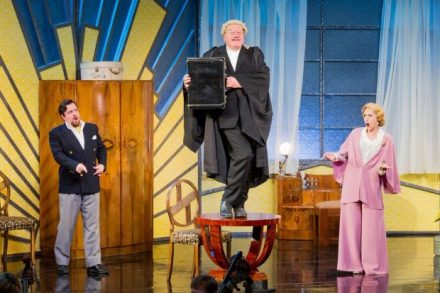
Sunset Boulevard Coliseum, in rep until 7 May Sunset Boulevard is a tale of fractured glory with Homeric dimensions. The movie presents Hollywood as a never-ending Trojan War that attracts fresh generations of dreamy youths in search of conquest and treasure. The lead characters have retired from battle, wounded. Joe Gillis, like Odysseus, is a vagrant warrior ensnared in the island-mansion of Norma Desmond, who plays the role of broken-queen-turned-sorceress. These fabulous elements are preserved in Andrew Lloyd Webber’s musical version. So is the Norma-Joe affair with its distasteful emotional template: mother-son, boss-slave, mistress-poodle, crone-toyboy. The lovers are linked by nothing but neediness and failure, and each desires the mirage that the other represents.

Giselle v Superman

I’ve turned up at my local cinemas for quite a few of the live ballet relays that now represent a major arm of outreach to the masses by the Royal Ballet and other world companies. Wending my way through the blockbuster queues at Odeons and Empires, I’ve alarmingly often found myself among only 15 or 20 people speckling the black auditoria drinking in a rare chance to see great ballet. Tomorrow it’s the Royal Ballet’s Giselle that will beam out live to the nation with a transcendent cast in a hauntingly pretty production of the masterpiece of romantic ballet with a fantastic cast. The story is much more sophisticated and real than the average classical ballet (and shorter too).

The genius of Myles na Gopaleen must not be subjugated by the imperialism of Flann O’Brien

Faith, has it really been two score years and ten? It has you know. Well, would you credit that? I know. Fifty years! Seems appropriate, though. What? That he'd leave this day. For sure. I mean, of all the days to pick! This one would be among the best. Possibly the very best. You're not wrong there. I might even be right. Woah, hold your horses! Even the little ones? Especially them. Brutish little creatures. Brutes, yes. Be that as it may - and mark my words, it may (even in April) - today marks the fiftieth anniversary of the death of Flann O'Brien, the second-greatest* Irish writer of the twentieth century. There should, by rights, be scarcely a dry eye in The Palace bar today. This includes the glass ones.

The future is here

Arts feature

Oculus Rift. It sounds like something from a science fiction novel, and in many ways it is. Its release this week is the first stirring of a future stuffed with virtual reality headsets. The hope of its Californian engineers and their bitcoin backers is that we, the consumers, will soon use them to spend a whole lot of time outside of our lives. Strap the goggles to your face, position the headphones over your ears, press the on button, and — bzzzztp — you’re in a different world. The question is, who will create these worlds? The first prototype of the Oculus Rift was built five years ago by an 18-year-old called Palmer Luckey, and he had an 18-year-old’s use for it: video games.

Old masters

Exhibitions

The Fitzwilliam Museum is marking its bicentenary with an exhibition that takes its title from Agatha Christie: Death on the Nile. But it turns out it was another writer of a different type of fiction who was directly involved. M.R. James, author of Ghost Stories of an Antiquary, amassed some of the exhibits in his capacity as director of the Fitzwilliam from 1893 to 1908. And almost any object on display would have made a perfect prop for one of his tales, because the subject is ancient Egyptian coffins. Generally, the main character in a story by James is a retiring gentleman scholar who comes across a venerable item which then brings upon him some diabolic haunting or curse.