Culture

Culture

The good, the bad and the ugly in books, exhibitions, cinema, TV, dance, music, podcasts and theatre.

Deluded divas

Arts feature

When the Fat Lady Sings, everyone is primed to chortle, even if she is Montserrat Caballé and doing it wonderfully well. Hergé’s cartoon creation of Bianca Castafiore embodies the type: with her flaxen plaits and heaving embonpoint, she is a ridiculously bad fit for the simpering virginal heroine of Gounod’s Faust, particularly when carolling her Jewel Song at such a pitch that an agonised Tintin and Captain Haddock are forced to cover their ears. But at least Madame Castafiore has a brilliant international career: what about the Fat Lady who Can’t Sing — the diva deluded into thinking she is a nightingale when in fact she is nothing but a crow? Two recent films explore this tragicomic syndrome.

Striking the wrong note

Cinema

Before we turn our attention to Florence Foster Jenkins — but if you can’t wait, it’s so-so — I feel I should address the several hundred (and counting; hell’s bells) comments below my negative review of Captain America: Civil War last week, and the many pleas that I should ‘get a life!’, which seemed a bit rich. Indeed, as I’m not the one overly invested in a film franchise where the films are barely films, just noisy assemblages of CGI set pieces, am I the one most in need of this ‘life’ being talked about?

Bell canto

Opera

Cursed, or perhaps blessed, with almost no visual memory at all, I had almost completely forgotten what the Royal Opera’s current Tannhäuser, directed by Tim Albery and with set designs by Michael Levine, looks like. Or perhaps it was the natural tendency to repress the memory of unpleasant experiences. Wanting to enjoy the Overture, I closed my eyes until the moment the Venusberg ballet that Wagner composed for the doomed Paris version in 1861 began. However many hundreds of times I hear that Overture, with its wind chorale and weary strings, I still hang on every bar. It was instantly clear that Hartmut Haenchen, the conductor of this first revival, was going to be lighter and fleeter than Semyon Bychkov had been first time round. Mainly, Haenchen’s way is preferable.

Last words | 5 May 2016

Music

This, my 479th, is to be my last contribution as a regular columnist to The Spectator. I have written here for 33 years and 4 months, a way of life really, and one I have greatly enjoyed. I thank Auberon Waugh in absentia for suggesting me to Alexander Chancellor in the first place; and Charles Moore for keeping me on in the early years, once we were up and running. I also thank three quite exceptional arts editors: Gina Lewis, Jenny Naipaul and the doyenne of these pages, Liz Anderson. Things have moved on from my habitual think pieces, outraged rants, ad hominem demolition of palpable idiots written in the back of aeroplanes.

Service with a smile | 5 May 2016

Radio

He’s been billed as the new Pied Piper but it’s going to take a while for Tom Service to quite match the engaging brilliance of David Munrow, who back in the 1960s persuaded us that medieval pipes-only music was cool listening. Munrow’s series on what was then the Third Programme was aimed at six-to-12-year-olds but succeeded in drawing everyone in because of his gift for communication and his willingness to explore the wilder shores of repertoire, creating sound connections we had never heard before. Service’s new magazine programme for Radio 3, The Listening Service, may be inspired by Munrow but it’s not yet sure what it’s meant to be. How experimental? How difficult the content? It’s timetabled at 5 p.m.

Paul McCartney

More from Arts

It’s slightly galling, after years of sticking up for Paul McCartney, to read a new biography of the bloke and realise that you don’t, in the end, really like him that much. But that’s how good Philip Norman’s book is — Macca has no agenda, it simply lets you make up your mind. And for me, it was the leg-combing wot won it. You can’t argue with McCartney’s work. In fact, what you have to argue against is the ridiculous notion that he was the poppy, pappy one while John Lennon was the radical. It was Macca who funded the underground newspaper International Times; who was into Stockhausen, Cage and Berio while Lennon was (to quote McCartney himself) ‘living on a golf course in bloody Weybridge’.

Wings of desire

Exhibitions

Maria Sibylla Merian was a game old bird of entrepreneurial bent, with an overwhelming obsession with insects. Born in Frankfurt in 1647, she sacrificed her health and financial stability in pursuit of her passion. It carried her halfway across the globe and earned her lasting renown among a handful of cognoscenti. Merian was 15 when Jan Goedart published the first of his three volumes of Metamorphosis et historia naturalis insectorum and is unlikely to have seen the book until later. Goedart’s purpose, based on close observation of a range of insects, was a fuller understanding of insect life cycles. It was the same purpose to which Maria Merian devoted herself — even resorting to selling snakes, lizards, a tortoise and a crocodile to fund her compulsion.

That’s entertainment | 5 May 2016

Television

The big returning show of the week began with servants laying out the silverware at a large country house in 1924. But rather than a shock comeback for Downton Abbey, this was — perhaps even more unexpectedly — Tommy Shelby’s new home in Peaky Blinders (BBC2, Thursday). Which explains why so many of the guests were carrying guns, and why the family matriarch was using the word ‘fuck’ a lot more than Lady Grantham ever did. When we last saw gang-leader Tommy (Cillian Murphy), he was still based in the Birmingham backstreets. He was also having a fairly tough time — what with juggling two women, trying not to get murdered and being required by the government to start the Irish Civil War. Two years on, however, things are clearly looking up.

Literary lap dance

Theatre

Great excitement for play-goers as a rare version of a theological masterpiece arrives in the West End. Doctor Faustus stars Kit Harington, a handsome, bearded bantamweight with round glasses and rock-star curls. We first meet him wearing a grey hoodie and lounging in a bedsit surrounded by cheap Catholic statuary. The druggy clothes and the religious iconography suggest a criminal Jesus-freak, possibly of Mexican origin, hiding out from cocaine dealers. Marlowe’s creation is somewhat different. Dr Faustus is a medieval potentate, a scholar of genius, a rich and celebrated German polymath admired by emperors and cardinals, who decides to exchange his earthly ambitions for the chance to wield supernatural powers for 24 years. But hell awaits him when the contract expires.

Filming the Final Solution

Arts feature

In July 1986, nine months before he died, I met the Italian author and Auschwitz survivor Primo Levi at his home in Turin. He was in shirtsleeves for the interview and the concentration camp tattoo 174517 was visible on his left forearm. (‘A typical German talent for classification,’ he tartly observed.) If This is a Man, Levi’s chronicle of survival, offers a warning to those who deliver facile judgments of condemnation: only those who have survived the Nazi camps have the right to forgive or condemn. Attempts to recreate the Final Solution on screen were mostly a ‘macabre indecency’, said Levi.

Is it art or science?

Exhibitions

William Henry Fox Talbot had many accomplishments. He was Liberal MP for Chippenham; at Cambridge he won a prize for translating a passage from Macbeth into Greek verse. Over the years he published numerous articles in scholarly journals on subjects ranging from astronomy to botany. One thing he could not do, however, was draw well — and it was this inadequacy that changed the world. While on holiday in Italy in 1832, he became so frustrated by his failure to draw Lake Como satisfactorily using a pencil and a drawing aid known as the camera lucida — his efforts were well below GCSE art standard — that he resolved to find another way to preserve such views. The results are on show in an exhibition at the Science Museum, Fox Talbot: Dawn of the Photograph.

His dark materials | 28 April 2016

Television

So: Game of Thrones. Finally — season six — the TV series has overtaken the books on which it is based and the big worry for all us fans is: will it live up to the warped, convoluted, sinister genius of George R.R. Martin’s original material? As regulars will know, the great thing about Martin is that you never know which of your favourite characters he’s going to kill off next. Really — and I can’t think of any other series of which this is true — they could die any moment, which is one of the things that makes it such gripping, unsettling, memorable TV. (The ritual immolation of that little girl last season, for example. Will it ever be surpassed?

Word processing

Radio

‘Comedy is like music,’ said Edwin Apps, one of the characters in Wednesday afternoon’s Radio 4 play, All Mouth and Trousers (directed by David Blount). ‘The words are the notes and they have to be in exactly the right place. And every line has to pull its weight, add something to the situation.’ Apps was one half of the writing partnership who created that most unlikely of TV hits in the supposedly swinging Sixties, All Gas and Gaiters, set in the cathedral close of St Oggs and featuring a laughably inept quartet of Anglican clerics.

Polly’s pleb adventure

Theatre

Down and Out in Paris and London is a brilliant specimen from a disreputable branch of writing: the chav safari, the underclass minibreak, the sojourn on the scrapheap that inspires a literary monument. Orwell’s first book was turned down by Faber boss T.S. Eliot, who received the script under its original title, Confessions of a Dishwasher. New Diorama’s dramatisation brilliantly captures the raffish sleaziness of Paris in the 1920s. Orwell’s crew of thieves, parasites and drifters come across as comradely and charming in this magnificently squalid setting. The austere lighting and the ingenious stage effects are done with tremendous economy. There are flashes of bleak humour too.

Sex offender

Music

I saw Prince play once. I was bored rigid but couldn’t mention this to the girls I’d gone with: as far as they were concerned, watching the purple sex dwarf (he was 5ft 2in) masturbating with and fellating his guitar and generally getting off on his sublime pixieness was like experiencing the second coming. Me, I could have done with a few more tunes. I like ‘When Doves Cry’ a lot: the keyboard hook, the demonic guitar, the naggingly catchy tune, the otherworldly vocals that make him sound like some kind of lascivious reptile from Venus. Whenever I hear it, though, I’m reminded of my fundamental problem with Prince: he was a really great pop star who wouldn’t do pop.

Less than Marvellous

Cinema

Captain America: Civil War is the 897th instalment — or something like it — in the Marvel comic franchise. This time round, the superheroes take sides, with the marketing asking if you’re #TeamCap or #TeamIronMan but not if you’re #TeamNeither, as would be most useful in my case. I swear this is the last Marvel film I will see as I never get anything out of them and whatever I say only sets the fans against me, which is not what you want at my age. I only attended this one because I had read the American critics (and some of the British ones who’d had a heads up). They all said, at last, a decent Avengers movie with ‘emotional depth’ and ‘moral complexity’, and now I have to question what planet they’re living on.

Sound and vision | 28 April 2016

Opera

Janacek’s Jenufa, his first great opera, had a one-night stand at the Royal Festival Hall last Monday, courtesy of the wonderful Czech Philharmonic Orchestra conducted by Jiri Belohlavek, the Czech Philharmonic Choir Brno, a large body that had all of five minutes’ singing, and a mainly excellent cast, with Karita Mattila making her transition from the title role, which she has so often performed to powerful effect, to that of the Kostelnicka, the terrifying figure of rectitude who drowns her daughter-in-law’s illegitimate baby rather than bring disgrace on the family.

Prince and me

Features

This is only interesting, well a bit interesting, because the poor man died last Thursday and for a few short days almost anything with the word Prince in it stands a chance of getting some traction. So forgive me if this feels a bit rushed. And opportunist. And exploitative. And attention-seeking. It’s all of those things because I’m cashing in. Obviously. If you want nothing more to do it with it, I can only applaud you. But for those of you who want to know more about the incredible untold story of my time with Prince, read on. I met him six years ago. Downstairs in his house in Los Angeles. A woman I was hopelessly in love with said, ‘Tom, come and say hi.’ I stepped forward. Prince shook my hand and said, ‘Hello Tom.

I hope more darlings are killed off in Game of Thrones season 6

So: Game of Thrones. Finally — season six — the TV series has overtaken the books on which it is based and the big worry for all us fans is: will it live up to the warped, convoluted, sinister genius of George R.R. Martin’s original material? As regulars will know, the great thing about Martin is that you never know which of your favourite characters he’s going to kill off next. Really — and I can’t think of any other series of which this is true — they could die any moment, which is one of the things that makes it such gripping, unsettling, memorable TV. (The ritual immolation of that little girl last season, for example. Will it ever be surpassed?

Chisenhale Gallery’s conceptual critique of neoliberalism is being funded by high finance

Over the next five weeks, visitors to East London’s Chisenhale Gallery will find the metal doors closed and a notice outside, in museum-style text, stating that the exhibition by Maria Eichhorn entitled 5 Weeks, 25 Days, 175 Hours consists of the staff not working and the gallery being shut. It then states that the exhibition ‘opened’ with a symposium on the first day of its run and that audio recordings of it are available on the website. Closing a gallery for the duration of an exhibition is not a new artistic strategy. Daniel Buren blocked the door to his solo exhibition at Galleria Apollinaire, Milan, in 1968 and the following year Robert Barry hung a sign on a gallery door stating ‘during the exhibition the gallery will be closed’.

All the world’s a stage | 21 April 2016

Arts feature

In this much-heralded Shakespeare anniversary year, one might expect a certain respect for the works to prevail. In Holland it’s different. Under the tutelage of a Belgian, Ivo van Hove, a huge slice of Shakespeare’s history theatre has been filleted for the stage into something that might sit nicely on HBO alongside Game of Thrones. It opens at the Barbican on 22 April, a day before the official Shakespeare-death day four centuries ago. And it’s all in contemporary Dutch verse — four hours of it... Kings of War starts with a photo, on a video-screen, of little Prince George. His infant form is followed in rapid succession by that of every English monarch back to Henry V. There, the display halts.

Special delivery

Television

Five Star Babies: Inside the Portland Hospital won’t, I suspect, have been a hard sell to BBC2’s commissioning editors. Childbirth and rich people are both reliably popular subjects for TV documentaries. So why not combine them into one handy package by showing us life at the UK’s only private maternity hospital? And yet, however artificial the programme’s conception, any sociologists studying contemporary Britain’s peculiar attitudes to the very wealthy could have done a lot worse than to tune in to Wednesday’s episode. ‘Parenthood: the great leveller,’ began the narrator — somehow managing not to add a hollow laugh. This sense of irony, though, was short-lived.

Written on the body

Radio

Sue Armstrong’s programme on Radio 4 All in the Womb (produced by Ruth Evans) should be required listening for anyone dealing directly with the refugee crisis, with those who have fled from intense fear and terrible violence in their home countries. Armstrong has been investigating recent developments in our understanding of the impact of severe trauma, how it affects not just the mind but also the body, creating physical changes that also need to be addressed. Those who lived through the Holocaust, for example, who were in prison camps or were forced to hide in dark, cramped, inhuman conditions, perpetually afraid that at any moment they might be discovered, have been found to have low levels of cortisol.

The Jezza effect

Theatre

Corbyn the Musical feels like it comes from the heart. Did the writers live through the 1970s when the hard-left was full of hope and confidence? Socialists then genuinely believed they could see off capitalism (which seemed in its death throes anyway) and replace it with a happier and more equal world. The show takes that objective seriously and attacks it with style, wit and affection. Young Jezza is portrayed as a sweet-natured bumbler entranced by an ideology he barely understands. He expresses his political dreams in terms of manhole covers and allotment vegetables. With his racy girlfriend, Diane Abbott, he sets off on a motorbike tour of East Germany, which they both regard as a communist paradise.

There may be trouble ahead | 21 April 2016

Cinema

Jane Got a Gun is being sold as a rousing feminist Western although the truth is that it’s about as rousing and feminist as my cat, Daphne, who is 17, and now barely moves but who, back in the day, made herself available to every passing Tom. So you don’t look at Daphne and think ‘rousing feminist’, just as you don’t come away from this film and think ‘rousing feminism’ — assuming you are minded to think anything at all, and haven’t just been bored to death. Produced by Natalie Portman, who also stars, the film has had its troubles.

The female gaze

More from Arts

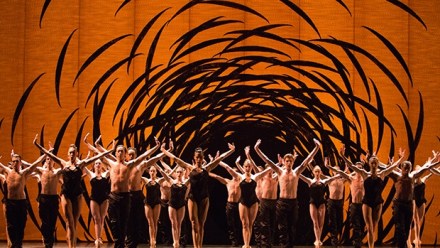
Tamara Rojo programmed three female choreographers for her English National Ballet spring bill because, she said, she had never danced a ballet by a woman, and wanted to see what women would produce. Just the two begged questions here. First, that female choreographers are being stifled by institutionalised sexism in the ballet establishment. Second, that female choreographers, if allowed to see the light of day, would offer a differently thought, differently imagined argument from the general tenor of those pesky male choreographers who dominate the stage.