Culture

Culture

The good, the bad and the ugly in books, exhibitions, cinema, TV, dance, music, podcasts and theatre.

Super human

Radio

‘We think we’re in charge of this stuff but we’re not,’ said Quincy Jones, the composer, arranger, jazz trumpeter, musical genius. He was talking to Julian Joseph at the Montreux Jazz Festival for Jazz Line-Up on Radio 3 (Saturday). ‘It’s divine intervention.’ Jones, who masterminded Michael Jackson’s Thriller as well as countless other hits, film scores (including The Italian Job and The Color Purple) and his own ‘Soul Bossa Nova’, was remarkably sanguine about his extraordinary career. His enormous self-confidence was there from the start. Finding himself in Paris in the 1950s touring with a big band, he decided to stay on so that he could study with Nadia Boulanger and learn how to write for a symphony orchestra.

Edinburgh Fringe has succumbed to the curse of pastiche

Walking along the Brighton seafront, I was struck by posters advertising endless tribute acts; among them Suspiciously Elvis, the Small Fakers and The Kinx. The Edinburgh Fringe is much the same. Shows this summer include Dirty Harry: The Ultimate Tribute to Blondie and Billie Holliday: Tribute to the Iconic Lady Day. Or how about Gary Bland’s Mr Romantic: A Tribute to Johnny Mathis — ‘an insight into Mathis’s career, and how Mathis’s music has been a big part of Gary’s life through love, heartache and laughter’. The theatre at Edinburgh, too, is full of remakes. Fancy Dan Choo-Park’s The Song of Beast (after Hamlet), where the Prince of Denmark is teleported to a South Korean slaughterhouse?

Requiem for a designer dream

Arts feature

Threnody. Dirge. Lament. Epitaph. Elegy. Wake. There are so many English terms to describe the passing of people and things that you wonder if introspection about demise might be a national characteristic. All these words are on my (doggedly cheerful) mind as staff have moved out of London’s Design Museum, securing the last open door with a padlock on 30 June and leaving inside cavernous spaces with rusting memories of designer people and designer things. So what was the old Design Museum? It arose from a conversation between Terence Conran and me in 1978. He was the proprietor of Habitat, whose decent, modern merchandise revolutionised popular taste, and I was the author of a book about design he had just discovered.

Tartan-ing up the arts

Festivals

Many years ago an arts spokesperson for the SNP launched an extraordinary attack on Scottish Opera, saying, ‘If push comes to shove, if I were arts minister and had to choose between the survival of Gaelic music and Scottish Opera, I would say rich people could always go to Salzburg for lieder and Sydney for opera.’ With various parties now competing for the class-war-and-grievance vote, I sense a return of this kind of rhetoric in debates on Scottish culture, arts and politics. Scottish Opera routinely invite Scotland’s politicians to their productions and their invitations are routinely ignored. The feeling is that there are votes to be lost in being seen supporting elitist culture.

Northern exposure | 11 August 2016

Festivals

As the festival grows, the good acts are harder to find and the prices keep rising to meet the throngs of showbiz refugees who surge north in the belief that the glory, this year, will be theirs. Arriving at my one-star hovel (no breakfast, no towels, shared bathroom), I was given a security key and a disc of see-through soap that I could have hidden beneath a tea-bag. The bill, payable in advance, was a third higher than last year. Glory in this city belongs to the landlord. Marcel Lucont’s Whine List is performed by a suave, self-adoring Frenchman who starts by asking if anyone in the crowd is new to his act. ‘Lucky bastards. What I would give to see myself for the first time.

Recycling the avant-garde

Exhibitions

One overcast afternoon in late July I took a train to Norfolk. It seemed a good time and place to catch up on the state of the avant-garde. My goal was the British Art Show 8, currently spread over several venues in the centre of Norwich and due next month to move on to Southampton, the final resting-point on its slow progress around what remains, for the moment at least, the United Kingdom. Not having caught the exhibition at its previous stopping points, Leeds and Edinburgh, I thought this would be a suitable place to see it since Norwich is a town of art historical pedigree — home to Cotman, the Cromes and Michael Andrews.

One of Grimeborn’s most striking rediscoveries: Mozart & Salieri at the Arcola Theatre reviewed

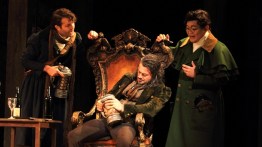
Mozart & Salieri Grimeborn, Arcola Theatre, until 13 August I have been a fairly conscientious reviewer of Dalston's Grimeborn festival for the last eight years. The name is less suitable now than it was. The Arcola Theatre, where the operas are performed, is now only a stone's throw from Dalston Square, with its chic apartment blocks and bars and the resplendent C.L.R. James library, and the whole neighbourhood is upwardly mobile. The Arcola itself remains a ramshackle place, and you can expect the usual late start, inadequate provision of programmes, and general air of administrative amateurism. This year's season began on 23 July, and runs till 8 September.

Funny is dangerous

Radio

‘I’m off now,’ says Michael Heath, signing off from his selection of Desert Island Discs on Radio 4, ‘to go and do a gag about God knows what. I haven’t the foggiest idea.’ You’d think at 80 he might want to stop, or have to give up because he’d somehow lost his touch. But not the cartoon editor of this magazine, and chief creator of wicked skits on the idiocies and affectations of contemporary life. What’s it like working as a cartoonist after the attacks on the satirical magazine Charlie Hebdo? asked Kirsty Young. ‘It adds a certain frisson to your drawing,’ Michael replies. ‘But I never wanted to be a political cartoonist… I wanted to be funny.’ ‘People take offence,’ he says.

The decade of Delia

Television

Proof that someone has really made it as a TV historian comes, I would suggest, when they join the likes of David Starkey and Simon Schama by getting their name into the programme’s title. So it is that Dominic Sandbrook’s The 70s, from 2012, has now been followed by The 80s with Dominic Sandbrook (BBC2, Thursday), a series that confirms his ability to put across moderately big ideas in a light easy style — and in a parka. Sometimes when watching television, you might be in the mood for a serious history documentary, and sometimes for a show that’ll just wash over you pleasantly. With Sandbrook — and I’m pretty sure I mean this as a compliment — you can have both.

Dorset’s winning formula

Opera

Dorset Opera seems to receive far less coverage than the rest of the country-house summer shows, although it is in most respects well up to the standard of any of them except Glyndebourne, which is in a category, social and artistic, of its own. The Dorset productions take place in the Coade Theatre of Bryanston School, and are the result of a brief but what must be an incredibly intense period of preparation, with some big names in the major roles, and the smaller parts and chorus taken by a large collection of young singers who are strenuously trained for the week-long rehearsals. I like going on the last day, when one opera is performed at 2 p.m. and another at 7 p.m.

Oven-ready

Cinema

Todd Solondz’s Wiener-Dog is billed as a ‘dark comedy’ although it is far more dark than comic. If pressed to put a number on it, I’d say that, despite the film’s poster, which shows a cute dachshund’s butt, and leads you into thinking cute dachshund thoughts, this is 98 per cent dark, and the sort of film that actually makes you want to come home, draw the curtains, and stick your head in the oven. Life’s a bitch and then you die, it says, literally. There’s every chance you’ll hate it. I’m not convinced I don’t. But this is a film that, once seen, you’ll always know you’ve seen and, in the most disquieting way, it feels as if it has somehow seen you too.

To call it ‘provincial’ would be an insult to the provinces: Bayreuth Festival’s Parsifal reviewed

Parsifal Bayreuth Festival, until 28 August In the days leading up to this year’s Bayreuth Festival, Bavaria was rocked by a spate of violent attacks. Security measures ran high for the premiere of a new Parsifal rumoured to be awash in Islamic symbolism. Such reports proved true, with the production set in a contemporary Middle Eastern country under threat, possibly from Isis. Far from being lauded as avant, however, the staging by Uwe Eric Laufenberg was instantly dubbed 'Provinztheater', or 'provincial theater', the worst insult that the well-heeled festival audience could come up with. I disagree.

Remembering Rosemary Butcher – the choreographer who changed the way I see dance

My ancient Liddell and Scott Greek dictionary of 1849 defines choreia as ‘a dancing, especially with joy’. The word choros has a more technical definition: a round dance, or a dance accompanied with song (hence the word chorus). From whichever word ‘choreographer’ is declared to derive, the British dancemaker Rosemary Butcher, who died last month at 69 after a career barely visible to the public, embodied the first idea in a way that I see with hindsight changed my eyes emphatically in realising the marvellous range of ways to enjoy dance-going. Choreia: ‘a dancing’ – an act of dancing, a piece of activity, rather than the choros, a dance creation.

The Spectator’s Michael Heath names his Desert Island discs

Michael Heath, The Spectator’s brilliant cartoon editor, has been on Desert Island Discs - which is like a knighthood, but without the cronyism. He's been talking through his illustrious career and his decades-long association with The Spectator. Subscribers know how well he draws; but his wit is a secret hitherto shared with those of us lucky enough to work with him. The interview (above) shares a bit of that with the rest of the world. Avant-garde jazz, he says, "sounds like fire in a pet shop". "I am the most romantic man you’ve ever met in your life – absolutely, completely certifiably-mentally soppy. If you showed me Bambi, I’d mop the floor sobbing..." "I don’t think there’s any fun without you being depressed at the same time.

Visions of suburbia

Arts feature

Art is aspiring; hungry; acutely aware of what it could become, and of what it could lack; longs for safety and reaches out in speculative attempts to do something new; exists on the outer edges of lives, looking inwards with hopes, some day, to be more essential. Art, literature and music are, in short, suburbs to the grands projets of our lives at their most significant. Over the next year the Architecture Foundation will present new films, walks, talks and another instalment of the Doughnut Festival, to contemplate the transformation of London’s outer ring. It’s an interesting moment. The capital is not physically expanding, but the relationship between inner and outer is significantly altering and will go on altering.

Beauty and the banal

Exhibitions

In 1965 William Eggleston took the first colour photograph that, he felt, really succeeded. The location was outside a supermarket in Memphis, Tennessee; the time — to judge from the rich golden light and long shadows — late afternoon. Eggleston’s subject — a young man with a heavily slicked, early Elvis hairstyle stacking trolleys outside the shop — was as ordinary as he could be. But the result was a photographic masterpiece. It is included in the exhibition William Eggleston: Portraits at the National Portrait Gallery, although, by most definitions, it is not a portrait. Indeed, it is as hard to say just what it is as it is to explain exactly why it is so good. Actually, great pictures are often images of very commonplace sights.

Greenhouse or group hug?

Television

The unacknowledged subtitle of Channel 4’s new reality series Eden (Mondays) is Die, Hippies! Die! Obviously they’re not going to admit this because that wouldn’t be right. But I’m sure Channel 4 is hoping that a terrible Lord of the Flies-type scenario will unfold for the 23 victims who’ve volunteered to get back to nature on a remote Scottish peninsula for 12 months, in which they hunt one another down with sharpened sticks, with hideously watchable consequences. In episode one, my money would have been on Anton as chap-best-placed-to-survive.

Far from Naples

Radio

It’s a brave dramatist who would seek to adapt for radio the hit novels of the Italian writer Elena Ferrante. As soon as her quartet of novels set in Naples from the 1950s onwards began appearing in English translation a few years ago they created a bestselling stir because of the unusually bold flavour of the writing and the brutal honesty with which Ferrante is prepared to expose the dark underside of female friendship and motherhood, its jealousies and bitterness, the betrayals and self-centredness. It was even rumoured that Ferrante must be a man (she has never given an interview) because no woman, surely, would be so critical of her own sex (which doesn’t explain why she is not kind to men either).

Losing the plot | 4 August 2016

Theatre

Consider it commercially. So powerful is the pull of the Potter franchise that the characters could simply re-enact the plot of ‘Incy-Wincy Spider’ and the fans would swoon with joy. The stage show has been written by a two-man committee, Jack Thorne and John Tiffany, with the help of billionaire equality campaigner J.K. Rowling. Harry is now 37 and working as a Whitehall clodhopper at the Ministry of Magic. He’s troubled by his stompy bed-wetter of a son, Albus, whose tantrums cause the middle-aged miracle-worker to suffer agonies of weepy self-doubt. Together they visit Hogwarts and the multifarious plotlines start to punch each other in the face.

Snakes and ladders | 4 August 2016

Opera

In Luis Buñuel’s 1962 film, the ‘exterminating angel’ of the title is a mystery illness. A debilitating virus — much worse even than man flu — that attacks the social immune system and shuts down your ability to act, to think, to be. It prevents you from remembering how to behave at middle-class dinner parties. You arrive at a friend’s house twice. You forget to leave. Open doors become terrifying, impassable geometric objects. Your handbag contains not keys but feathers and chicken legs. Occasionally it kills. The bug is Buñuel’s metaphor for a society gripped by cowardice. Composers can catch it. Not Thomas Adès, though. There is bravery (insanity?

Corn again

Cinema

The Carer is a Hungarian-British co-production about a cantankerous old thesp (Brian Cox) and the young Hungarian woman (Coco König) who is dispatched to look after him, much against his wishes, and whom he’ll eventually throw out on her ear. I’m joshing you. She wins him over, naturally, and mutual respect develops, naturally, and a friendship blossoms, naturally, although I wish he’d thrown her out on her ear as that way this wouldn’t have felt like something we’ve seen a hundred times before. There are affecting, powerful films to be made about old age, loss, mortality and dependence, but this, alas, has all the emotional grit of a Driving Miss Daisy.

Will I ever see a production of Die Fledermaus that does this masterpiece justice?

Die Fledermaus Opera Holland Park, until 5 August Johann Strauss's opera Die Fledermaus is a masterpiece that I have had a lifelong passion for, a passion which productions, whether in England or abroad, are obstinately determined should remain unrequited. I hadn't seen it, until Opera Holland Park's new production, since the 2003 production at Glyndebourne, which almost killed my passion, with its endless laborious prosiness. All the great operas and operettas with spoken dialogue have the same problem, how to keep the interest going when everyone is waiting for the next musical item, and one would of course feel hard done by if the performance simply jumped from one to the next, as is shown in those ill-advised recordings where the spoken dialogue is omitted.

Everything is illuminated

Arts feature

One could honour God with prayer, of course, and build cathedrals, amass treasuries, turn choirs into stained-glass jewel boxes, carve portals with saints and sinners. But for the medieval monks bent over vellum in chilly scriptoria colour, too, was devotion: offertories of lapis lazuli, azurite, cinnabar, silver and gold, gold and more gold. Silver tarnished on the page, but gold remained exquisite, inviolable, and monks and scholars found a dragonish greed for it. War, weather, revolution, Henry VIII, Oliver Cromwell, acquisitive magpies, trophy-hunters and time have stripped gold and pigment from sculptures and ivories.

Hang the DJs

Music

Electronic Dance Music is dying. You may not have noticed. It may not affect you directly. But it’s a really big thing and, unless your teenage children have already told you, then you heard it here first. In fact, your teenage children are probably still in denial about it, so go and tell them. Get them back for scratching the car or vaping in the kitchen or whatever pitiful infractions pass for rebellion these days. Tell them: sorry, but electronic dance music is dying. Your rave is going to its grave. Ibiza now exerts the same cultural pull as any other barren 220 square-mile island, including the Isle of Man. The DJ has been hung, not by Morrissey as some of us hoped, but by his own corporate greed.

Flawed genius

Theatre

An inspired decision to stage Jesus Christ Superstar in a summer theatre in Regent’s Park. The action takes place outdoors, in balmy climes, so the atmosphere is ideal for Rice and Lloyd Webber’s finest show. The songbook bursts with melodic inventiveness, and the score blithely rips apart the conventions of musical theatre and remakes them afresh. Lloyd Webber finds two contemporary registers and switches between them constantly: first the eerie, unhinged menace of late-1960s heavy rock, and secondly the sweet, escapist loveliness of 1970s pop. The transitions from blunt savagery to pure sugar sometimes occur with gunshot abruptness, on a single note.

Heavenly bodies | 28 July 2016

More from Arts

Initially it must have been a nasty surprise. On 16 August 1972 an amateur scuba diver named Stefano Mariottini was fishing in shallow waters just off the coast of Calabria. At about noon he was poking around some rocks when he saw part of an arm protruding from the sand. His first thought, a natural one, was that he had found a cadaver. On closer examination, it became clear that there was not just one body but two — and that they were made not of flesh but of metal. Mariottini’s discoveries are world-famous now, taking their name — the Riace bronzes — from the little resort near which he was swimming. In terms of classical sculpture, he had hit the jackpot. Bronze was the medium of choice for many of the most admired artists of the ancient world.