Culture

Culture

The good, the bad and the ugly in books, exhibitions, cinema, TV, dance, music, podcasts and theatre.

Double trouble | 7 July 2016

More from Arts

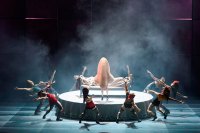
The Bolshoi Ballet’s wunderkind ballerina Natalia Osipova defied received wisdom when, in 2012, she cast off from the great Moscow company with her equally prodigious then boyfriend and partner Ivan Vasiliev to go freelance. Without the Bolshoi’s unmatched support system, its coaching and opportunities, its reputation behind her, protested the Russian media, how could she thrive? Much the same was said over here the following year when the Royal Ballet’s precocious young star, the matchlessly graceful, imperiously aquiline Sergei Polunin thumbed his nose at a cornucopia of Covent Garden leading roles and skipped off to an uncertain future trailing behind him incoherent tweets about wanting to run a tattoo parlour.

How does Karl Jenkins get away with his crappy music?

In a week that saw the UK vote itself out of the EU, the resignation of David Cameron followed by most of Jeremy Corbyn’s shadow cabinet, the audience who dutifully trooped to the Royal Albert Hall this Sunday for a concert celebrating the 2,000th performance of Karl Jenkins’ The Armed Man – A Mass for Peace were clearly looking for reassurance. And reassurance is what they got – because whatever happens in the big wide world outside, Jenkins’ music has always been, and probably always will be, utter crap. If you believe ‘crap’ to be unworthy of the critical lexicon, no word could be more apt. Believe me, nothing would have given me greater pleasure than going on record in calling his music shit.

Holy visions and dustbins

Arts feature

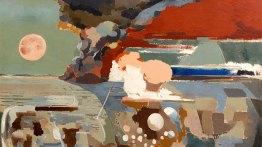
Woolworth’s spectacles. Pudding-basin haircut, rather sparse. Norfolk jacket. Pyjama cuffs below trouser legs and sleeves. Paints and brushes in an old black perambulator. And a sign propped up on a gravestone: ‘As he is anxious to complete his painting of the churchyard Mr Stanley Spencer would be grateful if visitors would kindly avoid distracting his attention from the work.’ This was Spencer in his Cookham dotage, a picture of wilful eccentricity, painting the church, cottages, meadows and Thames banks he had known since childhood. An odd little fellow, with the emphasis on little. He was 5ft 2in, by his family’s estimation, and better suited to the ambulance service than he was to the infantry when he volunteered in 1915.

Fringe benefits | 30 June 2016

Festivals

‘How do we feel about leaving the EU today? Who doesn’t give a fook?’ yelled Oli Sykes of Sheffield’s Bring Me The Horizon — instantly becoming my favourite act of this year’s Glastonbury Festival. Sorry, I’m just not buying the line put out by the Guardian, the BBC, Damon Albarn and the rest of the wankerati that the crowds were bummed out by the referendum going the wrong way. Most of the 160,000 revellers had more pressing matters to consider like: Adele or New Order; long queue for the shower or not bother; samosa or falafel; cider or reefer or both; and — of course — how to negotiate the Passchendaele-like vista of endless, wellie-slurping, soul-sapping mud without losing the will to live.

The big chill | 30 June 2016

Television

It’s sadly possible to imagine that The Living and the Dead was sold to BBC1’s commissioning editors as ‘Poldark meets The Exorcist’. Yet, while that wouldn’t be a completely inaccurate summary, the overall result is a lot more coherent, clever and ambitious than that. At heart, in fact, Tuesday’s first episode was a nifty twist on another genre: the one where a retired detective/gunslinger/master criminal comes out of retirement for one last job. The programme began in Somerset in 1894, where we met Harriet Denning, an unusually bright 16-year-old, whose intellectual curiosity alarmed her mother but who was encouraged in her reading of Ibsen, Zola and Darwin by her proud father.

Refuge from the referendum

Radio

A brief encounter with Radio 4’s Any Questions to gauge the measure of opinion in the shires after the referendum result was enough to convince me we are entering even more torrid times than during the campaign. For some mysterious reason both Harriet Harman and Alex Salmond, billed in Radio Times to appear on the panel alongside Ken Clarke and Chris Grayling, had reneged on their promise and been replaced by Emily Thornberry, the Labour MP who got into trouble in 2014 for her white van man tweet, and Steven Woolfe, an oxymoronic Ukip MEP.

Light and shade | 30 June 2016

Opera

Comedy and tragedy sit close beside one another in Mozart’s operas. Whether it’s the grinning horror of the Così finale — lovers joined, perhaps for ever, to the wrong partners — or the violence and mental instability so barely contained in the flimsy comic fabric of La finta giardiniera, there’s a continuum of emotion that belies the easy binaries of opera buffa and opera seria. Two new productions explore the shifting light of the composer’s chiaroscuro world, letting sunshine into the near-tragedy of Idomeneo and glancing into the darker corners of Le nozze di Figaro.

Moor four

More from Arts

Paradoxically, some ballet masterworks absolutely depend on tiptop performing to demonstrate how great they are. If they don’t get it, they can look like the dodgiest of curiosities — did people in those days really rate this stuff? A whole genre of fiercely zipped tragedies of feeling emerged in Britain and the US in the 1930s and 1940s, fed by Antony Tudor, Frederick Ashton and Robert Helpmann over here, and Martha Graham and José Limón over there; works that, unlike classical dance, require acting skills of rare force and perfect pitch. And this genre can be difficult to restage these days, when we tend to react ruthlessly to work that might look like all sobs and no steps.

Darkness visible

Cinema

Perhaps you have sometimes wondered: how would you even begin to make a film about going blind and being blind and what that means? How, when the subject is so profoundly and inherently uncinematic? Or maybe it’s other thoughts that keep you awake at night — such as when we all finally receive our £350 million a week plus free puppy, where will we be expected to keep them? — but even if that’s so you’ll still find Notes on Blindness to be a singular achievement, as well as a truly wonderful one. This is based on the audio recordings of John Hull, the academic, writer and theologian who was Emeritus Professor of Religious Education at the University of Birmingham.

Money for nothing | 30 June 2016

More from Arts

Tate Modern’s new Switch House extension in London has been greeted with acclaim. It is a building designed in the distorted geometry of neo-modernist cliché, and offers a breathtaking array of piazzas, shops and cafeteria, with the added attraction of a free panorama of London that is much better than the adjacent Shard’s. There has been criticism of the contents, which are more appropriate to an experimental Shoreditch warehouse than a national gallery of 20th-century art. But who cares? The Tate attracts almost five million visitors a year. League tables now dictate how we judge London visitor attractions, just as exam results are used to evaluate schools and waiting times hospitals. Last year the British Museum drew 6.8 million visits, the National Gallery 5.

The eyes have it | 23 June 2016

Opera

Tchaikovsky knew what he thought of the title character of his Eugene Onegin. ‘I loved Tatyana, and was furiously indignant with Onegin who seemed to me a cold, heartless fop,’ he wrote to a friend; and directors, by and large, have been happy to leave it at that. And why not? Dishy but emotionally unavailable Regency dandies have been a growth area in recent years — blame it on Colin Firth, if you like — and Eugene Onegin is probably the standard repertoire opera you’re least likely to see subjected to a directorial updating, in the UK at any rate. Michael Boyd’s new production at Garsington certainly doesn’t update anything.

Madeleine moments

Radio

I’d just heard (on catch-up) Jenny Abramsky (a former director of BBC radio) telling Gillian Reynolds (the esteemed radio critic of the Telegraph) why radio is so special to her: ‘It takes place in my head. It paints pictures in my mind. It talks to me as an individual. It surprises me. It stretches me.’ Then I popped down to the kitchen to make some soup for lunch, reached for the radio button and was hooked instantly as Jeremy Vine talked to a man who had lost his wife in a road accident when their child was just two. (Vine’s Radio 2 lunchtime programme on Monday was focusing on child bereavement following the tragic death of Jo Cox, mother to two young children.) It was just as Abramsky had described. One of those moments.

Animal crackers

Television

The other evening I was driving back in heavy rain from my pilates class when I noticed something rather upsetting in the gated road that goes through our estate. I stopped and got out of the car for a closer look. Yes, as I feared, it was a dead duck. Some bastard had squished her flat. What made me more upset still was that I could see her mate — a mallard drake — swimming forlornly in the ditch next to the road. I loved those ducks like Tony Soprano used to love his ducks. Especially the stupid way they waddled blithely across your path, forcing you to slow down and always making you smile whatever mood you were in. But clearly the tosser who did this was in too much of a hurry: either a van driver or someone in a 4 x 4, I guessed.

Show business

Arts feature

Sport has never held much appeal for me, so I rarely venture into stadiums. But I do appreciate their peculiar power: I was present at the 2012 Paralympics when George Osborne ill-advisedly turned up to award a medal while engaged in a campaign against disability benefits, and was roundly booed by the entire stadium. It was a transporting lesson in the joy of crowds and the proudest I have ever felt to be British. The stadium, ostensibly a facilitator of mass spectatorship, is actually a machine for producing such feelings. The Greeks were explicit about the ritualistic, community-forming function of their games, but it was the Romans who secularised the stadium and gave it its current form.

Jezza’s playing Glasto: is this a good idea?

Columns

I do like a wet and muddy Glastonbury. Albeit, admittedly, not quite as much as I like a dry and sunny one. It’s different, though. When the weather is poor, you become a pioneer, remaking the land, terra-forming the turf with your trudge. On the Sunday evening you can climb high up to the top of the park, the south-west slopes, past the tipis, along from the stone circle, and you will see all that was once green turned to brown. ‘We did that,’ you may think. Glastonbury is a secular pilgrimage, but it is the filth that makes it holy. Don’t laugh at me. It does. Mud, you learn, is not a substance but a process, taking you from wet ground to a slithering, splattering slide to a sucking, squelching treacle that fights for your boots.

Face value | 22 June 2016

Theatre

When Richard III’s bones were unearthed in a Leicester car park, Frankie Boyle suggested the headline ‘Bent royal found at dogging hotspot’. Rupert Goold opens his version of the play by restaging the 2012 excavation as if to inform us that the past and the future are held together by something called time. That glib gesture apart, this is a superb production whose modern-dress aesthetic works, just for once, extremely well. And it works because the costumes are dark, sober and unornamented and this visual restraint moves our attention upwards to the more fertile arena of the face. And what a face Ralph Fiennes has, all meat-cleaver and calculation: the haughty forehead, the deadened eyes, the mistrustful mouth petering out at the edges, the dominant, jeering brow.

Home alone

Cinema

The Secret Life of Pets is the latest animation from Illumination Entertainment, which also brought us Minions and Despicable Me, but whereas they were smart, funny, charming and original, this is not that smart, not that funny, not that charming and not that original. It’s an average caper that feels familiar and suffers mightily from an excess of chase scenes although, in the interests of full disclosure, I should add I attended the screening with a six-year-old who said afterwards: ‘I loved it.’ Six-year-olds. We are fond of them and all that, but they just don’t ever get the bigger picture, do they? This is set in Manhattan and concerns Max, a little terrier as voiced by Louis C.K. (The dogs speak, but to the human ear it sounds like barking.

Absolutely Fabulous

More from Arts

Absolutely Fabulous, which is about to make its cinema debut, is a comedy about women being useless. I watched it obediently in the 1990s — mostly for the clothes — and realise now, with more jaded eyes, that I was invited to laugh only at female failure. Failure is not a bad subject for comedy — it is actually one of the best, as Edmund Blackadder and Alan Partridge and David Brent tell us — but Absolutely Fabulous is too unsophisticated to be funny, and comedy without wit is spite. Absolutely Fabulous is based on a single sketch from Dawn French and Jennifer Saunders who were, then, the only female sketch double act on TV.

Out of this world | 16 June 2016

Arts feature

It is London in the summer of 1871. Queen Victoria has just opened the Royal Albert Hall in memory of her beloved husband; Lewis Carroll’s sequel to Alice in Wonderland has just been published, and French refugees from the Franco-Prussian war continue to arrive in the capital. Among them is Claude Monet, who is having a miserable time in the fog and mist. Not far from the Thames views that he had been painting, a fellow artist has just opened her first exhibition of 155 ‘Spirit Drawings’ in a gallery on Old Bond Street, in the heart of London’s art quarter.

Longborough’s Tannhäuser is a major relief after ENO’s abysmal Tristan

Tannhäuser Longborough Festival Opera, until 18 June The Longborough phenomenon continues, indeed if anything gets more remarkable each year. This year they are tackling Wagner's least popular opera, Tannhäuser, and making it actually thrilling, at least when the title role is taken by Neal Cooper. There really is nothing to be done with parts of Tannhäuser except to get a move on, and that is what the great Wagnerian Anthony Negus does. This is one of the shortest performances I have seen or heard: since Wagner never got the opera into the shape he wanted, there are many possibilities, from his alterations over the years, for adding or subtracting a sizeable chunk.

Split decision

More from Arts

In 1992 I wrote a column that was published under the headline ‘It’s Time to Split the Tate’. To my absolute astonishment, shortly afterwards it was announced that this would actually happen (no doubt a coincidence rather than a response to my words). Hitherto, though it is hard now to recall those times, there had been just a single Tate gallery in London — the one on Millbank, containing a cheerful jumble of British painting from the Tudor era onwards mixed with what was then described as modern ‘foreign’ art. Eventually, Tate Modern opened and became one of the most prominent features on the cultural landscape, not only of London but also of Britain. Nearly six million visitors a year pour through its doors.

Highly illogical

Cinema

Matteo Garrone’s first English-language film is a baroque fantasy based on Pentamerone (Tale of Tales), the 17th-century collection of fairy tales by the Italian poet and courtier Giambattista Basile. (It is also known as The Story of Stories, ‘Lo cunto de li cunti’, but that, I think we can all agree, travels rather less well in the original language.) Garrone, who is best known for his grittily realistic Neapolitan crime drama Gomorrah, has thrown gritty realism entirely to the winds here. Instead, this is fantastically unhinged, veering madly between wonder and horror, gorgeousness and grotesquery, as hearts are eaten, fleas are cuddled, and an old woman’s youth and beauty are restored once she’s been suckled by a witch. (Take that, Clarins!

I dream of Genie

Theatre

Gauche, perhaps, to complain about Aladdin but it slightly deserves it. The terrific Genie opens the show and then disappears for 45 minutes while the plot is explained. My squirmy ten-year-old kept whispering Aladdin-related trivia at me in order to occupy himself as the rags-to-riches storyline was laid out in far too much detail. Visually the show is impressive, despite minor flaws. The rangy architectural sets are intricate confections of teetering filigree but they look a little factory-fresh and unlived-in. Behind them the daylight skies are wrongly composed of a single hue (only the night sky has a single hue).

Swan upping

More from Arts

Was Tamara Rojo, when she danced Swan Lake last Saturday at the Albert Hall, thinking as she shaped each phrase, ‘This will be the last time I dance this ...and this ...and this’? I wonder. She told me a few years back that she had a five-year diary to cover the rest of her dancing career, a diary ending in 2016. Akram Khan’s modern Giselle this autumn will be a Rojo role, but if at 42 she was privately saying farewell to her classical career on Saturday, she did it with the spectacular and refined artistry the public has come to expect. A woman sitting next to me complained that the 5ft 2in Rojo is too short for this ballet.

My big fat Gypsy fortune

Television

In his latest documentary for the This World series, the Romanian film-maker Liviu Tipurita could have been forgiven for treading carefully — and not just because it meant him entering the world of organised crime. After all, his previous film in the series, the uncompromisingly titled Gypsy Child Thieves, was ferociously denounced by Roma groups for showing how some Roma parents send their children into European cities with strict instructions to beg and steal — the charge being not that this was necessarily untrue, but that it might confirm ugly prejudices. So how would Tipurita tackle the equally awkward facts behind The New Gypsy Kings (BBC2, Thursday)?

Women of substance

Radio

Three women, three writers, three very different life experiences. On Monday afternoon the artist Fiona Graham-Mackay introduced us to Imtiaz Dharker, whose portrait she has been painting. While she attempts to capture a visual impression, Imtiaz, who is a poet, tells us what it feels like to be the sitter, the one who is being looked at, drawn, observed with such sharp-eyed scrutiny. A Portrait of... on Radio 4 was one of those seductive programmes that draws you in simply by the quality of the voices and the clear-sighted honesty of what they’re saying. What would it feel like to be painted, and then see yourself as someone else has drawn you? How does the artist know where to begin? With the eyes, the mouth, a first impression?