Paris

Apocalypse Dau

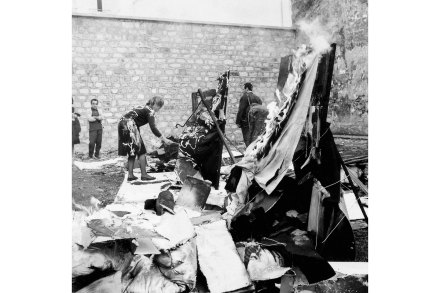
Dau is not so much a film as a document of a mass human experiment. The result is dark, brilliant and profoundly disturbing. For three years up to 400 people, only one a professional actor, lived for months at a time on a city-sized set specially built for the shoot near Kharkov, Ukraine. Modelled on the real Kharkov Institute of Experimental Physics between 1938 and 1968, every detail on the set was scrupulously in period, from the light fittings to the lavatory paper. The participants — who included a real-life Nobel Prize winner and famous orchestra conductor as well as real former KGB and prison officers — were required to live in role 24 hours a day, eating Soviet food, wearing Soviet underwear and undergoing Soviet-style total surveillance.

Whoever declares victory in France this weekend, Macron’s reputation has been diminished

Emmanuel Macron, though it may be a little premature to be sure, appears to be maintaining the semblance of a grasp on his capital today. He seems to have done it much in the manner of Inspector Renault in the film Casablanca, with a roundup of the usual suspects. The sun had barely risen on Paris before the Interior Ministry had announced hundreds of arrests. But few of these seem to have been made on the street. We have seen no camera-phone pictures of mass arrests. Rather, they were made in a pre-dawn sweep. The police will have known exactly who they were looking for. The operation appears to have been successful, even if the notion of preventive detention might make some worry.

Yellow fever

I met a friend for lunch in Paris last Sunday. He and his wife had come up from the countryside for a weekend’s shopping. As we sat down, their nerves were still frayed from the previous day. It was, they told me, the most terrifying few hours of their lives. Trapped between the rioters and the police, they retreated to their hotel, where staff instructed them to stay in their room. The mob soon arrived and against a background noise of helicopters, police sirens, breaking glass and detonations, they tried unsuccessfully to force their way inside the hotel while singing an ode to the Révolution. It has been said that the gilets jaunes movement is to Emmanuel Macron what the miners’ strike was to Margaret Thatcher in the mid-1980s. Not in the slightest.

Let them buy Teslas! How Macron provoked an uprising

Emmanuel Macron is supposed to be the cleverest man in France but he has painted himself so completely into a corner that there’s no way out. Whether the gilets jaunes insurrection achieves its objectives or not, it has become his nemesis. As the yellow wave roils France, Macron is a diminished figure after a crunching fall to earth. Bastion of anti-populism, he has united 70 per cent of France against him. He did self-identify as Jupiter. Now, perhaps, he is looking like a sickly lame duck, albeit one for whom the word hauteur might have been invented. Instead of the confident leader, lecturing and preening on the global stage, he is barricaded in his palace, a sort of latter-day Marie Antoinette. French people can’t afford diesel? Let them buy Teslas.

Poster boy

You don’t need to be much of a psychologist to understand the trajectory of Henri de Toulouse-Lautrec. Born to aristocratic first cousins, in a family never shy of consanguinity, he was blighted by congenital deformities and weaknesses. When his brittle legs broke in his teenage years, they stopped growing altogether, leaving the adult Lautrec tiny as well as weird-looking, with his heavy lips and thick-lidded eyes. Fortunately, Montmartre was waiting for him, offering a boozy and bosomy refuge from his peculiar family and woeful self-regard. In the dance halls of the capital, Lautrec found his people, and in his art they found themselves. His paintings tell the story best, all those fleshy whores lying in bed or lining up for medical examinations.

Short on wit

Nominative determinism is the term for that pleasing accord you occasionally find between name and profession: the immigration minister named Brokenshire, the sprinter named Bolt, and so on. Apparently, there was once a Republican candidate for the California state assembly called Rich White. And how wonderful for there to be a comic novelist called Patrick deWitt. Booker-shortlisted for his western pastiche, The Sisters Brothers, and praised as a latter-day P.G. Wodehouse, the Canadian author certainly seems sure of his calling. My copy of French Exit opens with a letter explaining that each character in his fourth novel ‘deliver[ed] on his or her promise, or beyond his or her promise’.

The piano tuner

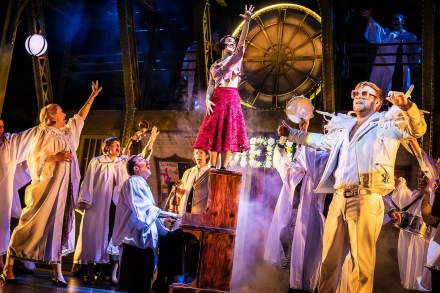
William Boyd’s 15th novel begins well enough. In 1894 Edinburgh, a 24-year-old piano tuner is promoted to the Paris branch of the firm he works for. Boyd is good on the inner workings of the piano: ‘the hammers, the rockers, the jacks, the whippens, the dampers — its innards were exposed like a clock with its back off or a railway engine dismantled in a repair shed.’ Brodie Moncur, the tuner in question, is possessed of perfect pitch and a fine sensibility which places him at odds with the brutal household of his tyrannical father and nine siblings (his mother has died in childbirth).

Round the horn

After the England football team beat Tunisia at this summer’s World Cup, they celebrated with a swimming-pool race on inflatable unicorns. Purple hooves, rainbow manes, cutesy eyes, yellow horns like upended Cornetto cones. The millennial unicorn is unrecognisable from the medieval. The proud unicorns of bestiaries and courtly romances have become the twinkling Bambis of Instagram. Search #unicorn (more than nine million posts) and canter into a pastel clearing of long lashes, swishy tails and crystal horns. ‘My favourite colour,’ announces one unicorn, pink, prancing, wide-eyed, ‘is glitter.’ Compare the simpering My Little Unicorn of the emoji palette with the noble creature in the ‘Unicorn Tapestries’ (c.

Books Podcast: Sebastian Faulks’s ghosts in Paris

In this week’s books podcast, I’m talking to Sebastian Faulks about his brilliant new novel Paris Echo, which describes the twined stories of a Moroccan teenager and an American academic in the French capital – and the way that the ghosts of the past, from the Occupation to the decolonisation of North Africa, still play out in the present.

Paris notebook | 26 July 2018

‘Problème est masculin; solution est féminine,’ says Brigitte, the adored French teacher at the British embassy in Paris. Good way to remember your ‘les’ and ‘las’. If only it were true. Theresa May has not — yet — solved Brexit. Angela Merkel has not resolved the migrant crisis. Anne Hidalgo, the city’s mayor, has not flushed out its rats. If she fails at re-election, it will be on pest control and tent cities. A sign on the Square du Temple gates asks picnickers to leave no croissant crumbs behind. It attracts the rats. Below, in black marker: ‘Et les Algériens?’ Not nice. But tempers run high in hot summers.  The morning after the World Cup final an email went around the embassy.

1968 and all that | 12 July 2018

Unless you have been sleeping under a barricade or a pile of Molotov cocktails it will not have escaped your attention that we — that is, a few broadsheets and BBC4 — have been having a good old think about the events of 1968. When student rioting brought France to its knees and the revolution didn’t quite happen. The Independent helpfully reminded us that Sgt. Pepper’s was released ‘around about then’, and that Lady Chatterley’s Lover was banned (also ‘round about then’). It is highly probable that Philip Larkin was mentioned. Over on BBC4, Joan Bakewell did a slightly better job of framing the whole caper. Daniel Cohn-Bendit got his props, as did the enragés.

Napoleon dynamite | 14 June 2018

The Musée de l’Armée at Les Invalides in Paris has a new exhibition that I believe to be the best and most extensive on the Emperor in three decades. Anyone interested in Napoleon Bonaparte, early 19th-century military history and strategy, the Grande Armée’s campaigns from 1796 to 1815, monumental battle paintings, First Empire beaux-arts, uniforms, weaponry or cartography, has only until 22 July to visit the truly breathtaking Napoleon: Strategist. On entering, you walk past the large busts of six of the seven great captains of history that Napoleon said he admired and wished to emulate: Alexander, Hannibal, Julius Caesar, Henri de la Tour d’Auvergne, Marshal de Saxe and Frederick the Great.

Free-wheeling flakiness

Early on in his introduction of nearly 60 pages, Owen Hatherley writes: ‘I find the Britain promised by Brexiters quite terrifying — xenophobic, paranoid, enclosed, pitifully nostalgic, cruel. But in much of the country that landscape never went away.’ One’s heart sinks. This isn’t even polemical; it’s just silly. The introduction, subtitled ‘What is a European city?’, continues to push the line until something like a position is reached: Britain is awful, Europe is wonderful. I was reminded of certain of my French, Italian and German friends who are excited by the new horizons of living anywhere but in their own homelands, which they find every bit as stultifying as Hatherley does his.

Women and children first

A lady licking an envelope. An intimate thing. It might be only the bill from the coal-man she’s paying, but it has the feel of something else: an assignation, a confession, an apology, a breaking-off. Would this woman in her deep-blue day dress and jacket be so unguarded if the artist had been a man? Mary Cassatt (1844–1926) was a femme sérieuse who painted women of quick wits and tender instincts. No grubby models, no ballet rats, no laundresses, no absinthe. Her sitters, you feel, would write a thank-you note, send flowers, recommend a dressmaker. Mary Cassatt: An American Impressionist in Paris, at the Musée Jacquemart-André, is the first French exhibition to be dedicated to the Pittsburgh-born painter since her death.

Diary of a revolution

In May 1968, civil unrest, bordering on revolution, exploded on to the streets of Paris. Student protesters and striking workers brought France’s economy to a standstill. President Charles de Gaulle warned of civil war. The Spectator’s then editor, Nigel Lawson, asked Nancy Mitford for a diary on the unfolding drama, which she followed from her house, about a mile from Versailles. This is an edited extract. 16 May We have heard the young leaders of the revolution on TV for three quarters of an hour. Having said how much they despised everything in life, especially money, they keenly gave the numbers of their bank accounts so that we could hurry out and send them some. There was a great deal of wailing about their treatment by the police. I despise them for it.

Acropolis now

‘My Acropolis,’ Auguste Rodin called his house at Meudon. Here, the sculptor made a Parthenon above Paris. Surrounded by statues of ‘mutilated gods’, he cast himself as the Phidias of the age. His collection was part cabinet of curiosities, part charnel house. He bought Nile crocodiles and Peking ginger jars, painted sarcophagi and chipped red-figure vases. Crowded among his 6,000 Greek, Roman, Egyptian, Assyrian, Chinese and Japanese objects were his own plasters, bronzes and clay models: hands by the hundred, legs vast and trunkless, arms beckoning, fidgeting, reaching. Isadora Duncan set up her ‘Dionysian’ dance school nearby to teach Hellenic rhythms.

Paris mismatch

There has been much debate recently about what exactly constitutes ‘literary’ fiction. If the term means beguiling, gorgeously crafted novels that are assured of their place alongside other writers, reacting to, and taking pleasure in discussing them; that are aware of the world’s events and their impact on humanity; that have delicately drawn characters; and that range with ease from intense emotions to moments of high drama; and that use careful, subtle imagery, then C. K. Stead’s The Necessary Angel is all this and more. His previous novel, Risk, touched upon banking and Iraq, but was never overwhelmed by them.

High wire act

‘Mid-century modern’ is the useful term popularised by Cara Greenberg’s 1984 book of that title. The United States, the civilisation that turned PR and branding into art forms, wanted homegrown creative heroes. In design there were Charles Eames and George Nelson with their homey hopsack suits and wash’n’wear shirts, their sensible Wasp homilies: a counterattack against imported — and often baffling — exotics from the Bauhaus. It was the same in fine art. Jackson Pollock (Jack the Dripper) was a roughneck from cowboy country in Wyoming who became a darling of the media, not least because of his readily reportable deplorable behaviour.

Rattle’s hall

Even in a Trump world where reality is what you say it is, the London Symphony Orchestra’s announcement of a new concert hall occupies a bubble of pure fantasy. New York architects Diller Scofidio + Renfro have been awarded a contract for a project that has no funding. Concert hall, what concert hall? The only cash on the table is £2.5 million from the Corporation of the City of London. The hall is hot air. There has been no public consultation, no actuarial study of demographic need, no consideration of best possible sites or size. There is not even a consensus within the classical sector that a new hall is a top priority when audiences consistently fail to fill the Barbican and Royal Festival Hall.

Cabbages and kings

The first pastry cook Chaïm Soutine painted came out like a collapsed soufflé. The sitter for ‘The Pastry Cook’ (c.1919) was Rémy Zocchetto, a 17-year-old apprentice at the Garetta Hotel in Céret in southern France. He is deflated, lopsided, slouch-shouldered, in a chef’s jacket several sizes too big for him. His hat is askew, his body a scramble of egg-white paint. Soutine painted at least six cooks in their kitchen livery. In their chef’s whites they look like meringues that have not set (‘Pastry Cook of Cagnes’, 1922), îles flottantes that do not float (‘Cook of Cagnes’, c.1924), and, in the case of the ‘Little Pastry Cook’ (c.