Art

Heavenly bodies | 28 July 2016

Initially it must have been a nasty surprise. On 16 August 1972 an amateur scuba diver named Stefano Mariottini was fishing in shallow waters just off the coast of Calabria. At about noon he was poking around some rocks when he saw part of an arm protruding from the sand. His first thought, a natural one, was that he had found a cadaver. On closer examination, it became clear that there was not just one body but two — and that they were made not of flesh but of metal. Mariottini’s discoveries are world-famous now, taking their name — the Riace bronzes — from the little resort near which he

Dear Mary | 21 July 2016

Q. Since my husband began to appear in the Rich List he has become much more popular with ‘artists’ in our wider circle and we receive enough private view invitations per year to last us a lifetime. My husband is a kind man and will often buy something he doesn’t particularly want just to be supportive. He recently made an appearance at a neighbour’s local show and bought the least awful picture he could see. Now we hear the girlfriend of this artist has been telling friends she is going to challenge my husband over his meanness because ‘it would have been no skin off his nose’ to have bought

Passing through Bologna

Sooner or later, no matter where you are travelling on Italian railways, you are likely to pass through Bologna Centrale. The city is the main junction between the north and south of the country, close to the route through the mountains. It always has been. The teenage Michelangelo stopped off while journeying between Venice and Florence, and — after a contretemps at the customs office, since Bologna was then a city state — carved some small sculptures for the Basilica of San Domenico. In 1786 Goethe spent a few days in this ‘venerable, learned’ place, ‘thronged with people’. It still is all those things. In the 21st century, however, not

Twists, turns and good red herrings

Jessie Burton’s first novel, The Miniaturist, set in 17th-century Amsterdam, read like a lantern-slide show. Her churches were by Pieter Saenredam, her town-houses those of Vermeer and Gerard ter Borch. Her kitchens and corridors and eaves-dropping maids came from Nicolaes Maes. She proved herself a painterly writer with an eye for the telling detail. The Miniaturist was inspired by a real work of art: Petronella Oortman’s dollshouse in the Rijksmuseum. Burton’s fictional Nella becomes the owner of a dollshouse filled with miniature furniture and family whose movements begin eerily to anticipate — perhaps exert malign influence over — events in the real house. Burton has pulled off a similar trick

Cool and underground

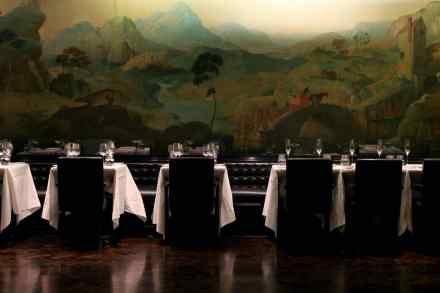
The Keeper’s House sits in the basement of Burlington House, a restaurant in disguise. It is quite different from the grand cafés of St James’s and Mayfair, which are raging exhibitionists with banquettes splayed like limbs. It is secretive and it knows, consciously or not, the tricks of children’s literature: the looking-glass, the wardrobe and the door. It is an 18th-century basement transformed, by magical whimsy, into a restaurant. To visit the loo is a quest for which you need a Gandalf, a hobbit and a lamp. Burlington House looks like an English mansion that stared at Palladio, had a panic attack and exploded. It is clever-clogs land, home to

Giving Tate Modern a lift

Tate Modern, badly overcrowded, has built itself a £260 million extension to spread everyone about the place more. This means that there are more galleries and other big rooms for various modish activities — 60 per cent more space, they say. It opens on 17 June with a total rehang throughout. But having been shown round the place, I’ve become transfixed by the lifts. When it opened in 2000 they never expected nearly five million visitors a year — which is well down on its 2014 Matisse-driven peak of nearly six million, but still twice as many as it was designed for. So when they called back Swiss architects Herzog

Dumbed-down ‘accessible’ writing is just as bad as obscurantist art-speak

When the art critic Robert Hughes died in 2012, someone from the Times turned up on Channel 4 News to sing his praises. The journalist burbled on for a few flailing, hapless minutes and you were left wondering whether she’d actually ever read him. The great critic’s strength was apparently his, wait for it, ‘accessibility’. Eschewing obscurantist art-speak – the desiccated argot of the art establishment – it seemed Hughes’ critical gifts lay in not being difficult to read. But who familiar with Hughes’ robust and sinuous prose would ever call it ‘accessible’? It wasn’t. His facility with language was underpinned by a ferocious intellect, and it showed. Acuity and insight made

Last words | 5 May 2016

This, my 479th, is to be my last contribution as a regular columnist to The Spectator. I have written here for 33 years and 4 months, a way of life really, and one I have greatly enjoyed. I thank Auberon Waugh in absentia for suggesting me to Alexander Chancellor in the first place; and Charles Moore for keeping me on in the early years, once we were up and running. I also thank three quite exceptional arts editors: Gina Lewis, Jenny Naipaul and the doyenne of these pages, Liz Anderson. Things have moved on from my habitual think pieces, outraged rants, ad hominem demolition of palpable idiots written in the

Wings of desire

Maria Sibylla Merian was a game old bird of entrepreneurial bent, with an overwhelming obsession with insects. Born in Frankfurt in 1647, she sacrificed her health and financial stability in pursuit of her passion. It carried her halfway across the globe and earned her lasting renown among a handful of cognoscenti. Merian was 15 when Jan Goedart published the first of his three volumes of Metamorphosis et historia naturalis insectorum and is unlikely to have seen the book until later. Goedart’s purpose, based on close observation of a range of insects, was a fuller understanding of insect life cycles. It was the same purpose to which Maria Merian devoted herself

Is it art or science?

William Henry Fox Talbot had many accomplishments. He was Liberal MP for Chippenham; at Cambridge he won a prize for translating a passage from Macbeth into Greek verse. Over the years he published numerous articles in scholarly journals on subjects ranging from astronomy to botany. One thing he could not do, however, was draw well — and it was this inadequacy that changed the world. While on holiday in Italy in 1832, he became so frustrated by his failure to draw Lake Como satisfactorily using a pencil and a drawing aid known as the camera lucida — his efforts were well below GCSE art standard — that he resolved to

The delights of Hieronymus Bosch

If you hope to inspire an appreciation of Renaissance art in your children, look to Hieronymus Bosch. Ideally, your children will not be sensitive types, nor prone to nightmares, but if they can handle a little, or indeed quite a lot, of fantasy, Bosch will blow their tiny minds. My four-year-old lad, Luca, definitely not a delicate chap, was deeply impressed by ‘The Garden of Earthly Delights’ when I showed him reproductions. He remains unmoved by Leonardo and bored rigid by Giotto, but Bosch snared him. I should hunt down a full-size poster and hang it in his room. I read somewhere that Leonardo DiCaprio snoozed beneath one as a

The Spectator’s notes | 7 April 2016

However wicked tax evasion is and however distasteful some tax avoidance may be, people should imagine a world without tax havens and see if they really want it. The prime reason that tax havens exist is that taxes in most countries are too high. If they did not exist, the competitive element would be reduced, and taxes would go up even more. The EU constantly complains about ‘unfair tax competition’, by which it really means just tax competition itself. Tax avoidance is what most of us try to do (see next item). Resentment about it is largely because the rich find it easier to achieve than the rest of us.

Round-up of new opera

A mixed year so far for new opera. A few really dismal things have appeared from people who should know better. Did the world really need an operatic treatment of Dante’s Divine Comedy for orchestra and chorus? Louis Andriessen thought so; his La Commedia (2004–8) luckily only reared its drab head for one night at the Barbican. If you’re going to splurge as much money as opera often has to splurge, you have to ask yourself why. If you don’t, you create a situation in which operas come about merely because they can, often just to continue the tradition in the most inoffensive way possible. ‘Don’t mind me!’ says this

Easy to swallow

Pharmacy 2 is the reanimated child of Damien Hirst; it lives inside the Newport Street Gallery in a forsaken patch of Lambeth by the railway arches. This makes it look, inevitably, like the set of The Bill, but with a painting of Damien Hirst on a nearby wall, which would surely confuse the Bill. Pharmacy 1 was, for five years until 2003, in Notting Hill. So we are already doing better. It is said that the Royal Pharmaceutical Society of Great Britain complained about Pharmacy 1, and worried it would confuse people looking for a real pharmacy, but I do not know if this was true. If it was, they were too stupid

Sweet and sour | 25 February 2016

Dear, good, kind, sacrificing Little Nell. Here she is kneeling by a wayside pond, bonnet pushed back, shoes and stockings off, while she rests her blistered feet. She scoops a palm of water with cupped hands and tenderly washes those of her grandfather: her feckless, gambling, on-the-lam grandfather. It is an old Oscar Wilde chestnut, but one would have to have a heart of stone to look at William Holman Hunt’s portrait of Charles Dickens’s saintly ‘Little Nell and her Grandfather’ (1845) without laughing. Likewise Arthur Hughes’s ‘The Woodman’s Child’ (1860), a portrait of a tousle-haired country mite sleeping in the woods, attended by a squirrel and robin, their red

Viewing the view

Landskipping is about viewing the view, from the 18th century to the present. From the title (which is the only self-conscious thing about this terrific book) I feared we might be in for a heavy dose of Wordworthishness and ‘the lone enraptured male’ school of writing. But Anna Pavord, along with Kathleen Jamie, Dorothy Wordsworth and Jane Austen, is more down-to-earth than any Romantic moper. Like the author of Sense and Sensibility, she sees both sides of the coin. Romantic mopers, however, do crowd the early pages. Once a ‘correct’ taste for landscape became a desirable attainment in the mid-18th century, the way you looked at wild places was a

Roaming in the gloaming

One of the epigraphs to Peter Davidson’s nocturne on Europe’s arts of twilight is from Hegel: ‘The owl of Minerva begins to fly only at dusk’, an image of philosophy as posthumous, able to explain things only after we have experienced them. Or an image of dusk as threshold, the blue hour when light transforms itself, and other worlds become possible. The Last of the Light is a cultural companion to such notions. A cabinet of curiosities — paintings, poems, music — framed by the idea of Europe as an archipelago of regret, many of whose most vital artefacts have dealt in echo and obscure longing, translated into a feeling

Ai Weiwei’s Aylan Kurdi image is crude, thoughtless and egotistical

Last September a photograph of three-year-old Aylan Kurdi’s lifeless body washed up on a beach near Bodrum made headlines around the world. The image had a significant effect on shifting public perception to the Syrian refugee crisis as well as sparking a debate around the ethics of the circulation of such images. Academics at the University of Sheffield have estimated that 53,000 tweets were sent per hour at the height of the image’s circulation reaching 20 million people around the world in 12 hours. Last week, over four months after the image appeared, the Chinese artist Ai Weiwei made his own contribution to the debate in a photograph which depicts

Show me the Monet

Philip Larkin once remarked that Art Tatum, a jazz musician given to ornate, multi-noted flourishes on the keyboard, reminded him of ‘a dressmaker, who having seen how pretty one frill looks, makes a dress bearing ninety-nine’. If you substitute paintings of flower-beds and dappled sunlight for chromatic keyboard runs, something similar is true of the new blockbuster at the Royal Academy, Painting the Modern Garden. That, however, is only half the verdict on this curious affair. It is a show that feels a bit overblown — like a visit to an enormous Victorian conservatory — but contained inside it is another, triumphantly successful exhibition that is inspiring, exalting and almost

Disciple of Duchamp

Michael Craig-Martin has had a paradoxical career. He is, I think, a disciple of Marcel Duchamp. But the latter famously gave up painting in favour of something more conceptual — ready-mades and whatnot — whereas Craig-Martin began with Duchampian concepts. He once exhibited a glass of water on a shelf together with a claim that he had mentally transformed these, by a kind of transubstantiation, into an oak tree. Then he metamorphosed himself into a still-life painter. As his current exhibition at the Serpentine demonstrates, for nearly 40 years Craig-Martin’s staple subject-matter has been everyday tools, gadgets and accessories. An early example, ‘Vertigo’ (1981), consists of elegantly pared-down line drawings