Art

The week in books | 19 July 2013

The best way to weather the heat wave is to head for the shade with a copy of the new issue of the Spectator, in which you will you find some diverting book reviews to while away an hour or two. Here is a selection: Philip Hensher treads carefully around Winston Churchill’s imperialism, the subject of Lawrence James’ Churchill and Empire: Portrait of an Imperialist. Hensher writes: ‘It is important for historians to make an effort to understand individuals by the standards of their own day, and not ours. There is a dismal school that finds it rewarding to debate whether Napoleon was homophobic or not, but for the most

When a smartphone gallery is better than the real thing

The best way to view some of the world’s greatest works of art is to go nowhere near them. Like other celebrities, the most famous paintings are hard to get close to and there are few less spiritual experiences than being cattle-prodded as part of a crowd through an overpacked exhibition. You may visit in the hope of communing with legendary art but, as often as not, gallery-going is anti-contemplative. While there is no way of replicating the experience of standing in front of a masterpiece, technology can at least allow you your personal space. Take Google Art Project, for example, a collaboration between the omnivorous internet search company and

Saving Italy, by Robert M. Edsel – a review

During the civil war, the Puritan iconoclast William Dowsing recorded with satisfaction his destructive visit in 1644 to the parish church of Sudbury in Suffolk: ‘We brake down a picture of God the Father, 2 crucifixes and pictures of Christ, about an hundred in all.’ The Taleban’s decision in 2001 to blow up two gigantic statues of Buddha in the Bamiyan valley in Afghanistan was more spectacular but not different in kind. War gives licence to such subterranean urges. In an order issued exactly three centuries after Dowsing’s expedition, General Sir Henry Maitland Wilson, supreme Allied commander in the Mediterranean, explained why great art needed to be protected. ‘Works of

Exhibitions: Why can’t the critical fraternity make up its mind?

As more time elapses since the regrettable fracas over Kitaj’s 1994 Tate exhibition and his tragic suicide in 2007, he comes more and more into his own as a great but still underrated artist. When I last wrote about him in this column, back in April, I had not yet seen the portion of his Berlin-originated retrospective which was shown at Pallant House in Chichester. Happily I managed to get there before it closed and was once again deeply impressed by the range and painterly intelligence of this extraordinary artist. Now another couple of shows pay justified tribute to his genius, this time as manifested through his printed work. After

Clive James – laughing and loving

Clive James was a recurring presence in last weekend’s literary press. There was, I regret to say, a valedictory feel to the coverage. Robert McCrum, of the Guardian, was not so much suggestive as openly morbid: ‘If word of his death has been exaggerated, there’s no question, on meeting him, that he’s into injury time, with a nagging cough that punctuates our conversation.’ If those words and others like them made little impact on the reader, then the photograph of James that illustrates McCrum’s interview might. Old age looks no fun; serious illness even less so. But, James’ spirit does not seem to have been shaken by the indignities visited upon

Don’t believe the spin, this arts cut is a disaster

Department for Culture, Media and Sport (DCMS) spending review rounds always work like this: officials choose three figures of increasing severity and ask those they fund to model what would happen should their funding be cut by the corresponding amounts. The organisations duly devote considerable resources to trying to work out what they could cut or stop doing entirely, worrying staff and donors and driving speculation in the press. Then the culture secretary of the day proudly announces that he or she has fought culture’s corner and we all now only have to cut by the lower figure. Cue grateful thanks in public, and private pain as the agreed changes

Christopher Sykes’s diary: David Hockney, Bridlington lobster, and the risks of a third martini

I began my week with a trip to Bridlington, the closest seaside town to my childhood home. ‘Brid’, as it’s known to the locals, has a special British charm, comprising miles of unspoilt beach, beach huts, a pretty little harbour, fish-and-chip shops galore, rows of guest houses and The Expanse, a splendid old-fashioned hotel. The council are, however, missing a trick. Brid’s main fishing industry these days is lobsters, as delicious as any you will ever taste. You wouldn’t know it, however, as, apart from a few expensive ones kept in tanks at the Blue Lobster on the harbour, they all go to Europe. So, come on Brid, how about

Spectator Play: The highs and the lows of what’s going on in arts this week | 21 June 2013

In this week’s lead feature in the Arts section, Tom Rosenthal explains just why he thinks the Lowry retrospective at Tate Britain is so long overdue. Lowry is one of our most popular artists – and it is exactly this that has been his downfall. ‘Can one disapprove of someone merely because he popular? Clearly one can’, writes Rosenthal. The lack of Lowry in London only highlights ‘the fashionable dislike of Lowry’s art’. But, finally, Lowry has made it to the walls of Tate Britain. Should his work be there? Andrew Lambirth will be reviewing the exhibition in a future issue of The Spectator, but for now you can make

Royal Ascot is not the same without Henry Cecil

For a moment it seemed incongruous reading obituaries in the same week of Sir Henry Cecil and of Esther Williams, the Hollywood star whom most of us only ever remember seeing in a swimsuit amid whirling patterns of leggy lovelies in water ballets. Then I recalled her comment that the only thing Hollywood’s moguls ever changed in her series of films were her leading men and the water in the pool and I realised there was something of a parallel. Esther Williams did her thing so exquisitely that all people ever wanted to see was a repeat. Those whom she did it with became irrelevant, and there was something of

Hollywood and oligarchs descend on Art Basel

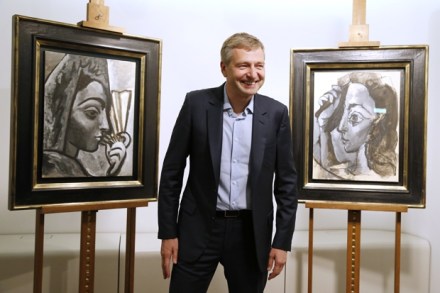
The art world has descended on the almost attractive city of Basel in Switzerland this week, for the annual art fair. And where the art world goes, glamorous collectors follow. Leonardo di Caprio appeared to be in the mood for some serious shopping when I glimpsed him, casting his eye over a Warhol or two. He may have looked at the Alexander Calder, or perhaps he saw the Edmund de Waal or the exquisite pair of Peter Doig etchings. And there’s this chap called Picasso; mark my words, dear readers, he’s going to be big. Di Caprio had competition from one Roman Abramovitch, who sloped by a few Edvard Munchs,

Painting begins at 90 – celebration of Jeffrey Camp, Anthony Eyton and Patrick George

The year 1923 was a good one for British artists, witnessing the birth of three painters who became friends and whose work epitomises a rich strand of realism in the native tradition. Jeffery Camp was born at Oulton Broad in Suffolk, and studied at Lowestoft and Ipswich Art Schools before going to Edinburgh College of Art in 1941. Anthony Eyton was born in Teddington, Middlesex, and attended the Department of Fine Art at the University of Reading for a term, studying under Professor Anthony Betts. He served five years in the army before continuing his education at Camberwell School of Arts and Crafts (1947–51). Patrick George was born in Manchester,

Seriously eccentric – Chaplin & Company by Mave Fellowes

Chaplin & Company is an alarming proposition for anyone with a low threshold for the cute and quirky. Its main character, Odeline Milk, is a mime artist. She is serious and eccentric. In bed she lies on her back ‘as if she has been arranged this way and told not to move’. She wears brogues several sizes too big for her feet. When we meet her, she is moving into a canal boat in London. Her mother, with whom she lived in Arundel, West Sussex, has just died. Odeline does not dwell on this. Instead she is thinking about her new life. In London, she thinks, her artistic endeavours will

Dreams and Nightmares: Europe in the twentieth century

So much abuse has been heaped on the European Union in recent years that it is easy to forget that Europe and the EU are not the same thing. Geert Mak reminds us of this fact. He is one of the most celebrated journalists and commentators in the Netherlands. Mak – widely read, multi-lingual and endlessly curious – considers the whole of Europe to be his home. He has won awards for his books in Germany, as well as in his native Holland, and been inducted into the Legion d’Honneur in France. He is also, on the side, a bit of an anglophile. In 1999, with millennial fever rising, Mak

What is the point of fiction if not to expand horizons?

While Ian McEwan’s recent piece in the Guardian is not expressly termed a treatise on the value of art, it is hard to see it otherwise. What is the use of fiction, what can a novelist tell us of, ‘why the Industrial Revolution began, or how the Higgs boson confers mass on fundamental particles…?’ he asks. At the heart of this modern day ‘defense of poesy’ is McEwan’s devotion to realism: it is realism that falls last to ‘the icy waters of scepticism’ and it is realism that saves him from it. He gives an account of how his thirteen year-old self, so overcome by the description of the 1900

The Young Van Dyck edited by Alejandro Vergara and Friso Lammertse – review

Precocious genius will never fail to impress. But it is also very hard to relate to. Aged 14, Anthony Van Dyck painted a Portrait of a Seventy-Year-Old man that looked like a portrait by a seventy-year-old man, signed it, and marked it with his age, the idea being that the younger you are, the more impressive you are. And Van Dyck was impressive. Looking at the work he produced in his teenage years, it’s hard not to think of Julius Caesar, sniveling before a statue of Alexander the Great because he achieved so much, so young. Frankly, I feel like a loser. Which is why The Young Van Dyck, edited

How Roy Lichtenstein became weighed down with superficiality

On both sides of the Atlantic there are still heated debates about who invented Pop Art, the Americans or the British, but it seems much more probable that concurrently each initiated their own brand in response to the zeitgeist of post-war consumerism. Certainly, the American Roy Lichtenstein (1923–97), after near-abstract beginnings, started in 1961 to paint large freehand versions of comic-strip frames, complete with speech bubbles, and exhibited them in New York in the first Pop Art shows. He moved on a bit from comic strips to Disney, advertising and the ordinary objects of the modern environment, and developed a style of measured drawing and stencils that broke up colour

Roy Lichtenstein: comic genius?

Tate Modern promises that its forthcoming retrospective will showcase ‘the full scope of Roy Lichtenstein’s artistic explorations’, to which Spectator art critic Andrew Lambirth responded acidly: ‘I look forward to being pleasantly surprised.’ And it’s true that once Lichtenstein perfected his dot patterning technique in the mid-Sixties, he stuck with it until his death more than 30 years later. Alastair Sooke’s How Modern Art Was Saved By Donald Duck is available as a Penguin Specials paperback from Tate Modern; elsewhere, it’s in eBook format only. It won’t convince any sceptics of Lichtenstein’s infinite versatility, but it does make a case for him as a supreme examiner of style. ‘Perfected’ is

Montgomery Clift and Elizabeth Taylor: beyond chemistry

Regularly voted one of the greatest American novels of the last century, Theodore Dreiser’s moralising epic An American Tragedy (1925) hasn’t aged well. Adapted for the cinema as A Place in the Sun, however, it paired Montgomery Clift with the 17-year-old Elizabeth Taylor and gave us a film that still grips more than 60 years later. Director George Stevens disparaged what he called Technicolor’s ‘Oh, what a beautiful morning’ quality, and monochrome is indeed more suited to the ethical grey area explored by the film: whether a man who plans a murder but can’t go through with it is as guilty as a killer. Clift and Taylor don’t have conventional

Interview with a writer: John Ashbery

John Ashbery is recognized as one of the most eminent American poets of the twentieth-century. He also been called America’s greatest living poet today. Ashbery published his first book of poems Some Trees in 1956; it earned him the Yale Younger Poets Prize: a competition that was judged by W.H. Auden at the time. He has picked up many literary prizes, including the Pulitzer Prize for Poetry, the National Book Critics Circle Award and the National Book Award. At 85, he shows no signs of putting down his pen. He has recently published a collection of poems entitled Quick Question. Although the majority of critics have recognized his talent, many

The Duchess of Cambridge, defining a portrait

Poor Kate Middleton. In the royal tradition of artistic and literary representation, what defines her at this moment in time? The creepy feature on her wardrobe statistics in February’s Vogue? Or Paul Emsley’s even creepier official portrait revealed last week? Emsley’s Vaseline lens ‘Gaussian girl’ take on the future consort would have been appropriate had she the complexion of Doris Day, whose preference for the blurred lens was renowned. The fact we all know that Kate’s skin is like butter, her eyes sparkly, and demeanour jollier than her hockey stick makes her first official portrait instantly bewildering. Just imagine, though, if we didn’t know any of those things. Traditionally, we