Notes on...

What your signature says about you

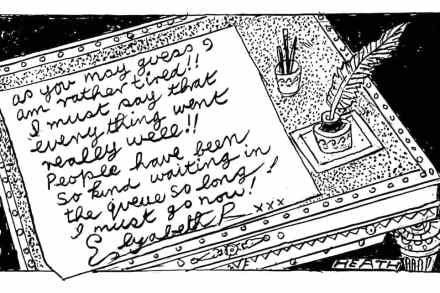
I have a photograph of Queen Elizabeth II and her parents on the wall of my bathroom, not out of any lack of respect but because the gloom there prevents it fading. It is signed Albert, with an odd droop forward of the bar of the T to join a single flourish beneath, and Elizabeth in a familiar hand. This is not the late Queen’s signature, though, for it was made in 1927, when Princess Elizabeth was hardly into talking, let alone signing. Queen Elizabeth, whom we still think of as the Queen Mother, was a simple royal duchess then. Yet one can’t help thinking that in choosing her style of italic signature she had taken note of that of her namesake: the first Queen Elizabeth.

The barcode revolution

Beep-bop. The sound of the supermarket checkout – a noise Morrisons felt the need to mute after the Queen’s death – is made possible by an invention which turns 70 this week: the barcode. On 7 October 1952, a patent was granted to American inventors Bernard Silver and Norman Woodland. Four years earlier, a shopkeeper in Pennsylvania went to the local university begging for help. He needed a way to get customers through his store quickly because logistics were stopping him meeting demand since typing in product numbers and prices into tills was cumbersome. An electronic system wasn’t possible, said the university. Silver overheard the conversation, set up shop in his parents’ apartment and enlisted Woodland.

In defence of Warhammer

Warhammer is a tabletop battle game. Players build and paint little models of aliens, tanks and killer robots and then set their armies against one another on a miniature battlefield. It’s a hobby that lights up the obsessive bits of the male brain: collecting, DIY, military uniforms, hierarchy and complex calculation – all in the name of domination. There are Warhammer clubs across the country as well as 138 dedicated Games Workshops where players can battle one another. Enthusiasts have long been stigmatised as hygienically challenged young men with limited knowledge of the opposite sex; that’s certainly how I remember my early teens when I was – briefly – into Warhammer.

The joy – and occasional pain – of a fountain pen

Our new King isn’t the only royal to have lost his rag over a leaky pen, as happened when he was signing a visitors’ book at Hillsborough Castle near Belfast. ‘Oh God, I hate this,’ King Charles said, before handing the pen to his wife, Camilla, Queen Consort. ‘I can’t bear this bloody thing… every stinking time,’ he added. Tired of having to wash his hands after every warrant-signing session, the 10th-century Arab Egyptian ruler the Fatima caliph al-Mu’izz demanded his servants find him a writing utensil that wouldn’t leak everywhere. Courtiers set to work and soon a revolutionary new pen appeared that held ink in a reservoir. It allowed him to write at any angle without fear of leakages.

The Queen’s handbag was her secret weapon

In this period of national mourning, it may seem frivolous to comment on the late Queen’s handbag. After seven decades of selfless service to the nation, fashion is but a footnote to Her Majesty’s glorious reign. And yet her style is something that helped to create the powerful majestic image of Queen Elizabeth II, and which made her instantly recognisable worldwide. A key part of that image, and a constant presence in her working life, was her black Launer handbag. Launer London was Her Majesty’s handbag maker for more than 50 years and has held the Royal Warrant since 1968. Launer bags are formal and structured, and proved to be the ideal regal accessory for public engagements. Its first royal patronage came from HM Queen Elizabeth the Queen Mother in the 1950s.

The competitive world of metal detecting

Some detectorists will tell you that the holy grail of metal detecting is a hoard of Roman coins or Anglo-Saxon jewellery. Others will point out – borrowing a line from the TV series Detectorists – that actually the holy grail of metal detecting is the Holy Grail. Since I took up metal detecting, last summer, I have tried to set myself more modest goals. They can be summed up in some wise words spoken to me in a field in Wiltshire after I’d suffered a near-barren day (my only finds having been a musket ball and ‘canslaw’ – a shredded drinks can). ‘A find is a bonus, a good find is a good bonus,’ said my fellow detectorist with a consoling hand on my shoulder.

I’m being terrorised by a Bengal cat

Over the past year and a half, I have been victimised by my neighbour’s cat. Bollinger the Bengal weighs just seven pounds and has a silly dangly bell around his neck, but he manages to terrorise both me and my two cats. He fights my male cat, George, so viciously that I fear he might kill him. Nothing irks me more than watching people cooing around Bollinger when they see his ocelot-like frame. While some Bengal cats can be wonderful pets, their wild instincts make them territorial and aggressive, as well as horribly effective hunters that can ravage bird populations. This summer, the town of Walldorf in southwest Germany introduced a cat curfew to protect the breeding season of the endangered crested lark.

The politics of butter

Butter was not a major part of my childhood. In fact, I don’t remember it ever being in our fridge. My parents were subject to the saturated fat scaremongering of the 1980s, and consequently believed that butter was the enemy. Instead, we had spread: margarine, rebranded as a cholesterol-busting alternative to heart-clogging butter. But spread wasn’t so bad. It lubricated my sandwiches and melted on my toast. Spread was everyday. Butter was for high days and holidays. Otherwise, we were all certain to die young. Butter has always been a bellwether of the British psyche. We want luxury, but only every so often, and only so much – and we don’t want to pay too much for it.

The brutal truth about holiday packing

The general flying advice this year, with airports resembling cattle markets and when you can’t be sure if you’re ever going to take off, is: only travel with hand luggage. Packing a fortnight’s holiday into the tiniest of bags has become an art form. Social media is awash with tips on minimalist packing and dedicated websites on travelling light have sprung up, with experts advising what you should, and shouldn’t, pack. It’s depressing. Yes, the lighter the plane the less fuel it uses, which is no bad thing for the environment. But a holiday is meant to be an indulgence, a chance to experiment with new outfits. Instead, the less-is-more principle is being abused to such an extreme that we’re having to do clothes-washing while away on holiday.

Who needs a hosepipe? The watering cans worth investing in

In the hot, dry summer of 1976, I was working as a gardening student at Arboretum Kalmthout in Belgium. The temperatures in July were frequently 40°C by lunchtime, so we worked in the early mornings and through the evenings. My job was to drive a tractor pulling a trailer, on to which were placed dustbins full of water drawn from a borehole. These were ferried around the grounds so we could water rare, precious and drought-hating rhododendron and tree species. The owners of the garden were white-faced with apprehension all that month but the stratagem worked and we saved the lot. Something of that anxiety comes back to me, for my garden is at risk of losing plants from drought. We have had a measly 0.

How to blend your own beard oil

Every few months I take out a box of essential oils and carefully lay them out on my kitchen table, organising them in order from sweet-smelling to musty. On the left will be scents like juniper berry, lime, frankincense and bergamot; in the middle, woodish fragrances such as sandalwood and cedarwood; on the right, the darker stuff of patchouli and pine needle – and occasionally, when I’m feeling brave in my endeavour to make the perfect beard oil, lavender. Next I fill several large vials with a mixture of carrier oils, usually almond, jojoba and argan (and normally with almond making up the bulk as it’s the cheapest). I then begin mixing in various essential oils: a dash here, a dash there.

The parallel universe you can explore on two wheels

Many of us daydream about escaping into an imaginary parallel universe. The good news is that Britain has its own genuine, and literally parallel, universe that we can escape into at any moment. It’s the National Cycle Network that threads its way quietly and meanderingly over, under and alongside our gridlocked main roads and our daily lives. Once you try it, you’ll fall in love with supposedly ‘broken Britain’ all over again. You’ll be reminded that it’s a country of dog-walkers, rivers, farms and front gardens. And you don’t have to wear Lycra to do this. You just need ordinary clothes, plus KitKats, Thermos and sandwiches, and off you trundle at 8 mph.

Hornets aren’t the villains they’re made out to be

There’s surely not a more despised creature in Britain than the hornet. They have long been viewed as yellow jacketed killers: wasps on steroids with Hannibal Lecter tendencies. Unlike bees, a member of the same insect family, you’d be hard pushed to find a friendly portrayal of a hornet (with the exception, perhaps, of Watford FC’s mascot). Yet hornets are misunderstood villains. Like bees, they are important pollinators. What’s more, the fact that hornets are carnivores (bees are not) means they feed on many of the species of caterpillars and flies that destroy plants and crops. One of their main food sources is the nectar from ivy.

The lost art of letterheads

One of the pleasures of the letters from unhappy ministers to the Prime Minister last week (though not, presumably, for the recipient) was the assortment of letterheads from Whitehall departments we saw in the papers. One was from Nadhim Zahawi, on HM Treasury writing paper. It’s a fair bet that most of Mr Z’s communication these days is by email or text or WhatsApp. Yet when it came to calling for Boris Johnson to resign, nothing would do but a letter with the Treasury insignia to indicate that the writer was staying where he was. There are so few opportunities nowadays to show off a letterhead that they have become a special medium.

The twists and turns of ‘desire paths’

Pause in a park or field in summer and look out across the grass and you’ll see a multitude of thin, earthy tracks breaking up the swaths of green like shatters in a pane of glass. These are most commonly known as desire paths – although other names include cow paths, desire lines, pirate paths or social trails – and are created when humans (or animals) are drawn in the same direction over and over, flattening the grass and eventually wearing it away. The term ‘desire path’ was coined by French scientist, philosopher and poet Gaston Bachelard in his 1958 book La Poétique de l’Éspace (or ‘The Poetics of Space’).

We’ve reached standing ovation saturation

‘And now the end is here / And so I face the final curtain…’ You said it, Frank. The lights dim, the curtain falls, exeunt all to rapturous applause. Too rapturous, if you ask me. The standing ovation, once the exception, is now the rule. Post-Covid, I got it. After months of empty theatres and keeping the ghost lamps burning, I’d have clapped any man and his dog to the skies. But university revues, pub two-handers, primary-school plays? I feel a scab for sitting when every man jack is on his feet. I did it at Cabaret, The Glass Menagerie and Straight Line Crazy. A sit-in protest. ‘Grinch,’ you’ll say, and fair enough. But I want a standing ovation to mean something. An exclamation mark, not just a standard full-stop.

The triumph of the National Army Museum

Five years ago this month I wrote an article in The Spectator denouncing the National Army Museum after its £24 million Heritage Lottery Funded refurbishment. The concept of decolonisation was then in its infancy, and I criticised the museum’s relentless attempts to make visitors ashamed of the British Army’s supposed legacy of imperialism and slavery, when that constituted only a tiny part of its overall glorious story (and it was in the forefront of fighting against the latter). I am thrilled to say that today the museum, which has been under new leadership since 2018, has returned to the aims of its Royal Charter, anchored itself to historical facts rather than contemporary politicised fashions, and thus been totally transformed.

The mystery and delight of English elderflower

There’s an old saying that English summertime begins when the frothy heads of elderflowers appear in hedgerows – and ends when the black elderberries have ripened. People have been picking these great white ‘plates’, as the flower heads are known, to make drinks since at least Tudor times. In Hannah Glasse’s The Art of Cookery Made Plain and Easy (1747) there’s a recipe for elderflower wine. But only in the past 20 years or so have elderflower cordial and pressé become ubiquitous as soft drinks. That expansion has largely been brought about by Peverel Manners of Belvoir Fruit Farms in Leicestershire. ‘Pev’, a cousin of the Duke of Rutland, still uses his mother’s recipe.

Beach huts have never been so fashionable – or expensive

Despite claims the property market is on the brink of a crash, one niche seems recession-proof: beach huts, barely bigger than Wendy Houses, have never been more in demand. Rightmove has reported that the average asking price for these glorified sheds has more than doubled since 2019, so on average a beach hut costs an astonishing £50,000. Last year, the UK’s most expensive beach hut sold in Dorset for £500,000. This news is especially galling for me. I bought a beach hut in Clacton-on-Sea for £2,500 in 2011. If I hadn’t sold it, it’d probably be worth ten times that now. The popularity of beach huts comes from the English obsession with prudishness.

How to make a royally good Dubonnet cocktail

The Platinum Jubilee celebrations look like boom time for the drinks industry, with various whisky, gin and port brands all releasing special commemorative bottles. But there’s one curious omission: Dubonnet, a liqueur that is said to be the Queen’s favourite. According to a spokesman from parent company Pernod Ricard, there’s nothing planned to celebrate 70 years on the throne of its most famous fan. To be honest, I wasn’t expecting a flurry of activity. I picture the Dubonnet promotional department as two old Frenchmen asleep by a telex machine in the back of a dusty café in Béziers. But then again, who needs le marketing when you’ve got the Queen?