More from Books

Judge a critic by the quality of his mistakes

What the title promises is not found inside. It is a tease. John Sutherland says he has ‘been paid one way or another, to read books all my life’, yet he does not regard himself as well read in the genre of novels. With two million languishing in the British Library vaults, nobody could be, he insists. And although the publishers have given it the subtitle ‘A guide to 500 great novels and a handful of literary curiosities’, the author declares in his admirably succinct preface: ‘This book is not a guide.’ He’s right. It is an engaging game, or a compendium of games (as the Gamages Christmas catalogue used to describe a chess board with snakes and ladders on the back). I started off by seeing what the Prof thought of some of the books I like.

Exclamation marks, no; aertex shirts, yes!

Jonathan Meades, the architectural, food and cultural commentator, appears on television in a pair of retro shades and a trademark Blues Brother suit. He looks like a poseur, and indeed studied drama at Rada. Lynn Barber, the ‘celebrity interviewer’, is the self-acknowledged scourge of pomposity and pretension. (Melvyn Bragg, among others, has felt the lash of her schoolmarm tongue.) Like Meades, Barber grew up in early 1950s middle-class England. An only child, she found a way out of the bridge/ canasta tea parties and sherry-tippling of Twickenham, her childhood home, to become a staff writer on Penthouse girlie magazine; her first book, published in 1975, was a sex manual entitled How to Improve Your Man in Bed (which, incidentally, my wife has still not read).

Dylan Thomas: boozer, womaniser, sponger, charlatan — or master craftsman?

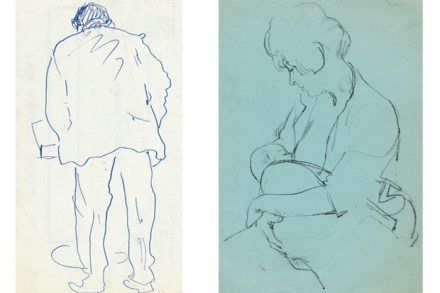
Who the hell was Dylan Thomas? Boozer, womaniser, sponger, charlatan — or master craftsman, besotted husband, generosity personified and one of the greatest literary talents of the 20th century? Or all of these? Fifty years ago (in November 1964) the writer Constantine Fitzgibbon grappled with these questions in The Spectator as he completed the first full-length biography of his friend the poet. The article was illustrated by my late father, the artist Alfred Janes, a mutual friend (Thomas had a lot of them). It was one of three portraits that he made of his contemporary, whom he had first met in their ‘ugly, lovely’ hometown of Swansea in the1930s. This one was posthumous: Thomas had died in New York in 1953 aged 39.

A cult of inspired amateurishness that seized the 60s

The Exploding Galaxy flashed brightly in the black-and-white world that was just coming to an end as I was growing up. When I first met them, my opinion of art was fixed firmly against what I thought of as amateur. I came from a theatrical family, dedicated to extreme professionalism and mockery of anything less. Whether it was holiday pantomimes, school plays or cabaret flamenco — anything short of Yehudi Menuhin and John Gielgud — we would be told how ludicrous they were, how comically inept. It seemed to be the only thing my parents agreed about, and so we went along with it. How we laughed! They would wrap themselves in contempt for less immaculate performers as a form of protection from the rawness of appearing in public. Professionalism is a counterfeit art.

Half-poetry, half-prose, half-Belgian – and not half bad

Patrick McGuinness’s prose trembles on the edge of poetry, occasionally indeed tipping gently over into it. This is thoroughly characteristic of a book that does sometimes feel as though it might be an abandoned sequence of poems, reconfigured in often spell-binding prose. The title itself is poetic: who the ‘other people’ are and which ‘countries’ they come from is never wholly clear. However, perhaps this cavil is unjustified. Poetry, after all, inhabits a literary space in which fact and fiction merge or dissolve into one another, as they do in (or are made to by) memory, so the subtitle hints at what is to follow, which is an attempt to describe the act of remembering.

It’s not nice being used and abused

The term ‘psychological thriller’ is an elastic one these days, tagged liberally on to any story of suspense that explores motivations while keeping blood and chainsaws to a minimum. In many cases, the line between a thriller and a crime novel has become too blurred to be useful. In the novels of Nicci French, however, there is little ambiguity: their pattern is to deliver the mental shock-equivalent of a dead body, followed only later by a real one. It is an effective formula — as Alfred Hitchcock put it: ‘There is no terror in the bang, only in the anticipation of it.’ Among the best of Hitchcock’s own psychological thrillers is Spellbound, whose story unusually wrapped the subject of psychoanalysis around a murder mystery.

Bitchiness gets in the way of the Gielgoodies

In the summer of 1955 a group of finals students trooped into a classroom at the Royal Academy of Dramatic Art. We had come to hear Ernest Milton talk about theatre. It was exciting to be in contact with a famous actor, even though Milton had not worked for some time. But better him than the man who taught diction, whose chief experience had been as a camel-driver in Chu Chin Chow. Milton was sitting on a chair in a long, old raincoat, a brown paper bag of groceries at his feet; his beaky nose sniffed us as we crowded into the room. Peter O’Toole was in the vanguard. He had told us all that Milton was the genuine article.

John Crace digested – twice

Fiction ‘So how come we’re in the same book?’ Paul from The Stranger’s Child asked Florence from On Chesil Beach. ‘Apparently,’ replied Florence looking up from the introduction to The 21st Century Digested, ‘the parodies of new books that John Crace has been doing in the Guardian since 2000 are now so popular that 131 of them have been turned into a hardback collection.’ ‘Impressive,’ murmured Paul. ‘But one thing worries me. Once even Crace’s fans see them all together, won’t they be forced to realise that he relies on the same handful of tricks for almost every novel he takes on?’ ‘You mean, like simply having the characters point out what’s wrong with the book in their dialogue?

What would Raymond Chandler do?

If the inclusion of the erstwhile master of the genre, Raymond Chandler, as a fictonalised character in a pastiche 1930s detective novel is a bit of a gimmick, it is a nice gimmick. In The Kept Girl it keeps us guessing whether the author, Kim Cooper, believes Chandler’s greatest invention, Philip Marlowe, was a self-portrait, or based on someone he knew. The most likely candidate Cooper offers is Tom James, a Los Angeles detective inspector busted down to traffic cop for trying to expose police corruption. But equal billing might go to the fictional Chandler’s secretary, Muriel Fischer, a woman with more pluck than the average Chandler heroine. In this story Chandler is forced to investigate the fate of money that has gone missing from his employer, Dabney Oil.

Who’s raiding the fridge?

There is a problem with describing what happens in Nagasaki: impossible to reveal much of the plot without flagging up serious spoiler alerts. The story demands an innocent eye; the gaining of knowledge should come page by page, and not be hurried. To set the scene: Shimura-san, a bachelor of 56, set in his ways, lives quietly in a house on the steep hillside above the Nagasaki dockyards. He has an undemanding job as a meteorologist, analysing weather patterns. One day, returning after work, hot, sticky and tormented by the clamour of cicadas, he notices, not for the first time, that a pot of yoghurt is missing from the fridge. Is the fruit juice bottle exactly where he left it that morning? He measures the level, and next day it has dropped.

The fruitcake island of Sicily and its legion of literary visitors

At the opposite end of the Continent to ourselves, Sicily has always been an attraction for the English who, from the vantage of Europe’s historically most stable society, have gazed with fascination at perhaps its least stable. There were already links between us in the age of the Normans, who conquered Sicily at roughly the same time as they conquered us. The revival of classical learning in the Renaissance made the English increasingly familiar with the Sicilian connections of Homer, Plato, Archimedes, Aeschylus, Pindar, Empedocles, Theocritus, Virgil and Cicero, and with the island’s mythological and classical geography. Shakespeare set several plays there. English travellers and reprobates were among the first to make Naples and Sicily their playground.

Shooting prize-dispensing fish in literary barrels

Edward St Aubyn’s new novel is a jauntily malicious satire on literary prizes in general, the Man Booker Prize in particular and, it may be presumed, the 2011 Man Booker Prize in especial particular. That was the year of the great ‘readability’ brouhaha in which — as every reviewer will point out — among many unexpected omissions from the longlist was Edward St Aubyn. He afterwards told an interviewer that ‘the Booker 2011 is of no more interest to me than the World Heavyweight Championship, which I’m not going to win either.

The book that brought out the Lady Bracknell in me

I’ve always said that speech is my second language, so naturally I’m somewhat slang-shy; I love words all written down properly and punctuated to within an inch of their lives. Not so Jonathon Green, who has the same relationship with slang as Jordan does with eating wedding cake in a thong; five books about it published and another one in the pipeline. According to Wikipedia, Green is often referred to as ‘the English-speaking world’s leading lexicographer of slang’, and has even been described as ‘the most acclaimed British lexicographer since Dr Johnson’.

For God, King and Country

Flags and flowers: three bloody years worked in silk. At the needle’s eye stand easy, ghost, slip through my fingers your blue, indelible, weightless kisses for the children. Tell Charlie, Min, time is short now. Up to the firing line for night operations — a ‘fabrication française’ where threads unravel, unvarnished truths must be embroidered by cheery cards. Not the only one not by a long way, your loving brother Albert.

To be topp at lat., throw your Cambridge Latin Course away

The wisest words about learning Latin were said by that gifted prep-school boy, Nigel Molesworth: ‘Actually, it is quite easy to be topp in lat. You just have to work.’ But things have changed since Molesworth learnt Latin at St Custard’s in the 1950s. Over the last half-century, the work has been extracted from Latin learning and, without the work, the whole point of the language disappears. As Gwynne’s Latin — an uplifting throwback to the good old days — reveals, many schools now don’t teach the vocative case. In the Cambridge Latin Course, used in 85 per cent of schools, you learn the nominative, accusative and dative cases in the first volume. Two more cases appear in the second, and you only learn the ablative at the end of the fourth.

An escape from New South Wales

Thomas Keneally has constructed his latest novel around a framework of true events: the mass break-out of Japanese PoWs from a camp in New South Wales. This intrinsically thrilling incident, triggered by a fascinating clash between mutually uncomprehending cultures, is an obvious gift to a writer. There may be some who claim that any novelist could therefore have produced an interesting fictional version of it; but this is like saying that anyone could have made a landscape out of the fine park at Blenheim. Keneally spotted both the tale and its possibilities, which in itself is a truly enviable talent. His imagination is fired by the incongruities of the camp in the small town of Cowra, here fictionalised as Gawell.

The train stations that don’t really exist

In 1964, as part of his railway cuts, Dr Beeching ordered the closure of Duncraig, a small, little-used station in the Scottish Highlands. The train drivers working the line simply ignored him. They continued to stop there, and the station remains open to this day. A world where nothing ever changes, or indeed happens — this is just the sort of world that appeals to Dixe Wills. His latest travelogue takes in 38 of the 150 or so remaining ‘request’ stops on Britain’s railway network. I didn’t know such things existed at all, but apparently there they are (including Duncraig), only seeing action as and when a passenger informs the guard accordingly.

Recent crime fiction | 24 April 2014

Louise Welsh rarely repeats herself, a quality to celebrate in a crime novelist. Her latest novel, A Lovely Way to Burn (John Murray, £12.99, Spectator Bookshop, £10.99) is a dystopian thriller set in an all-too-plausible version of contemporary London. Three members of the establishment have shot dead innocent bystanders. The weather is broiling. A plague-like virus known as ‘the sweats’ spreads, bringing panic in its train. Stevie Flint, a cynical TV presenter on a shopping channel, is one of the few survivors. She contracts the disease shortly after stumbling on her boyfriend’s body. The boyfriend, a surgeon who apparently died of natural causes, had concealed a laptop in her loft shortly before his death.