More from Books

‘This sweet, delightful book’: The Natural History of Selborne revisited

Gilbert White’s Natural History of Selborne is a true classic in that it has never been out of print since its first publication in 1789. It was based on the daily journals White kept for years in which he noted first the weather (‘Rain. Rain. Rain’) and wind direction, then the progress of his garden (he was very proud of his cucumbers) and occasional nature notes, usually about birds. Jenny Uglow has chosen to concentrate on one year of these journals, 1781, when he was 60 years old and halfway through writing his Natural History, and to interpolate it with her own observations.

The young Anton Chekhov searches for his voice

This book collects 58 pieces of fiction that Anton Chekhov published between the ages of 20 and 22. Many appear in English for the first time. In her introduction, Rosamund Bartlett refers to the material with disarming candour as a ‘wholly unremarkable debut’. Is there ever any point in publishing juvenilia? In his first years as a medical student Anton Pavlovich dashed off these pieces for a few kopecks a line (his father, born a serf, was a bankrupt shopkeeper). Ranging in length from three paragraphs to 76 pages, they appeared under pseudonyms in lowbrow comic magazines that included another Spectator (founded in Moscow in 1881).

Nostalgia for the 1980s New Romantic scene 

It is hard to write the history of a subculture without upsetting people. Events were either significant or inconsequential depending on who was there, which leads to absurdities. When Jon Savage wrote England’s Dreaming, his history of punk, Jenny Turner berated him in the London Review of Books for being ‘a bit of a Sex Pistols snob’. Ironically, the most exclusive British subculture of them all seems to have escaped infighting over who or what mattered, possibly because so few people were part of it. The Blitz, Steve Strange and Rusty Egan’s much mythologised early 1980s nightclub, had a brutally selective door policy.

Revenge of the invisible woman: Other People’s Fun, by Harriet Lane, reviewed

Do you have one of those friends who is uncannily conscious of the most subtle signs of insincerity; who quietly witnesses selfish and narcissistic behaviour and drily expresses their observations with devastating wit in a few well-chosen words? Well, Harriet Lane is like that friend, and you don’t have to know her to enjoy her deliciously bitchy awareness of fakery. Her first novel, Alys Always (2012), told the story of a silently sour sub-editor who seizes her chance to better her lot through a tragedy. She inveigles her way into the life of a recently bereaved male writer and exploits the situation to enjoy new-found power and material benefits.

The last straw in Lloyd George’s cash for honours scandal

Why another book about Maundy Gregory? The spiv who in the 1920s acted as middleman between David Lloyd George and potential peers, baronets and knights – the former desperate for money to fund his campaigns, the latter greedy for status, irrespective of any merit they might have – has been documented extensively. Gregory also features in histories of the period, in studies of the honours system and in countless newspaper and magazine articles. Stephen Bates’s book, which appears to have been published to mark the centenary of the 1925 Honours (Prevention of Abuses) Act, adds little to what we already know. Despite other potential candidates, Gregory is the only person ever to have been prosecuted under that act.

Homage to the herring as king of the fishes

In 1755, Samuel Johnson (this was before his honorary doctorates) defined the herring as ‘a small sea-fish’, and that was it. By contrast, Graeme Rigby has spent 25 obsessive years documenting the cultural and economic importance of this creature. The resulting omnium-gatherum is like the bulging cod-end of a bumper trawl net, farctate with glistening details that embrace zooarchaeology, cooperage, otoliths, skaldic verse and Van Gogh’s ear. Clupea harengus is a highly adaptable, widely distributed marine teleost that can form shoals covering several square miles, and their milky spawning trails are so long they can be seen from space. The name may derive from the Germanic heer (army), and its nicknames include ‘Digby Chickens’.

Pride and Prejudice retold in a thousand different ways

‘It is a truth universally acknowledged that any essay about Jane Austen... must be in want of a poorly rendered paraphrasing of her most famous opening lines,’ writes Ella Risbridger in this sharp, gleefully obsessive field guide to romantic fiction. For her, Austen is the genre’s ‘mother’, and she crisply notes that while George Eliot disparaged ‘silly novels by lady novelists’, ‘she does appear to have read a lot of them’. Risbridger is the author of two cook books, including the award-winning Midnight Chicken (and Other Recipes Worth Living For); a children’s novel, The Secret Detectives; and the editor of anthologies of poetry and food writing. She has read a lot of romance novels, too.

What not to say when visiting Santa’s grotto, and other tips from Ben Schott

Where might you observe both form policing and labour pains? What’s the difference at a casino between a flea, a vulture and a fish? Who talks about plate spinning, monkey branching and hard nexting? Why would a devotee of competitive eating (otherwise known as a gurgitator) exploit a manual typewriter yet shun the Roman method? Should you worry if a sommelier tells a colleague you are a whale and ready to drop the hammer? If a doctor identifies you as a Honda, is that praise or disapproval; and how should you feel when prescribed a therapeutic wait? This handsomely produced volume, a field guide to the esoteric languages of different professions and tribes, provides answers to all these questions and many more.

How Hans Holbein brought portraiture to England

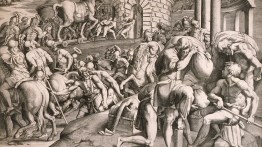
On the evening of 6 May 1527, Henry VIII entertained an embassy from France at a lavish party in Greenwich. The festivities took place in a banqueting house and a theatre, both built for the occasion. At the feast’s end, Henry led his guests out through a great archway. After a moment, he invited the French to turn around and look at a painting which hung behind them. It was a vast panorama of the 1513 siege of Thérouanne – ‘very connyngly wrought’, a chronicler reported. As Henry knew, the siege was a sour memory for his guests. Henry himself, in league with Maximilian I, the Holy Roman Emperor, had routed them there. So great had been their humiliation that it was known as the Battle of the Spurs, after the spectacle of the French cavalry fleeing the field.

China today is following Victorian Britain’s industrial pattern

On a damp Derbyshire day in 1771, Richard Arkwright watched the world’s first water-powered mill begin to turn, setting in motion a force that would remake the world. The tailor’s son from Preston had become one of Britain’s first industrialists, his spinning frames driven by water and his workers by hunger. Within those mill walls, as Edmond Smith argues in Ruthless, the modern economy took its first breath. Yet the real invention was not mechanical but social. Arkwright had helped pioneer the system that would propel Britain into the lead in the first Industrial Revolution – web of investors, miners, shippers and merchants, bound by credit, trust and the push for profit. In Smith’s phrase, it was ‘networked capital’, the invisible machine behind the visible one.

Childhood illnesses and instability left Patti Smith yearning for ‘sacred mysteries’

The punk icon Patti Smith’s latest memoir stretches from 1940s Michigan to present-day Nice, weaving around and complementing her other works of autobiography in its rendering of formative scenes. These include descriptions of periods of childhood illness, displays of sibling loyalty, powerful encounters with art and poetry, attachment to beloved clothes, marriage to Fred and the deaths of people close. Smith looks ahead to a time when she and her dwindling companions are gone: ‘Write for that future, says the pen.’ Our attention is periodically drawn to the pen’s motion as it ‘scratches across the page’, conjuring a lifetime of fluctuation.

Witches, dragons and the Terrible Deev: a choice of this year’s children’s books

Now here’s a combination you never thought you’d see, not least because one of them is dead: Maurice Sendak and Stephen King. But there they are in Hansel and Gretel (Hodder Children’s, £20). Who knew that Sendak had illustrated Grimm, or that Mr Horror wrote fairy tales? It turns out that Sendak created sets for the Humperdinck opera, and King writes to these illustrations, which loom large and dramatic. King says that he has always been attracted both to fairy tales and to Sendak, and that one image especially that spoke to him was the infamous candy house becoming a terrible face. I thought: this is what the house really looks like, a devil sick with sin, and it only shows that face when the kids turn their backs...

Alice in Nightmareland: The Matchbox Girl, by Alice Jolly, reviewed

Vienna, 25 July 1934 is a significant date in Austria’s history. But in The Matchbox Girl, the big events happen offstage, the world seen entirely through the eyes of its youthful narrator. We focus not on the assassination of Chancellor Dollfuss and a failed Nazi coup, but the children’s hospital, where 12-year-old Adelheid Brunner is waiting to be assessed for admission because she’s mute – designated ‘special’. Or, as her grandmother puts it, hopeless, ‘an idiot’. In the tall, shabby hospital, the young inmates are a protected community, closely observed by a team of specialist doctors, among them young Hans Asperger, later to find fame with his syndrome. Sister Victorine, a patient, saintly nun, oversees the gaggle of unruly, sometimes frenzied children.

Bats have suffered too long from the ‘Dracula effect’

Perhaps it is not surprising that bats, which sleep by day, feed by night and swoop through the darkness as erratically as moths, are among the least understood group of mammals. Yet one of the most poorly appreciated facts about them is their global success. They have a near universal presence across six continents and are amazingly diverse, with 1,500 species, representing almost a quarter of all mammals. We can blame our negative attitude towards them on a certain Victorian novelist. The representative of a British environmental group once recalled how they frequently received questions such as: ‘Do all bats drink blood?’ Here, fortunately, is the book to counter Dracula and to present us with a perfect PR campaign for bats.

How the teenage Carole King struck gold

On 7 December 2015 the Kennedy Centre Honours were awarded to Carole King, George Lucas, Rita Moreno, Seiji Ozawa and Cicely Tyson. King sat by the White House Christmas tree during the afternoon reception wearing her medal and laughing as Barack Obama recited the most familiar of her thousands of song lines: ‘You make me feel like a natural woman.’ Obama grinned: ‘I think I just became the first president ever to say that... It sounded better when Aretha said it.’ That evening the tribute to King as a singer-songwriter included performances from James Taylor and the cast of the Broadway spectacular Beautiful: The Carole King Musical and concluded with an astounding performance by Aretha Franklin of ‘(You Make Me Feel Like) A Natural Woman’.

Cook books for a colourful Christmas

‘When people see the word “chef” on the cover of a cookbook, it can set off alarm bells. It’s intimidating, I get it,’ says Ben Lippett, a former chef. The statement does make one wonder. When does a cook become a chef or a chef become a cook? Recently I sulked, I don’t know why, when a friend introduced me as ‘a chef’. It is an estimable compliment, surely suggesting one is better than a good professional cook. But I have never put in all those hours. With his book How I Cook (HarperCollins, £26), Lippett reminds me of the early Nigel Slater. He is a wonderful mentor to get you started if you seriously want to become a good home cook, but one who will not saddle you with an Instagrammer’s furbellows.

The new power players running the world

At the opening of The Hour of the Predator, Giuliano da Empoli describes Spain’s conquest of the Aztec empire, its doomed ruler Moctezuma II’s response (ineffective vacillation, delaying any course of action), its consequences and its relevance to politics today. It is a striking introduction to a brief, bracing and profoundly alarming book. The author argues that an alliance of tech bros and authoritarian rulers – whom he calls modern-day Borgias – are sweeping away the rules-based international order. He sees our elected leaders as comparable to the procrastinating Aztec emperor, appeasing and hesitating as the opportunity for action passes into history. Da Empoli has a peculiar vantage point.

A Faustian pact: The School of Night, by Karl Ove Knausgaard, reviewed

The fourth novel in Karl Ove Knausgaard’s spooky supernatural series differs from the others in that it is a standalone and doesn’t involve previous characters. Gone, too, are the multiple narrators; and there is only the briefest mention of a new star in the sky – which in the other three books coincided with all sorts of inexplicable occurrences. But it is no less compelling. This is the story of an arrogant young Norwegian, Kristian Hadeland, who arrives in London in 1985 to study photography at a prestigious art college. Though enthusiastic about his subject, he finds it hard to accept the constructive criticism of his lecturers.