Lead book review

Viewing the view

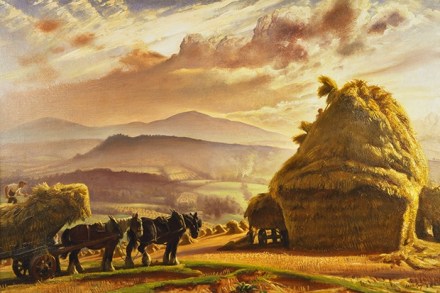
Landskipping is about viewing the view, from the 18th century to the present. From the title (which is the only self-conscious thing about this terrific book) I feared we might be in for a heavy dose of Wordworthishness and ‘the lone enraptured male’ school of writing. But Anna Pavord, along with Kathleen Jamie, Dorothy Wordsworth

A box of delights | 11 February 2016

How could you possibly justify a whole book about buttons? How could the mention of a humble wooden toggle, a diamond clasp, a ‘blue side buckle’ inspire such an unusual and irresistibly delightful account of more than a century’s worth of women’s lives? You might wonder. But as Lynn Knight sorts her way through her

Tawdry tales of Tinseltown

This is a very odd book that Jean Stein has compiled — about the evanescent splendour of Los Angeles, which only occasionally touches on the film industry. Its setting’s most memorable landmark appears to be the name of one of its districts, written in enormous white letters on a hillside. That, and various opulent houses,

Autocracy tempered by strangulation

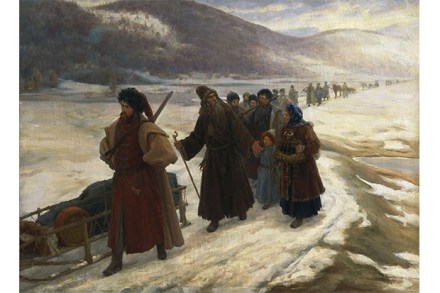
‘It was hard to be a tsar,’ Simon Sebag Montefiore writes in his opening sentence, and what follows fully bears this out. In his thought-provoking introduction, he stresses the unique nature of Russian autocracy and its perverse contradictions; the tsar was absolute ruler, yet he was bound by a tangle of restrictions. His subjects were

Charlemagne’s legacy

Last month in the Financial Times, Tony Barber closed a gloomy summary of the European Union’s future with this comparison: Like the Holy Roman Empire which lasted for 1,000 years before Napoleon put it out of its misery in 1806, the EU may not disintegrate but slip into a glacial decline, its political and bureaucratic

One for all

Mei Fong tells the routine story of a girl who managed to conceal an illegal pregnancy until the baby was almost due, when family planning officials surrounded her hiding place at night. ‘She ran and ran and ran until she came to a pond. Then she ran in, until the water was at her neck.

Between the woods and the water

At the beginning of the historical record, the lands that we now call Ukraine were a reservoir of fantasy. Achilles probably did not sail from a Greek port on the north of the Black Sea up the rapids of the Dnipro River to find his final resting place, as some Greeks once believed. Nor is

A touch of class | 31 December 2015

The New Yorker, not far off its centenary now, has moved beyond rivalry to a position of supremacy among American magazines. It has attained this not by taking a particular political position, although it certainly has one — it represents, obviously, a metro-politan, liberal, outward-facing attitude to the world. Rather, its pre-eminence is down to

Casual, funny, flirtatious, severe

When The Waste Land first appeared, there were rumours that it was a hoax. It seemed so strange: 400 lines in many languages, and even the sections that were in English looked as if the author was only teasing. ‘Twit twit twit’ ran one line: ‘Jug jug jug jug jug jug.’ Eliot’s long poem was

George and Martha Washington were an odd first First Couple

‘Would Washington have ever been commander of the revolutionary army, or President of the United States, if he had not married the rich widow of Mr Custis?’ asked John Adams. The answer, says Flora Fraser, is no. We like to see our ‘men of destiny’ as striding the world alone before stepping onto the customary

The four men who averted the Apocalypse

In March 1987, as Professor Robert Service records in his new account of the end of the Cold War, Margaret Thatcher visited Moscow. She had been reluctant to do so, largely out of fear that such a visit would only make it easier for a credulous Reagan — as she saw him — to offer

Celebrity lives

I learned from this little lot that if one has read The Diary of a Nobody, then one can derive pleasure from even the most pedestrian life story, as there’s always an unintentional chuckle to be had. The former racing driver Nigel Mansell’s Staying on Track (Simon & Schuster, £20) delighted me with its Pooterish

Books of the Year: the best and most overrated of 2015

Anna Aslanyan   My top title of the year is Satin Island by Tom McCarthy (Cape, £16.99), convincing proof that the best writers of our time are anthropologists, and that James Joyce, were he alive today, would be working for Google. I also enjoyed Ben Lerner’s 10:04 (Granta, £14.99), a self-deconstructing novel whose metafictional plot

The best British short stories — from Daniel Defoe to Zadie Smith

Philip Hensher, the thinking man’s Stephen Fry — novelist, critic, boisterously clever — begins his introduction to his two-volume anthology of the British short story with typical gusto. ‘The British short story is probably the richest, most varied and most historically extensive national tradition anywhere in the world.’ Take that, ye upstart Americans, with your

Through the Looking Glass

‘Have you got over your father yet?’ the 26-year-old David Cornwell was asked by MI5’s head of personnel when he joined the agency in the spring of 1958. And the answer, more than half a century later, has to be ‘no’. We knew of his conman father Ronnie’s cartoonish presence in Cornwell’s life, but never

The swastika was always in plain sight

In 1940, when Stephen Spender heard a German bomber diving down towards London, he calmed himself by imagining that there were no houses, and that the bomber was ‘gyring and diving over an empty plain covered in darkness’. The image consoled Spender with his ‘smallness as a target, compared with the immensity of London’. But

Margaret Thatcher’s most surprising virtue: imagination

In almost every one of the many biographies of Margaret Thatcher that now exist, the story is told of her being congratulated for her good luck in winning a prize when she was nine — either for reciting poetry or for playing the piano. She indignantly replied, ‘I wasn’t lucky. I deserved it.’ Now, in

Retracing The Thirty-Nine Steps in Buchan’s beloved Borders

Like Richard Hannay, I had to run to catch the early morning train from London to Edinburgh. Thankfully, unlike Hannay, I wasn’t wanted for murder — I’d merely overslept again. As the train pulled out of King’s Cross, I fished out my old Penguin edition of The Thirty-Nine Steps, Hannay’s first — and most famous