Features

Say no to wind farms: Selling our birthright

A few weeks ago, I attended a planning seminar at Ripley Castle in Yorkshire organised by the Historic Houses Association (HHA). It was a chilling presentation which contained a clear message: the current planning proposals — which close for consultation next week— pose a serious threat, not just to our countryside, but to our heritage. With the removal of Public Planning Statement 5 (PPS5) from the draft National Planning Policy Framework (NPPF), there are now few safeguards to prevent developers building 300ft-high industrial wind turbines right next to historic castles, new sprawling social housing next to the walls of stately homes or 12th-century village churches. No, no! I can already hear the government ministers’ response.

Say no to wind farms: Shale of the century

The arguments for wind farms just became obsolete. We’re entering an era when gas will be cheap, plentiful – and green Which would you rather have in the view from your house? A thing about the size of a domestic garage, or eight towers twice the height of Nelson’s column with blades noisily thrumming the air? The energy they can produce over ten years is similar: eight wind turbines of 2.5 megawatts (working at about 25 per cent capacity) roughly equal the output of an average Pennsylvania shale gas well (converted to electricity at 50 per cent efficiency) in its first ten years. Difficult choice? Let’s make it easier. The gas well can be hidden in a hollow, behind a hedge.

Textbook error

If young people don’t want to learn languages, it might be because the teaching materials are so drearily trendy Tonight’s homework: learn ‘Bonjour’, ‘Je m’appelle,’ ‘Comment t’appelles-tu?’ ‘Ça va?’ ‘Ça va bien’, ‘Pas mal’, and ‘Qu’est-ce que c’est?’. And the tired child, already sick to death of French, having been taught it since the age of three but never methodically, starts climbing the Everest of trying to master these horrible, spiky phrases, with their sudden apostrophes, their ­unexplained hyphens, and the dangly fives under some but not all of the ‘c’s.

Top gear | 15 October 2011

The exciting thing about showbiz is, you never quite know where you are. I thought of a good test some weeks ago. I phoned Denee, my agent’s assistant. ‘Can you ring Audi and see if they’ll give me a car. But for goodness sake be discreet.’ I know it sounds grasping, but I’d been forced to it. Orlando Bloom had a A4 3.0 TDI A4 when we did Pirates, which he let me drive up Regent Street because he was worried about his carbon footprint; Kate Winslet was in a Q7 last year in Cornwall when I got lost following her because I couldn’t understand her directions; and Michael Gambon has an R8, but he probably paid for that. He also has a Ferrari. Fair enough.

To catch a minister

Old hands in Westminster are confident that they know what lies behind the Liam Fox-Adam Werritty relationship. With a knowing glint in their eye, they lean forward and whisper: ‘He’s a lobbyist.’ They’ve seen it all before, they say. It explains why Werritty thought it was worth spending tens of thousands of pounds just to be in the same city as the Defence Secretary. ‘We all know the drill with these people,’ one senior Tory explains. ‘Their job is to get as close to you as possible and if it is easier to bump into you in Dubai or Washington than London, that’s where they’ll do it.’ Lobbyists for special interests are a cancer on the body politic.

Investment special: Be very afraid

In The Fear Index, the latest thriller by Robert Harris, now heading for the Christmas bestseller lists, a brainbox hedge fund manager with little in the way of interpersonal skills discovers that his computer-driven trading system has flown out of control and threatens to send the world’s stock markets into a tailspin. Anyone familiar with Mary Shelley’s Dr Frankenstein will recognise the genre of the oddball genius consumed by his own creation — populist fiction at its best. But is it fiction? Not so fast, reader. As Harris makes clear in a footnote near the end of his novel, the market meltdown which Dr Alex Hoffmann’s trading system appears to have prompted in The Fear Index is one that actually happened.

Investment special: Flying through storms

The financial crisis has unleashed a great debate about rebalancing Britain’s economy. The conventional wisdom is that our prosperity during the Nice decade (non-inflationary continuous expansion, that is) was over-dependent on finance and that we need to refocus our attention on high-quality manufacturing. Under New Labour, and the Tories before them, manufacturing was allowed to wither, declining from 18 per cent of GDP in 1996 to just 12 per cent now. The better news, however, is that what’s left behind is much better than what was lost. In certain sectors, including high-end engineering and aerospace, Britain has managed to retain a strong competitive edge.

Bailout country

In a theatre in central Athens, over a thousand tax inspectors have gathered to shout crossly about the latest cuts to their pay and pensions. Eventually the argument, between the government-affiliated union leader and his members, spills out on to the street. The rank-and-file feel betrayed: they were persuaded to accept the first wave of pay cuts earlier this year, and now they are being asked to take even more. This does not feel to them as if they’re being bailed out by kindly neighbours. It feels to these tax inspectors, and to Greeks in general, like humiliation. They feel trapped in an inescapable relationship with sadistic Germany.

In praise of the police

Outside London, at least, there are still officers who have their priorities right – as I discovered when my home was burgled The moment we stepped through the front door we knew that something was wrong. There was a bitter coldness in the hallway, accompanied by a faint sighing of the wind. On walking into the dining room, my wife and I found the cause of the chill. The main back window had been broken and opened, and shattered glass left across the floor. Immediately, we made a quick search of the rest of the house, which only confirmed our fears: we had been burgled. Almost every room showed signs of the break-in. Drawers and cupboards lay open, clothes and other possessions had been flung to the ground.

How to fix orphanages

Kigali, Rwanda Madame B has dressed up for our visit. She’s sitting on a bench with her back to the orphanage wall, talking about just how much she loves each child, but it’s her get-up that’s most impressive: black silk dress, hair done, make-up just so; finger and toenails painted hot pink, each with an elegant white scalloped edge. Everything else here, at the Mpore Pefa home for children, is muted: grey walls, grey kids, blurred by dirt. Those toes are an anomaly. ‘My husband and I started this home after the war,’ Madame B is saying. ‘Since he died, it is so difficult.’ Her eyes slide from left to right, checking our reaction.

A life in letters

Diana Athill, now nearly 94, lives in what must be the nicest retirement home in London, a large red brick house at the top of Highgate village, run by a charitable trust and populated by former writers and doctors and psychiatrists. On this unseasonably warm day she has on a flowing Kenyan kaftan — the residents’ summer clothes get packed away in autumn to make space, and she is worried about what to wear if the heatwave continues. A strong, boxer’s face, direct blue eyes. She aims a hearing aid at her ear, it whistles briefly, and away we go. Her latest book (see review, p. 38) is a kind of epistolary memoir, called Instead of a Book: her first book was Instead of a Letter, and she thinks this will be her last.

Hacked hack

As a former Sun editor, I didn’t see why voicemail hacking bothered celebrities – until it happened to me It was the kind of building George Smiley would have been happy to call home. Anonymous and bleak, it’s the home of Operation Weeting, where 60 officers flog themselves to death every day in the biggest Scotland Yard inquiry in anyone’s memory. I am here by appointment. A charming woman detective has called me a couple of times — when you are a former tabloid editor that’s worrying in itself  — and asked me to drop by ‘at my convenience’ to look at the fact that my name and mobile number had been found in the paperwork of the private investigator Glenn Mulcaire. At reception I ask for the detective.

TRAVEL SPECIAL: Swimming With Sharks

I came to the conclusion a long time ago that the best way to deal with a phobia is to tackle it head-on in the most extreme way possible. I countered my fear of heights by completing the world’s highest bungee jump and of snakes by trying to hunt down a mamba in Zambia. I’ve cage-dived with crocodiles, but this time, it was my shark phobia that I wanted to defeat. The centre of great white shark activity, I discovered, was the town of Gansbaai a couple of hours drive up the Eastern Cape from Cape Town. Gansbaai is a quiet, windswept place.

TRAVEL SPECIAL:  Other animals

There’s more to South African wildlife than just the ‘big five’, says Taffeta Gray Anyone who has been on safari in South Africa will boast that there is nothing like seeing the ‘Big Five’. Even if you are in the bush yourself, thrilled at having just spotted one of the great beasts, you’re bound to find someone who insists they’ve seen better. The trick is not to compete with the naturalist know-alls, but to outsmart them. And the way to do that is to swot up on lesser-known creatures, and stalk them instead. Here’s my alternative five. Meerkats The adverts on TV make out that meerkats come from Russia and have names like Aleksandr and Sergei. That’s rubbish, obviously.

Plan B

On 9 May 2003 I was having dinner with Nigella Lawson, Charles Saatchi and Dominic Lawson at the Rib Room of the Carlton Tower Hotel when the subject of who would make a good leader of the Conservative party came up. Iain Duncan Smith was struggling and didn’t look as though he’d last the year. ‘I think Dominic would be perfect,’ said Charles. ‘I think I could do it,’ said Nigella. ‘I could get a seat and be leading the party within five years.’ I suggested Boris Johnson, at that time the editor of this magazine and the Conservative MP for Henley. I hadn’t meant it particularly seriously, but when Nigella dismissed the idea I felt an unexpected surge of loyalty.

‘There are no exits’

William Hague always knew the euro would go up in flames. But now he’s focused on the rescue operation Politicians normally have to wait for history to vindicate them. For William Hague, vindication has come early. All his dire predictions about the dangers of the euro, so glibly mocked at the time, have come to pass. But as he makes clear when we meet in his study in the Foreign Office, he is not enjoying this moment. Rather, just days before the start of Tory conference, he is absorbed with trying to sort out the mess that others have created.

George, you need a holiday

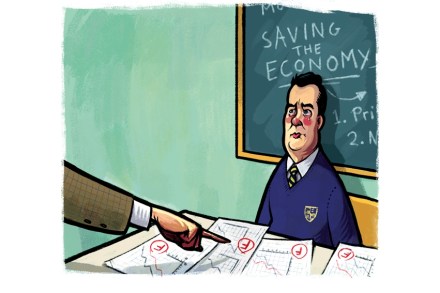
Why is it all going so wrong for George Osborne? Only 16 months ago, the poor guy entered the Treasury full of sound principles and good intentions. He would put in order the dodgy public finances inherited from Gordon Brown’s regime, stand back and let market forces do the rest. The Office for Budget Responsibility would certify that he had. Within a short period, the benign influence of sound finance would restore confidence in the private sector; and room for it to take up the running in promoting national economic growth would be created by reining back the bloated public sector.