Features

Marrakesh: Moroccan style

Jeremy Clarke on lust, literature and luxury at one of Churchill’s favourite hotels A retired Egyptian army officer, comfortably married, two grown-up children, is relaxing with friends by the pool at his club in the smart Maadi district of Cairo. A lifelong heterosexual, Captain Ni’mat is surprised to find his idle gaze drawn for the first time in his life towards the youthful male bodies on display around him. That night he is assailed by a powerful homo­erotic dream, and the next day he finds himself casting lustful glances at his Nubian valet, Islam. During his daily massage, he asks Islam to also massage his buttocks. Islam does so, and it occurs to Captain Ni’mat that his buttocks, neglected for over 60 years, are being kneaded back to life.

Hour of surrender

The proposal to change Britain’s clocks has returned, this time with tacit government support. It makes no sense — except perhaps in Brussels Since the day I flew backwards across the International Date Line I have known that you should not mess around with time. On that occasion I left Siberia on Monday morning and arrived in Alaska the previous Sunday afternoon in time for lunch. This was and remains confusing, though it offers disproof of the old cliché that you cannot put the clock back. Though I have been to North Korea and Bhutan, I still count it among the most startling journeys I have ever taken. It lasted about an hour.

Politically, it’s cuckoo

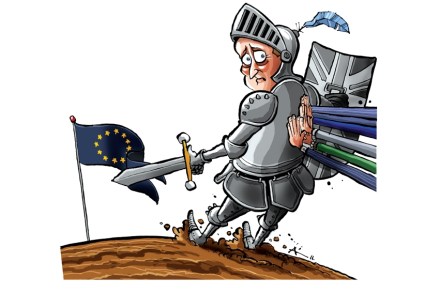
As David Cameron recovers from the biggest-ever Tory rebellion over Europe, he should beware of another dramatic, self-inflicted injury. The government has stopped short of giving its official endorsement to Rebecca Harris’s bill to move Britain on to Central European Time. But nor has it quashed the idea, which it could have done. Instead, government whips have allowed the bill to move to its next stage — the so-called money resolution. When this happens, the proposal will be significantly closer to becoming law.

Shelf hatred

On Newcastle University library’s horrible ‘makeover’ Though I retired early from Newcastle University in 1997, I have access to the university library as an associate member and use it fairly regularly. The staff and porters are excellent, and the classical section still serves my humble purposes well enough. But for how much longer? It was over Christmas 2007 that the culture began to change, and the library to go the way of the rest of the university. Management ‘rebranded’ it, and in January 2008 one walked in to find something called ‘YourSpace’, which offered students places where they could (i) work in comfort, (ii) work with friends, or (iii) chat.

Let’s hear it for elitism

Last month, on the most glorious of autumnal days, the world of music paid its last respects to Robert Tear. St Martin in the Fields was packed and the singing, as you can imagine, was magnificent. Sir Thomas Allen gave us Kurt Weill’s ‘September Song’, Sir John Tomlinson contributed Sarastro’s aria from Zauberflöte, and Dame Janet Baker read a poem by Emily Dickinson. It was some send-off. Bob deserved no less. As well as being one of the finest tenors of the past half-century, he was a man of many accomplishments, not the least of which, as his agent Martin Campbell-White said in a splendid address, was being ‘effortlessly friendly’. A fellow of King’s, Cambridge, he was utterly without malice or pomposity.

Mao’s girl and me

In 1997 in Hong Kong one of Mao Zedong’s numerous sexual partners — in this case an underage one — told me her life story. Mao the monster was already notorious: his lunatic policies had caused the world’s worst famine (1959–1961), in which 40 to 50 million Chinese starved to death; he inspired the Cultural Revolution (1966–1976), when a few million more died. And before he came to power in 1949, Mao often ordered the murder of those who ­challenged his ambitions within the Chinese Communist Party. But a paedophile? Yes indeed. Ms Chen, the young woman with whom Mao began sleeping in 1962, was 14. The Chairman was born in 1893.

A broad church

The protesters outside St Paul’s are united in polite disagreement It’s really not clear why the doors to St Paul’s had to be closed. Perhaps the church will have concocted a reasonable explanation by the time it’s all over, but after an afternoon walking around the protesters’ camp, it’s hard to imagine that they pose any sort of threat. Already the site has the peaceful air of a hippy festival. Groups sit in circles, talking and picking at the piles of crisps and chocolates donated by supporters of the cause. Others are gathered on the steps, listening quietly to a man giving a speech through a hastily assembled speaker system.

The emperor’s new weeds

Even a dreadful garden will receive warm praise if you open it to the public – as Sir Roy Strong has proved There is no garden in Britain so awful that someone won’t describe it as ‘lovely’. Especially if it is associated with a celebrity. I recently listened to Sir Roy Strong on the radio oozing complacency as he discussed his garden at the Laskett and why it should be saved for the nation. He made a virtue out of its disorder: ‘If a giant thistle seeds itself in the middle of the kitchen garden my head gardener just lets it grow there… and people love that.’ Oh no they don’t. If there is one thing most garden visitors can’t cope with, rightly or more possibly wrongly, it’s weeds and untidiness.

Algerian Notebook

• This is surely a mistake, I thought, stooping to kiss the hand of Algeria’s minister of culture. Madame la Ministre Toumi Khalida is throwing a party to mark the start of Algeria’s annual book fair, the Salon International du Livre. This year’s line-up includes a contingent of South Africans led by Breyten Breytenbach, the dashing poet and former revolutionary, now resident mostly in Paris. My inclusion is a complete mystery, given the event’s broadly anti-imperialist tenor. Clearly, Algerians do not read The Spectator. But one doesn’t turn down a busman’s, so here I am, helping myself to a drink off a passing tray.

The free market in danger

Young people say capitalism has failed them. They’re right. We must change the system to save it It would be easy to attack the London spin-off of the Occupy Wall Street protests, which manifested itself in the form of a 300-tent encampment outside St Paul’s last weekend. Their political agenda? The same, meaningless, Dave Spartesque gobbledegook which has been a feature of anti-capitalist demos for the past decade and a half, such as the demand for ‘Structural change towards authentic global equality’ and ‘an end to the activities of those causing oppression’. Look for leadership and what do you see? The usual old suspects: Billy Bragg, Julian Assange and assorted vegans, unilateral disarmers and other hangers-on.

A case in point

You can tell that the economy of East Anglia is more flourishing than that of the West Midlands because the fine for drunken vomiting in the back of the taxis of Peterborough is £50, whereas it is only £40 for doing so in the back of the taxis of Wolverhampton. The other difference between the taxis of the two cities (as I discovered on making the journey between them recently) is that the former are driven entirely by Muslims, the latter by Sikhs. How this arrangement came to pass — if, indeed, it is an arrangement — I do not know, but I am glad to report that both lots of drivers are extremely helpful and obliging, at least to their customers.

Playing Churchill

Where would gentleman actors be without Churchill? No prime minister has given as much work to the profession as Winston (though Blair comes a close second), patron saint of jowly thespians of a certain age. Churchill now features in a new stage play called Three Days in May, about the British war cabinet in May 1940. The great man is played by Warren Clarke, whose fleshy fizzog is well known to fans of the 12 series of the BBC’s Dalziel and Pascoe — he plays Detective Superintendent Dalziel. A splendidly robust actor, he has roughly the same baby-fed-on-whisky looks as Churchill. In this he doesn’t wear rompers, instead you get the Churchill outdoors look — spotty bowtie, homburg and cigar.

Strauss rules

Andrew Strauss is arguably the most successful England captain of the modern era. He shares with Mike Brearley the distinction of having beaten Australia at home and away, and this year he became the first captain to take England to the top of the official world Test rankings. Yet, unlike Brearley, Strauss is not talked about with hushed awe. His achievements are acknowledged but not mythologised, and when we meet for lunch at a busy pub in the Chilterns, no one pesters him for an autograph. You sense that not becoming a superstar is one of Strauss’s ambitions and, as usual, he has got what he wanted. Strauss has never quite joined cricket’s aristocracy. Even this summer, as England closed in on the No.

Skeletons in the closet

Britain must publish the truth about Irish presidential candidate Martin McGuinness – before it’s too late Martin McGuinness is standing for the presidency of a cash-strapped Ireland. Soon after this paragraph is printed he may be among the world’s heads of state. If so he has promised to refuse the €250,000 salary and subsist on the minimum wage. It is ‘high time’, he has stated, that ‘those at the top shared the pain’. That McGuinness has had a lifelong interest in so doing is a point that should not need making. But, like his old colleague Gerry Adams, he is now trying to change history — not the future, but the past — by professing amnesia about his role in many murders over a 30-year period.

Yes, Ma’am

Less than four months away from her Diamond Jubilee — only the second in history — we still tend to forget that we have the oldest monarch (85) and oldest consort (90) in history. We see a monarch who is reassuringly unchanged — and unchanging — in an uncertain world. It is an integral part of her appeal, at home and overseas. In Australia right now, the republican tide is out. Invited to field a ‘royal’ phone-in on national Australian radio earlier this week, I was struck by the consistent level of affection for the Queen. In half an hour, I encountered only one and a half republicans. It could have been Radio Royal Berkshire. Yet what lies at the root of the Queen’s enduring popularity is not her small-c conservatism.

Investment special: The zero era

The Bank of England’s latest announcement of quantitative easing, widely referred to as QE2, prompts as many questions as it does answers — particularly for investors and pension-holders. Under a QE regime, money printed out of thin air is used to purchase government bonds from banks and other private sector investors. The theory then has it that long-term interest rates will fall, and banks will have more money to lend to eager borrowers. There’s just one problem with this cunning plan: it doesn’t work. It did not work in Japan, the first country to flirt with QE. Richard Koo, chief economist of the Nomura Research Institute, calls QE ‘the 21st century’s greatest monetary non-event’.

INVESTMENT SPECIAL: The kids can wait

The government wants you to save more. You might think that odd for two reasons. First, because if you are an average person you’re unlikely to have much extra to save; your mortgage payments may be lower than they were, but what the financial crisis has given you with one hand it is ripping away with the other. High inflation is destroying the purchasing power of your net income. Secondly, if you watch the news at all you will know about the paradox of thrift. If we all start saving at once our horribly ill-balanced, consumption-based economy won’t be able to cope: economic growth will continue to collapse and we will all end up worse off.

Your nominations for the Spectator Threadneedle parliamentarian awards

Voter apathy? Don’t you believe it. Ever since we asked our readers to nominate this year’s best parliamentarian, our digital post bag has been full to bursting. Nominations have come from as nearby as Westminster and as far away as Australia. They have spanned all three major political parties, and Ukip besides. And they have been by turns witty, insightful and impassioned. This really is democracy in action. One early frontrunner is the Conservative backbencher Philip Davies. Reader Steve Mullins praises him as someone who ‘defends us almost single-handed against the massed ranks of pressure groups and sanctimonious political busybodies who want to dictate what we can say, do and see’.