Features

Gay rites

Gay marriage will never jeopardise straight marriage. But it can provoke political divorce. In America a new generation of Republicans is challenging the traditional consensus of their party on gay marriage. They — as well as some of the GOP old guard like Dick Cheney — are coming out in favour. In Britain the subject is also back on the agenda with the coalition government, at the insistence of the Prime Minister apparently, planning a ‘public consultation’ on the matter. Though not exactly political leadership, this nevertheless constitutes a change — not least in stealing the mantle of gay equality from the left. For decades it was presumed that conservatives could only oppose such moves.

A Press Lord’s Notebook

My day started with a bang — or rather, a right hook and a left-right jab combination. A friend in Moscow rang me excitedly, revealing my father had punched someone live on Russian television. I don’t condone violence, but I couldn’t help but find the video clip amusing. Eventually, I got through to my father. He explained that Sergei Polonsky, a corrupt property developer who has long associated with the yet more reprehensible former mayor of Moscow Sergei Luzhkov, was being rude about ordinary Russians and, also, threatening him. Russian people have a fondness for robust characters — hence Vladimir Putin’s occasional displays of manliness. So, rather than causing a scandal, my father instantly obtained cult hero status.

The great euro swindle

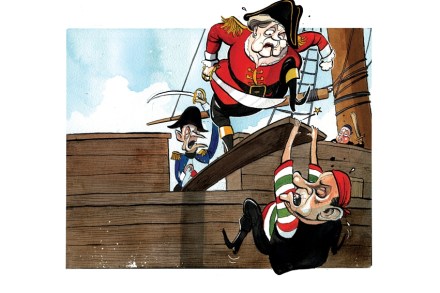
Finally, the Eurosceptics have been vindicated. But will their dishonest opponents ever be held to account? Very rarely in political history has any faction or movement enjoyed such a complete and crushing victory as the Conservative Eurosceptics. The field is theirs. They were not merely right about the single currency, the greatest economic issue of our age — they were right for the right reasons. They foresaw with lucid, prophetic accuracy exactly how and why the euro would bring with it financial devastation and social collapse. Meanwhile the pro-Europeans find themselves in the same situation as appeasers in 1940, or communists after the fall of the Berlin Wall. They are utterly busted.

The last Blairite

Jim Murphy is that rare breed, a genuinely working-class, modern British politician. We meet on the eve of Labour conference in a café in an upmarket shopping centre in his native Glasgow and he begins by talking about his childhood. Labour’s 44-year-old shadow defence secretary was born on a Glasgow housing estate and spent his early years ‘sleeping in a drawer’, he says, in a one-bedroom house containing four generations of his family. But there’s no self-pity or faux-nostalgia in his reminiscing. What defines Murphy and his politics is not his family’s poverty, but their determination. When his father lost his job, he simply got on a bus and travelled around the UK until he found another one.

Ridley was right

‘It’s very easy to be wise with hindsight,’ Nick Clegg this week told a BBC interviewer who had tasked the Deputy Prime Minister with his long-held view that the euro is a wonderful currency which Britain was crazy not to join. A cross-sounding Clegg went on to argue that ‘no one’ had envisaged that the eurozone might be in the plight it is today. This we can only describe as being foolish with hindsight. Although it is true that no one forecast the exact circumstances of the crisis, one politician did set out with startling clarity the main reason why the currency was misconceived — and it cost him his job.

Classic comeback

A new programme to revive Latin and Greek in our schools Some 15 years ago, at the behest of the then editor Charles Moore, I wrote a jovial 20-week QED: Learn Latin column for the Daily Telegraph. It attracted a huge following, and I still have four large box-files full of letters from users. The majority of them expressed one of three sentiments: ‘I learned Latin at school x years ago, loved it and am delighted to renew my acquaintance’; ‘I learned Latin at school, hated it, but now realise what I have missed’; and ‘I never learned Latin at school and have always regretted it’.

Slovenia Notebook

Last week I headed to Maribor in Slovenia for a music festival featuring the Australian Chamber Orchestra under the directorship of maestro Richard Tognetti, the virtuoso violinist. I even briefly performed a couple of Edith Sitwell poems to music by William Walton, but my efforts were at the beginning and end of a long programme featuring the New York avant-garde of the Sixties, including a work by John Cage which contained a long movement of complete silence disturbed only by the sound of the audience leaving. I think I once read that Cage believed there to be three different kinds of silence required by his music: the silence of expectation, the silence of appreciation and the silence of paralytic boredom. I’m not sure about the last.

In praise of the shura

The West has much to learn from Afghanistan’s community courts Kabul, Afghanistan I was invited to take part in a shura this week. One of our masons had been hit around the head with an iron bar by a local mechanic. Shura describes a traditional Islamic approach towards sociopolitical organisation and comes from an Arabic word meaning ‘consultation’. An elderly alim (religious scholar) sat next to a younger mullah at the head of the room. The mullah’s name was Qari Abdul Ahad. He is a well-known local figure and happens to be the mason’s brother. I took my place beside the alim having greeted the other 15 reesh safedan (‘white-beards’) who sat cross-legged around the room.

Private passions | 24 September 2011

Do you paint yourself? Or...sing in a choir maybe? John Studzinski looks at me anxiously from the other side of a conference table, in a sleek little office belonging to his firm, Blackstone, the American private equity giant. He’s normally a confident man; outspoken on the subject of leadership, networking and England’s art scene (which he generously props up). But getting him to answer a personal question is like trying to flip a cat on to its back. Every time I think he’s about to reveal the underbelly of a personal life, a hobby or habit, he swivels in the air and lands on safe ground again, discussing the nature of philanthropy or the importance of art. So come on then, John, what do you do for fun? Watercolours? The flute? ‘Well...

Spectator debate: Is it time to leave the EU?

 Christopher Booker, of the Sunday Telegraph, proposed the motion by taking a blast at his own side. Christopher Booker, of the Sunday Telegraph, proposed the motion by taking a blast at his own side. The present Euro crisis had inspired Tory Eurosceptics to talk of "a re-negotiation" and a "repatriation of powers". This, he said, utterly misconstrued the EU project and its "sacred aim" to strip nations of their rights and "never to give back a power once ceded." He called the EU "a 40-year-long slow-motion coup d’etat" and "a crazy make-believe project" whose hubristic ambitions were now facing nemesis. He heaped scorn on Herman van Rompuy for claiming that the best remedy for the Euro was "more Europe".

This is going to hurt

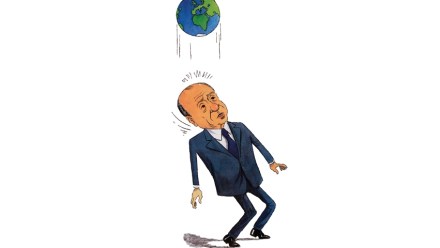
There is much to be terrified about in today’s global economy. The eurozone’s death dance, China’s slowdown and America’s inability to create jobs are enough to make the most upbeat investors gloomy. But even these problems pale in comparison with the biggest threat, one with implications so hideous that financiers are reluctant to talk about it even now. The truth is that the economies of rich countries, including the UK, are being kept alive by another and astonishingly under-reported bull market — in government debt. This is the bond bubble; and when it bursts, as it surely will, the result will be a recession far deeper than the crash from which we are trying to recover.

The world’s worst flirts

Why can’t British men show a natural, healthy appreciation of women? Last week, on the Paris Métro, I had a marvellous boost. I’d been feeling wretched after a flaming row with my boyfriend on the station platform, when a charming man winked at me and offered me his seat. I gratefully accepted. My eyes sparkled and my pulse quickened. Suddenly the day seemed so much brighter.   I can’t remember the last time I saw this happen on the London Tube. Naturally timid British men have now become so terrified of causing offence that they’ve given up on flirting altogether — even that casual meeting of eyes that used to make the day go with a swing is a thing of the past. And as for chivalry, what’s that?

Paddy pulls no punches

The former Lib Dem leader on learning to love the Tories – and the fate of the euro  ‘Have you ever been in the world’s smallest lift?’ Paddy Ashdown asks when we meet at the entrance to the House of Lords. ‘It was designed by William Gladstone!’ We travel up in the lift, admiring the old-fashioned sliding doors and suited attendant. Ashdown explains that the parliamentary authorities tried to shut it down on health and safety grounds but, he says proudly, he fought to keep it open. ‘My greatest parliamentary achievement,’ he keeps saying — only half joking. He’s still talking about the lift when we reach his office and sit down: ‘A proper Liberal Democrat council campaign,’ he declares.

Bad Juju

The Mandela years are well and truly over. Now, sharp-suited Mugabe fan Julius Malema has the people’s ear It is spring here in Johannesburg, and in the spring, one’s thoughts turn to throttling Jonny Steinberg, a newspaper columnist who would have us believe that Julius Malema is about to be expelled from the ruling African National Congress for daring to speak ‘the truth’. Malema is the ANC youth leader presently fighting for his political life at an intra-party disciplinary hearing, and Steinberg is a normally rational fellow who seems to have lost his bearings while trying to pin down a fairly tricky idea.

Feel the pain

There’s a passage in Willy Russell’s wonderful novel, The Wrong Boy, which could almost be funny — except, wisely, Russell doesn’t play it for laughs. The book chronicles a childhood blighted by adult misunderstanding, and describes an instance of it in which zealous ‘educationalists’ observe that the Boy’s artwork is harshly, relentlessly black: echo and evidence, all agree, of a darkness in the child’s soul. The truth, had the evangelical minds been open to it, was both simpler and easier to mend. The Boy was a shrimp of a kid, easily elbowed aside. So when the school crayons were put out, the coloured ones were promptly snaffled, leaving him with the last in the box: the black pencil.

Are explicit sex scenes OK?

Yes! Philip Hensher In April, I published a novel, King of the Badgers, about a series of events in a small town in Devon called Hanmouth. It is, in a way, about private and public lives, and the surprising and sometimes deplorable events that happen between people when their front doors are closed. It got very enthusiastic reviews: the Sunday Times said it was ‘a really good old-fashioned novel: the sort of thing George Eliot might have written if she was interested in gay orgies and abducted chavs’. Though it doesn’t make a point of obscenity, it does contain one scene in which a group of overweight gay men meet, as they regularly do, to have sex with each other.

Russian Notebook

It took me more than three hours by taxi to get from Moscow’s Sheremetyevo Airport to the centre of town. My Bulgarian friend, Ivan Krastev, a shrewd political analyst, describes the difference between Russia and the Soviet Union as one between traffic jams and queues. Queues were tedious, freezing in winter, but sometimes convivial. Traffic jams are just as tedious, warmer, but often lonely. Compared with the last time I was here, in 2001, I notice more ethnic diversity in the streets: dark Middle Eastern-looking faces from the Caucasus, Chinese-looking people from the various Asian republics, an area which a well known American expert once described as Trashcanistan. Moscow is a magnet for poor migrants, legal and illegal.

Preaching to the converted | 17 September 2011

Loudly and eccentrically religious candidates represent the Republicans’ best chance of losing to Obama Atlanta, Georgia The prelude to the first presidential primaries is always an entertaining phase of the American electoral cycle. Exotic blooms flower for a moment or two, but shrivel almost as quickly when the voters discover what they actually represent. Two of this year’s morning glories are Michele Bachmann, a Minnesota Congresswoman, and Rick Perry, the governor of Texas. Both, in addition to being highly photogenic, are serious evangelical Christians, possibly even ‘dominionists’, who seek to consecrate America’s political life to their religious convictions.