Features

Can you trust a Christian?

For some time we have known about the tension between George Osborne and Iain Duncan Smith over welfare reform. The Chancellor wanted more welfare cuts, and the Work and Pensions Secretary resisted: real reform, he said, would cost money. So far, so understandable. But a new biography of the Chancellor by Janan Ganesh reveals another element behind the struggle. Ganesh writes that Osborne ‘questioned the analytical rigour of the Christian Conservatives who hovered behind the project’. A Treasury source is quoted making it clearer still: ‘He thinks the people pushing this are such total advocates and evangelicals that they blind themselves to any downsides.’ To put it another way, the Christianity of Mr Duncan Smith and his associates makes them suspect.

Leaving Lebanon

Beirut is usually a party town, capital of the Middle East’s most glamorous country where people from all over the region come to kick back — but this year’s been a little different. Kidnappings, bank robberies, roadblocks and gun battles — no wonder the free-spending and normally blasé Gulf Arabs have stayed at home, leaving us Lebanese to consider not only a decimated economy, but also the very real prospect of a descent into another civil conflict. Which is why finally, after 20 years, I’m leaving. My Lebanese adventure, during which I married, had children, lived through three wars, a popular revolution and an attempted coup, has come to an end.

I am not my cancer

In the evenings the kidneys came. The helicopter, a bright yellow, would land on the grey cement disc, its blades chopping slower, slower, slow — stop. People in blue scurried from an opening in the building and ran towards the aircraft, hauling from it boxes and bags. These containers held hearts, lungs, livers. The organs were brought into the body of the main building then dispatched in all directions. I could see all this from the high window of my room in Siena. I also saw spectacular Tuscan sunsets, and if it weren’t for the chunky, rounded plastic furniture in the room and the drips in my arms, I would have thought I was in a smart hotel.

Till faith do us part

A girlfriend who was about to get married was telling me about her wedding plans recently when she said, almost as an aside: ‘Oh, and I’ve converted to Islam.’ Her fiancé was a Muslim but she thought it no more than a minor detail — like ordering the corsages, or finalising the table plan — to arrange a private ceremony before the big day in which she took on his faith. I think she expected me to say ‘How lovely. And have you decided on the centre-pieces?’ But instead I blurted out: ‘You’ve done what?’ ‘It’s fine. I really don’t mind,’ she continued, whilst puffing on a Marlboro Light. ‘It was easy. I just had to say a few words and it was done.

A tale of three cities

Conference Season: for people watching it on telly, it is noise coming from Huw Edwards’s face, with pictures of people waving. For the rest of us, the devil has blown into town. First come the Lib Dems, in Brighton — the only party sentimental enough to think of candy floss and helter skelters and then of politics. Lib Dems are damp, think damp, love damply: they haven’t been happy since 2010, when power fell on them like a book. Power disorientates them; they have the bewildered look of sheep forced to do algebra. They hate the Tories in their damp way, and only really sit up for Palestine, suddenly aggressive herbivores. There is a party: the Lib Dem Glee Club, in a cavernous room in a hotel, with pink light that makes everyone look like pink zombies, but knitted.

High society | 11 October 2012

How thrilling it is when someone finally stages a demonstration against you. All right, it was a very small protest (one person), and it was in Southampton on a wet Sunday morning. But it was all mine. Stretched by the roadside was a dank bedsheet bearing the words ‘Peter Hitchens is a hypocritical racist alcoholic. Spread your bile elsewhere. No one cares what you have to say.’ I don’t accept this as entirely accurate, but, under the circumstances, why quibble? Also, it made me think. Standing beside it, smirking, was a person in a woolly hat and sunglasses. He had a striking pallor, the sort you might get from spending many months in a basement with a computer, converting sugary drinks into lard.

Early edition

If you were to ask the editor of one of our quality newspapers whether he had thought about how to adapt to the internet, he would look at you as if you had been locked in a basement for 20 years, and then tell you that he thinks of little else. And it would be true, sort of. The Kindle, the iPad, new business models for the website: that’s where the clever ideas are. But the printed paper is also affected by the web, and in that realm the conventional wisdom is curiously out of date. You can learn more about the unique advantages of print in the age of the internet from one page of a 1950s newspaper than from a whole edition of one of today’s broadsheets. As it happens, I have a specific page in mind: page six of the Times for 2 June 1953.

Rural idol

Ronald Blythe, our greatest rural writer, remembers sheep being driven through Lavenham, the Suffolk wool town, before the war. Now he’s lived long enough to see the same street filled with Japanese tourists. On the eve of his 90th birthday, on 6 November, Blythe doesn’t mourn that lost way of life. If anything, Akenfield — his 1969 bestseller about a fictional Suffolk village from 1880 to 1966 — exposed quite how back-breakingly grim country life was for most farmworkers, like his own father, a Gallipoli veteran. ‘The old farm work was terribly hard on people — there was terrible rural poverty,’ says Blythe. ‘A lot of the people think of depressions in terms of manufacturing and the cities.

Grounds for optimism

Before the summer, the occupants of Downing Street were being worn down by coalition, battered by bad news and demoralised by dire economic data. One No.  10 source says: ‘We were all so depressed we wanted to slit our wrists. But now we’ve got our confidence back.’ This is just as well, for the electoral mountain they have to climb is now considerably steeper. With the boundary review went one of the central planks of the Tory plan for a majority, and Ed Miliband’s conference speech suggested that there’s more political life in him than many had appreciated. But the Cameroons have justified reasons for optimism. First, the coalition is functioning again.

Dave’s going down

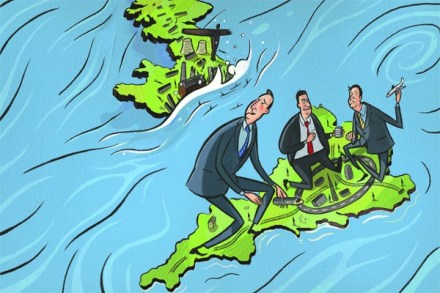
By now, it will be clear even to David Cameron that he is on course to lose the next general election. The British electoral system always was rigged against the Conservatives, and his hopes for changing that were dashed by Nick Clegg before the summer holidays, when he scuppered Tory plans for boundary reform. All parties are returning to a new reality: the economic recovery has evaporated, and with it the Tories’ chances of winning next time. An unprepared Labour Party is cruising towards power, under a leader who has just held a surprisingly successful party conference. Every bookmaker now agrees: Cameron is heading for a crash. The Tory party conference, which starts in Birmingham this weekend, ought to be a crisis meeting. How did things get to this stage?

Up in the air

Like the War of Jenkins’ Ear in 18th-century Anglo-Spanish relations, Heathrow is becoming something of a totem in the fight for the soul of the Conservative party. Whether you prefer your new runways to the east or west of London positions you on the other great issue of the day: who should be leader. If you’re an MP with a constituency anywhere near west London, you’ll probably be in the Cameron camp, shifting uncomfortably in your brogues, wondering how best to perform the Yeo flip and support a third runway at Heathrow. The alternative is of course the Boris camp, whose members think the PM’s plan pathetic. Brave, confident countries build big airports in anticipation of big planes.

Doctor Hunt

‘I would like to be the person who safeguards Andrew Lansley’s legacy,’ says Jeremy Hunt, the Health Secretary, as he sits in his new office. Hunt is touchingly eager to praise his predecessor. He predicts that Lansley ‘will be seen as the architect of the modern NHS’ and stresses that he is in regular touch ‘to make sure that I learn as much as I can from him, because I don’t think there is anyone who knows more about the NHS than Andrew’. But if Lansley was such a paragon, why was he moved? Hunt replies defensively: ‘You’d have to ask David Cameron about that.

Was Lennon really a genius?

It was 50 years ago today... well, this week, that the Beatles released their first hit single, ‘Love Me Do’, on 5 October 1962. Within 12 months, John Lennon and the other three Beatles were household names throughout the world, and in the years since then Lennon’s reputation has expanded with each new wave of listeners. He even has an airport (Liverpool John Lennon Airport: ‘Above us only sky’). Have we now placed him among the greatest English composers and musicians of all time — say, Dunstable, Tallis, Byrd, Purcell, Handel, Elgar and Britten? Will history’s verdict be that Lennon truly deserves to rub shoulders with these geniuses, or was he an accomplished craftsman with a pretty face?

Strangers on a train

If I subtracted from my life all the time spent either thinking about sex, or engaging in behaviour calculated to achieve it (by which I mean most of my social life and career choices); or dealing with the consequences of having achieved it (by which I mean all of my romantic life), well, I don’t know how much of my life I’d actually have left. Childhood. The useful bit. Fifteen years ago, in August, I boarded a train in New Orleans bound for New York.The journey time was 29 hours. What to do? Write postcards? Read a book? Try to have sex with someone? It was a sultry afternoon: Spanish moss dangled in a sensuous manner, the edges of things were blurry in the heat. And we passengers would be packed together for a really long time going in and out of tunnels.

Tweet revenge

First rule of Twitter: if you don’t use it, you can’t understand it. Nor should you try to: it is a kind of digital crack cocaine for a tiny minority addicted to gossip. In the old days, political gossip had to be exchanged in bars, corridors and (famously) urinals of the Commons. Twitter delivers these fixes straight to the addicts’ mobile telephones. The good news is that anyone can open a Twitter account under an assumed name, and have a little fun with our elected representatives — if you know, or can guess, how their minds work. Last year, I had a go, and became, for a while, a Westminster phenomenon. By then, certain political types were taking advantage of Twitter’s immediacy, reach and power.

Return-free risk

Voltaire said it best: ‘Doubt is not a pleasant condition, but certainty is absurd.’ Investors seeking certainty — safety, in other words — are in for a shock: there is no longer any such thing. How did we get into such a terrific mess? Rather than rehash the causes of the financial crisis and the current depression, there is a two-word answer: central banks. There was once a more innocent age when central banks performed a sole function: they acted as lenders of last resort to the banking system. To avert a banking panic, central banks would lend to solvent institutions, backed by solid collateral, in times of need. Note those key phrases: solvent institutions, solid collateral. They no longer really exist either.

Danger in the mines

The London Stock Exchange recently unveiled a glossy new guide to best practice in corporate governance for companies quoted on its platforms. This must be regarded as a timely exercise, given the increasing domination of the FTSE100 by natural resources groups with operations in the most exotic corners of the world. In its desire to be the world’s IPO capital, the City through the ages has offered a haven to overseas miners. There has been a tendency, however, to overlook their governance, environmental and social failings. In general, mining firms based in the great Anglo-Saxon democracies of the United States, Canada and Australia offer their workers a decent wage and reasonable housing, and adhere to environmental and safety standards.

Profit among the ruins

The place to look for investment bargains, said the fund manager Sir John Templeton, is not where the news is good, but where it is really bad. Today that means looking for advantage amid the volatility and extreme valuations which the crisis in the embattled eurozone has brought in its wake. The strikes and riots that are spreading across southern Europe are exactly the kind of scary scenario in which investors with ice-cold blood in their veins, as one admirer once described Templeton, have historically been able to profit. Since June, the broad European stock market index has risen by 11 per cent, reversing the losses of the previous three months.