David Rose

Revealed: Extinction Rebellion’s plan to exploit the Covid crisis

From our UK edition

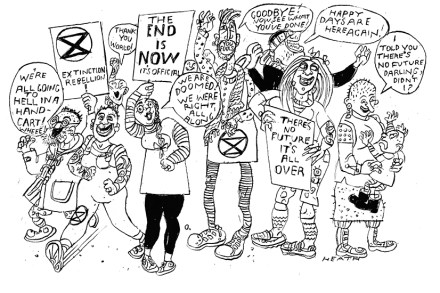
As we contemplate the havoc being wrought by coronavirus, most of us see mainly sickness, death and economic ruin. Dr Rupert Read, spokesman for the climate protest group Extinction Rebellion — plus sometime Green party candidate, and associate professor of philosophy at the University of East Anglia — has rather a different view. In this pandemic, he writes, ‘there is a huge opportunity for XR… It is essential that we do not let this crisis go to waste.’ Read’s thoughts are set out in a paper entitled ‘Some strategic scenario-scoping of the coronavirus-XR nexus.’ The paper is not meant to be widely read. ‘NB, this is a confidential document for internal XR use, NOT for publication!’ he writes at the head. Small wonder.
‘I was tossed out of the tribe’: climate scientist Judith Curry interviewed

From our UK edition

It is safe to predict that when 20,000 world leaders, officials, green activists and hangers-on convene in Paris next week for the 21st United Nations climate conference, one person you will not see much quotedis Professor Judith Curry. This is a pity. Her record of peer-reviewed publication in the best climate-science journals is second to none, and in America she has become a public intellectual. But on this side of the Atlantic, apparently, she is too ‘challenging’. What is troubling about her pariah status is that her trenchant critique of the supposed consensus on global warming is not derived from warped ideology, let alone funding by fossil-fuel firms, but from solid data and analysis. Some consider her a heretic.

The disturbing case of Roger Khan – and the cost of cheap justice

From our UK edition

The defendant, Roger Khan, was on trial for a vicious attack that left a man’s skull shattered and his brain exposed to the elements, but he had no lawyer representing him in court. He was dyslexic and had no legal knowledge, but the judge had told him that, if he fired the legal-aid lawyers he no longer trusted, he would have to defend himself. In fact, the only legal advice he was getting came from the prosecution. Throughout the four-week trial, a junior Crown barrister went down to the cells each morning to advise him on how to conduct his defence — although naturally enough, the prosecution’s aim was to get him convicted and sent to prison. Even more strangely, some of those in court had been acquainted with each other long before the trial began.

Blackout Britain — why our energy crisis is only just beginning

From our UK edition

BASF, the world’s largest chemical company, has been headquartered in Germany since before the country formally existed. Founded in 1865 by the industrial pioneer Friedrich Engelhorn, it still occupies the vast site on the banks of the Rhine at Ludwigshafen where its first dye and soda factories were built. A third of its staff are employed in Rhineland Palatinate. It is a global company, yet as German as Goethe and gummi bears. A few days ago Kurt Bock, the firm’s chief executive, warned that its Ludwigshafen plant may soon be forced to close, with BASF’s German jobs relocated elsewhere. The reason, he said, was Germany’s soaring energy costs and the crippling green levies being used to pay for ‘renewables’ such as wind farms.