Features

Would human life be sacred in an atheist world?

[audioplayer src="http://traffic.libsyn.com/spectator/TheViewFrom22_16_April_2014_v4.mp3" title="Douglas Murray and Freddy Gray discuss the return of God" startat=37] Listen [/audioplayer]What was your reaction recently when it emerged that thousands of unborn foetuses had been burnt by NHS trusts? And that some had been put into ‘waste-to-energy’ incinerators and so used to heat hospitals? Revulsion, I would imagine. But why? I would hazard that it is either because you are religious or because your customs and beliefs are still downstream from faith, even if you reject it. Because if you grant that an unborn foetus is not a life and that once aborted it could have no further use, there is at least an argument that these bodies might as well be put to use.

Don’t call him an oligarch – meeting Dmitry Firtash

Who is Dmitry Firtash? Can he solve Ukraine’s troubles? And why is he currently under effective house arrest in Vienna, awaiting extradition on corruption charges to the US, with his bail set at a whopping €125 million? None of these questions has a simple answer — and when I fly to Austria to meet him it’s not even clear if I’m going to ask him. Firtash appears to be up for it, as far as can be ascertained via his barrage of minders, advisers, security and hangers-on. But his expensive American lawyers most definitely aren’t. It might jeopardise his case, they’re saying. Firtash mustn’t say a word about anything. ‘Who do they fucking think they are?’ says one of Firtash’s PRs.

As a doctor, I’d rather have HIV than diabetes

'There is now a deadly virus, which anyone can catch from sex with an infected person. If we’re not careful, the people who’ve died so far, will be just the tip of the iceberg… If you ignore Aids, it could be the death of you.’ It has been hailed as one of the most memorable health campaigns ever created. The message couldn’t have been clearer and people were petrified. For anyone over the age of 30, the ‘Iceberg’ and ‘Tombstone’ adverts — as they came to be known — with John Hurt’s menacing voice-over, still bring back a sense of crushing dread.

Scots and English are the same people, with different accents. Why pretend otherwise?

[audioplayer src="http://traffic.libsyn.com/spectator/TheViewFrom22_10_April_2014_v4.mp3" title="Fraser Nelson and Angus Robertson debate Scottish independence" startat=32] Listen [/audioplayer]Sometimes it is easy to understand why countries break up. Some founder on the rocks of their internal contradictions. Others are historical conveniences that have simply run their course. Czechoslovakia was an artificial construct, a country with two languages and cultures, which split soon after the Iron Curtain fell. The division of Cyprus in 1974 marked the end of the fraternity between the island’s Turks and Greeks. The partition of India was driven by trouble between its Hindus and Muslims.

Why can’t country views be protected from wind turbines?

‘Surprisingly’, writes Geoffrey Lean (Daily Telegraph, 4 April), ‘two thirds of the country support onshore wind turbines’. It should not surprise him: those would be the two thirds who live in towns and cities, the people whose distinctive, familiar skylines are on the whole safe. When proposed city structures reach the height of St Paul’s they are the subject of deliberation and careful design. Not so in the country. I live in the East Mendips, a soft target for onshore wind turbines as it has little protection from developers: this is because its hills were sacrificed to quarrying after the war and it therefore does not qualify as an area of outstanding natural beauty. And yet it is outstandingly beautiful.

How fascist is Ukraine’s Svoboda?

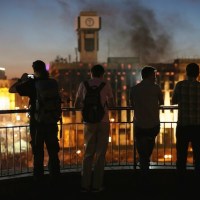
 Kiev Ihor Miroshnychenko, a parliamentarian from Ukraine’s ultra-nationalist Svoboda (Freedom) party, is an ‘emotional’ man. That is the word that he and his colleagues use to describe his raiding the headquarters of the country’s state television broadcaster last month. Accompanied by five other Svoboda bully boys, Miroshnyschenko berated and beat the station director before forcing him to sign a resignation letter. So proud were they of this deed that one of the Svoboda members videotaped the whole confrontation and posted it on YouTube. The proximate cause of Miroshnychenko’s anger was the station’s transmission of a Russian news channel broadcast of a victory concert in Red Square celebrating Moscow’s annexation of Crimea.

Governments have failed — mayors are the future

As Michael Bloomberg approached the end of his time as Mayor of New York, Americans expected him to run for the White House. He had the money, the profile and the ego to be President. But the problem, as it turned out, was his ambition — he had too much of it to settle for the Oval Office. As he put it: ‘I have my own army, the seventh largest in the world. I have my own state department and I don’t listen to Washington very much.’ His ambition, it turns out, was not to be the next President of the United States. He wants to be Mayor of the World. Bloomberg is deadly serious. Since stepping down last Christmas he has recruited a hit team of government advisers who intend to travel the world giving advice on how to run cities.

The summer of love

Last time I was allowed to write a story for The Spectator, I managed to get away with a frankly smutty and boastful piece about sex. Well, it’s been a while, so... I do hope nobody minds if I do that again. If I’m honest, when young, one of the reasons I decided to mortgage my life to showbiz was because I thought that if I did, I would get more than my fair share of bedroom action. Hang on. Sorry, not more than my fair share. (I must stop putting myself down.) Firstly, as we all know there is no such thing as fair in these matters; very attractive women regularly confound the rest of us by sleeping with people everyone thinks are ghastly.

How green policies hurt the poor

[audioplayer src="http://traffic.libsyn.com/spectator/TheViewFrom22_3_April_2014_v4.mp3" title="Matt Ridley and Fraser Nelson discuss the IPCC's latest report" startat=67] Listen [/audioplayer]Advocates against global warming often frame the issue in terms of helping the poor. ‘You’re right, people dying thanks to climate change is some way off...’ ran one fairly typical advert recently, ‘about 5,000 miles, give or take.’ Indeed, the United Nations agrees that, looking toward the future, climate change ‘harms the poor first and worst’. And the logic stacks up: the poorer you are, the less able you’ll be to afford the resources to adapt to a changing climate. However, climate policies also have a cost, and these predominantly hurt the poor.

Michael Lewis vs Wall Street’s new predators

‘The US stock market is rigged.’ That’s the j’accuse headline that screams out from Flash Boys, the new book by Michael Lewis. It’s a very big claim, made by America’s foremost financial writer. It’s also a claim that, after years of accumulating evidence, warrants extremely close and sustained official scrutiny. Lewis produced Liar’s Poker, his first bestseller, in 1989 — after a four-year stint as a fresh-from-the-Ivy-League bond dealer at the now defunct firm Salomon Brothers. The book, an insider’s account, brilliantly lampooned the macho, aggressive behaviour of the ‘big swinging dicks’ who paced the carpet-tiled trading floors.

The Visit

Clarissa Tan, who wrote articles and TV reviews for The Spectator, has died of cancer aged 42. She came to London from Singapore after winning this magazine’s Shiva Naipaul prize for travel writing and over the next seven years wrote about a great many things: Asia, race and the East; also smartphones, Sienna and socks. Clarissa paid attention to prose and all her pieces were beautiful and funny but, perhaps most unusually, they rang true. She was much loved by all at The Spectator and we miss her. Here is her prize-winning piece.    I wish to write about a place of which I know everything yet nothing, where everything is familiar yet strange, a place where I feel I go too often, but never quite enough. This place is the same for everyone, only different.

Before you talk about ‘Lessons from Rwanda’, read this

In Rwanda I was an ant walking over the rough hide of an elephant — this time 20 years ago I had no idea of the scale of what I could see on the ground. Trekking with a column of rebels from the Ugandan frontier south towards Kigali, we came upon the early massacres of Tutsis, hysterical survivors, flames leaping above huts, mortars roaring down misty valleys. But we had seen a lot of this across Africa in the 1990s. We visited a Catholic pastor in his rectory and I suppose at that point I and my Tutsi guides still respected the priesthood and could not imagine their complicity in murder. As we drank tea with him, we failed to ask why he had the body of a woman with her brains bashed out sprawled on the steps of his church. And then it just went on and on.

We’ve got gay rights, now let’s have gay responsibility

[audioplayer src="http://traffic.libsyn.com/spectator/TheViewFrom22_3_April_2014_v4.mp3" title="Douglas Murray and Julie Bindel discuss monogamy in gay marriages" startat=665] Listen [/audioplayer]As inexorably as night follows day and push comes to shove, so the words ‘Tory’ and ‘scandal’ seem destined to conjoin with ‘Brazilian’ and ‘rent-boy’. Yet the main response to the allegations about Mark Menzies MP last weekend was neither laughter or condemnation, but pity. The tone was similar to that recently adopted by Jeremy Paxman when interviewing the disgraced former Co-op chairman Paul Flowers. How sad, it seemed to sigh, in this day and age. Is there anything we can do?

It’s time to reclaim Islam from the fanatics. Here’s how

[audioplayer src="http://traffic.libsyn.com/spectator/TheViewFrom22_27_March_2014.mp3" title="Quilliam's Maajid Nawaz discusses reforming Islam with Freddy Gray" startat=41] Listen [/audioplayer]I am not a moderate Muslim, I am a reformist. Rooting out corrupt practices can never be an act of mere moderation. Restoring integrity, or wholeness, is always a radical act. It transcends notions of left and right, emphasising the need to think independently. In Islam, independent thought has a strong history, not that you’d know it from the news about bombings, beheadings and bloodshed. ‘Jihad’ has become part of the West’s vocabulary and with good reason. But there is a lesser-known term in Islam — one that has the capacity to change the world for good.

Why Simon Stevens – more radical than most Tories – may save the NHS

In a valedictory interview, Sir David Nicholson was quite frank about the state of the health service that he has run for the last eight years. ‘In its current form,’ he declared, ‘the NHS is unsustainable.’ It is hard to imagine Simon Stevens, who takes over as NHS England chief executive this week, having to say that when he leaves. His friends know him as an experienced reformer, a policy expert and a radical. His CV causes some suspicion in Tory circles — he is a former adviser to Tony Blair (I’m also guilty in that respect) and was a co-author of the last Labour government’s health reforms — but that is precisely why he will be so valuable to David Cameron now.

Why I won’t let my children learn French

[audioplayer src="http://traffic.libsyn.com/spectator/TheViewFrom22_27_March_2014.mp3" title="Liam Mullone and Freddy Gray debate whether it's a good idea to let children learn French" startat=1467] Listen [/audioplayer]My children won’t learn French. If their school tries to force the issue, I’ll fight tooth and nail. There’ll be the mother of all Agincourts before I let it happen. It’s not that I have any problem with the language, even though it has too many vowels and you have to say 99 as ‘four-twenty-ten-nine’, making it impossible (I imagine) to sing that song about red balloons. It’s just that I want my children to be successful, and learning French makes no business sense.

The equal pay bomb that could wipe out public sector jobs

I have just decided that my work is of equal value to that of the feminist supermodel Cameron Russell. Neither of us, admittedly, is quite as useful as a plumber, and I can’t claim to be of much use promoting swimwear. But otherwise I reckon we are a pretty close match. We both tart ourselves around and while my work doesn’t involve a lot of physical input, I would like to think that it requires a slightly higher contribution from the brain department. There then arises the question: should I not be paid as much as she is? Ludicrous? Perhaps, but no more so, I think, than what is going on in Birmingham, where council taxpayers are facing a £1 billion bill for a mass equal pay claim on the part of 11,000 female staff.