Features

My Parkinson’s diagnosis has shown me how kind society really is

Like Ozzy Osbourne, I was last year diagnosed with Parkinson’s disease, the degenerative condition that impairs the functioning of the body. In a series of recent interviews, Osbourne has spoken frankly about the impact of the neurological disorder. ‘That thing has knocked the shit out of me,’ he said, Brummie-style. I’m with Ozzy. It’s done the same to me. My difficulties began about 18 months ago, when my left leg developed an involuntary twitch, which soon extended to my other limbs. My gait became increasingly awkward, alternating between a strange quickstep and a longer, more laboured shuffle, complete with stoop and limp. The effect was like a cross between John Inman in Are You Being Served?

Battle of the billionaires: Trump vs Bloomberg could be the nastiest election ever

‘There are two things that are important in politics,’ said Mark Hanna, the American senator, in 1895. ‘The first is money and I can’t remember what the second one is.’ In 2020, Hanna’s maxim could be updated: the second thing is being an old white guy from New York. The presidential election is 36 weeks away and it looks as if the winner will be one of three men. There’s the Manhattan billionaire incumbent, Donald Trump, 73, whose fortune is estimated at $3 billion (he claims eight). There’s the socialist outsider from Brooklyn, Bernie Sanders, who is 78 and worth $2.5 million. And last but not least is 78-year-old Mayor Mike Bloomberg, the richest fruit in the Big Apple, weighing in at a whopping $64 billion. Money, money, money.

The internet is taking the joy out of quotations

‘Quotation (n.) — The act of repeating erroneously the words of another.’ Ambrose Bierce said that, or at least wrote it in the Devil’s Dictionary. That was in 1906, and those are words for the ages. In his Rhetoric, centuries before the birth of Christ, Aristotle identified one of the most common and effective ways of making an argument seem stronger. In his section on ‘proofs’ he talked about what he called ‘ancient witnesses’. By this he meant not only the testimony of witnesses such as you might call in court — but the witness borne by proverbs and quotations. Any speaker or writer can get an extra fillip of authority by quoting a revered forbear. Don’t just take my word for it, we say: Shakespeare or Montaigne put it best.

Northern lights: Seven steps for levelling up Britain

If you ever need a reminder of what northern Britain has achieved, I’d recommend a trip to York. The National Railway Museum brilliantly evokes the local creative energy that produced Stephenson’s Rocket which ran on the world’s first inter-city passenger railway and ushered in the railway age. Just over the River Ouse is the chocolate museum, which celebrates York’s chocolate-makers and their entrepreneurial legacy. It’s easy to be scornful about Boris Johnson’s talk of ‘levelling up’. Real levelling up would mean that for the foreseeable future, the North will grow faster than London, which seems almost unimaginable to Whitehall and in the City.

The government’s plans for a pandemic are both reassuring and alarming

Like the Trumpton fire brigade, Britain’s disaster planners have had precious little opportunity to show off their skills over the past few decades. Plans for a nuclear war merely gathered dust. Global pandemics failed to arrive, as did a no-deal Brexit. Just about the only crisis requiring nationwide emergency planning concerned foot and mouth disease in 2001 when six million animals were slaughtered and Labour ministers announced ‘the countryside is closed’, killing off rural businesses, yet still failed to prevent the spread of the disease from Cornwall to Northumberland.

The rise and rise of the museum cafe

Saatchi & Saatchi started it. ‘V&A: An ace caff, with quite a nice museum attached,’ said the ad campaign of the late 1980s. Other slogans in the series played on themes of taste and tastiness — ‘Where else do they give you £100,000,000 worth of objets d’art free with every egg salad?’, ‘All right, the mirror’s seen better days but the currant buns are very tasty’ — but it was the ace caff quip that stuck. Egg salad and currant buns seem quaintly retro now. At the V&A last weekend it was seared salmon and caper salsa, cavatelli and butternut squash, beetroot pesto and sriracha wraps. I sat under the olive boughs of the Morris Room and ate my feta and olives to the strains of a baby grand.

Pangolins are being blamed for coronavirus – and I’m sorry for eating one

Pangolins are in the news. It may be that the small ant-eating mammal covered in armour plating was the source of the virus striking fear into the heart of the Chinese state and giving us all a nasty turn elsewhere. I rather hope it does turn out to be the pangolin, for if that is the case I may have inadvertently acquired immunity, and the pangolin some timely protection. The Chinese are catholic eaters, free from the taboos we have erected around the food we eat. Try serving tripe to your friends, or tongue to the young, and see what happens. The last truly poly-phagous Englishman was the Victorian naturalist Frank Buckland, who ate everything that crossed his path in his role of unofficial vet to London Zoo. He snacked on puppy, giraffe and fried viper.

The Korean wave: how Seoul film and music won over the world

If you think that Boon Jong-ho’s Parasite (which won four Oscars this week, including Best Picture) is pretty black as comedies go, you should try the South Korean film The President’s Barber. Set in 1970s Seoul, a working-class hair clipper is appointed to tend the dictatorial leader Park Chung-hee, and tensions grow between his family and the upper-class presidential entourage. The barber becomes convinced that the head of state is a vicious, violent maniac, and his son ends up as the victim of an electrode punishment — played onscreen for laughs of the bleakest kind.

The Shia Krays: The whole of Iraq is being held to ransom

It’s been only six weeks since the death of the Iranian general Qassem Soleimani, but already there are a number of local hardmen vying to take his place. Most notable are his sidekicks, the Kray twins of the Shia world: Qais al-Khazali and his brother Laith. Qais and Laith who? Unless you’ve scanned Washington’s latest list of designated global terrorists, these two names won’t be familiar. Yet when I mentioned the brothers in a Baghdad teahouse a few weeks ago, folk lowered their voices and looked surreptitiously around, as if discussing the Krays in a pub in 1960s Bethnal Green. The Khazalis lead an Iran-backed Shia extremist group called the Asaib Ahl al-Haq, or League of the Righteous.

Will Brexit make Valentine’s Day flowers less expensive?

Any florist will recognise the look of furtive shame, the shifty hangdog look which announces that an Englishman is about to buy flowers. Some of them try to make it easier for you. I used to go to a splendid florist in Ealing who talked to me about rugby for no less than five minutes each visit. But most florists are more interested in flowers than people, and let it show. For some reason, you’re never allowed to write the card yourself. You have to dictate it, endearments and private jokes and all, while a couple of women who remind you of your mother lurk in the background. My colleague Rory Sutherland believes that this is the point, that buying flowers is something men don’t like doing, so it is a mild human sacrifice which signals intent, a commitment device.

The Scottish literary giants who stoked the fires of Anglophobia

Though Scots are doubtful about secession from the UK, Scots literary figures and intellectuals are likely to be strongly, even aggressively, for it. Conspicuous in this is Anglophobia, which is a default position for many. At an extreme, it amounts to a rejection of the English and Scots unionists which conjures up the rhetoric of racial hatred. The influence of two large 20th-century figures has soaked into the Scots literary ground. These are the poet and polemicist Hugh MacDiarmid (1892-1978), and the intellectual Tom Nairn (born 1932). They have a close disciple in the figure of the novel-ist James Kelman (born 1946), the only Scots Booker Prize winner in the past half-century.

Terror cells: how Britain’s prisons became finishing schools for extremists

Sometimes it appears as if, over the past ten years, the government has been actively trying to destroy the whole criminal justice system. It’s like an evil experiment: impose a 20 per cent cut in the prisons budget, meaning a 26 per cent reduction in the number of operational front line staff — then sit back and see what happens. What happened was predictable, with disastrous consequences for both inmates and the public. As a previous Conservative home secretary once said, our prisons became places that ‘make bad people worse’. Imagine a young man like Sudesh Amman arriving in prison after his first offence. He was already a drug user, known to have a cannabis habit. He was mentally unstable and radicalised by Islamist propaganda.

As prisons minister, I saw how bad things really are on the inside

What happened on Streatham High Road last weekend was exactly what I had feared during my time as prisons minister: a recently released convict mounting a terror attack. It was the second incident of this nature in Britain in three months, but the truth is we are lucky that there have not been more like it. When I was appointed prisons minister in January 2018, I was introduced to the full scale of the problem. In one wing of a prison in Liverpool, half the windows were broken. Prisoners could stick their hands straight out to take drugs from drones. In Lewes, an X-ray scanner — which was meant to detect what prisoners were smuggling back into the cells — had been defunct for seven months.

Did Britain commit a war crime in Dresden? A conversation

  In February 1945, the Allies, led by Sir Arthur Harris and Bomber Command, destroyed the historic city of Dresden, killing 25,000, most of them civilians. For the 75th anniversary, Sinclair McKay, author of a recent book on the bombing raid, and A.N. Wilson discuss whether it should be regarded as a ‘war crime’.   SINCLAIR MCKAY It was an atrocity. But I hesitate about war crime because war crime is a legal term and not a moral one. It is a legally defined concept.   A.N. WILSON Certainly at one stage of 20th-century history it was a crime to deliberately kill non-combatants and civilians who weren’t in the line of fire for warfare.   MCKAY Indeed, but there are then a number of follow-on questions that come with the label war crime.

After Iowa, Donald Trump looks invincible

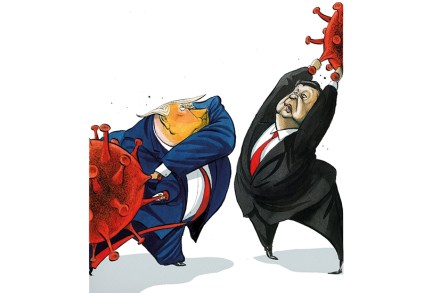
Any future history of the decline and fall of the American Republic ought to include a page or two on the Iowa caucuses of 3 February 2020. It’s a meltdown story for the ages. The Democratic party, desperate to undo the victory of Donald Trump in 2016, somehow managed utterly to cock up its first meaningful vote in 2020. The calamity is so great that it may turn the whole Democratic primary — and therefore this presidential election year — into a farce. That suits President Trump. ‘Big WIN for us in Iowa tonight,’ he tweeted, on Tuesday night, as news of the Democratic imbroglio spread. ‘Thank you!’ He then retweeted Piers Morgan, who had responded to his tweet with a ROFL (Rolling on the Floor Laughing) emoji. Fun times.

Dining, swimming, therapy: why is everyone obsessed with going ‘wild’?

‘Wild’ used to be one of my favourite words. It was in all the songs I loved best — ‘Walk on the Wild Side’, ‘Wild Thing’, ‘Born to Be Wild’. How times have changed. Wild — once meaning brave, bold, reckless — is now yet another sanctimonious nag. Everyone seems to want to get in touch with their wild side. Dark green is the new black. Even vulgar Channel 5 has given us Ben Fogle: New Lives in the Wild, in which he ‘travels to remote corners of the globe to experience extreme lifestyles with those who have left modern-day amenities behind’.

The comfort of building your own coffin

H.G. Wells got it right in his comic novel The History of Mr Polly, where the wake is so much more fun than the wedding breakfast. How often have you come home from a wedding feeling slightly nauseous from an overdose of cheap champagne and fake bonhomie? Yet a funeral can be heartwarming and inspiring; a celebration, a gathering, without the flimflam and interminable jollity. But how many of us will make plans for that final reckoning? How many will decide on the venue, the music, the food and flowers? Most likely it will be your relatives who will choose the coffin in the funeral director’s brochure (£265 for cardboard, rising to £1,990 if you want one in oak with the Head of Christ carved on the side).