Arts feature

Poetry in motion

Henrietta Bredin talks to Peter Manning about taking risks and creating opportunities There is an almost palpable forcefield of energy around Peter Manning. You expect a crackle of static to explode when he shakes your hand or wraps you in an enthusiastic hug. Concertmaster of the Royal Opera House orchestra, founder of the eponymous Manning Camerata chamber orchestra and now music director of Musica Vitae in Sweden, his relish for a challenge, for fresh stimuli, is voracious. He is a violinist, a conductor, and now a galvanising producer and artistic director. His current, most pressing preoccupation is with a fabulously multi-layered and ambitious project, the performance of a new opera he has commissioned, for the Manning Camerata to play.

‘Booming, beaming waves of noise’

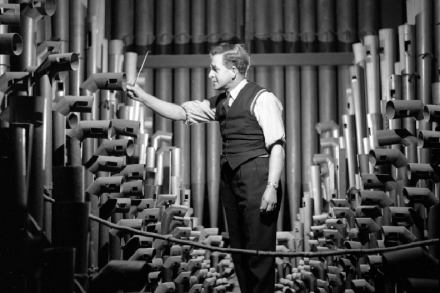
Igor Toronyi-Lalic looks back to the early 20th century when organs were in their heyday ‘As in England, in America the organ is King,’ wrote the French organ-composer Louis Vierne in 1927, following a phenomenally successful three-month tour of America and Canada. His 50 recitals had drawn in around 70,000 obsessed fans, including some 6,000 at the Wanamaker’s department store in Philadelphia alone, home to the world’s largest organ. There was a time, not so long ago, when the organ and its practitioners were at the top of the musical pile.

Top drama at bargain prices

Lloyd Evans talks to the Donmar’s artistic director Michael Grandage about his Wyndham’s venture It might so easily have gone wrong for Michael Grandage. In 2002 he was appointed to succeed Sam Mendes as boss of the Donmar Warehouse. Mendes would be a hard act for anyone to follow, let alone a director with just seven years’ experience behind him. But if anything Grandage has outshone his luminous pre-decessor, winning acclaim for heavyweight revivals like Schiller’s Don Carlos and taking the Donmar’s reputation overseas with Frost/Nixon, which transferred to Broadway, and his acclaimed version of Guys and Dolls, which had a successful run in Melbourne.

Perennial Cézanne

Andrew Lambirth on the artist’s profound and far-reaching influence For a certain generation of English artists, there have been enough Cézanne exhibitions to last more than one lifetime. These are the painters who had the gospel of Cézanne rammed down their gullets at art school, and who feel that the world has other things to offer. Roger Fry was the first great apostle of Cézanne in England, who at every opportunity lectured the unwary on the principles of ‘significant form’ and the consciousness-changing gifts of the master. Henry Tonks (who, as head of the Slade, resisted the siren call of modern art as forcefully as he could) caricatured him mercilessly in a 1922 painting called ‘The Unknown God’.

All roads lead East

Andrew Lambirth on our continuing fascination with the Orient Almost everywhere you look these days there’s an exhibition to do with China or the Far East. Tinselly young oriental artists are fêted as if they were better than their limp-brained occidental counterparts, and scarcely a considered brushstroke between them. The East is Big Business and there’s more than one specialist agent concentrating on bringing over Chinese contemporary art to deluge the already schmaltz-surfeited English market.

Edinburgh’s cultural jamboree

Lloyd Evans on the esotericism of the Festival and the ragamuffin risk-taking of the Fringe Here we go again. Like some vast, hairy, attention-seeking arachnid, the Edinburgh Festival has settled its gross and gorgeous shape in the shadow of Arthur’s Seat. Ever since its inception in 1947 the Festival has grown steadily and spawned a rowdy litter of symbiotic events. Comedy, literature, classical music, film, ballet, modern dance, jazz and blues and even ‘spirituality and peace’. All are represented. But the Festival’s heart, its alpha and omega, is the theatre. Whenever I flip through the International Festival brochure I’m staggered and slightly alarmed by its strenuously esoteric contents. Daring. That’s the word.

Corruption, celebrity and confidence

Lloyd Evans talks to Matthew Bourne about his new ballet Dorian Gray and co-directing Oliver! Matthew Bourne is a whirlwind. He’s a dynamo, a powerhouse, a force of nature. He has created the busiest ballet company on earth and turned Britain into the world’s leading exporter of dance theatre. His breakthrough came in 1995 with an all-male production of Swan Lake which won awards in London, New York and Los Angeles. Since then he has updated the Nutcracker, re-imagined Carmen as The Car Man, and created a dance version of Edward Scissorhands, which has toured more or less constantly since opening in 2006. But in person the whirlwind is remarkably unruffled. He’s a tall, quietly spoken 48-year-old with a lean, unlined face and small sensitive features.

Moral and political dilemmas

Robert Gore-Langton talks to Ronald Harwood about musical life in Nazi Germany Nazis in the theatre liven things up no end. They provide the hilarity in The Producers, the creepiness in Cabaret. And when you can’t take any more bright copper kettles or warm woollen mittens in The Sound of Music on comes the SS, arguably the best moment in the show. Now there’s a new play about music in Nazi Germany, a sobering reminder of just how seriously the Third Reich took its music and music-makers. Collaboration is about Richard Strauss and his relationship with the Jewish writer Stefan Zweig, who together wrote an opera in the 1930s while the storm was gathering over Europe.

‘Culture knows no political borders’

Tiffany Jenkins talks to James Cuno about looting, exporting and owning antiquities James Cuno is a busy man. I pin him down between two projects: promoting the new Modern Art Wing at the Art Institute of Chicago, opening next year, where he is president and director, and the launch of his new book Who Owns Antiquity? Museums and the Battle over Our Ancient Heritage (Princeton University Press, £14.95), which is provoking controversy on both sides of the Atlantic. He was prompted to write it, he tells me, ‘as an intervention into the war, or should I say “discussion”, between museums, archaeologists and nation states, about who can acquire antiquities’.

What a carry on

James Walton suggests reading George Orwell in order to understand the appeal of Carry On films Recently, we’ve been hearing quite a lot about how the winds of revolutionary change blew through Britain in 1968. Which doesn’t really explain why, in 1969, the highest-grossing film at the UK box office wasn’t Midnight Cowboy, The Wild Bunch or Easy Rider — but Carry On Camping. (It didn’t get any better for British cinéastes, incidentally: in 1971, the nation’s favourite movie was On the Buses.) Not that the film in question completely ignored the turbulence of the times. Towards the end, you may remember, the presence of hippies on a neighbouring field caused the solid schoolgirl-chasing yeomen of Britain to come together and drive them out.

A world elsewhere

Henrietta Bredin visits Oslo's new opera house and finds it impressive, both inside and out Oslo is a small city, with a population of just over half a million, but it now boasts, funded entirely from the public purse, and on budget — Olympic Committee, please note — a spanking new all-singing, all-dancing opera house which has already rooted itself deeply in Norwegian affections, despite initial resistance from many quarters, especially in rural areas. Completed an impressive five months ahead of schedule, it sits on the waterfront in the old harbour area of Bjørvika like an iceberg that might slip into the fjord at any minute.

How the West was won

Alexander Stoddart unravels the relationship between art and politics The great British philosopher Brian Magee, writing about Richard Wagner’s political life, points out that it is wrong to think of the Sage of Bayreuth moving to the Right in his later life. Magee’s proposal is compelling; Wagner leaves left-wing politics precisely as men who are maturing leave politics generally. They drift in middle age towards the static wasteland of metaphysics, and this is observed by those still remaining in politics as a move towards the Opposition, since they still cannot think of anything outside the political sphere. It appears that the ageing man ‘goes Tory’.

Critical condition

Lloyd Evans on the perils of being both playwright and critic ‘No man sympathises with the sorrows of vanity.’ Dr Johnson was speaking of a poet who looked to his friends for solace after his verses had been savaged in the press. He got none. That’s the risk all artists take. I’ve been through this experience myself (and I’m about to submit to the ordeal once again), and though I found it hurtful and humiliating to have my work trashed in public, it also enriched my understanding of the theatre and assisted me as a professional critic. In 2005 Toby Young and I collaborated on a sex farce, Who’s the Daddy?, which enjoyed a sell-out run on the London fringe and won a best new comedy award in a trade paper.

Morality takes to the stage

Henrietta Bredi joins in the preparations for Vaughan Williams's 'The Pilgrim's Progress' ‘Come, thou blessed of the Lord’ sing the sopranos and altos, and now the tenors and basses are joining them, with a wondrously layered swelling of sound. The hairs on the back of my neck are standing on end — this is the first rehearsal and the first music I’ve heard from Vaughan Williams’s The Pilgrim’s Progress, which will be given two performances at Sadler’s Wells, on 20 and 22 June. VW, as some people matily refer to him (personally, I wouldn’t dare), died 50 years ago, and celebrations of his life and work are abounding.

China’s piano fever

Petroc Trelawny visits the world’s largest piano factory in the country where under Mao it was dangerous to play the instrument As my plane makes its final approach into the southern Chinese city of Guangzhou, the mountains give way briefly to green paddy fields, and then industry takes over. Beneath are hundreds of vast blue-roofed sheds and smoking red-brick chimney stacks. The landscape is mapped with railway marshalling yards and lorry parks; heavily laden barges crawl along the creeks of the Pearl River. With a massive economy that’s now larger than that of nearby Hong Kong, Guangdong Province deserves its title as the factory of China.

An eccentric part of the landscape

Robert Gore-Langton talks to an irreverent Dominic Dromgoole about the Globe A few months ago I was at a literary festival on a drama panel which featured a senior actress of the stage. She was holding forth about working with the Royal Shakespeare Company at Stratford when I suggested that Shakespeare’s Globe was just as hugely popular but nobody took it half as seriously. ‘Ah, well, you see there’s a feeling in the industry that it’s all a bit twee — you know, a bit heritage Shakespeare,’ she said. ‘Patronising cow,’ I thought at the time, while laughing along sycophantically. But she probably spoke for most of her generation to whom Stratford is the sacred temple of Shakespearean excellence. A dubious claim these days.

Exhibition suspicion

Martin Gayford questions the point of art shows. Should they educate or give pleasure — or both? Towards the end of June, 1814, Maria Bicknell, the wife-to-be of the painter John Constable, went to an exhibition at the British Institute on Pall Mall. It was the second retrospective exhibition ever held in London. The first, the previous year, was devoted to the work of Joshua Reynolds and had been so popular that special evening viewings by candlelight were announced. The same was done in 1814 for the follow-up, a joint show of work by Hogarth, Gainsborough and Richard Wilson. Maria managed to get a ticket for one of the candlelit evening sessions, only to be disappointed.

An unassuming genius

Pete Hoskin on the Hollywood actor James Stewart, who was born 100 years ago The great director and critic François Truffaut once labelled James Stewart as one of those rare actors who could be ‘moving and amusing within the same scene’. Quite so. On the one hand, Stewart — angular, lanky, and awkward in action and speech — was made for comedy. That meandering drawl alone is enough to get punters giggling in their seats, ‘W...w...w...well, golly.’ But on the other, he was capable of such sincerity of expression that none of his physical quirks matters. Make no mistake, he’s a truly great actor. And perhaps the only one who could make us believe in giant invisible rabbits. Why bring this up now?

Crescendo of polyphony

Peter Phillips on a Zambian chamber choir which decided to perform Byrd, Tallis and Tippett As calling cards go, renaissance polyphony would not seem to promise a ticket to anywhere much, unless to heaven. When I started giving concerts in 1973, the received wisdom on the subject, even in the UK, was that whole concerts of it would never draw an audience. How true that was. But slowly perceptions have changed, and not only in the UK. With something of a crescendo, the opportunities to conduct this repertoire have multiplied, taking me to some very unlikely places. So far as Africa goes I had previously worked only in Fez and Cairo; never in any of the sub-Saharan countries.

‘You’re always learning’

Henrietta Bredin talks to Sally Burgess about taking on the role of Carmen Just as dancers are fortunate if they have especially long legs and strong, flexible feet, there are all sorts of different physical attributes that can help a singer to produce a good sound. But there’s a particular facial, or cranial, disposition which certain singers share and which is to do with high cheekbones and a generously sized mouth indicating a large, resonant cavity within. Renée Fleming has it and so does Sally Burgess, who uses it to produce not only a luscious singing tone but also a fabulously abandoned, down-and-dirty laugh.