Tiffany Jenkins

Lice combs, vaginal syringes and cesspits: at home in 17th century Holland

From our UK edition

The room is dark, the lighting deliberately low. At its centre stands a solitary object: a yellow and green earthenware vessel decorated with biblical symbolism. It’s a fireguard – or ‘curfew’ – used to keep households safe as peat fire embers smouldered through the night. Around it is a mocked-up fireplace, conjuring up that liminal moment when everyone is still asleep and the day has yet to stir. Ths scene is set, the world outside silenced. This is how Amsterdam’s Rijksmuseum has chosen to answer one of its most frequently asked questions: what was daily life really like?

The extinction of private conversation

From our UK edition

A police officer has been sacked for gross misconduct. His offence? Racist remarks made while off duty in a pub – that traditional sanctuary of the sharp and unguarded tongue – captured by the Panorama programme filming undercover. Mr Neilson, dismissed over what were described as ‘highly racist and discriminatory remarks’ about different ethnic groups, protested that the undercover reporter had ‘breached his human rights’ and had been ‘egging me on’. He’d had eight or nine pints of Guinness – and wasn’t, he said, a ‘drinker’. His body-worn camera footage, he insisted, proved that on duty he treated everyone ‘with the utmost respect’.

The radical power of sentimentality

From our UK edition

When Samuel Richardson’s Pamela was published in 1740, it unleashed something unprecedented in literary history. This epistolary novel about a virtuous servant girl resisting her predatory master saw new depths of feeling on the printed page, reducing readers across Europe to tears. The revolutionary impact of emotion informs Ferdinand Mount’s ambitious cultural history, Soft. The former TLS editor and one-time head of Margaret Thatcher’s policy unit has crafted what reads like an elegant love letter to the human heart itself. Mount grasps an important truth: emotions do not mean the same thing across time, nor are they consistently valued in the same way. What one era celebrates as virtuous emoting, another dismisses as mawkish excess.

Antony Gormley has no right to complain when the public interacts with his public art

From our UK edition

Antony Gormley is not amused. The artist who has installed hundreds of life-sized, cast-iron sculptures of his naked body in cities all over the world is affronted with the way a mysterious member of the British public has responded to one of the artworks. The piece in question, which could be known as ‘Narcissism’ but is in fact called ‘Another Place', consists of 100 figures, spread over 2 miles of coastline, on Crosby Beach, north of central Liverpool, looking out to sea. Someone has given it a make over: at least nine of the statues were recently adorned. One, standing upright at just over 6 feet tall, appears to be wearing a fetching pink polka-dot bikini, with a male appendage; another a pair of bright orange shorts.

Bones of contention | 12 April 2017

From our UK edition

A few years ago, a group of Native American leaders drove 12 hours from Oklahoma to Denver Museum of Nature and Science, a natural history museum in the Rocky Mountains of Colorado, to collect 26 sets of human remains. When Chip Colwell, the museum’s senior curator of anthropology, explained to them that, though the remains were fragments from people that populated the Great Plains, he didn’t know from which tribes, they were shocked: ‘The room plunges into silence,’ he recounts, followed by ‘heated deliberation’. The visitors were affronted. ‘They had come to rebury their kin — not strangers.

Making history | 22 September 2016

From our UK edition

‘A fool’s errand’. That is how Lonnie Bunch, founding director of the Smithsonian’s National Museum of African American History and Culture, wryly characterises the decade’s work it took him to get the museum built. It opens in Washington DC this weekend. A talented fundraiser, he and his team matched the $270 million from the federal government (Oprah Winfrey donated $21 million, Michael Jordan $5 million), and travelled the country sourcing artefacts. Most difficult of all has been convincing critics that such an institution — devoted as it is to the history of black America — is necessary and not divisive, that it will tell a story, not of one culture for that culture, but of America.

Symbols of eternity

From our UK edition

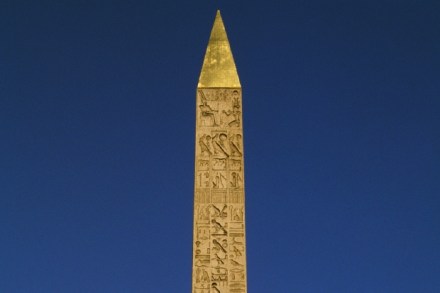
On the banks of the River Thames in central London, an ancient Egyptian obelisk, known as Cleopatra’s Needle, reaches towards the sky. Carved from a single slab of red granite, it is 69 feet tall, weighs a substantial 224 tonnes, is decorated with hieroglyphs, and was made for the Pharaoh Thotmes III in 1460 BC. In 1877, six sailors lost their lives transporting the obelisk from Alexandria. Mohammed Ali, Viceroy of Egypt, gave it to the Prince Regent in thanks for the British victories over the French at the Battle of the Nile and Battle of Alexandria. The Cleopatra, a specially designed iron cylinder container, was used to carry it, towed by a steam-ship. A hurricane off the Bay of Biscay resulted in the brief disappearance of the Cleopatra and the drowning of half the crew.

Viewpoint – Valuing culture

From our UK edition

How should we measure the value of a work of art? Let’s take, for example, Michelangelo’s statue of David in the Accademia in Florence. How should we measure the value of a work of art? Let’s take, for example, Michelangelo’s statue of David in the Accademia in Florence. The 17ft marble figure attracts a huge number of visitors from all over the world, so the box denoting popularity gets a tick. The revenue box gets ticked as well because of the gallery’s entrance fees and the money spent on accompanying T-shirts and postcards. And also to be considered is the amount this piece would fetch in a hypothetical sale.

Mourning in America

From our UK edition

New York is in the grip of memorial mania, writes Tiffany Jenkins In early 1991, the construction of a federal office building in lower Manhattan was halted after an unexpected discovery. Underneath the ground, covered by a patina of concrete and steel, was the coffin of a colonial-era African. It was not alone. Construction work was halted, archaeologists called in, and it was soon established that the site was a major burial ground from the 17th and 18th centuries. As many as 15,000 to 20,000 black men, women and children were buried there, by the historians’ count, making this one of the most important archaeological finds in all America. The significance was not lost on New York’s people or its authorities.

Interview

From our UK edition

Tiffany Jenkins talks to Scotland’s culture minister about the new ‘creative industry’ quango The unexpected hit of this year’s Edinburgh Book Festival was Mike Russell MSP, the SNP minister for culture, external affairs and the constitution. Surprisingly for a leading Scottish Nationalist, there was no mention of Rabbie Burns. Nor was it a populist pitch — bigging up bestselling Scottish writers like Irvine Welsh or Ian Rankin. Instead, he spoke of his love for the Chilean communist writer Pablo Neruda, the Russian poet Anna Akhmatova, and even that pillar of Victorian imperialism, Alfred Lord Tennyson. Whatever you think of his politics, you can’t call Mike Russell parochial.

The case for the defence

From our UK edition

The past ten years have been peculiar times for the arts. Under the Labour government pots of money were thrown at culture. But strings came with this funding, requiring art to serve political ends. While there has been cash it has been less for culture and more for schemes promoting social inclusion, community issues and urban renewal. Rather than rebel against these demands the Arts Council has been at the vanguard. As a consequence, artists needing support have had to jump through hoops asking more about their sexual identity than about the art form. This has contributed to high-profile failures, as the purpose of projects became disorientated.

A rich legacy

From our UK edition

The Philippe de Montebello Years: Curators Celebrate Three Decades of Acquisitions Metropolitan Museum, until 1 February 2009 Philippe de Montebello retires from the position of Director at the Metropolitan Museum of Art in New York, after 31 years of service, at the end of this year. A forum of curators has organised an exhibition of around 300 great works of art and artefacts (chosen from over 84,000) acquired under his watch, to honour his contribution. The Philippe de Montebello Years is the result. It is an exhilarating and eclectic display that crosses the centuries from ancient prehistory to the present. Spanning the globe from Europe to Asia, Africa and Latin America, it includes artefacts, art and costume, from ancient Egypt to Weimer Germany.

‘Culture knows no political borders’

From our UK edition

Tiffany Jenkins talks to James Cuno about looting, exporting and owning antiquities James Cuno is a busy man. I pin him down between two projects: promoting the new Modern Art Wing at the Art Institute of Chicago, opening next year, where he is president and director, and the launch of his new book Who Owns Antiquity? Museums and the Battle over Our Ancient Heritage (Princeton University Press, £14.95), which is provoking controversy on both sides of the Atlantic. He was prompted to write it, he tells me, ‘as an intervention into the war, or should I say “discussion”, between museums, archaeologists and nation states, about who can acquire antiquities’.

Keep out of politics

From our UK edition

‘Museums are the new United Nations.’ So says Jack Loman, the director of the Museum of London. He is one of many professionals, and increasingly policymakers, calling on cultural institutions to act as instruments of foreign policy. Tessa Jowell, Secretary of State for Culture, Media and Sport, is enthusiastic about this mission and is currently floating it as a new strategy. A recently appointed programme manager has been working on the viability of the idea for the DCMS, undeterred, it seems, by the hostility towards Labour’s foreign policy and the criticism of its cultural policy enacted to date. Many think government foreign policy can only benefit from this approach.