Arts feature

‘Take risks and be exciting’

Lloyd Evans talks to Michael Attenborough, whose star at the Almeida is the theatre itself The back office of the Almeida Theatre in Islington could do with a major refit. Dowdy, open-plan and scattered with Free-cycled furniture, it looks like the chill-out room of a student bar or the therapy suite of some underfunded weight-watch clinic. The tin chairs are arranged around elderly coffee-tables. The walls have been painted with the ramshackle expediency of a squat — a blue stretch here, some scarlet columns there, a few purpley flourishes. Beneath the roof eaves a beer gut of damp and crumbly brickwork bulges outwards precariously. I’d give it three months, maybe six, before it collapses.

Contrasting characters

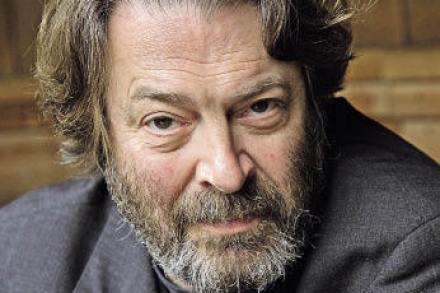
Mary Wakefield talks to Roger Allam and discovers that he thinks acting is only a game As I meet Roger Allam’s eye, in the bar area of Shakespeare’s Globe, I feel a lurch of dread. I love Roger Allam. I’ve held a torch for him since the mid-Eighties, when he starred in Les Mis as the original and best Inspector Javert — but the look in his eye today is one of profound boredom. It bodes badly. You must be in the middle of rehearsals [for Henry IV Part 1] I say, brightly. ‘Yes.’ He looks out of the window at the glittering Thames. It must be difficult to do interviews then — do you still feel in character as Falstaff? ‘No. Not really.’ Roger Allam is, everyone says, a nice man.

Hollywood’s introspective icon

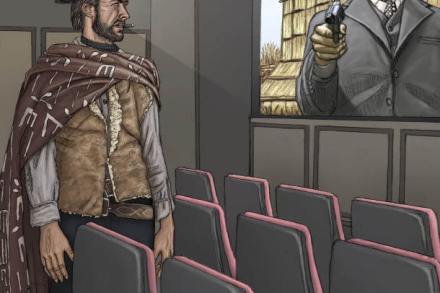
As Clint Eastwood celebrates his 80th birthday, Peter Hoskin salutes his artistic legacy My life at the movies began with Clint Eastwood about a decade ago. Channel 4 was screening A Fistful of Dollars (1964) one night, and my brother insisted that we stay up and tune in. I didn’t know beforehand that it was a western, let alone one directed by the great Sergio Leone. But, from the opening scene, I knew everything I needed to know about Clint: the poncho, the cheroot, those eyes burning with cathode ray intensity. This, I realised, is what people meant when they talked about cinema. And I was hooked. Fast forward to the present, and the lone gunslinger is about to turn 80 years old. He still stands tall, lean and gruff, with none of that old intensity dimmed by the passage of time.

Comic timing

New Labour inspired a golden age of political comedy. William Cook looks to satire’s future Although few will mourn Gordon Brown’s departure, his drawn-out demise should be a source of sadness for comedy aficionados, be they red, yellow or blue. For New Labour’s most unlikely legacy was to inspire a renaissance in political comedy. It may have ended with a disgruntled whimper rather than a bang, but for anyone with a taste for satire these were 13 golden years. When Tony Blair first swept into Downing Street in 1997, a lot of left-wing comics seemed bemused. They’d been attacking the Tories for 18 years. Now that the Labour landslide they’d yearned for had happened, they didn’t quite know what to do.

A great individualist

Andrew Lambirth talks to Jeffery Camp about the primacy of drawing in an artist’s practice More than 20 years ago, when I first interviewed Jeffery Camp, he forbade me to bring a tape recorder as he would find it off-putting. ‘I speak slowly enough for you to write it all down,’ he drawled in measured tones. Although born in Oulton Broad, Suffolk, and spending his early years in East Anglia, Camp has a placeless accent but a memorable delivery: you can indeed jot down most of his obiter dicta if you’re nimble with the stylus. Sitting in his kitchen sipping hot chocolate (he doesn’t have coffee) on a balmy spring day, I begin to make notes, but even this, it seems, is inhibiting to his flow.

Two men in a boat

Robert Gore-Langton on a stage adaptation of the Erskine Childers classic Riddle of the Sands The Riddle of the Sands was published in 1903. It was an instant bestseller and has never been out of print since. It’s the story of two young Englishmen who, while sailing off the German coast, unearth a fiendish plot to invade Britain. The book is often cited as the first ‘factional’ spy story, one that launched a genre. With its mass of authentic, verifiable detail it set the trend for Fleming, le Carré and the rest. The book includes maps, charts and tide timetables.

The great communicator

Conductor Marin Alsop talks to Henrietta Bredin about sharing a concert platform with Bernstein Last September there was a Mass Rally at the Southbank Centre in London. For an entire day the concert halls and foyers overflowed with shoals of people — children lugging instruments, parents rushing after them, singers clutching scores — all gathered to help launch the Bernstein Project, a year-long celebration of the extraordinary genius of Leonard Bernstein. Beginning with fanfares from Bernstein’s Mass, it will culminate in July with a complete performance of that work, involving community choirs, a marching band and a rock group, alongside dancers and professional soloists.

Brutal beauty

William Cook takes us on a tour of 2010’s unlikely European Capital of Culture ‘And the European Capital of Culture in 2010 will be ...the Ruhr.’ When I first heard the announcement, it sounded like a particularly unfunny German joke. The Ruhr, after all, is Europe’s biggest rust belt — a vast swathe of mines and factories, many now derelict or redundant, which stretches across north-west Germany like a huge unsightly rash. It’s hard to imagine a less likely cultural capital, and normally I wouldn’t have gone anywhere near it had it not been for a fond memory of one of the nicest afternoons I’ve ever spent. A few years ago I was in this part of Germany on business and ended up in Essen, one of the biggest cities in the Ruhr.

In the firing line

Henrietta Bredin goes backstage at the Royal Opera House and finds a stash of weaponry I am standing outside a heavily reinforced metal door somewhere in the furthest flung recesses of the labyrinthine corridor-tangle backstage at the Royal Opera House. A painted shield has the word Armoury picked out on it in gold lettering and next to a no smoking warning is a sign saying ‘No trespassing. Violators will be shot. Survivors will be shot again’. The door swings ponderously open to reveal the possessor of this somewhat macabre sense of humour, chief armourer Rob Barham. He is not a small man and his lair seems to fit around him like a tortoise shell, leaving him the minimum of space in which to manoeuvre.

Alive and kicking | 10 April 2010

Marianne Gray talks to Debbie Reynolds, one of the last of Hollywood’s Golden Era Debbie Reynolds is the first to admit she’s no longer Tammy. At 78, she’s more like the Unsinkable Molly Brown as she tours Britain this month in her one-woman show, Alive and Fabulous. ‘You people in England probably think I died years ago but I’m still kicking,’ she says, laughing. ‘I know that a lot of young people don’t know who I am unless they’ve noticed me as Grace’s mother, Bobbi Adler, in the sitcom Will & Grace, but I’ve never stopped working. I’m an Aries and it’s in my nature to be a performer.

Time for thought

Andrew Lambirth on how a powerful Easter message can be found in images of the Crucifixion Easter is not just a time for bonnets and bunnies, but also for reexamining the fundamentals of life and faith. In the self-denial of Lent, whether we’ve given up chocolate or alcohol, or something even more difficult, we are offered the opportunity of facing and considering temptation, without the usual pretence that it’s not happening to us. Taking the easy way out is perhaps our most constant temptation, particularly rife in a society which dislikes rules and moral restraints, but Lent gives us the chance to confront that insidious habit. Also the chance to check — if only fleetingly — the wilder excesses of self-indulgence. And the purpose of all this self-denial?

Round the galleries

I admire J.G. Ballard, who died last year, but much of his writing leaves me cold — as if abandoned in one of the lunar jungles or deserts that Max Ernst’s paintings so often depict. I admire J.G. Ballard, who died last year, but much of his writing leaves me cold — as if abandoned in one of the lunar jungles or deserts that Max Ernst’s paintings so often depict. It’s a deep chill of the psyche, a numbing of the human warmth that makes life bearable, and Ballard rightly identified it as taking over our culture. He wasn’t really a science fiction writer so much as a social commentator, dissecting our present dystopia — a remarkable and original voice, unafraid to describe the dark psychopathology of the human race, however ominous his predictions.

A diet of unrelenting mush

Ben West on the decline in quality of regional theatre; he fears it can only get worse We may have been languishing for months in the worst recession for decades, but theatre appears to be booming. West End theatres enjoyed a record £500 million in ticket sales in 2009, with audience figures exceeding 14 million for the first time. Attendance for straight plays was up 26 per cent on 2008, at 3.6 million. The many hits have included Ian McKellen and Patrick Stewart’s Waiting for Godot, the National Theatre’s War Horse, and Enron and Jerusalem, which both transferred from the Royal Court to the West End.

A woman of substance

Felicity Kendal tells a surprised Mary Wakefield of her admiration for Mrs Warren From the moment Mrs Warren bustles in halfway through Act I of Mrs Warren’s Profession, she’s clearly an excellent sort. ‘A genial and presentable old blackguard of a woman,’ says George Bernard Shaw fondly of his heroine. And she is a heroine, though she’s also a brothel-keeper as compromised as St Joan is righteous. I’ve only read the play, not seen it, but I’m also very fond of Mrs Warren, and, as I walk to the Comedy Theatre to meet Felicity Kendal, I begin to worry. Kendal playing Mrs Warren in the West End? The more I think about it, the less suitable it seems. Surely Felicity is winsome and twee; Mrs W is a business-like old pimp. How can that work?

A view from the pit

Henrietta Bredin talks to the leader of ENO’s orchestra about working ‘in the trenches’ ‘Working in the trenches’ is how some people describe their lives in the orchestra pit, playing for opera performances. The traditional opera house has a horseshoe-shaped auditorium and the musicians are accommodated below stage level so that, ideally, the sound they make floats up and out into the theatre without overwhelming the singers. At Bayreuth, in the Festspielhaus that Wagner had built specifically for the performance of his own operas, the musicians are completely invisible, in a pit that is not just recessed well beneath the stage but is also covered by a hood.

Rare magic

Paul Nash: The Elements Dulwich Picture Gallery, until 9 May Paul Nash (1889–1946) is one of those rare artists whose work manages to be British, Modernist and popular at the same time without imploding. It is thus curious that there are not more exhibitions of his beautiful and poignant work. The last general Nash survey in London was at the Tate in 1975. More recently, the Imperial War Museum has shown his war work, and in 2003 there was a good and wide-ranging show at Tate Liverpool. With that exhibition the Tate no doubt felt it had done its duty to Nash, so the current, long-overdue London display was left to other hands. All praise, then, to Dulwich Picture Gallery for rising to the challenge. But a show of Paul Nash there presents certain problems.

The Russian connection

Marianne Gray talks to Helen Mirren about her latest film, for which she’s had an Oscar nomination The first time I met Helen Mirren was at the Berlin Film Festival in 1985 when she was playing a Russian cosmonaut called Tanya Kirbuk in Peter Hyams’s space epic 2010. She laughed about having to learn Russian phonetically so she could say ‘roll the condensers’ and ‘send up the pod’ with an authentic Moscow accent.

‘If he couldn’t paint, he couldn’t live’

Ariane Bankes talks to the widow of Arshile Gorky, whose retrospective is about to open at Tate Mougouch Fielding opens the door to me looking a little gaunt but as beautiful as ever, though I have not seen her for a couple of years. She is in her late eighties, but no less stylish now than when we knew her as children; we were mesmerised by her chic, her gravelly voice with its hint of an American accent, her sense of fun and the faint whiff of excitement that enveloped her. When she was about 17, my father, then working in China, helped her ashore from a capsized sailing dinghy and fell in love with her on the spot. She was then Agnes Magruder, daughter of a captain in the American Navy stationed off Shanghai, and her youthful romance with my father evolved into a lifelong friendship.

The first Romantic

Peter Phillips on the life and times of Chopin, who was born 200 years ago The year 1810 may seem a little late to look for the beginning of the Romantic movement in music, but with the births of Chopin, Schumann and S.S. Wesley one could make a case. Think of the difference in the lifestyles of these composers, especially Chopin’s, when compared with those of their immediate predecessors. Where Mozart was tied to a court and lived more or less the life of a servant, these three travelled as they liked, the original freelancing musicians. Where Haydn was emotionally tied to the Church (and physically to a court), only Wesley relied on the Church for employment, and was famously outspoken about the low standards he found there, making himself thoroughly unpopular.

Do the locomotion

On the Move: Visualising Action Estorick Collection, 39a Canonbury Square, London N1, until 18 April The Estorick Collection, which specialises in modern Italian art, has mounted a series of rewarding exhibitions in recent years, all of which bear some essential relationship to its permanent holdings. Futurism remains the best known and most widely celebrated modern Italian art movement, and the current exhibition helps to put in context the Futurist obsession with recording movement through the static image. This display, curated by Jonathan Miller, offers a background to and explanation for the way in which the Futurists depicted movement by examining how animal locomotion was first represented and analysed through the developments in scientific photography.