Spectator Life

Spectator Life

An intelligent mix of culture, style, travel, food and property, as well as where to go and what to see.

There’s a reason we only eat Christmas food at Christmas

The 1990s comedy series the Royle Family includes a perfect scene in which Barbara says she won’t bother getting a turkey the following year, as nobody actually likes it. Everyone looks horrified. But she’s right. Advocaat, mince pies, Christmas pudding, Christmas cake (especially the marzipan) cranberry sauce, and balls of sausage meat made into stuffing – there is a very good reason why we tend only to eat and drink certain things at Christmas. Never buy a cheese selection, because among the mediocre bits and pieces, there is bound to be some abomination That said, I am aware that certain ingredients are staples in some households. Boiled carrots and sprouts, for example, which – for some unknown reason – appear on Sunday lunch menus week in, week out.

What’s your Christmas Eve pub tribe?

Come on in, take a seat, drink deep by the roaring hearth and don’t worry about the time – there’s bound to be a lock-in. Such is the Christmas Eve pub scenario of our fantasies. It’s been a long trek back to our home town, most likely thanks to a ‘cow on the line’ or some such nonsense announced by Avanti somewhere between Milton Keynes and Rugby. But you’re finally home so what could be finer than heading down to your old local for a festive pint or three? Well, quite a lot, actually. Like staying in and sticking hot pins into your retina. Yet out we go regardless, already drunk on the spirit of Christmas. But who will you be sharing bar space with this evening?

The curious history of the Christmas cracker

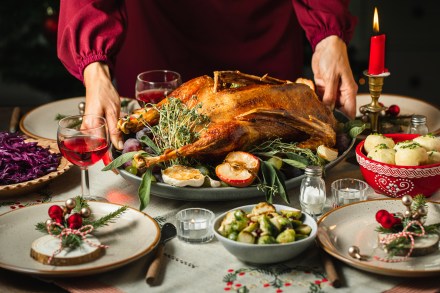
Those who still make a habit of the Sunday roast are faced with a challenge come Christmas: how to make sure the big meal doesn’t disappoint. What if the turkey is a let-down given everyone so loves the topside of beef? It would take a real Grinch to sniff at the festive spread – we serve it not because turkey would be anyone’s death row meal but because, as I have written before, there is virtue in tradition for its own sake. And truth be told, there is little reason to fear disappointment when pigs in blankets are close at hand. But there is one other trick up the Christmas dinner host’s sleeve – something that if served at any other occasion of the year would prompt raised eyebrows and being led away gently on suspicion of imbibing too much red wine.

Bets at Ascot and Haydock tomorrow

Dual-purpose trainer Hughie Morrison usually has one of two jumping stars to supplement his talented flat horses at his Berkshire stables. In recent years, Not So Sleepy has been the flag-bearer for the yard over the winter months but he was retired, aged 12, after winning on the level at Newbury in September. If Morrison has a successor to Not So Sleepy, it could come in the form of SECRET SQUIRREL and the five-year-old gelding looks nicely weighted off an official mark of just 126 in tomorrow’s Ladbrokes Handicap Hurdle at Ascot (3.35 p.m.). It’s a competitive event over the minimum trip in which Be Aware and Dysart Enos are at the head of the market on the back of their second and third respectively in the Unibet Greatwood Hurdle at Cheltenham last month.

Where do you stand on ‘I was sat’?

Perhaps because more and more BBC radio programmes are being broadcast from Salford, the whole of Britain is getting used to hearing multiple uses of the expression ‘I was sat’ or ‘I was stood’. Often, those words come at the very beginning of programmes, spoken by the presenter to set the scene. ‘I’m sat in a crowded pub’, ‘I’m sat in the back of a van on a lay-by’, ‘I’m stood in the rain on the outskirts of Oldham, waiting for…’ To those who live south of the Watford Gap services, this simply sounds grammatically wrong. It’s a misuse of the passive voice. It should be ‘I was sitting’ or ‘I was standing’.

Were Boney M the weirdest pop act of all time?

For a spell in the late 1970s there were two pop groups which dominated the UK singles charts – both, coincidentally, vocal quartets from continental northern Europe. But while one, Abba, have since become a billion-pound industry with an apparently permanent hologram-shaped presence on the London concert scene, their then rivals for pop supremacy, Boney M, have almost completely disappeared from public consciousness. And this is a shame because Boney M remain uniquely noteworthy in one field in particular: weirdness.  There are other contenders: Little Richard, the Sweet, Village People, the KLF.

The many faces of Oxo cubes

It is now not unusual to find ‘bone broth’ in the refrigerated sections of supermarkets or delis, on sale for more than £7. Who can afford this stuff? If you have the time to make your own stock then all credit to you. But if not, the concentrated stock in little cubes or tubs is perfectly acceptable. Knorr and fancy upstarts such as Kallo pose as the superior products. But Oxo has stood the test of time. In a flooded stock market, their cubes remain my choice. Beef is the classic (the name ‘Oxo’ is thought to come from the word ‘ox’). Retailers seem to have taken the lamb version off the shelves, though the brand says they’re working on getting it back. The company has moved with the times, a few years ago launching the first vegan cube.

How Gen Z ruined Guinness

James Joyce called Guinness ‘the wine of Ireland’. Now it feels a bit more like the Coca-Cola of alcohol – as much brash branding as beer. Once, it merely had an ugly logo and the rowdy promise of Emerald Isle hedonism which – I confess I have often thought – is crafted to appeal to simple people. For who, other than simple people, chooses Guinness in this day and age when faced with the proliferation of ales, IPAs, helles, sessions, Belgian beers and porters? The sorts of people who find the Irish pub in a Mediterranean town and hit it hard. Guinness is taking on a strange new life But now, Guinness is taking on a strange new life.

The death of anticipation

Were there arguments? Undoubtedly. By the time Christmas Eve arrived, it was a dead cert that Great Aunt Mary would prefer BBC Two’s festive celebration from Westminster Cathedral (complete with the puberty-defying nearly-15-year-old Anglesey treble Aled Jones) to Kenny Everett’s reworking of A Christmas Carol on BBC One (louche, anarchic and probably regrettable, with its jokes about a pudding with cystitis and pantomime-style wordplay of the ‘Good golly, Miss Marley?’ variety). And it was 1985, so only 30 per cent of British homes owned a video recorder, making the ‘what to watch’ argument notably fraught in the season of peace and goodwill toward men. The problem with anticipation is the element of waiting. How long is it since patience was a virtue?

The anatomy of an earworm

In the pantheon of memorable pop songs, Chappell Roan’s ‘HOT TO GO!’ is right up there. A breezy, unpretentious electropop effort, it has quite a forgettable verse, but that soon gives way to a shouty, cheerleader-style chorus in which Ms Roan repeatedly informs us that she is, indeed, ‘hot to go’. Somehow I recently heard it twice in one day, and that was all it took for ‘HOT TO GO!’ to get stuck on repeat in my mind’s ear for three whole days. Of course, I’ve had earworms before, but never for longer than a few hours; this was something else, worming on an epic scale. It became the soundtrack to every moment of my waking life, the unofficial theme tune of every person I saw.

The sad decline of the Booker Prize

There was a magnificent chorus of spluttering and gasping in literary London last week when it was announced that the actress Sarah Jessica Parker was to be one of the judges for the Booker Prize. As one critic remarked, ‘Just because she plays a writer of sorts in Sex and the City doesn’t mean that she is one.’ In fairness, the appointment is not quite as strange as it initially appeared. Not only is Parker a keen reader who frequently offers literary recommendations on her Instagram account to her near ten million followers (most recently, Linda Grant’s The Story of the Forest), but she sufficiently impressed Penguin to be given her own imprint at the publisher, SJP at Hogarth, which she parlayed into an independent imprint, SJP Lit, last year.

The town that inspired One Hundred Years of Solitude

The homes of famous writers are disappointing. Often, you see the famous desk, and that’s about it. There are exceptions: for example, Pushkin’s home in St Petersburg is interesting because they have the blooded waistcoat he wore during his fateful duel. Hemingway’s house in Cuba is intriguing because it is so macho – pistol, rifles, leather everywhere – you conclude he must have been secretly gay. Sadly, I can report that the home of Gabriel García Márquez in remote little Aracataca, in Colombia, is predictably disappointing. They don’t even have the desk. They’ve got the bed where he soiled his nappy – allegedly his first childhood memory – and half a kitchen. A visit takes ten minutes, as does a tour of his tedious hometown. https://youtu.be/4oQeQR1DEjw?

Three bets for tomorrow’s cards

GABORIOT was my fancy for last weekend’s Boylesports Becher Chase until the weather intervened and the Aintree meeting was cancelled. Joint trainers Oliver Greenall and Josh Guerriero have, however, wasted little time in finding their eight-year-old gelding a new target in the form of a big handicap tomorrow. I am going to stay loyal to Gaboriot when he contests the bet365 Handicap Chase (Doncaster, 2.05 p.m.) over three miles because I think he remains leniently treated off an official mark of 128. I was impressed with his seasonal debut when third in the BoyleSports Grand Sefton Chase over Aintree’s Grand National fences.

Stuff the turkey: try capon or partridge for Christmas

‘It was a Turkey! He never could have stood upon his legs, that bird. He would have snapped ’em short off in a minute, like sticks of sealing-wax.’ (A Christmas Carol.) And there is exactly the problem with festive fowl. In most cases, we get turkey. And usually we get it far too big, which leads to all the problems of using the thing up over the course of a week. It may have been fine for Bob Cratchit’s large family but for most people, the mammoth turkey isn’t the way to go. A turkey is a fine bird (one of the trinity of actually useful things, with potatoes and tomatoes, to come out of the European discovery of America) – but it’s not the only option.

Where posh kids go to pull

This week, in honour of its 70th anniversary, the Feathers Association released photos of youths aged 14 to 16 at its annual Christmas charity ball. Among them, a young David Cameron is pictured poutingly draped around Laura Stanley. The Queen’s son, Tom Parker Bowles, stands with his black tie askew, laughing at the camera with all the exuberance of youth. In private homage to the Feathers Ball, this week I too dug out the picture I have of myself before my first Feathers Ball in 1997. It is categorically not for public consumption. Standing in the Kensington townhouse of a school friend before we left for the ball, I am wearing a mini-dress and platform shoes. My expression is one of awkwardness but also, I think now, of foreboding.

My Desert Island Discs

Withnail and I’s Uncle Monty found it crushing to realise that he was never going to be given the part of Hamlet – ‘I shall never play the Dane!’ – for many of us, an equal disappointment is realising, sooner or later, that we’ll probably die uninvited onto Desert Island Discs. This programme has run almost unchanged since 1942 and is the nearest thing – after a knighthood or a CBE – to a nod of recognition from the Establishment, a sign you’ve finally arrived. I imagine most people in public life occasionally ponder the eight discs they’d take should the call from Radio 4 ever come, or which luxury or book (along with Shakespeare and the Bible) would go into their knapsack.

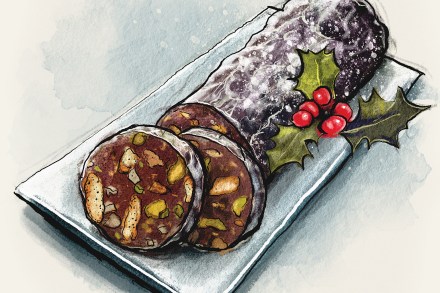
How to make chocolate salami

For as long as we’ve been serving food, we’ve been unable to resist a bit of culinary deception. Making one thing look like another thing – especially if it makes a sweet thing look savoury or vice versa – seems to have universal comedic value. There’s something Willy Wonka-ish about the visual wrong-footing, the surprise – we find it delightful. I’m not even going to stop you slinging some mini marshmallows in there – it is Christmas, after all There’s a long history here. At medieval and Tudor banquets, the food was entertainment as much as it was sustenance: huge pastries made to look like life-size stags and swans stood alongside carefully carved marzipan fruits, both imitating the real thing as closely as possible.

Something out of a Spectator reader’s dreams: The Guinea Grill reviewed

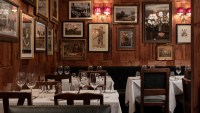
Back to the past: it’s safer there. There is a themed restaurant dedicated to George VI of all people, near Berkeley Square – a sort of Rainforest Café for monarchists who won’t sink to the Tiltyard Café at Hampton Court. I was looking for a restaurant my husband might like – Brexit, meat, maps of the Empire at its height in colour – and I found the Guinea Grill in Bruton Place. George VI isn’t a vivid monarch. He lived in the shadow of queens – one Mary, two Elizabeths – and on film he is always crying, or dying. In The Crown (Jared Harris, marvellous) he lost his lung. In The King’s Speech (Colin Firth, good, but handsome) he lost his happiness. I like to think George was tougher and less pitiable than the chronicles suggest.

How to turn eggnog into a superfood

Recently, scientists were baffled by the discovery that ice cream is a superfood. Yes, that’s right, people who eat ice cream tend to be healthier than those who don’t. A lot healthier. It’s ‘nutrition science’s most preposterous result’, according to the Atlantic. In fact, there’s nothing preposterous about it, if you actually know anything about the ingredients that go into ice cream. You’ve got high-quality milk protein and fat, sugars and a whole lot of vitamins and minerals. The fats make the protein and the vitamins and minerals more bioavailable – meaning you can absorb more – and they slow the digestion of the sugars, so you don’t get a massive sugar spike, just a gentle release of energy. The same could be said of eggnog.

The best (and worst) of this year’s sport

It was quite a year for some of the worst of sport – America’s golfers, already among the richest and greediest men on the planet, wanting a massive extra bung to pitch up for the Ryder Cup and, equally noisome, Bill Sweeney, chief executive of the Rugby Football Union, paying himself £1.1 million while announcing a loss of £37.9 million. That salary included a performance-based one-off payment of £358,000. Performance? Well may you ask. As Francis Baron, a former RFU chief, observed sagely: ‘We are paying stellar salaries for junk-bond performances.’ Fair enough in my view, and that’s not even looking at the England rugby team’s less than stellar showing.

Lily Phillips is scared of real sex

A young woman called Lily Phillips, known to certain users of the internet, has recently spoken about a cunning stunt she performed earlier this year. She had sex with 101 men in a single day. As I see it, there are three possible responses to this story. Or maybe four (phwoar!). The first is to suggest that Ms Phillips’s behaviour is not entirely ladylike. Or, less pompously, that she is a slut and a whore and so on. This is the traditional response. It is, to almost all cultures known to history, common sense. Most of these cultures had, and have, stern penalties for such behaviour. The modern West gradually decided that exclusion from polite society was punishment enough, but it has become hard to say whether we still have a polite society from which to exclude people.

The sad demise of the scathing school report

As the first term of the school year draws to a close, pupils’ reports will soon be landing, encrypted and password-protected, on parents’ smartphones. But once they’ve finally managed to open them to find how little Amelia or Noah has been performing, there will be another code for them to crack: what on earth the teachers are actually trying to say about their child. These days, reports tend to be written with the help of AI software or templates, which makes it impossible to work out how your child is really doing. In our super-sensitive age, many schools now play it safe by couching all comments as positives, and only using approved adjectives from word banks and drop-down menus.

Red lights and shinto rites in Osaka

It gets somewhat forgotten, Osaka. On the bamboo-and-tatami trail of Japanese sites, this ancient port, fort and conurbation at the very heart of Japan commonly misses out on foreign visitors: as everyone rushes from Tokyo to Kyoto, from sacred Mount Fuji to ancient Nara to haunted Hiroshima. For most overseas tourists, Osaka is just a fleeting stop on the Shinkansen high-speed trains – a glimpse of another sprawling Japanese city with bland, utilitarian housing. The edgiest place in Osaka is about as dangerous as the Cotswolds The Japanese themselves know otherwise. They flock to the city because they revere its pivotal history – Osaka was Japan’s archaic imperial capital, back in the 4th to 7th centuries – and they celebrate its epochal sites.

The mystery of Baileys

December is when about 90 per cent of Baileys consumption takes place, and yet nobody really knows why. I used to work at an ad agency called Young & Rubicam, and we had the Baileys account. We’d spend all year writing ads to persuade people to drink it at some point – any point – between January and November, but to no avail. Baileys was never intended as a Christmas tipple Baileys introduced more summery variants: strawberries and cream flavour, apple strudel, even ‘Baileys colada’. For these, we wrote ads featuring happy drinkers in straw boaters, German lederhosen and loud Hawaiian shirts, but the British public gave a big thumbs-down to all of it. Come 1 December, however, they’d again start caning Baileys, overwhelmingly favouring its original flavour.

Why are Brits such bad neighbours?

I sometimes wonder if a property lawyer dreamt up the idea that an Englishman’s home is his castle. Over the years, it’s certainly been a lucrative concept for the legal profession, especially when said castle is worth a few bob. Barely a week goes on when one of the posher papers doesn’t feature an expensive spat in an equally expensive neighbourhood. The latest feud I’ve seen involves a brook that runs through two properties – one owned by an artisan potter, the other a part-time painter – in the bucolic Leicestershire village of Thrussington. The row over who owns the right to this peaceful babbling has so far cost the rival parties a nerve-jangling £300,000 after it was heard by three judges in the Court of Appeal last month.

Does Starmer hate music?

Sometimes, on slow days, I picture Sir Keir Starmer and our Education Secretary, Bridget Phillipson, doing the can-can while sticking their fingers in their ears and singing ‘la la la I can’t hear you’, to a backdrop of mounting concerns about VAT on school fees. It recently emerged that Tony Blair (for it is he) was firmly against it back in the 1990s, on the sound basis that taxing parents for sending their children to school is a bit stupid. But Starmer is no Blair, more’s the pity. It is abundantly clear, now, that this is an education tax, pure and simple, and that it has some decidedly problematic consequences, foreseen or not.

Stop messing with my Negroni

My first Negroni was in a bar called Turandot, in a piazza in Lucca, Tuscany. It was the summer of 1996, and I noticed the waiter bringing out an intriguing-looking red liquid, served in a rocks glass over a large ice cube, and garnished with an orange slice. I had agreed to split a bottle of prosecco with my three holiday companions, despite hating the stuff. But it was a warm, lazy evening, the fizz was nice and cold, and a drink is a drink, after all. I asked the waiter to bring me whatever it was he was serving the other customers, and soon I was taking my first sip of what has since been my favourite pre-dinner cocktail. I can’t understand why there are so many bastardised variations. Why mess with perfection?

A middle-aged man’s guide to ageing gracefully

Middle-aged men might be feeling persecuted at the moment. But we bring so much of the opprobrium upon ourselves. The MasterChef host Gregg Wallace has, it should be remembered, not been charged with any crime. But the allegations of his inappropriate, predatory and downright cringe-worthy behaviour towards women have inspired the kind of reaction among my male colleagues and friends that I haven’t heard the likes of since the arrival of David Brent and The Office some 20-plus years ago. Nobody finds your Tommy Cooper impression funny because the only other person old enough to remember Tommy Cooper is outside hectoring a stranger about the smoking ban ‘You don’t understand, Rob,’ said the editor of the magazine I worked for at the time.