
In defence and security, two adages form a powerful alliance: money talks, and you get what you pay for. These seem obvious truths, but when an issue is most effectively addressed by spending money, many politicians become remarkably open to magic bullets, untested theory and counterintuition. We are, however, now seeing the underlying power of spending emphasised at the 60-acre, glossily glazed Nato headquarters on Boulevard Leopold III in Brussels.
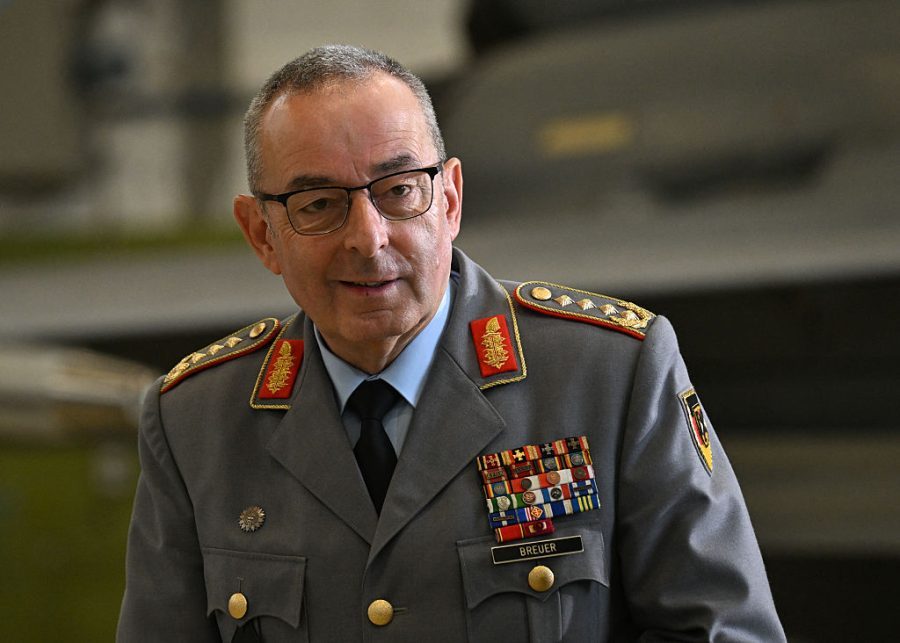
It was reported over the weekend that the Chief of Defence of the Bundeswehr, General Carsten Breuer, has been chosen as the next chairman of Nato’s military committee. The 61-year-old Rhinelander has more than four decades of military service and became Chief of Defence in March 2023. Breuer has consistently warned of the danger posed by Russia. During a visit to Poland in 2024, he told reporters:
What we see is a threat in five to eight years… By then, based on our analysis, Russia [will have] reconstituted its own forces to a degree that an attack against Nato soil could be possible.
The military committee advises Nato’s principal decision-making body, the North Atlantic Council. Technically, it consists of the most senior officer of each member state’s armed forces – in the UK’s case, Chief of the Defence Staff Air Chief Marshal Sir Richard Knighton – but routinely their places are taken by a permanent military representative.
In a military alliance, you gain a hearing for what you bring to the collective capabilities
The way the chairman of the military committee is chosen is characteristic of Nato. Breuer was chosen by a secret ballot of the alliance’s 32 chiefs of defence on Saturday night. It was announced, rather superfluously, that he had won the support of at least 17 of them – that is, a majority: but no more detail was disclosed to avoid prompting dissent or division within the organisation.
We know that Breuer beat General Jennie Carignan, Canada’s Chief of the Defence Staff, and it is widely believed that her candidacy was hampered by the current tension between Canada and the United States. Whether she received one vote or 15 is unknown, though Breuer was regarded as the strong favourite.
Breuer is a talented, experienced and well-respected military figure. He has formed a close working relationship with the Federal Minister of Defence, Boris Pistorius; he has been firm and outspoken on the threat from Russia and what Nato must do to meet and deter that threat; and he strengthened his reputation for leadership, practicality and crisis management when he headed the Covid-19 response unit in the Chancellery in Berlin between 2021 and 2022.
It is impossible, however, to ignore the issue which has come up again and again in reaction to his election at the weekend and on which Breuer himself campaigned: Germany’s substantial increase in defence spending and military commitments.
When Breuer became Chief of Defence in 2023, Germany spent 1.5 per cent of its GDP on defence, well below the then Nato-wide target of 2 per cent. In 2024, the defence budget grew enormously, meeting the 2 per cent target for the first time, and it rose further last year to 2.3 per cent, around €100 billion (£87.5 billion). This year it is expected to come to €120 billion (£103 billion), and by the end of the decade Germany’s annual expenditure on defence will exceed €150 billion (£129 billion), meeting Nato’s revised target of 3.5 per cent of GDP by 2035 five years early. Berlin will have more than doubled its defence expenditure within a decade and will be the fourth biggest spender in the world.
Compare and contrast: in 2023, the UK spent £55 billion, 2.25 per cent of GDP, on defence. By 2029, it is expected to spend £80 billion, representing 2.7 per cent. Money talks.
The argument is not as simple as advocating that the UK matches Germany’s overall defence expenditure (although we are the fifth or sixth largest economy in the world, roughly four-fifths the size of Germany, which should suggest a benchmark). What is indisputable is that we have fallen far behind Germany and others in terms of our proportional spending and have as yet no coherent plan to get anywhere near Nato’s target.
Money buys influence because it represents both hard-power capability and intent. The UK for decades enjoyed enormous influence in Nato. Partly this was the legacy of our having persisted throughout the Second World War – we were a combatant from 3 September 1939 to 2 September 1945 – and of our status as a founding member of the alliance in 1949; partly it was because our armed forces were often very good. But Britain also put its money where its mouth was. At its peak, the British Army of the Rhine numbered 80,000 soldiers and 800 main battle tanks; our defence expenditure did not fall below 4 per cent of GDP until the end of the Cold War.
Our clout in Nato is waning. We still, by convention, provide the Deputy Supreme Allied Commander Europe, currently Air Chief Marshal Sir Johnny Stringer, and host the headquarters of the Allied Rapid Reaction Corps (ARRC) at Imjin Barracks in Gloucester. In the event of a conflict, we are committed to providing two warfighting divisions, the 1st (UK) Division and 3rd (UK) Division to Nato’s overall land forces. No one believes we could generate those formations at full strength in a remotely helpful timeframe.
Sir Keir Starmer preened himself over his ‘Coalition of the Willing’ for an undefined role in Ukraine which never emerged. His successor would struggle even to construct that kind of paper tiger. We are failing to keep up with our Nato allies on defence spending, and, worse, we are still in denial about that failure.
Five British officers have chaired the military committee; General Breuer will be the sixth German general to do so. It is a microcosm, perhaps, but illustrative. In a military alliance, you gain a hearing for what you bring to the collective capabilities. Germany has shown what it brings and how serious it is. Increasingly, though in the opposite sense, the UK is in danger of doing the same.






Comments