
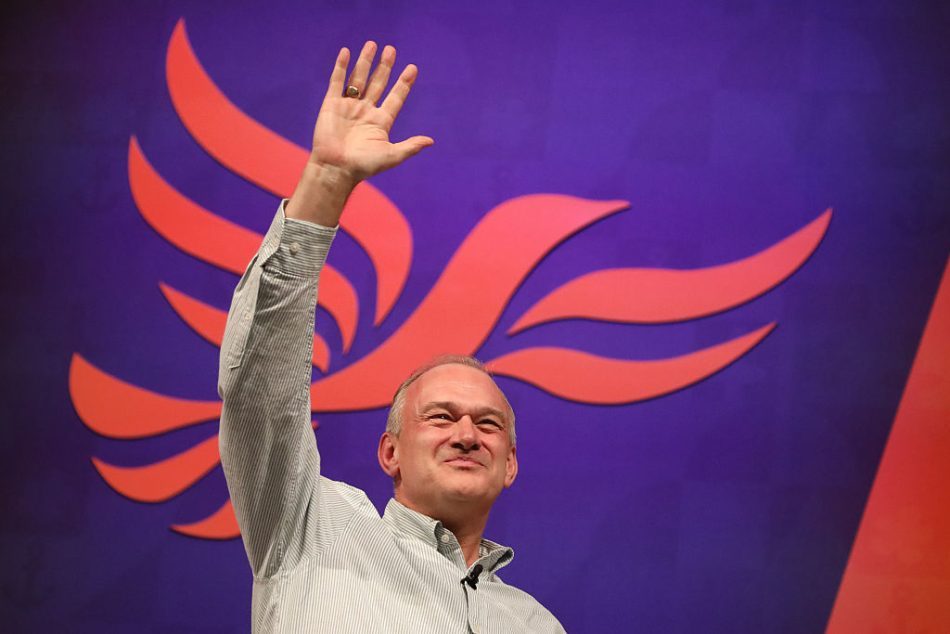
In Brighton Rock, Graham Greene’s 1938 work has two characters debating whether people can truly change. Rose, the naïve, tragic café worker hopefully believes they can; Ida, the more grizzled, maternal sleuth, is much more cynical. ‘Look at me. I’ve never changed’, she says. It’s like those sticks of rock: bite it all the way down, you’ll still read Brighton.’ Similar arguments have dominated these past three days in the bars and halls of the Lib Dem conference in Brighton. Amid much talk about Sir Ed Davey’s future, his troops are debating whether the party’s frustrations are personal or strategic. Could a new leader do a better job – or would they encounter the same perennial problems of leading a third party?
Grumbles have tended to focus on the party’s relative marginalisation. In a crowded electoral landscape, the spotlight on Reform and the Greens has left the Lib Dems struggling to cut through. After seven years as a national leader, ‘don’t know’ is still the phrase most used to describe Sir Ed in focus groups. Among the troops, there is a frustration that liberalism and Liberal England now seem in retreat. One council leader has questioned Davey’s leadership, claiming that the party is ‘lacking ambition’. Roz Savage has meanwhile been ‘gagged’, according to MP colleagues, after suggesting the Lib Dems are ‘struggling for relevance.’ There are plenty of other mutterings about too many Davey stunts, a lack of donations and a failure to fully embrace the 60 of the 72 new MPs won in 2024. The first round of applause in Ed Davey’s members’ Q&A on Sunday was a call for the party to be a more national force. ‘We want the world to know we’re happy as can be!’ proclaims a new song in the party’s Glee Club songbook. But not all share the sentiments of Cliff Richards.
The solution that Davey’s team has alighted upon is threefold. First, a refresh in personnel with James Holt brought in as Political Director and Ruth Younger as Chief of Staff. Second, more policy and involvement from MPs in building out their public offering. Third, a punchier approach, demonstrated by Sir Ed’s speech today, and an overhaul of the media strategy. The party has merged the communications and digital team, with several wide-eyed youths running around Brighton with microphones. A party podcast is set to begin from next month. One criticism of Davey’s ‘stunts’ are that they are designed for consumption through a more ‘boomer’ media lens: pictures in newspapers or clips on the BBC. With Zack Polanski dominating on TikTok, the aim is to get Davey on younger voters’ phones.
Overall, though, Davey’s team firmly believe that they have the right strategy. One aide argues the ‘party could get to 20 per cent next week’ by making a series of wild and popular announcements. But much like Polanski’s extravagant past claims, such polls would prove pyrrhic and collapse on contact with reality. The memory of 2019 has deeply scarred Davey’s team. Off the back of an anti-Brexit message, the Lib Dems soared to 20 per cent in the polls, only to find it squeezed mercilessly by polling day. Better to creep forward, slowly and steadily, they argue, rather than try to race ahead and risk misjudging the finish line. Davey used a members’ Q&A on Sunday to address the criticism that he is not ‘exciting’, noting that Donald Trump was ‘exciting’ but for all the wrong reasons.
He is helped in that there is no obvious successor, in the way that, say, Gordon Brown clearly was under Tony Blair. Daisy Cooper, his deputy, and Josh Babarinde, the party president, have done the rounds in the bar of the Grand, the former’s power suits mixing with the latter’s linen outfits. The likes of Max Wilkinson and Callum Miller are both spoken of highly too. There are signs of a potential generational divide in the party, with younger members keen for an offer on student loans and new groups like ‘Lib Dems for Growth’ popping up in the party to organise pro-building measures. It will be worth watching to see if any MPs try in the coming months to embrace such causes.
‘The problem with the Lib Dems is that you can ask five members for their favourite voting system – and get eight different answers.’
In a volatile political climate, the Lib Dems believe their best bet is standing still while the building is crashing all around them. ‘100’ is the figure bandied around as the upper limit of the party’s expectations in terms of seats: Davey has cited the statistic than in 57 seats, the party was within 10,000 votes of first place. With polls pointing to a hung parliament, many in the party, scarred by the memory of coalition, are thinking about what comes next. Unlike in the 1990s, there are less personal ties between Labour and the Lib Dems, although Davey’s ex-chief of staff Rhiannon Leaman is believed to be friendly with Morgan McSweeney. Many of the Lib Dems now sit in traditional Tory seats, digging in like Japanese knotweed. If they were to prop up a Labour government, the risk is that they would be the Tories a powerful herbicide to eradicate them from parliament.
Before that, the party must ensure it is in the strongest possible health if Andy Burnham decides to go to the country earlier. A decent number of donors are coming in around the £10,000 mark: Davey’s task in London will be to go further in winning over big donors of the Lord Sainsbury variety. Cooper’s new City Exchange offers a potentially useful convening forum for businesses burned by Brexit. The fringe is at a ten-year high – but membership is slightly down, with some activists complaining of a ‘fetishisation’ being made of their considerable efforts. Next week, Tom Gordon’s party reform report lands on Ed Davey’s desk, as he looks to try and solve the ‘chicken and egg’ problem of resources in target seats: only winnables are given funds, but only once they are given funds can they become winnable.
At most political conferences, it is the journalists who are agitating for change and the party figures more hesitant. In Brighton, curiously, it has been the inverse, with plenty of broadsheet hacks reminding members that, like Macmillan, they have ‘never had it so good.’ As one MSP put it to me ‘The question now is whether the party can hold its nerve’. Expect more handholding and plenty of stat-citing in the coming months as Davey tries to overcome mid-parliament blues to keep his party happy. As one activist put it thus: ‘the problem with the Lib Dems is that you can ask five members for their favourite voting system and get eight different answers.’






Comments