
The Archbishop of Canterbury has given the country a perfect lesson in interfaith engagement – in what it is, rather than what its practitioners imagine it to be – and, like most perfect lessons, she taught it by accident.
Those of us who have sat through a lifetime of clunky ‘interfaith’ initiatives – and I have done so from the Jewish side of the table for at least 20 years – learn to recognise the tell. The harder an event works to demonstrate that two communities get along, the more clearly it announces that somebody doubts it. I have said for decades, usually to sneers, that these choreographed encounters are not coexistence but a performance of it; that the performance tends to prove the opposite of what it intends; and that a stage, once built, attracts performers.
Mullally’s bumbling voyage through every woke, reactionary cause is providing her flock with a valuable lesson in how such ‘leadership’ only drags them in one direction: towards disaster
On Friday 11 September, 25 years to the day since the Twin Towers came down, the Archbishop of Canterbury presented an award for interfaith cooperation to a cleric who once proposed making Osama bin Laden the ‘Sword of God’. Six days later, she took it back. But this wasn’t Dame Sarah Mullally’s first rodeo. She has now proved the point twice in a single summer, and we should be grateful: it is the most complete practical course in the subject this country has ever been given. The other was during her Instagram influencer trip to visit Palestinians in the Middle East in June.
Her bumbling voyage through every woke, reactionary cause is providing her flock with a valuable lesson in how such ‘leadership’ only drags them in one direction: towards disaster. And it is all being photographed, press released and shared on Instagram for maximum effect, confirming that this type of fakery’s only value is through performative, enforced visibility. If she is the shepherd and the Church her flock, she seems determined to remind us that the end destination for sheep is always the slaughterhouse.
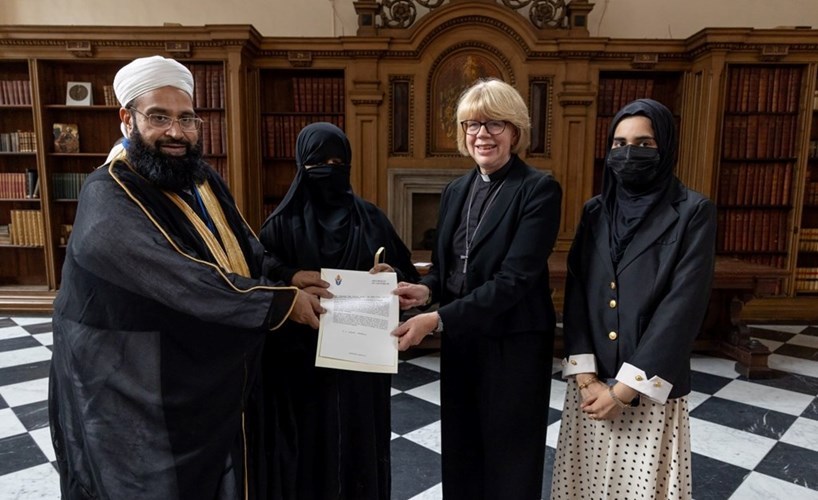
Her 9/11 award was the Hubert Walter Award for Reconciliation and Interfaith Cooperation, named after a crusader-era archbishop who negotiated with Saladin. The cleric was Hafiz Tahir Ashrafi, chairman of the Pakistan Ulema Council, honoured in Lambeth’s words as ‘an ambassador of interfaith harmony’. Beside him stood his wife, swathed in a black robe that left only her eyes visible, next to the first woman ever to run the Church of England, at a ceremony celebrating the meeting of faiths. If that tableau alone did not strike anyone at Lambeth as saying something about the gulf they were papering over, God help them.
It took Nick Timothy MP, and what appears to have been a question to an AI chatbot, to do what Lambeth’s due diligence had not. In June 2007, when Salman Rushdie was knighted, Ashrafi announced that his council would answer the insult by conferring on bin Laden the title Saifullah, in tribute to a man who had ‘been fighting for Islam against the Russians, Americans and British’. In 2013, he was reported to have declared suicide bombings in Afghanistan lawful – remarks he said were distorted, though not before Hamid Karzai’s government and Nato’s secretary general had responded. He insists that Pakistan’s blasphemy laws – some 2,000 prosecutions since the 1980s, Christians and Ahmadis first in line – ‘save lives’. Ashrafi told the BBC his words had been ‘totally taken out of context’, complained of ‘an unfair campaign’, then defended the comparison between a novelist and the murderer of nearly 3,000 people. Lambeth had cited his defence of one Christian girl falsely accused of blasphemy in 2012. That intervention was real, but it was also the only page anyone read when they chose him as a paragon of harmonious coexistence.
This was not the Archbishop’s first lesson of the summer. The earlier one came in June, on her pilgrimage to the Holy Land. Before leaving, she visited the Nova exhibition in London, posted once about 7 October, and departed for a week of set-pieces about Palestinian suffering at Israeli hands. In Bir Zeit she stood beside Layan Nasir, a 26-year-old Anglican presented as a victim of Israeli detention, without mentioning her activity in the student bloc aligned with the Popular Front for the Liberation of Palestine – designated a terrorist organisation by the US, the EU and Israel. The Archbishop then issued an open letter demanding an end to the ‘occupation’ and praising the ‘indigenous’ Christian presence – a word to be handled with care in the land of the Jews, who lived there first and rather famously existed long before Christianity.
What she did not mention was the thing Palestinian Christians themselves keep saying. Open Doors, which tracks the persecution of Christians worldwide, records a 20-year-old convert killed by her own family in February 2025, and the message her pastor then received: ‘We killed our daughter, do you think we won’t kill you?’ Bethlehem, the birthplace of Jesus and a Christian-majority town within living memory, is now overwhelmingly Muslim. On this, silence. In July, the General Synod completed the set, voting overwhelmingly to ‘hear’ a document denouncing ‘Zionist theology’ and a ‘genocidal war’.
None of this was bad luck. It was the ‘interfaith’ method, faithfully executed.
Genuine coexistence happens constantly and nobody photographs it. A Muslim colleague is a colleague; a Jewish neighbour is a neighbour. Often, these people collaborate on good work and causes in their shared society without once even thinking of each other’s religion. Institutional interfaith work runs the process backwards, starting from the conclusion and manufacturing an encounter to prove it. My own community is as addicted to this as any. Take the fashion for synagogues to host iftars. Jews and Muslims eat together all the time without a press release – in the office, in restaurants, in each other’s homes. The artifice is in bringing Muslims into a Jewish house of prayer to perform a Muslim rite, because the picture of Ramadan under a synagogue roof is meant to say something: the venue has become part of the performance. But historically, the only occasion on which Islamic worship took place inside a synagogue was a conquest or a takeover – not what any synagogue intends, and exactly why the picture says the opposite of what its organisers think. If a thing were normal it would need no choreography. Instead the participants become representatives of categories. We need a Muslim. We need a Palestinian Christian victim. Find one, photograph him, issue the release.
The trouble is that a manufactured role can be filled by anyone who understands the casting call, and those who understand it best have the most to gain. The Muslim Brotherhood’s 1991 memorandum for North America, entered into evidence at the Holy Land Foundation trial, describes its mission as a ‘civilization-jihadist process’ aimed at ‘eliminating and destroying the Western civilization from within’ – and, in the same breath, the ‘art of dealing with others’ and the building of coalitions. Lorenzo Vidino’s history of the Brotherhood in America, published last year, shows why those are not contradictions. Yusuf al-Qaradawi urged Muslims in the West to build ‘your small society within the larger society’, and promised that the conquest of Europe ‘will not be by the sword but by preaching and ideology’. Britain’s own 2015 review of the Brotherhood found that its ‘public narrative – notably in the West – emphasised engagement not violence’, and that it said different things in English and Arabic.
Anglicans need not wait for the next award, the next pilgrimage or the next Synod motion to learn how such enterprises end
The case closest to Ashrafi’s is Abdurahman Alamoudi, the moderate Muslim every bishop, rabbi and congressman of the 1990s wanted at the table; the FBI called his organisation ‘the most mainstream Muslim group in the United States’. He also backed Hamas and Hezbollah, was stopped at Heathrow in 2003 with hundreds of thousands of dollars and was linked to a Libyan plot to kill the Saudi crown prince. He was sentenced to 23 years in prison in October 2004. What the Islamist wants from the interfaith event is not conversion, it is certification: the photograph, the citation, the bishop’s handshake, and the proposition ‘this man is moderate’ – and soon, ‘this man represents Muslims’. The liberal Muslim with no organisation – with whom there is at least a scrap of hope of coexistence – receives none of this. The disciplined activist receives all of it.
Which is why Mullally’s summer is such a perfect specimen. She needed a Muslim to honour; a man with a council behind him, a government past and one famous good deed presented himself, and nobody asked what he said in Urdu. She needed innocent Palestinian Christians; the network supplied them, red keffiyehs cropped from the frame. Each time the category was delivered and the individual left unexamined, and when the truth arrived the damage fell not on Ashrafi but on the Archbishop, because the certifier’s judgement was the only thing on sale. Observers concluded the whole thing was theatre. They were right.
That is her great service to her church, and to every synagogue and mosque that stages the same pageants. Anglicans need not wait for the next award, the next pilgrimage or the next Synod motion to learn how such enterprises end. They end this way because they are fake; they are fake because they are manufactured; and they are manufactured because the tensions they exist to disprove are real. Real coexistence would have happened without a photographer. Everything Dame Sarah did this summer required one.





Comments