Eliot Wilson

Eliot Wilson

Eliot Wilson was a House of Commons clerk, including on the Defence Committee and Counter-Terrorism Sub-Committee. He is contributing editor at Defence On The Brink and senior fellow for national security at the Coalition for Global Prosperity

Why Trump is threatening the Falklands

There are still those who argue that President Trump’s aggressive, impulsive and inconsistent foreign policy is radical and disruptive, and because of this delivers results. The jury remains out on that. But there is one aspect of international affairs in which Trump is at a marked disadvantage. The US President is often governed by impulse, satisfying his instinct of the moment. That has been underlined by a leaked email from the US Department of Defense, setting out a list of potential punishments for countries which so far have failed to support Trump’s military action against Iran, Operation Epic Fury.

War bonds won’t fix Britain’s creaking defence

From our UK edition

The Chancellor Rachel Reeves is reported to be considering proposals to issue war bonds to fund a splurge in defence spending. We have been here before when it comes to the Labour government suggesting that it is willing to put its money where its mouth is on defence. Only 14 months ago, Sir Keir Starmer seemed to have seized the initiative when he announced that the government would not only fulfil but accelerate its manifesto commitment to spend 2.5 per cent of GDP on defence. That was brought forward to 2027, while he 'set a clear ambition' to go further to 3 per cent of GDP 'in the next parliament'. But what seemed like a bold act of leadership is now much diminished as other Nato member states have made greater commitments to defence.

Treasury squabbles are harming Britain’s national security

From our UK edition

The symphony of criticism aimed at the government for failing to live up to its promises of boosting Britain’s defences came to its crescendo this week. The lead author of last year’s strategic defence review (SDR), former Labour defence secretary and Nato secretary general Lord Robertson of Port Ellen, gave a speech at Salisbury’s Guildhall in which he savaged Sir Keir Starmer’s administration: he identified 'a corrosive complacency today in Britain's political leadership' and accused ministers of paying 'lip service' to 'the risks, the threats, the bright red signals of danger'. One of the mainstays of the criticism aimed at the government is the months-long, ongoing delay in publishing the defence investment plan (DIP).

Starmer is being ‘corrosively complacent’ about defence

From our UK edition

The old joke runs that you can tell when a politician is lying because his lips are moving. It is unfair – our elected leaders rarely indulge in flat-out, unambiguous untruths – but part of politics is certainly about presenting complex issues in a favourable light. The current government has its own strange and maddening approach to this, but I will come back to that. Robertson’s rebuke is especially important because he was the lead author of last year’s Strategic Defence Review which Sir Keir Starmer hailed as a ‘landmark’ document Outside the arrogant utopianism of Zack Polanski’s Green party, there is a widespread consensus that the United Kingdom needs to spend more money on defence.

Can the Royal Navy really deter Vladimir Putin?

From our UK edition

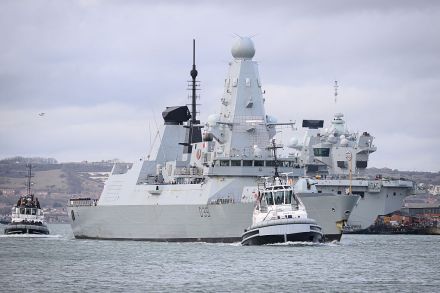
The Royal Navy has not had a good few weeks in reputational terms. It was nothing short of humiliating that it took three weeks to get the destroyer HMS Dragon to the eastern Mediterranean after RAF Akrotiri in Cyprus was attacked by Iranian drones on 1 March. The ship was the only one of six Type 45 destroyers available for operations (and has now had to put into port at an undisclosed location because of a water supply issue). Then it emerged that a frigate of the Russian Navy had escorted two shadow fleet tankers through the English Channel this week. Despite Sir Keir Starmer’s tough talk about boarding parties and 'starving Putin’s war machine of the dirty profits that fund his barbaric campaign in Ukraine', the ships were unmolested.

Putin has called Starmer’s shadow fleet bluff

From our UK edition

Theodore Roosevelt, the blur of energy who occupied the White House for the first years of the 20th century, famously advised statesmen: ‘Speak softly and carry a big stick.’ Sir Keir Starmer is increasingly performing a morbidly fascinating inversion of this, and pursuing a policy of speaking loudly (and piously), while having no stick at all. Putin currently has little to fear from Starmer’s moralising bluster At the end of March, 10 Downing Street proudly announced that the United Kingdom would ‘step up its pressure on Putin’ by giving permission for military and law enforcement personnel, including our still-vaunted Special Forces, to board vessels from Russia’s ‘shadow fleet’ if they passed through UK waters.

The Iran deal has shown Britain’s irrelevance

From our UK edition

With Donald Trump’s threat that ‘a whole civilization will die… never to be brought back again’ looming on Tuesday night, a temporary two-week ceasefire between the United States and Iran was agreed. The arrangement, mediated by Pakistan’s Prime Minister Shehbaz Sharif, is fragile, but showed who the leading players in the current conflict are. Starmer seems to have created an image of himself as an influential but essential eirenic figure on the world stage, a diplomatic heavyweight with invaluable convening power Sir Keir Starmer, by contrast, appeared to be confused about his own role in the conflict.

The fate of this US pilot could determine the Iran war

From our UK edition

Around dawn on Friday, a McDonnell Douglas F-15E Strike Eagle from the US Air Force’s 494th Fighter Squadron was shot down over south-western Iran. Although the Iranians initially talked about a ‘massive explosion’, it seems that anti-aircraft fire tore off the F-15E’s tail fin, causing it to crash; but the two crew members seem to have ejected before then. The capture of a pilot by an enemy regime would rekindle some of the American public’s worst, most horrifying atavistic memories The pilot has already been rescued by US Special Forces, but the fate of the weapons systems officer (WSO, or ‘wizzo’), who sits behind the pilot and controls the air-to-ground avionics, is unknown.

The one hurdle to Trump taking America out of Nato

From our UK edition

Donald Trump has never liked the North Atlantic Treaty Organization (Nato). Disagreements have been managed before and problems deferred, but his recent rage at Nato over what he sees as a lack of support for his war against Iran is now threatening to bring the issue to a head. When he was still a candidate for the Republican party’s presidential nomination in March 2016, Trump made his feelings clear to The Washington Post: Nato is costing us a fortune, and yes, we’re protecting Europe with Nato, but we’re spending a lot of money. His objections were and are typically Trumpian: he sees other countries taking advantage of the United States, American goodwill and generosity being exploited and insufficient fealty being paid to him.

Civilian ships can’t do the Navy’s job in the Strait of Hormuz

From our UK edition

There are those who will claim that Sir Keir Starmer has handled the UK’s response to America’s war with Iran skilfully and diplomatically. That said, one in ten of the population believes in astrology, so fringe positions will always attract some support. I would not even be sure the Prime Minister himself belongs to this particular clique. Starmer does, though, seem conscious that his stance was too passive and inscrutable when Operation Epic Fury began on 28 February and has been playing catch-up since then. The latest proposal for Britain’s contribution to containing and managing the conflict has been discreetly briefed to journalists.

Could Britain help unblock the Strait of Hormuz?

From our UK edition

It has not required advanced training in detecting nuance or reading between the lines in recent days to understand that Donald Trump is annoyed. A man who wears his demands, if not quite his heart, on his sleeve, he has made it abundantly clear that he wants America’s allies, especially but not exclusively the leading members of Nato, to provide additional resources and assets for a US-led effort to maintain maritime commerce through the Strait of Hormuz. The President is angry and disappointed that such help has not been immediately forthcoming.

Should Nato help America defend the Strait of Hormuz?

As soon as Operation Epic Fury, America’s latest campaign against the Islamic Republic of Iran, got underway on the last day of February, political, military and economic minds around the world should have turned their attention to the Strait of Hormuz. The waterway provided the only shipping route from the Persian Gulf to the Gulf of Oman and the open seas beyond. That has long made the strait the dagger Iran holds at the throat of the world. At its narrowest, it is less than 25 miles across, and Iran controls the northern shore; to the south is the Musandam Peninsula, shared by the United Arab Emirates and an exclave of Oman.

The glaring problem with the RAF’s new helicopters

From our UK edition

It was good news, albeit good news of the your-house-hasn’t-burned-down variety. Last week, the Ministry of Defence (MoD) announced that Leonardo UK had been selected for a £1 billion contract to provide the armed forces with a new medium helicopter, thereby securing the future of the company’s factory at Yeovil and 3,300 jobs dependent on it. It had not been an easy journey to the awarding of the contract. Leonardo was the only bidder, with Airbus, Boeing and Lockheed Martin having dropped out between the announcement of the competition in 2022 and the end of the bidding process in 2024. The MoD had also dragged its feet after it was clear that Leonardo was the only bidder, much to the frustration of the company’s CEO, Roberto Cingolani.

Does Trump really have ‘whatever it takes’ to win in Iran?

With Operation Epic Fury in its sixth day, it is hard to tell how long the current United States military campaign against Iran will last. It may not be swift; yesterday, the US Senate rejected a resolution to halt further action. Meanwhile, President Trump has been alarmingly indifferent to the question: Whatever the time is, it’s OK, whatever it takes. Right from the beginning we projected four to five weeks, but we have the capability to go far longer than that. We’ll do it. US Secretary of Defense Pete Hegseth struck a different note with reporters: 'This is not Iraq, this is not endless.' Yet he has refused to rule out deploying ground forces to Iran and later said, 'We have only just begun to fight.

Iran has shown how naive Keir Starmer truly is

From our UK edition

Being one of America’s closest allies – which Britain remains – is like having a very rich friend. You are invited to meetings and parties to which you might not otherwise have access, and people listen to you because of your connections. Sometimes, though, your friend will expect a favour in return which you know might make you unpopular with others. It is the quid pro quo. That relationship of unbalanced dependency has come under the spotlight since the United States launched Operation Epic Fury, its latest campaign against the Islamic Republic of Iran, at the weekend. America has an enormous military infrastructure in the Middle East with facilities in Qatar, Bahrain, Saudi Arabia, Jordan, Kuwait, the UAE and Iraq.

Why Starmer must raise defence spending fast

From our UK edition

Britain’s armed forces lack the mass, readiness and resilience needed to produce a credible deterrent in an era of intensifying threats. The danger comes not only from an aggressive and expansionist Russia but from a reckless and murderous Iranian régime with its back currently to the wall, while China continues to use any means at its disposal to advance its interests globally. To begin to meet these threats, His Majesty’s government must give an absolute and unqualified commitment to increase core defence spending to 5 per cent of GDP, with a clear timeline for delivery. This cannot wait. This argument has been set out in an open letter to the Prime Minister by the analysis and advocacy group Defence on the Brink.

Do Labour MPs even know what a leader looks like anymore?

From our UK edition

Last week could have been worse for Sir Keir Starmer, but only because he remains Prime Minister – for the time being. After the tawdry relationship between Lord Mandelson and the late child sex offender Jeffrey Epstein surged back into the headlines, Starmer’s chief of staff, Morgan McSweeney, was forced to resign as a burnt offering. For a while it seemed as if Starmer’s tenure as leader of the Labour party had hours rather than days, weeks or months, left to run. Labour MPs are understandably desperate. But they are losing touch with reality Survival is a basic human instinct.

Ireland had no right to name agent Stakeknife

From our UK edition

Micheál Martin, now in his second stint as Ireland’s Taoiseach, is by our standards a political veteran, having led Fianna Fáil for the past 15 years. But like our Prime Minister Keir Starmer, after finding domestic politics ever more challenging, he is finding solace on the international stage. Micheál Martin’s response was simply not the way allies or partners act towards each other Last week, Martin lived up to the Irish desire to be the ‘Most Oppressed People Ever’. In the Dáil he gave the Irish government’s official response to the final report from Operation Kenova, the investigation into the handling by British security forces of the agent within the Provisional IRA codenamed ‘Stakeknife’.

Parliament’s modernisers have been foiled

From our UK edition

Parliament is pointless without debate. It is there in the definition of the word itself: the Old French parlement derives from parler, to talk or discuss. Parliament is a forum in which our elected representatives debate how we live as a society and a nation. It has not been as effective or interested in that central purpose as it should for some years. This week, however, a House of Commons select committee drew a line in the sand and prevented debate being further marginalised.

Why is Starmer so desperate to tap into Europe’s defence fund?

From our UK edition

Keir Starmer has been seized by a dogged determination he does not always exhibit and has announced that he is seeking to revisit the UK’s participation in the European Union's defence fund, SAFE. Established last May, Security Action for Europe (SAFE) is a fund designed to provide €150 billion (£130 billion) in competitively priced, long-maturity loans for urgent, large-scale defence procurement projects. It was primarily intended for the 27 EU member states, but the terms were drawn very carefully: the loans were also open to Norway, Ukraine and third-party countries which had agreed security pacts with the EU, and could be spent with companies meeting the same criteria.