Culture

Culture

The good, the bad and the ugly in books, exhibitions, cinema, TV, dance, music, podcasts and theatre.

Uninventive and far too polite: BRB’s Black Sabbath – The Ballet reviewed

Dance

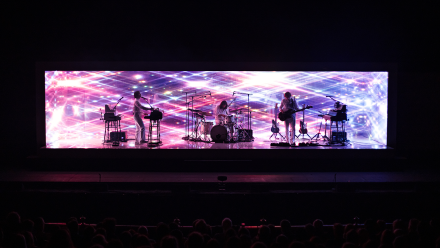
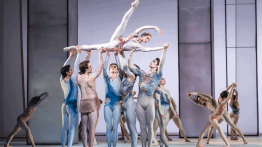
Not being an aficionado of the heavy-metal genre, I snootily suspected that I would rather be standing in the rain flogging the Big Issue than suffer the racket that goes by the name of Black Sabbath. The noise, my dear, and the people! How could they? So I approached Birmingham Royal Ballet’s attempt to dance to its shenanigans armed with earplugs and gritted teeth. It wasn’t nearly as bad as I expected: in fact, it erred towards the polite and tasteful, and I wondered if a crowd largely consisting of hairy and leathery old rockers – some of them possibly anticipating satanic rituals or heads being bitten off chickens – got much out of it.

Virgin on the astonishing: Madonna, at The O2, reviewed

Pop

When I was a kid listening obsessively to AC/DC and Iron Maiden and Black Sabbath, I despaired of music writers. How come none of them – except the staff of Kerrang! magazine and a couple of writers on Sounds – could see the majesty and splendour of this music? Why were they always banging on about flipping Echo and the Bunnymen and Joy Division, or harking back to old man Dylan? These days, all three of those bands are to some degree or another as revered. Not everyone loves them, but you won’t find many serious critics – even those who don’t personally care for ‘Whole Lotta Rosie’, ‘The Number of the Beast’ or ‘War Pigs’ – who’ll simply write them off as worthless. ‘A wandering worthless exercise’, wrote NME of Madonna’s Like a Virgin.

Juicy solution to the Purcell problem: Opera North’s Masque of Might reviewed

Opera

Another week, another attempt to solve the Purcell problem. There’s a problem? Well, yes, if you consider that a composer universally agreed (on the strength of Dido and Aeneas) to be a great musical dramatist left only one stageable opera (that’d be Dido and Aeneas), but hour upon hour of theatre music that’s effectively unperformable in anything like its original context: i.e., yoked to text-heavy Restoration dramas. How to get this stuff back on stage?  The story is rudimentary – just enough to support song, dance and a thumping great moral Masque of Might, David Pountney’s new extravaganza for Opera North, is one solution, and it’s rather a fun one.

What happened to the supermodels of the 1990s?

Radio

‘What advice would you give to your younger self?’ has become a popular question in interviews in recent years. It’s meant to generate something profound but, musing privately, I always find it a puzzler. Sometimes I think that maybe I shouldn’t have wasted so much of my twenties talking nonsense in pubs, but on the other hand I really enjoyed it. So I usually settle on: ‘Don’t buy a sofa bed, especially not the kind with a concealed metal frame that you pull out.’ Unbelievably, I’ve done this twice. These vast, unwieldy contraptions cost a bomb, weigh a ton, make a terrible sofa and an uncomfortable bed. If you’re 16 and reading this, be warned.

The Goldberg crown has settled on a new head: Vikingur Olafsson’s Golberg Variations reviewed

The Listener

Grade: A+ In 2018, the Icelandic pianist Vikingur Olafsson released a solo Bach album. It bounced along unforgettably. Olafsson’s subsequent albums for Deutsche Grammophon were all lovely, but like many ‘intellectual’ pianists blessed with a pearly touch he could sound a bit precious. I missed the playfulness of his Bach, and so when he announced he was recording the Goldberg Variations I was excited. Could he sprinkle the magic of his original album over this famous Aria and its 30 tightly argued variations, at a time when there are more than 200 rival recordings on piano floating around – and roughly the same number on harpsichord? (When Glenn Gould cut his sensational Goldberg Variations in 1956, the only competition was a forgotten disc from Claudio Arrau.

New Order’s oldies still sound like the future

Pop

The intimate acoustic show can denote many things for an established artist. One is that, in the infamous euphemism coined by Spinal Tap, their audience has become more ‘selective’. Attempting to make the best of a bad job, the artist shifts down a gear while aiming upmarket, much in the manner of a balding man cultivating a fancy moustache. The cosy concert is also favoured by pop stars craving some old fashioned string-and-wire authenticity. Occasionally, the urge is a creative one, propelled by the sense that the material being promoted lends itself to a less triumphalist approach.

An awfully long night for a band without any bangers: The National, at Alexandra Palace, reviewed

Pop

Over the past few years, the National have become the most important band in modern rock music. The strange thing is that this has happened at a point when their own work has perhaps lost a little of its earlier intensity. They’ve become important because they have come to represent something to other artists: a kind of adventurous but accessible integrity. The brothers who are the musical core of the band – guitarists Aaron and Bryce Dessner – have been so in demand that they have worked with, between them, (deep breath) Taylor Swift, Ed Sheeran, Michael Stipe, Sharon Van Etten, Bon Iver, Philip Glass, Steve Reich, Paul Simon, Sufjan Stevens, Nico Muhly, Jonny Greenwood, Bruce Springsteen and Ryuichi Sakamato. And those are just the ones you might have heard of.

Ebullience and majesty: Opera North’s Falstaff reviewed

Opera

Opera North has launched a ‘Green Season’, which means (among other things) that the sets and costumes for its new Falstaff are recycled. On one level, that’s nothing new: this eternally underfunded company has been performing miracles of sustainability for years now, and there’s usually at least one production each season that looks like it’s been cobbled together from the lumber room. A few seasons back, when ON rebooted their ‘little greats’ season of one-act operas, they mixed ’n’ matched sets between wildly different operas, with cheerful abandon.

Striking but not altogether successful: ENB’s Our Voices reviewed

Dance

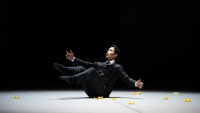
Aaron S. Watkin, an affable bearded Canadian, is the new artistic director of English National Ballet. He arrives from Dresden, where he ran a similarly scaled company comfortably subsidised by public funds. Doubtless, he finds what the Arts Council gives ENB meagre to the point of stingy. One may wonder, therefore, what the attraction is, but he certainly inherits from Tamara Rojo a solid organisation and a fine body of dancers, particularly strong on the male side. His inaugural piece of programming is striking but not altogether successful. It starts gloriously with Balanchine’s Theme and Variations, an essay in his grand tsarist style, set to some noble music by Tchaikovsky, that poses notorious challenges for the leading couple.

ENO’s Peter Grimes shows a major international company operating at full artistic power 

Opera

In David Alden’s production of Peter Grimes, the mob assembles before the music has even started – silhouetted at the back, muttering and menacing. Ah, Britten’s mob: simultaneously the source of some of the most electrifying, elemental choral writing since Mussorgsky and a licence for British directors to indulge in premium-strength snobbery. Fully endorsed by the composer, of course: it’s essential to Britten’s artistic schema that we believe the inhabitants of small-town England are only ever one beer away from forming a lynch mob. As their hatred boils over, Alden has them pull out little Union Flags, completely without pretext. There’s no trace of political nationalism anywhere in the libretto or score.

The real reason you shouldn’t buy Roisin Murphy’s new album

The Listener

Grade: B The rather wonderful, liberating thing about being a sentient human being, rather than a moron, is that one can agree with Roisin Murphy that giving kids puberty blockers is a kind of child abuse, while at the same time not liking her new album very much. Just as a sentient human being can enjoy watching Michael Sheen pretending to be other people quite well in films, while thinking him an egregious tit. The cancellation of Murphy was, of course, as obscene as it was predictable – but I do not quite swallow the idea that we are required, as a consequence, to buy Hit Parade. The title is a bit of a misnomer: three or four decent songs does not, to my mind, constitute much of a parade.

In praise of the Festival Song – the four-minute wonder that can sustain a career for decades

Pop

As the sun sets on another too-long summer festival season, let us take a moment to reflect on the Festival Song. This is the one tune by a band that even the most reluctant festival attendee will know. It is the song producers stick on the TV highlights package for bored insomniacs surfing the red button. It can save a set, turn grey skies blue and get old bones shaking. The Festival Song survives the artist’s critical nadir; it is the musical cockroach that emerges unscathed from a commercial apocalypse. It is the cast-iron guarantee to every festival booker in the land that an act can still bring something to the party.

Cheesy skit: A Mirror, at the Almeida Theatre, reviewed

Theatre

The playwright Sam Holcroft likes to toy with dramatic conventions and to tease her audiences by withholding key information about the characters. This tinkering seems to scare the critics into praising her scripts even though they feel like clumsily written thrillers or botched sci-fi yarns where the rules keep changing. Her technique appeals to high-minded theatres such as the Almeida because it enables A-level drama students to fill their notebooks with impenetrable guff about ‘metatextuality’ and ‘poly-ironic approaches to narrative’. It could be Noises Off by an author who wants to be Brecht or Pirandello Holcroft’s new satire, A Mirror, opens with a bogus wedding that gets disrupted when a gang of cops march on stage and cancel the ceremony. A strange start.

Wagner rewilded: Das Rheingold, at the Royal Opera House, reviewed

Opera

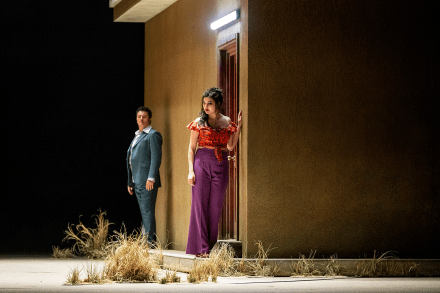
In Northern Ireland Opera’s new Tosca, the curtain rises on a big concrete dish from which a pair of eyes gaze down, impassive. Walls of scaffolding tower on three sides of the stage, creaking as they expand under the heat of the stage lights. Point taken: Cameron Menzies’s production (the sets are by Niall McKeever) is a semi-abstract updating. It’s a fairly standard contemporary approach to Puccini’s Napoleonic thriller, though whether you get the full impact that comes with a more period-specific setting – that sense of individuals being crushed beneath the wheels of history – is another question.

The dazzling classic The Red Shoes has several unfashionable lessons for us today

Arts feature

The Red Shoes, Michael Powell and Emeric Pressburger’s 1948 film about a ballet and its company, is 75 this month, and its birthday is being marked with great fanfare. From October to December, the BFI is putting on a major retrospective of the films of Powell and Pressburger, with an accompanying exhibition and nationwide screenings of The Red Shoes itself. A companion book to The Red Shoes by Pamela Hutchinson – stuffed with insight and background – is being published, as well as a lavish volume, The Cinema of Powell and Pressburger, complete with pictures and essays (almost love letters) about the late filmmakers from artists such as Tilda Swinton and director Joanna Hogg.

Rejoice that Hyperion’s impeccable back catalogue is finally available to stream 

Classical

At the beginning of the 1980s a former ice-cream salesman called Ted Perry drove a London minicab to raise money for his dream project: the world’s most smartly curated classical record label. For the first time these magnificent recordings are arriving on Spotify, Apple Music and other platforms He called it Hyperion, after the Greek sun god, and by the time he died in 2003 it had acquired its own mythology.

Watch three irascible women screaming at each other: Anthropology, at Hampstead Theatre, reviewed

Theatre

Anthropology is a drama about artificial intelligence that starts as an ultra-gloomy soap opera. A suicidal lesbian, Merril, speaks on the phone to her kid sister, Angie, and they discuss Merril’s beautiful ex-girlfriend. After ten minutes, we learn that Angie’s voice belongs to a robot, Digital Angie, created by Merril to replicate the real Angie who vanished a year earlier in unexplained circumstances. Then another surprise. Digital Angie becomes self-aware and turns into a detective who offers to help Merril investigate Angie’s disappearance and to find out if she’s still alive. Angie then turns into a third character who tries to interfere with Merril’s social life.

A haunting masterpiece: Northern Ballet’s Adagio Hammerklavier reviewed

Dance

One could soundly advise any choreographer to avoid music so transcendentally great in itself that dance can add nothing except banal images. Only a handful of exceptions sneak past the rule: MacMillan’s setting of Song of the Earth, perhaps, and also Hans van Manen’s Adagio Hammerklavier, his audacious attempt to visualise the infinitely slow movement of Beethoven’s epic piano sonata Op. 106. No individuals stand out; this is an ensemble with a collective identity that rejects the concept of stardom Northern Ballet has honourably revived this haunting masterpiece as part of its autumnal triple bill, and its impact overshadows the two novelties that frame it. What is its secret?

Mildly pleasant 1980s hard rock: ‘Angry’, by the Rolling Stones, reviewed

Pop

The new Rolling Stones single, supposedly their best in many a decade, is called ‘Angry’. And while on the surface it seems to be about the millionth anguished plea from Mick Jagger to some unseen woman to give him a shag, it reportedly stems from Mick’s mystification as to why everybody is angry these days. I suppose he is forgetting that youth has always been in a more or less perpetual state of pre-rational, pettish fury – a fury which, back in the day Mick was canny enough to take advantage of. You may remember his incandescence at being unable to attain any satisfaction, for example, or at the unwanted ingression of an unidentified person on to the cloud he was occupying.

The best new album I’ve heard this year: Being Dead’s When Horses Would Run reviewed

The Listener

Grade: A– The point of a sudden, abrupt change in the time signature and instrumentation of a song is to surprise the listener and undermine his or her expectations. If, however, you do it in every song, then the point is lost, and the listener finds himself actually waiting for the weirdnessto begin. So it is with Being Dead – and it’s about the only thing I have to carp about, because overall When Horses Would Run is a lovely album, full of often complex but always catchy melodies and imbued with an agreeably surreal sense of humour. The band is comprised of Falcon Bitch, Gumball and Ricky Moto and they come from Austin, Texas. Their shtick is punky surf guitar on top of which those clever tunes are sung as if by a cathedral choir in falsetto.

Every crumb of Kurtag’s music is a feast: Endgame, at the Proms, reviewed

Classical

The fun starts early in Beckett’s Endgame. Within minutes of opening his mouth, blind bully Hamm decides to starve his servant. ‘I’ll give you just enough to keep you from dying,’ he tells Clov. One biscuit and a half. Which feels positively lavish compared with what composer Gyorgy Kurtag feeds us musically in the first 20 minutes of his operatic adaptation (receiving its British première at the Proms). Crumbs, we get. One single lonely tone, from one instrument, every few seconds, all so spaced out that it almost sounded like the orchestra was on tiptoe, glutes clenched, attempting a heist perhaps, trying to half-inch some notes from somewhere. Every crumb of Kurtag’s music is a feast.

A euphoric meat-and-two-veg programme: Tonhalle-Orchester Zürich/Paavo Jarvi, at the Proms, reviewed

Classical

We used to call it a ‘meat and two veg’ programme, back in my concert planning days: the reliable set menu of an overture, a concerto and a symphony. It was an unfortunate term. No artistic planner likes to feel that they’re playing it safe, still less (and sources report that this goes double at the BBC) that they’re giving the public what they want. Traditional formats, familiar warhorses, dead white males: yawn! Then Paavo Jarvi and the Tonhalle-Orchester Zürich rock up at the Proms with a Beethoven overture, a Tchaikovsky concerto and Dvorak’s New World symphony and what do you know? The Royal Albert Hall was packed.

‘People thought I was insane’: Graham Nash on the birth of Crosby, Stills and Nash

Arts feature

Graham Nash always seemed like the reasonable, peace-making one among his famously fractious compadres, David Crosby, Stephen Stills and Neil Young. But he didn’t get to where he is today by being plagued with doubt or false modesty. Even talking remotely over a Zoom connection, he still radiates a kind of unshakeable certainty. ‘I just trust that the universe loves me enough to support what I’m doing,’ he declares. ‘I don’t seek my life, my life happens to me and I’m perfectly content to let it. Look what I’ve done in my life… Pretty nice!’ ‘Joni was the only witness to that sound and it was created in less than a minute’ At 81, Nash is, incredibly, a pre-baby boomer, but mentally he seems about three decades younger.

Doesn’t get better than this: The Threepenny Opera, at Edinburgh International Festival, reviewed

Classical

It’s the Edinburgh International Festival, and Barrie’s back in town. Once, Edinburgh was pretty much the only place that you could see Barrie Kosky directing in the UK; there was a satisfyingly transgressive thrill about an opera director whose priorities were so self-evidently about the whole art form that he’d happily stage Monteverdi as a tango-powered revue. In recent years, Baz the Knife has supplied increasingly rare moments of discovery amid the EIF’s all-you-can-eat buffet of touring orchestras and reheated prestige productions. But he’s not the rare bird he was. In fact, with a Carmen in rep at Covent Garden and a new London Rheingold coming soon after his Dialogues des Carmélites at Glyndebourne and the Proms, he’s starting to look like a fixture.

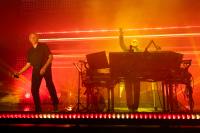
A 50-quid, hour-and-a-bit troll: Aphex Twin, at Field Day, reviewed

Pop

Forty per cent of London is green space. And what we do with all that grass – all that potential – is pave it with music festivals. This year, Hyde Park hosted Billy Joel and Bruce Springsteen. Gunnersbury Park had Boygenius. Finsbury Park welcomed Pulp and Travis Scott. Field Day is a staple of the season. Always falling on a Saturday in late August, the day is wholly reserved for electronic music. Reams of twentysomethings make the pilgrimage: set off from wherever, change at Bank, District Line to Mile End, 15-minute walk, enter, set aside £7.50 for a can of warm Red Stripe. Everything is very clean: the organisers don’t want Woodstock. The first thing you see upon entry is a stand to buy Alpine’s MusicSafe Pro High Fidelity Earplugs.

Invention and irreverence: Lankum, at The Queen’s Hall, reviewed

Pop

In a few days, Lankum will most likely win the 2023 Mercury Music Prize for their fourth album False Lankum – but don’t let that put you off. Increasingly, the Irish quartet feel like they belong to the lineage of artists who have wreaked radical and lasting change upon British and Irish folk traditions, from Davey Graham, Fairport Convention and Pentangle to Steeleye Span, the Pogues and Lau. The kind of artists who burrow deep into the forest of tradition in order to plant dynamite within the heartwood. At times, we might have been below deck on a ship heading for Ellis Island Appearing at the Edinburgh International Festival (EIF), Lankum played a set spilling over with invention, irreverence and attrition.

Fast cars, minimalist design and en suite bathrooms: the real Rachmaninoff

Arts feature

The train from Zurich to Lucerne tips you out right by the lakeside, practically on the steamboat piers. A white paddle-steamer takes you out of the city, past leafy slopes and expensive-looking mansions. Tribschen, where Wagner wrote the ‘Siegfried Idyll’, slides away to the right as you head out across the main arm of the lake. At the foot of Mount Rigi, shortly before the steamer makes its whistle-stop at the lakeside village of Hertenstein, is a promontory where – if the sun is coming from the west – a yellow-coloured cube shines among the trees. This is the house that Sergei Rachmaninoff built between 1931 and 1934: Villa Senar, his last attempt to make a home outside Russia in Europe.