Culture

Culture

The good, the bad and the ugly in books, exhibitions, cinema, TV, dance, music, podcasts and theatre.

The ex factor | 22 November 2018

Exhibitions

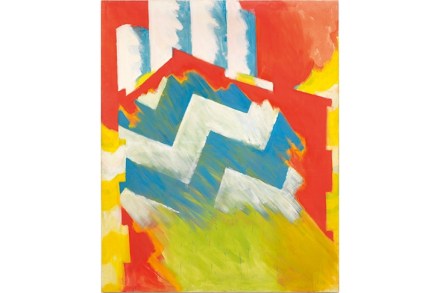
It is easy to assume that the contours of art history are unchanging, its major landmarks fixed for ever. Actually, like all histories it is a matter of shifting perspectives. As we move through time, the view backwards constantly alters. The rising and falling critical estimations of the painter Richard Smith are a case in point. Had you asked an art-world insider in 1963 who the brightest rising star of British art was there is a strong chance — though other names such as David Hockney might have been mentioned — that the answer would have been Smith (1931–2016). Appropriately, 1963 is the end date of an excellent little show at Hazlitt Holland-Hibbert gallery. This collates many of the most impressive pictures from Smith’s earliest and most seductive period.

All about his mother

Exhibitions

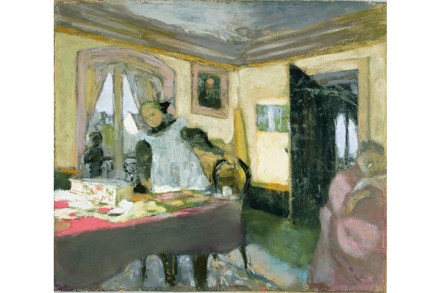
Fin-de-siècle Paris was not just the art capital of the world, it was also the fashion capital. In 1901, 300,000 Parisians were employed in the rag trade, and one of them was Édouard Vuillard’s mother. Stout, sensible and self-sufficient, Mme Marie Vuillard was no Mimi out of La Bohème, embroidering flowers in a draughty garret. She was the independent patronne of a dressmaking atelier — more of a couture flat, admittedly, than a couture house, operating out of rented apartments in the garment district. Before being left a widow with three children, she had prudently invested in a small business producing dresses and made-to-measure corsets for a fashion-conscious petit bourgeois clientele.

Brought to book | 15 November 2018

Exhibitions

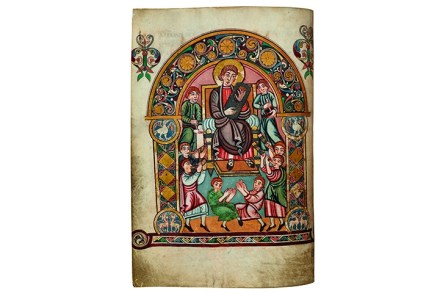
‘The barbarians drive us to the sea, the sea drives us to the barbarians; between these two means of death we are either drowned or killed.’ So wrote the British monk Gildas in his 6th-century proto-polemic On the Ruin of Britain, recording the arrival of the hated ‘Germans’ to the island. Bad news for the Britons, but fantastic for visitors to the British Library, now running perhaps the most significant exhibition of recent times, Anglo-Saxon Kingdoms. Historians dislike the term ‘Dark Ages’, but by any measurement western Europe saw a collapse in living standards, literacy, population, trade and significant cultural output from 500 ad. Yet that only makes the flame that appeared all the more striking, and the exquisite art so inspiring.

The big sleep | 8 November 2018

Exhibitions

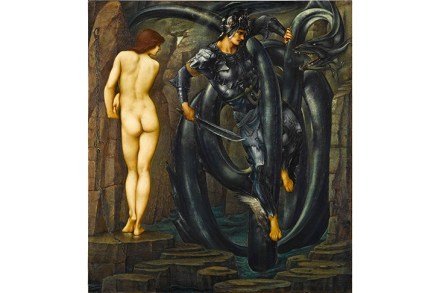
‘I want big things to do and vast spaces,’ Edward Burne-Jones wrote to his wife Georgiana in the 1870s. ‘And for common people to see them and say, “Oh! — only Oh!”’ That, however, was only the first part of my own reaction to the exhibition at Tate Britain of Burne-Jones’s works. Perhaps I’ve got a blind spot when it comes to B-J, but time and again I found myself thinking, ‘Oh no!’ Nonetheless, this comprehensive display and the accompanying catalogue give plenty of clues as to where he went wrong. Sir Edward Coley Burne-Jones (1833–98) followed an extremely unusual career path.

Spelling it out | 25 October 2018

Exhibitions

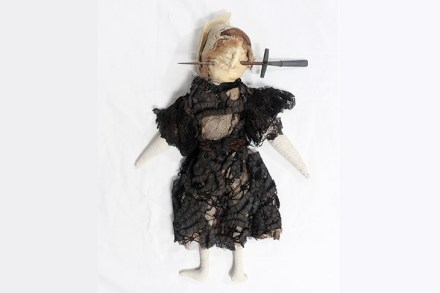
Just in front of me, visiting Spellbound at the Ashmolean last week, was a very rational boy of about seven and his proud mother. ‘I don’t believe in magic, witches or Father Christmas,’ he announced to the girl presiding over Room One. ‘Perhaps you’re spiritual but not religious,’ said the girl. The rational boy gave her the look she deserved. In that first room pride of place is given to a squat little silvered bottle with a hand-written label: ‘Obtained in 1915 from an old lady living in Hove, Sussex. She remarked: “and they do say there be a witch in it, and if you let un out there’ll be a peck o’ trouble”.

All together now | 18 October 2018

Exhibitions

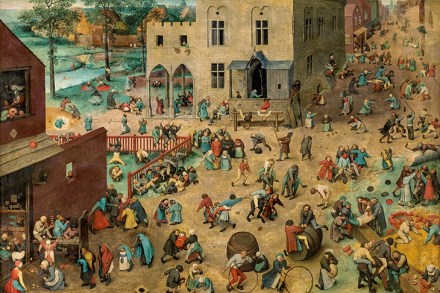
‘About suffering’, W.H. Auden memorably argued in his poem ‘Musée des Beaux Arts’, the old masters ‘were never wrong’. Great and terrible events — martyrdoms and nativities — took place amid everyday life, while other people were eating, opening a window or ‘just walking dully along’. As an example, Auden took ‘The Fall of Icarus’ by Pieter Bruegel the Elder. As it happens, Auden himself was wrong there, because the work he cited is no long thought to be by the painter after all. This picture is not, therefore, included in the exhibition Bruegel at the Kunsthistorisches Museum, Vienna.

Girls from the black stuff

Exhibitions

‘They did not look like women, or at least a stranger new to the district might easily have been misled by their appearance, as they stood together in a group, by the pit’s mouth.’ As opening sentences go this is a cracker, but few modern readers of Frances Hodgson Burnett’s That Lass O’Lowrie’s get far beyond it because the novel’s characters speak in a Lancashire dialect that makes Mark Twain’s Huck Finn sound like a Harvard preppy. In real life, though, it wasn’t the Lancashire pit girls’ lingo that put contemporaries off so much as their costume.

Poster boy

Exhibitions

You don’t need to be much of a psychologist to understand the trajectory of Henri de Toulouse-Lautrec. Born to aristocratic first cousins, in a family never shy of consanguinity, he was blighted by congenital deformities and weaknesses. When his brittle legs broke in his teenage years, they stopped growing altogether, leaving the adult Lautrec tiny as well as weird-looking, with his heavy lips and thick-lidded eyes. Fortunately, Montmartre was waiting for him, offering a boozy and bosomy refuge from his peculiar family and woeful self-regard. In the dance halls of the capital, Lautrec found his people, and in his art they found themselves. His paintings tell the story best, all those fleshy whores lying in bed or lining up for medical examinations.

Lost in the Pacific

Exhibitions

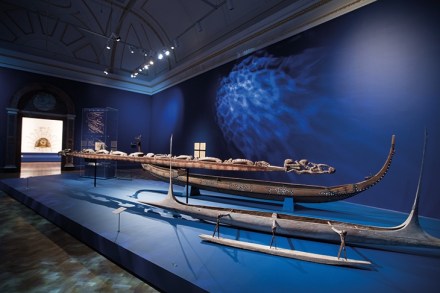
At six in the morning of 20 July 1888, Robert Louis Stevenson first set eyes on a Pacific Island. As the sun rose, the land ‘heaved up in peaks and rising vales’. The colours of the scene ‘ran through fifty modulations in a scale of pearl and rose and olive’, rising into ‘opalescent clouds’. The whole effect was a ‘suffusion of vague hues’ shimmering so that mountain slopes were hard to distinguish from the cloud canopy above. Oceania, the new exhibition at the Royal Academy devoted to the region’s arts and cultures, is almost as beautiful as that dawn landscape, and just about as difficult to make out with any precision. Nonetheless, it is full of the most marvellous things to see.

Doors of perception

Exhibitions

A reflection on still water was perhaps the first picture that Homo sapiens ever encountered. The importance of mirrors in the history of art has been underestimated. Alberti, Vasari and Leonardo recommended them as a tool for painters. Van Eyck delighted in them. Caravaggio had one in his studio. And they haven’t stopped fascinating artists. Shape Shifters, the new exhibition at the Hayward Gallery, might as well have been entitled ‘Modern Art through the Looking Glass’. Consequently, you see yourself all over the show, generally in surprising forms and positions. Early on, for example, you come across Anish Kapoor’s ‘Non-Object (Door)’ (2008), a rectangular block of highly polished stainless steel, each side of which is curved and convex.

Shock and gore

Exhibitions

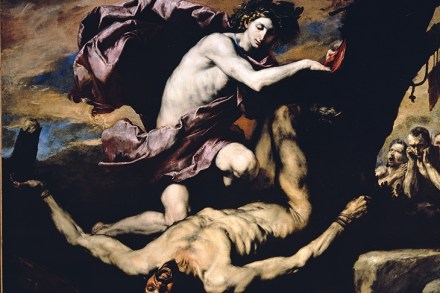
Last year my wife and I were wandering around the backstreets of Salamanca when we were confronted by a minor miracle. The iron gates of the convent of the Agustinas Descalzas — generally chained and padlocked — were ajar. Quickly we slipped through before they closed again. Inside was a vast 17th-century church, slightly dusty and completely deserted. On the high altar and the walls of the transepts were paintings by Jusepe de Ribera, a great master who is today half-forgotten. His art has seemed perhaps too gory, too dark — in short, too Catholic — to appeal to British tastes. But that may be about to change: next week, a Ribera exhibition opens at Dulwich Picture Gallery, the first ever seen in this country.

A soldier’s-eye view

Exhibitions

The first world war paintings of Paul Nash are so vivid and emotive that they have come to embody, as readily as any photograph, the horrendous, bitter misery of the trenches. His blighted landscapes represent the destruction of a generation of soldiers, men who were blasted apart as carelessly as the bomb-shattered mud in ‘The Mule Track’ (1918) or the reproachful twists of blackened wood and pocked land in ‘Wire’ (1918/9). These works are fixtures in our visual understanding of that war. It is strange, then, to see an exhibition of first world war art that excludes Nash, his brother John, and indeed any of the other artists we associate with the period. No Otto Dix or Max Beckmann, no Sydney Carline, William Orpen or John Singer Sargent. But, one little C.R.W.

There will be blood | 13 September 2018

Exhibitions

For the past few decades, admirers of video-games have every couple of years mounted a new attempt to persuade the wider arts-loving public of the form’s merits. Look, they say, games are not all about shooting people in the face! They are a dynamic fusion of animation, architecture, intellectual challenge, music and drama! They can be political and subversive! This is true, and yet somehow it never catches on. Will a new exhibition at the V&A enjoy any greater success? You walk through a series of large black rooms with giant screens that appear to be floating through the air. Along the walls are ranged game designers’ working notebooks, and concept art for the characters and landscapes, beautifully rendered in inks and watercolours.

Hidden treasure | 30 August 2018

Exhibitions

In 1675 Lady Bedingfield wrote to Robert Paston, first Earl of Yarmouth. Never, she exclaimed, had she seen anything so fine as the latter’s mansion, Oxnead Hall. It was ‘a terrestriall paradise’, the ‘gardens so sweet — so full of flowers’, the house so clean. ‘Nor,’ she concluded, ‘did I ever in my life find anything in poetry or painting half so fine.’ Almost all this splendour vanished long ago. But its essence survives, compressed into a single painting, ‘The Paston Treasure’, currently the centrepiece of an exhibition at Norwich Castle Museum.

Horror show

Exhibitions

‘It is disastrous to name ourselves!’ So Willem de Kooning responded when some of his New York painter buddies elected to call themselves ‘abstract expressionists’. He had a point. Labels for movements — such as pop art, impressionism and baroque — are almost always misleading and seldom invented by the artists themselves. That was certainly the case with the idiom examined in a little exhibition at Tate Modern, Magic Realism: Art in Weimar Germany 1919-33. Actually, this rather heterogeneous assortment of painters has two tags.

The play’s the thing | 9 August 2018

Exhibitions

Nothing was so interesting to Yves Klein as the void. In 1960 he leapt into it for a photograph — back arched, chin raised, spread-eagled. The same year, he took out a patent for International Klein Blue (IKB), a colour inspired by the limitlessness of the sky itself. He even went so far as to stage an exhibition of white walls and an empty cabinet. If there is a less appropriate place to exhibit his work than the lavishly adorned Blenheim Palace, I can’t think of it. Klein was born in Nice in 1928 and learned judo as well as art. In his late teens he visited the Scrovegni Chapel in Padua and marvelled at Giotto’s 14th-century frescoes, particularly the ceiling, which was bluer than the deepest seas.

Outsider art

Exhibitions

The complexities of Schleswig-Holstein run deep. Here’s Emil Nolde, an artist born south of the German-Danish border and steeped in the marshy mysteries and primal romanticism of that landscape. In 1920, he sees his region, and himself, become Danish following a post-Versailles plebiscite. An already well-established German nationalist bent — pronounced despite, or perhaps because of, his shifting national identity and shaky grasp of the German language — is inflamed. He moves back across the new border before eventually joining the local branch of the Nazi party and writing a volume of autobiography entitled, Jahre der Kämpfe in which he rails against the Jewish dominance of the art world.

Beasts from the East

Exhibitions

One area of life in which globalism certainly rules is that of contemporary art. Installation, performance, the doctrine of Marcel Duchamp, conceptualism — nowadays these flourish throughout the world and nowhere more so than in the Far East. Plenty of evidence for this is on view in an exhibition at the Hayward Gallery by the South Korean artist Lee Bul. But though the idioms are familiar, the works themselves can seem outlandish to an occidental eye. Just inside the door you are confronted by a sculpture entitled ‘Monster: Pink’ (2011). It looks like one of those oddly shaped vegetables that are sometimes displayed at village fêtes — but running riot on a monumental scale and sprouting innumerable carrot-like tubers.

Grim and glorious

Exhibitions

Tick, tock. Tick, tock. Stay too long in the Lee Miller exhibition at the Hepworth Wakefield and the metronome might drive you mad. Considerate curators will only set it swinging in stints to spare the gallery guards. Man Ray, who made the metronome ‘Object of Destruction’ (1923), meant it to infuriate. His assembled sculpture came with instructions. ‘Cut the eye from a photograph of one who has been loved but is seen no more. Attach the eye to the pendulum of a metronome and regulate the weight to suit the tempo desired. Keep going to the limit of endurance. With a hammer well-aimed, try to destroy the whole at a single blow.’ Tick, tock. Tick, tock. Smash. The eye on Man Ray’s metronome was Lee Miller’s, beautiful, blue, bewitching.

Roll out the barrels

Exhibitions

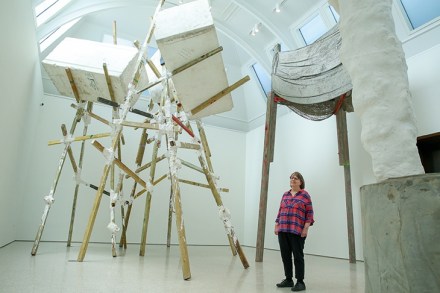
It’s not a wrap. This is the first thing to note about the huge trapezoid thing that has appeared, apparently floating, on the Serpentine Lake. Many of the projects by the artists who conceived it, Christo and his late wife and collaborator Jeanne-Claude, have involved bundling something up in a temporary mantle. The items thus packaged over the years include a naked woman (in Düsseldorf, 1964), the Pont Neuf (1985) and, famously, in 1995, the Reichstag. This London work, however, is the product of an equally long-running obsession with the barrels in which oil is stored and transported. At first, and second, glance, these objects lack charm.

The real Tolkien

Exhibitions

To no one’s surprise, the Tolkien: Maker of Middle-earth exhibition at the Bodleian in Oxford, where J.R.R. spent so much of his time, has been a huge success. Were tickets on sale, it would be a sell-out, but the Bodleian has made it free. The visitors book is peppered with observations such as: ‘It made me cry with joy… sensationally splendid’.There’s also a less hyperbolic view, in a childish hand: ‘It was interesting to see how he made The Hobbit and Lord of the Rings.’ It is rather a small show, a remarkable feat of compression on the part of the curator, Catherine McIlwaine, who had to pare down 500 boxes of Tolkien holdings to produce it, and was instructed by advisers that her captions mustn’t exceed 70 words each.

A self examined

Exhibitions

In 2004 Mexican art historians made a sensational discovery in Frida Kahlo’s bathroom. Inside this space, sealed since the 1950s, was an enormous archive of documents, photographs and personal possessions. This hoard forms the basis of Frida Kahlo: Making Herself Up, an exhibition at the V&A. Oscar Wilde once remarked that ‘one should either be a work of art or wear a work of art’. Kahlo opted for both, and she didn’t stop there. Though she was a Marxist who numbered Trotsky among her many lovers, she also channelled the role of saint and martyr. She was neater than Francis Bacon, whose studio-floor detritus has also been subjected to zealous forensic analysis — but the clutter Kahlo left behind her was similarly eclectic.

Searching high and low

Exhibitions

In the Moderna Museet in Stockholm there is a sculpture by Katharina Fritsch, which references Chekhov’s famous story ‘Lady with a Dog’. It was part of a Jeff Koons mini-show. At the time (2014), I thought it was by Koons. The postcard disabused me. It shows a woman in unapologetic Barbara Cartland pink, with a parasol, accompanied by a white fighting Pekinese. Both are constructed entirely from shells — she mainly scallop shells, her ample bust the bulging hinge of a clam, her arms fashioned from auger shells like mini-whelks. We have seen this ‘art’ before in a thousand evening classes for housewives who couldn’t get into the over-subscribed flower-arranging or macramé.

The good, the bad and the ugly | 21 June 2018

Exhibitions

Some disasters could not occur in this age of instant communication. The first world war is a case in point: 9.7 million soldiers died, 19,240 British on 1 July, 1916, the first day of the Battle of the Somme, alone. If all that had been seen on social mediaand rolling news threads, public opinion would have shifted immediately. A hundred years ago, however, the sheer awfulness of what was happening took more time to sink in. Aftermath, an exhibition at Tate Britain, deals not so much with the art of the war itself as with the shocked and grieving era that followed the cataclysmic conflict: post-war art. The horrors of the fighting continued to haunt artists on all sides, but not with equal force in every combatant country.

Napoleon dynamite | 14 June 2018

Exhibitions

The Musée de l’Armée at Les Invalides in Paris has a new exhibition that I believe to be the best and most extensive on the Emperor in three decades. Anyone interested in Napoleon Bonaparte, early 19th-century military history and strategy, the Grande Armée’s campaigns from 1796 to 1815, monumental battle paintings, First Empire beaux-arts, uniforms, weaponry or cartography, has only until 22 July to visit the truly breathtaking Napoleon: Strategist. On entering, you walk past the large busts of six of the seven great captains of history that Napoleon said he admired and wished to emulate: Alexander, Hannibal, Julius Caesar, Henri de la Tour d’Auvergne, Marshal de Saxe and Frederick the Great.

Minor key

Exhibitions

‘When I’m on good form,’ Edward Bawden told me, ‘I get to some point in the design and I laugh and talk — and if I’m laughing, it probably means the work is rather good.’ You can see his exuberance everywhere in the exhibition of his work at Dulwich Picture Gallery. It is a thoroughly jolly affair, but it also raises a delicate question: was Bawden (1903–89) really a serious artist? He was certainly a tricky one to pigeon-hole. Bawden is, deservedly, one of the most popular of 20th-century Britishartists. But when one thinks of him, it is hard to bring a major work to mind — much harder than in the case of his mentor Paul Nash or fellow-student and friend Eric Ravilious.

Out of order

Exhibitions

Patrick Heron’s paintings of the 1950s melt like ice creams. You want to run your tongue along the canvas and catch the drips. They capture a sense of summer holiday sea-and-scampi freedom. When Heron (1920–99) was five, his father, a blouse and silk-scarf manufacturer, moved from Leeds to St Ives in Cornwall. Heron played with the children of the potter Bernard Leach, and with Peter Lanyon, a friend from Sunnycroft primary school and a future painter, founded the Golden Harp Club, a society for the preservation of culture in England. After the Slade School of Fine Art in London, Heron returned to St Ives in 1944 on an ‘approved placement’ for conscientious objectors at the Leach Pottery. He met Ben Nicholson, Barbara Hepworth and Naum Gabo.

You know the drill

Exhibitions

In his Physiognomische Fragmente, published between 1775 and 1778, the Swiss physiognomist Johann Kaspar Lavater insisted that ‘clean, white and well-arranged teeth … [show] a sweet and polished mind and a good and honest heart’, while rotten or misaligned teeth revealed ‘either sickness or else some melange of moral imperfection’. Whatever one might think of the notion that one can read human character directly from the face, Lavater reminds us that dentistry has never been just about teeth. Possession of a functional, pain-free mouth is a practical necessity — we all must breathe and eat and talk — but it is also central to our sense of self.

Occupational hazards

Exhibitions

A conservator at Kansas City’s Nelson-Atkins Museum was recently astonished to find a tiny grasshopper stuck in the paint of Van Gogh’s ‘Olive Trees’ (1889). The discovery would not have surprised Van Gogh, who complained to his brother Theo in 1885: ‘I must have picked up a good hundred flies or more off the four canvases that you’ll be getting.’ On the evidence of a new exhibition of drawings on the theme of Artists at Work at the Courtauld Gallery, insects are the least of the plein-air painter’s problems: the 19th-century protagonist of Eduard Gehbe’s ‘The startled painter’ has been sent flying by a passing roebuck. Animals aside, there’s the physical discomfort to contend with.