Culture

Culture

The good, the bad and the ugly in books, exhibitions, cinema, TV, dance, music, podcasts and theatre.

War and plague have menaced theatres before, but rarely on this scale

Arts feature

It seems a long time ago now. I was meeting the artistic director of a pub theatre near Westminster on the afternoon of 16 March. Already it was clear that this was one of the worst days of his professional life. That evening’s performance of a John Osborne play had been cancelled because a cast member had caught a severe cold over the weekend. During the morning, four more shows had withdrawn their productions, and the theatre had nothing to present for the next eight weeks. As we spoke, his phone pinged. Another cancellation. The door swung open and the production manager came in with a look of doom on his face. ‘Downing Street’s just announced — all theatres to close indefinitely.’ The artistic director turned to me.

Riveting documentary about a remarkable man: Harry Birrell Presents Films of Love and War reviewed

Television

First shown on BBC Scotland, Harry Birrell Presents Films of Love and War (BBC4, Wednesday) was the documentary equivalent of a William Boyd novel, showing us a 20th-century life shaped by 20th-century history. The programme was made by Harry’s granddaughter Carina, who’d been eight when he died, and known him only as ‘a lovable, frail, blind old man’. But then she came across 400 carefully labelled reels of film in the family shed, together with an equally well-organised collection of diaries. Exactly — or even vaguely — when this discovery took place was one of many details that Carina tantalisingly failed to disclose. (Now and again, we did see her dusting off old cannisters with a look of surprise, but this felt distinctly like re-enactment.

The grisly art of Revolutionary France

Exhibitions

There was a basket of thick red wool and two pairs of large knitting needles at the start of University College London’s cleverly curated exhibition, Witnessing Terror: French Revolutionary Prints 1792–94. Visitors were invited to contribute their own lines of stitches before picking up a copy of A Tale of Two Cities, in which Dickens fictionalised the tricoteuses, the women who gathered around the guillotine knitting and waiting for heads to roll. The first six prints are French portraits of ‘revolutionary martyrs’ ranging from Louis XVI, wearing the bonnet rouge, or red cap of liberty, that was placed on his head when the crowd broke into the Tuileries Palace in 1792, to Robespierre, whose death in 1794 marks the formal, if not actual, end of the Terror.

You’ll keep saying ‘I’m sorry, did I hear that correctly?’: Fiasco reviewed

More from Arts

Kevin Katke was quite a man. He had no military training, no political background and no espionage experience. Nonetheless, his hatred of communists and can-do attitude made him the pre-eminent idiot savant of private American intelligence throughout the Reagan administration. It was a peripatetic career that culminated with him spearheading a bungled plot to oust a leftist regime in Grenada while holding down a full-time job at Macy’s. Call it the American dream. I learnt this — along with dozens of other things to make you say, ‘I’m sorry, did I hear that correctly?’ — listening to Fiasco (Luminary), a political-history podcast whose second season retells the bizarre and shambolic story of the Iran-Contra scandal.

Gorgeous and electrifying: And Then We Danced reviewed

Cinema

The film you want to see this week that you mightn’t have seen if you weren’t stuck at home is And Then We Danced, a gay love story set in Tbilisi, Georgia, and it is truly wonderful and gorgeous. Every cloud and all that. However, in my area the demand on broadband is so high that all I get is buffering, buffering, buffering, like it’s 1996, so the only way I could watch this in its entirety was by getting up at 5 a.m. And if it was an absolute pleasure then, it’ll be an absolute pleasure anytime. It passed the 5 a.m. test, you could say.

The director that everyone loved to hate: David Thomson interviews Peter Bogdanovich

Arts feature

Peter Bogdanovich’s new documentary about Buster Keaton, The Great Buster, is a match made in movie heaven. I can’t think of two men more devoted to making motion pictures — huge successes in their day — more acquainted with the merciless climate of Hollywood, or more aware that they were as instrumental in their own downfall as in their glory. ‘Buster said he made the great mistake of his life in 1928,’ says Bogdanovich. ‘He had done these masterpieces in the 1920s — Steamboat Bill Jr, Sherlock Jr, The Navigator, The General — and done them the way he wanted with his own production unit... It couldn’t get any better. But then [he was] told to sign with MGM. And Buster was never the same again.

Old-school Sunday-night family viewing: ITV’s Belgravia reviewed

Television

The world may be going to hell in a handcart but some things remain reassuringly unchanged: Julian Fellowes period dramas about feisty dowager duchesses, social climbing and snobbery, say. I like and admire Fellowes so I don’t want him to take this the wrong way. But when I say that his new series Belgravia (ITV) borrows from the same template he employed so successfully with Downton Abbey, and before that Gosford Park, and also in that series set on the Titanic that didn’t do quite so well, I’m not trying to suggest he’s a one-trick pony. More that he’s a canny chap who understands his market, has found the perfect formula and is damned if he’s not going to milk it for all it’s worth.

To ‘review’ such supreme paintings is slightly absurd: Titian at the National Gallery reviewed

Exhibitions

In 1576 Venice was gripped by plague. The island of the Lazzaretto Vecchio, on which the afflicted were crammed three to a bed, was compared to hell itself. In the midst of this horror Tiziano Vecellio, the greatest painter in Europe, died — apparently of something else. He was in his eighties and working, it seems, almost to the end. Titian: Love, Desire, Death, which was briefly on at the National Gallery, before it was closed down this week by our own plague, contained several of the greatest masterpieces of his old age — and also of European art. It comprises just seven canvases, all done for Philip II of Spain — a villain of English history, the man who launched the Armada, but as far as Titian was concerned his most discerning patron.

The director of Persepolis talks about her biopic of Marie Curie: Marjane Satrapi interviewed

Cinema

The problem with making an accurate film about science is that science is rarely exciting to watch, explains director Marjane Satrapi. Movie convention tends to insist on the climax of the eureka moment and the fiction of the solitary male genius, who doggedly closes in on his discovery in the same way that a detective might doggedly close in on a killer. ‘It doesn’t happen this way,’ says Satrapi. ‘It’s a result of lots and lots of work, which most of the time is repetitive and most of the time you know you don’t know where you’re going, and it’s lots of collaboration.’ Satrapi studied mathematics in her birthplace of Iran, and has a scientist’s intolerance for dramatic licence.

The magic of Bryan Ferry

Pop

The accepted line about Bryan Ferry is that his is one of the greatest reinventions in English pop culture: Peter York said, in 1976, that his life was ‘the best possible example of the ultimate art-directed existence’. But watching him at the Albert Hall, I couldn’t help thinking of my father. That’s not to diminish the show — which was a lush and all-enveloping pleasure, like getting into bed in a very good hotel — but I couldn’t help wondering if there was actually something very specific about Ferry that tends to get ignored: his generation. He’s 74 now, though from a distance you might put him in his mid-fifties, especially in his beautifully cut suit.

The musical vaccination we all needed: ETO’s Cosi fan tutte reviewed

Opera

Anyone familiar with Joe Hill-Gibbins’s work will brace instinctively when the curtain goes up on his new Figaro. He’s the young British director who smeared the Young Vic with jelly and custard (The Changeling) and transformed it into a giant mud pit (A Midsummer Night’s Dream), covered the Almeida in blood and more mud (The Tragedy of King Richard the Second) and bathed his cast in a stomach-turning blend of salad cream, ketchup and baked beans at the Edinburgh Festival (Greek).So when the curtain rises on a white-walled corridor whose sterile purity is broken up only by four equally white doors you do mentally reach for a mop. But Hill-Gibbins’s plans for Figaro are surprisingly clean and surprisingly, well, dry.

Catherine Deneuve at her most Deneuve-ish: The Truth reviewed

Cinema

To tell you the truth about The Truth, even though it stars Catherine Deneuve at her most Catherine Deneuve-ish (i.e. campily grand) and I was so looking forward it — it’s the first non-Japanese production from Hirokazu Kore-eda, who made the very lovely Shoplifters — it is now quite hard to concentrate on anything in films beyond the fact that they already feel like social history. My God, there was a time when people just went out and about willy-nilly? And they hugged and kissed and weren’t always washing their hands while singing ‘Happy Birthday’? So that gets in the way, as does having to watch films at home rather than on a big screen, now that cinemas have closed. But we will try our best — here to serve and what have you.

A mesmerising piece of theatre: On Blueberry Hill reviewed

Theatre

On Blueberry Hill sounds like a musical but it’s a sombre prison drama set in Ireland. Two bunkbeds. Above, an older man, Christy. Below, his younger companion, PJ. They take turns to talk, and gradually they reveal how their lives are interwoven. These are men of unusual intelligence and articulacy, and both are so profoundly in love with life’s simplest joys that their incarceration seems barely credible. Each might be a professor of literature or philosophy. During his boyhood, PJ tells us, he once worked as a golf caddy for a movie actor who shot a perfect round. It made him more happy than anything he had ever done. He tipped PJ ten shillings (50p), which was such a vast sum that his mother thought he’d stolen it.

What is driving the rise in extreme cinema?

Cinema

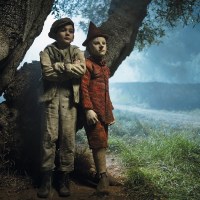
Why do we watch films like The Painted Bird? The movie tracks a young Jewish boy, an unclaimed innocent, wandering Eastern Europe as the second world war rages around him, drifting from village to village, encountering rape, paedophilia, mass murder and one spectacularly grisly scene where a miller gouges out his love rival’s eyes with a spoon — before tossing them to the cat. In the current climate you might want something more restorative than a film reminding us of forgotten civilian monstrosities. But increasing numbers are lapping up this kind of cinematic experience. This isn’t just cinema for people sick of Marvel. This is extreme cinema, endurance viewing for audiences keen on experiences that are viscerally unsettling.

Mother nature is finally getting the art she deserves

Arts feature

I guess that few would currently dispute that the world is in crisis. I’m not talking about Covid-19. Nor am I primarily addressing the issues arising from the 36 billion tonnes of carbon that the human project sends into our atmosphere every year. Climate chaos is a part of the issue, but I’m thinking principally of those things that most impact upon the biosphere as an ongoing live enterprise.

A lost opera from the most powerful musician you’ve never heard of: La ville morte reviewed

Opera

Who was the most influential figure in 20th-century classical music? Stravinsky? Pierre Boulez? What about Bernstein or Britten? John Cage or Karlheinz Stockhausen? Powerful public figures all. But there’s a case to be made for a very different kind of character — less king than kingmaker, a musical éminence grise.With a Who’s Who of pupils that included Leonard Bernstein and Aaron Copland, Elliott Carter and Astor Piazzolla, Philip Glass, John Eliot Gardiner and Daniel Barenboim, Nadia Boulanger is the most powerful musician you’ve never heard of, ‘the most important teacher since Socrates’, as one composer only partly joked. Photographs show us a stern, spectacled, almost invariably elderly figure.

The creators of Breeders are locked into a game of How Far Can You Go

Television

Sky One’s Breeders (Thursday) bills itself as an ‘honest and uncompromising comedy’ about parenting. To this end, the opening scene featured Martin Freeman as Paul trying to do some work while his two children under seven made a bit of noise a couple of rooms away. Having given himself a little pep talk about not screaming at them, Paul then screamed at them — bursting in on their blameless fun to yell: ‘Jesus fucking Christ! How many times do I have to tell you to be quiet?’ He further informed them that he was going to leave home and they should ‘tell mummy that daddy’s gone cos he couldn’t stand the fucking noise anymore.

‘Irish writers don’t talk to each other unless they’re shouting abuse’: Sebastian Barry interviewed

Interview

Sebastian Barry, Irish literary Laureate, is in London to promote his first play in a decade. He didn’t plan on leaving it so long, he insists; it’s just that finishing the play — On Blueberry Hill — took longer than he’d planned. How long? Most of the decade, he confesses. At one point progress was so slow that he wrote to his agent and offered to pay back the advance. ‘God knows, money is tight enough already in theatre without me taking it for not writing a play,’ he says. In his defence, Barry has been rather busy, publishing no fewer than three novels (including the Costa prize-winning Days Without End) in the time it took to finish one play. Why did On Blueberry Hill take so long then?

Another triumph for Crystal Pite and Jonathon Young at Sadler’s Wells

Dance

It must have been hard for Crystal Pite and Jonathan Young to live up to the success of 2016’s devastating Betroffenheit. In Revisor, their imaginative retelling of Nikolai Gogol’s satirical comedy of errors The Government Inspector (Revizor in the original Russian), Pite and Young draw on familiar techniques: dancers from Pite’s company, Kidd Pivot, lip-sync to actors’ voiceovers, their movements synchronising with, or playing off, the text. Ghoulish and farcical, Pite’s choreography is knife-sharp, the performers eye-wateringly good. Imagine watching a stage full of puppets, twitching without strings, sashaying between menace and campy drama.

Astonishing to think Miss World ever existed: Misbehaviour reviewed

Cinema

Misbehaviour is a film about the 1970 Miss World contest that was disrupted by ‘bloody women’s libbers’ — that’s what my dad always called them, anyhow — throwing flour bombs and shouting ‘we’re not cattle!’ as Bob Hope fled the stage in a panic and our televisions temporarily blacked out.Marvellous, I think now, although at the time I was probably as annoyed as my dad. I loved this show when I was growing up and wouldn’t have known there was anything amiss, as it was all so normalised, watched by a global audience of 100 million. Great family entertainment, I’d have said, now get out my way so I can see the contestants parade with actual numbered discs on their wrists as Michael Aspel pervs all over them.

Corpse! really is as good as everyone says it is

Theatre

Here’s the problem. Much communication is done online, especially by youngsters, and much drama focuses on communication. So how do theatre-makers represent emails and telephonic chitchat in ways that are stimulating and realistic? The usual solution is to mount blank screens around the stage and to beam the comms on to the boards while the characters crouch over their devices, tapping away. Realistic, yes. Hardly stimulating. When play-goers have seen this once — and most of us have seen it repeatedly — they crave a new approach. Roxana Silbert’s production of Al Blyth’s spy drama The Haystack projects the text messages just like everyone else. And the show relies too heavily on photographic inserts.

The gloriously indecent life and art of Aubrey Beardsley

Arts feature

Picture the young aspirant with the portfolio of drawings pitching up nervously at the eminent artist’s studio, only to be turned away at the door by a servant; then the master catching up with him, inviting him in and delivering the verdict on his portfolio: ‘I seldom or never advise anyone to take up art as a profession; but in your case I can do nothing else.’ Within two short years of this fairy-tale meeting in the summer of 1891 between Edward Burne-Jones and the 18-year-old Aubrey Beardsley, the self-taught insurance clerk who had fallen under the Pre-Raphaelite spell had turned himself into the most talked-about artist in London.

‘I feel compelled to be disgraceful’: Miriam Margolyes interviewed

Arts feature

I meet Miriam Margolyes in her large Victorian house in Clapham. She is very small and round, with a shock of grey hair, and the clear and open gaze of a curious child. There is an innocence to her, like someone who has not quite grown up. She has a wonderful voice, which bought this house. When it rests it is low and serious; but when she is telling a good story it takes flight. She is best known, now, for Harry Potter films and Blackadder; and for The Graham Norton Show which she dominates by speaking filth while looking delighted. This is deceptive though. When she wants, she can be very serious, although she struggles to be serious for long, which is why, I think, she does not have Janet Suzman’s career. When I say I find her serious she is delighted.

If your instinct is to undermine Beethoven, you’re directing the wrong opera: Fidelio reviewed

Music

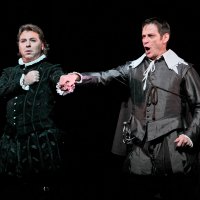
‘People may say I can’t sing,’ said the soprano Florence Foster Jenkins, ‘but no one can ever say I didn’t sing.’ There were groans of dismay as an official walked out before the start of the Royal Opera’s new Fidelio: Jonas Kaufmann was not feeling on top form, but he was going to perform the role of Florestan regardless, and begged our indulgence. The mind plays tricks and after an announcement like that it’s hard to be entirely sure whether you’re hearing a skilfully proportioned interpretation or a singer dialling it down. But let the record show that Kaufmann did sing, and if you’ve booked for this production on the strength of that magic name alone, you can breathe easy.

Oracles, perverts and the Dirtbag Left

More from Arts

For 500 years the State Oracle of Tibet has worked as a kind of angry immortal advisor to the Dalai Lama, a Tibetan hybrid of Dominic Cummings and John Dee. The current incumbent, like all previous ones, alternates between his human incarnation and his spirit version. ‘In Tibetan Buddhism, the unseen parallel world of spirits is not to be taken lightly,’ explains anthropologist David Sneath on Heart and Soul (BBC World Service). ‘There are so many other living species,’ the Minister of Religion and Culture tells Sneath, ‘many of which we don’t even see.