Culture

Culture

The good, the bad and the ugly in books, exhibitions, cinema, TV, dance, music, podcasts and theatre.

The Black Crowes’ latest album shows they truly are the American Oasis

Pop

Leonard Cohen used to speak self-deprecatingly about his sole ‘chop’ – that mesmeric, circular minor-key guitar pattern deployed on so many of his earliest and greatest songs. It was a classic Cohen humblebrag, the implication being that, in popular music, practical competence at just one thing was acceptable – but any artist with multiple ‘chops’ was to be viewed with great suspicion. The slightly strange notion that anyone peacocking their technical mastery is covering up for some other inadequacy – usually a lack of heart or, worse, of ‘authenticity’ – has found widespread acceptance in the field of music criticism over the years.

The true inventor of the superhero comic? William Blake

Exhibitions

Among the documents in the West Sussex Record Office is an indictment for sedition of a certain William Blake. During an altercation in a Felpham garden in August 1803, he is accused by one John Scofield, a soldier in the British army then at war with France, of having shouted: ‘Damn the King. The soldiers are all slaves.’ Fortunately for the accused, when the case came to trial in Chichester the following January the ‘invented character’ of Scofield’s evidence was judged to be ‘so obvious that an acquittal resulted’. It looks as if Blake got off lightly.

It’s disturbing how proud some music-lovers are about detesting Bruckner

Classical

There was a pleasing simplicity about the Glasshouse’s Big Bruckner Weekend. Five concerts, five major works, just one composer. You went big or you went home, and in truth that’s usually the deal with old Anton; in the words of the The Bluffer’s Guide to Music: ‘Bruckner just didn’t write pleasant little recommendable pieces.’ But it was striking how much more manageable he felt in this context. With a single work per concert, even the most obstinate Brucknerphobe was confronted with no more than 80 minutes of music at a sitting. No distractions, then – with the added sweetener of hearing a state-of-the-nation showcase of four leading British orchestras before teatime on Sunday. It certainly made for a fascinating thought experiment.

What would Balanchine say? New York City Ballet, at Sadler’s Wells, reviewed

Dance

It’s been 16 years since New York City Ballet appeared in London, and its too-brief visit to Sadler’s Wells offered a welcome chance to encounter a previously unseen range of repertory and personnel. Perhaps the company can never be what it was when I first saw it as a youngster – its founder George Balanchine still in charge, the likes of Suzanne Farrell and Edward Villella in their prime – but one cannot live off misty memories and what has emerged now certainly has living, evolving force. Yet the evening’s highlight for me had to be its ‘heritage’ element – the exquisite performance by Megan Fairchild and Anthony Huxley of Balanchine’s mysteriously beautiful miniature Duo Concertant from 1972.

The fading art of elegant gallery dining

Arts feature

We live in times generally unfriendly to ritual, religious or civic. For 50 years at least, churches have stripped away once-glorious liturgical rituals in order, they say, to render themselves more accessible, even as pews have emptied. On the civic side, great art museums – some would say the cathedrals of our secular age – once invited visitors to a ritual that gave a rest to the feet and the eyes while enhancing the experience of being there in the first place. It was called having lunch. The space is still there but is a shell. ‘Redesigned’ is not the adjective; vandalised would be better Visual attentiveness requires energy even if, like me, you shy away from reading the labels. Energy requires calories.

Homework, not theatre: WNO’s Cosi fan tutte reviewed

Opera

Mozart’s Cosi fan tutte hasn’t always been taken seriously. In fact for much of the 19th century it wasn’t even reckoned to be very good (Donald Tovey described its characters as ‘humanly speaking, rubbish’). For the modern director, there are several potential approaches. One – the hardest – is to try and evoke in the audience an approximation of a late-18th-century mindset. Another, scarcely easier, is to go all-in on psychological subtlety – the path taken by Tim Albery in the current Opera North production. A third is simply to play the whole thing as a saucy romp with a beautiful score, and that’s the choice that Max Hoehn has taken in his new staging for the Welsh National Opera.

Another exhibition that sees everything through the prism of race

Exhibitions

A wave of totalising race-first exhibitions has swept through UK art institutions of late. The National Portrait Gallery’s remit of ‘reflecting’ British society could reasonably make one wary of its turn at the same project. Indeed, a false, stilted language accompanies curator Ekow Eshun’s The Time is Always Now. To have some 20 artists ‘reframing the black figure’ somehow sounds both ambiguous and politically predetermined. What unites these works is more often a trendy hashtag than ‘lived reality’ Eshun has long been invested in the artistic black diaspora. His 2022 Hayward Gallery show In the Black Fantastic played on fantasy and Afrofuturism and had artists make new worlds that would take over the failing present.

This play about Hitchcock isn’t worth leaving the house for

Theatre

Double Feature is a new play by John Logan, whose credits include Skyfall. The subject is movie-making, and the action is set in 1964 in a Hollywood cottage where Alfred Hitchcock is preparing Tippi Hedren for a nude scene in Marnie. The great director, who made a star of the unknown Hedren by casting her in The Birds, has all the power here. He positively quivers to get her into bed and yet he hesitates because he’s three times her age and nine times her girth. Nobody, not even a director of Kent’s powers, can make a gourmet feast out of two half-eaten pizzas Their interactions have a gruesome master-slave vibe and it’s hard to know whose side to take. The control-freak director who appears physically revolting despite his natty suit?

John Galliano shows the cancelled can be uncancelled

Cinema

Kevin Macdonald’s documentary High & Low: John Galliano charts the highs and (spectacular) low of the British fashion designer who was fired as creative director of Dior after a number of anti-Semitic tirades came to light. I went into the cinema wanting to hear what Galliano had to say about it all. Why Jews, John? Why not Buddhists? What was going on? But the film never properly gets to the bottom of it. (‘I have no memory of that’ is his favourite reply.) As to whether the ‘cancelled’ can be ‘uncancelled’, there is a clear answer: yes. He is now riding high and appears to have been forgiven by the fashion world. But whether he’s been forgiven by me is another matter entirely.

The joy of meat-and-potatoes rock

Pop

‘Meat-and-potatoes rock’ is the pejorative term critics use when describing groups of white men with guitars who play loud, uncomplicated music. Why would anyone enjoy such stuff, when there are the ceviches of hyperpop, the flavoured foams of experimental hip-hop, the chargrilled seasonal vegetables of jazz? Don’t they know the world has moved on? Unfortunately, the world has a habit of not listening to the critical consensus. The highest new entry in last week’s album chart came from the Snuts, a meat-and-potatoes guitar band. This week’s No. 1 album is all but guaranteed to be by Liam Gallagher and John Squire, the Toby Carvery of meat-and-potatoes rock.

The Last Dinner Party are sadly rather good

The Listener

Grade: A- There is something decidedly fishy about this convocation of terribly well-bred young ladies who became a kind of sensation two years ago, before they had even recorded a single song – and now have their first album at number one, a sell-out tour in the US and a Brit award. All a bit too good to be true. Do they write their own stuff? Are they music industry nepo-kids, like everybody claimed Clairo was? For the first time, a glimmer of trouble afflicted them last week when a member of the five-piece band seemingly announced that people didn’t want to hear about the cost-of-living crisis. Cue outrage from the lefty music press. But don’t worry, they quickly released a statement ranting about living in a time of National Emergency, etc. Lots to dislike, then.

Workmanlike romp: Sky Atlantic’s Mary & George reviewed

Television

If there’s such a thing as a workmanlike romp, then Mary & George might be one. This drama about political and sexual shenanigans during the reign of James I certainly has all the scheming, racy dialogue and nudity that any romp-lover could wish for. At the same time, there’s the slightly awkward sense that it’s harbouring a guilty secret: it wants to be taken seriously as history and thinks it has some important things to say about class, gender and sexuality in 17th-century England and beyond. As a result, the naughty stuff – while definitely naughty – occasionally feels rather dutiful, and the playfulness somehow rather solemn.

In Bermondsey I heard the future – at the Barbican I smelt death: new-music round-up

Classical

To Dalston to witness the worst gig of my life. The premise of the Random Gear Festival was simple and rather inspired: gather some arbitrary objects; get people to play them. In previous iterations, the offerings had included an ice skate, a wet baguette and an exercise bike. This time we had a trampoline, a microwave, a dead fish. I kept an open mind. I was reminded that years ago at Cafe Oto I had seen the then chief conductor of the BBC Scottish Symphony Orchestra Ilan Volkov rub two blocks of polystyrene together with the subtle virtuosity of Martha Argerich at a Steinway. I was reminded too of what the composer Hector Berlioz had declared in his 1844 Treatise on Orchestration: ‘Every sounding object employed by the composer is a musical instrument.

Serious composers write ad music too

Arts feature

Next month in London, they’re celebrating a composer you’ve probably never heard of, but whose work you’re sure to have heard. If you’ve watched much British TV or cinema in the past half century, you’ll already know his music, and better than you think. A quick test of age: do you remember ‘The Right One’ – the song that used to advertise Martini (‘any time, any place, anywhere’) in a haze of wah-wah pedal and 1970s hair? How about Dennis Potter’s sci-fi swansong Cold Lazarus, or more recently, the Bafta-winning Édith Piaf biopic La Vie en Rose? Still no? Then picture David Suchet as ITV’s Poirot: and come on, surely you can already hear that smoky sax curling across the titles?

Dazzling but it’s all show: Tate Britain’s Sargent and Fashion reviewed

Exhibitions

Madame Ramon Subercaseaux, the beautiful wife of a Chilean diplomat, was not a Parisienne. So when the 25-year-old John Singer Sargent’s portrait of her in a black and white ensemble straight out of the Renoir playbook won a second-class medal at the 1881 Paris Salon, French pride was wounded. Édouard Pailleron, father of the purebred French children in Sargent’s other Salon submission, kicked up a fuss and had to be placated with another medal. But that was nothing to the scandal that erupted three years later over the American artist’s provocative portrait of femme du monde Virginie Gautreau, salaciously anonymised as ‘Madame X’.

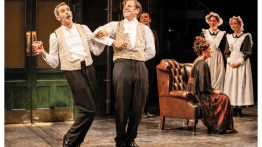
118 minutes too long: The Picture of Dorian Gray, at the Theatre Royal Haymarket, reviewed

Theatre

Sarah Snook, who appeared in Succession, takes centre stage in Kip Williams’s adaptation of Oscar Wilde’s only novel. The best thing about The Picture of Dorian Gray is the narrative premise: a young aristocrat commissions a portrait of himself and the image grows old while he retains his youthful good looks. It’s a ghost story, really, and Dorian ‘dies’ when the portrait is completed and then haunts his own life as an ageless and untouchable spirit. Wilde used the book as a literary showcase for his aphorisms. On ageing: ‘The tragedy of old age is not that one is old, but that one is young.

Why are there so few decent poetry podcasts?

Radio

The late John Berryman described A.E. Housman as ‘a detestable and miserable man. Arrogant, unspeakably lonely, cruel, and so on, but an absolutely marvellous minor poet… and a great scholar’. The Times obituarist went further, declaring Housman to have been, on occasion, ‘so unapproachable as to diffuse a frost’. That such a man could be so moved by a cherry tree in spring and by the dales of Shropshire in autumn says something about the separability of art and life. The greatest contradiction for Frank Skinner, whose poetry podcast has returned for a ninth series, lies between Housman’s work as a Cambridge classicist and his verse.

Twisted, fuzzy, psychedelic pop: Slowdive, at the Liquid Room, reviewed

Pop

Rachel Goswell, one of Slowdive’s two singers, has cool hair. It is dyed half black and half white, and by the end of this show I had a feeling it might have been trying to tell us something. Slowdive broke up in 1995 having made three albums. They reunited in 2014 and have since made two more. Can we spot the join tonight between the two eras? I think we can. When they first arrived on an independent music scene still subordinate to the critical whims of Melody Maker and NME, Slowdive were not exactly beloved. Back in the early 1990s they were more or less the whipping boys and girls of what was known as ‘shoegaze’.

Will a new Labour government let architects reshape housing?

Arts feature

‘We make our buildings, and afterwards they make us,’ Winston Churchill said in 1924 in a speech to the Architectural Association. This was flattery of the highest order, designed to butter up the audience of budding architects and inflate their sense of how much power they had to shape society. It’s remarkable then, 100 years later, how powerless architects have become when it comes to the biggest architectural crisis of our time: housing. According to the Royal Institute of British Architects, only 6 per cent of new homes in the UK are designed by architects. Everything else is dealt with by volume housebuilders, with the top three alone building 25 per cent of them, churned out from identikit designs.

Dramatically riveting and visually superb: Dear Octopus, at the Lyttelton Theatre, reviewed

Theatre

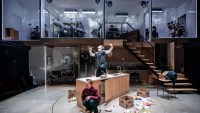
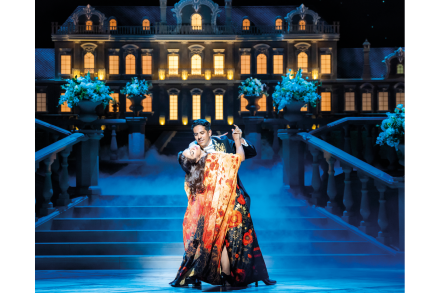
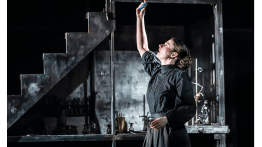
Big budget, huge stage, massive temptation. The Lyttelton is a notorious elephant-trap for designers who feel obliged to fill every inch of space with effortful proof of their brilliance. Frankie Bradshaw, designer of Dear Octopus, avoids these snares and instead creates a modest playing area, smaller than the actual stage, which is bookended by a doorway on one side and a fireplace on the other. These physical boundaries draw the actors towards the middle of the stage with a staircase overhead to complete the frame. Brilliant stuff. Perfectly simple, too. Any director planning to work at the Lyttelton should see Emily Burns’s fabulous production. So should everyone else.

Gleefully silly: Scottish Opera’s Marx in London! reviewed

Opera

A bloke was working the queue outside the Theatre Royal, selling a newspaper called the Communist. ‘Marxist ideas, alive today!’ he shouted into the Glasgow drizzle. Was he part of the show; a Graham Vick-style touch of Total Theatre? In any case, he didn’t seem to be shifting many units. He might have been even more disappointed by the opera itself: Jonathan Dove’s Marx in London!, here receiving its first UK production, is a new opera buffa with Karl Marx as the protagonist of a gleefully silly period comedy.

He barely knows what he’s doing: Oliver Anthony, at the O2 Shepherd’s Bush Empire, reviewed

Pop

What does a chubby, bearded American feller wearing a plaid shirt and singing about his dog and truck have in common with a chic, sonically adventurous Irish art-pop star? Both, last year, were inadvertently parachuted into the battlefields of the culture wars. Oliver Anthony recorded a song called ‘Rich Men North of Richmond’ – Virginia, not Surrey – that was picked up by MAGA-types from an obscure country music YouTube channel, became a talking point in the Republican presidential primary debates and ended up entering the Billboard Hot 100 at No. 1 last August. While the music is appealing enough, Anthony is an appalling lyricist.

Never achieves the flow of the Arkham series: Suicide Squad – Kill the Justice League reviewed

More from Arts

Grade: B- There was much to hope for with this game. Its developer is Rocksteady – the studio which gave us the superb Batman: Arkham series. A lot of money was poured into it, and a lot of time (the release date was much delayed). The premise is a winner, too: the Suicide Squad – Harley Quinn, Deadshot, Captain Boomerang and King Shark (a massive bloke with a shark’s head) – are dispatched to murder the noisome goody-goodies of the Justice League because, y’know, alien invasion, mind control etc, etc. Who wouldn’t be tickled by the prospect of having Harley slap Wonder Woman upside the head with a giant mallet, or – a boy can dream – seeing King Shark stuff the top half of the Flash in his mouth in one go so just his legs are sticking out?

A neat fantasy that asks why Britons don’t revolt: BBC1’s The Way reviewed 

Television

‘The British don’t revolt, they grumble,’ said someone in the first episode of The Way. But what if we ever reversed this policy? That was the question posed by a drama that’s clearly a passion project for its director, Michael Sheen – and therefore set in Wales. More specifically, The Way takes place in Port Talbot, the south Welsh town in which Sheen grew up and to which he moved back a few years ago, unexpectedly preferring it to LA. Or at least it takes place in a version of Port Talbot – because, perhaps necessarily for a show about a British revolution, there are hefty elements of the dream-like amid the realism.