Culture

Culture

The good, the bad and the ugly in books, exhibitions, cinema, TV, dance, music, podcasts and theatre.

Irresistible: Hansel and Gretel, at the Royal Opera House, reviewed

Opera

Fun fact: Engelbert Humperdinck composed part of Wagner’s Parsifal. Shortly before the première, it was discovered that Wagner’s score didn’t allow time for a crucial scene change. The 27-year-old Humperdinck, then working as Wagner’s assistant, composed a few temporary bars to cover the gap and, rather to his own surprise, found that they met with the Master’s full approval: ‘Why not? It should work!’ It’s worth knowing partly because of the light it throws on the practical, collegial working methods of music’s favourite cartoon supervillain, and partly because it reaffirms the originality of Humperdinck’s own best-known opera, Hansel and Gretel. How many artists could have flown that close to Wagner’s magic fire, and still emerged with their individuality unsinged?

Albums should be forced by law to reveal where each song was written

Pop

Bob Dylan is heading into the new year with a reduced property portfolio, having sold his Scottish bolthole, Aultmore House in Speyside, for a shade over four million quid. Though the spec looks grand – 16 bedrooms, 11 bathrooms, a folly (to complement his Christmas album, presumably) – only one aspect interests me: did Dylan ever write anything notable there? Is some piece of the Cairngorms National Park forever preserved in a line – perhaps the one he cribbed from Robbie Burns about his heart being in the Highlands – that came to him while gazing out enigmatically over the croquet lawn?

It’ll make you cry despite being very ordinary: One Life reviewed

Cinema

One Life is the story of Nicholas Winton (Anthony Hopkins), the British stockbroker who arranged the Kindertransport that saved hundreds of children from almost certain death in the Holocaust and be warned: you will need one tissue, if not two – maybe 12. Which isn’t to say it’s a great film. It’s fine, in its workmanlike way. But the story is so inherently powerful and moving and there is so much goodness and decency at work it will set you off. Take a whole box of tissues if you want to play it safe and would rather not deploy your sleeve. Hopkins’s performance is quiet, patient, masterly and as understated as the man himself Directed by James Hawes with a screenplay by Lucinda Coxon and Nick Drake, the film opens in 1988 with Winton’s appearance on That’s Life.

CBBC’s The Famous Five shows you can update a classic without trashing it

Television

The new Doctor in Doctor Who has blond hair, blue eyes and a firm handshake, dresses in a splendid red coat and has an exciting catchphrase: ‘Hounds are running! Tally ho!’ No, not really. The new Doctor is so very much what you’d expect the new Doctor to be like that you can guess without my telling you. And it’s not that I think that Ncuti Gatwa is going to be bad as the Doctor. On the contrary, from what little I’ve glimpsed of him so far, he seems charismatic, energetic, and fun. But I do wish the BBC commissars responsible for the series would try to make their social programming agenda a bit less insultingly obvious. Like all the best propaganda, Doctor Who is often gripping and visually enticing ‘It’s not aimed at you.

Do we really need this unsubtle and irrelevant play about Covid?

Theatre

Pandemonium is a new satire about the Covid nightmare that uses the quaint style of the Elizabethan masque. Armando Iannucci’s play opens with Paul Chahidi as Shakespeare introducing a troupe of players who all speak in rhyming couplets. A golden wig descends like a signal from on high and Shakespeare transforms himself into the ‘World King’ or ‘Orbis Rex’. This jocular play reminds spectators with a low IQ that Orbis is an anagram of Boris. The former prime minister, also labelled the ‘globular squire’, is portrayed as a heartless, arrogant schemer driven by ambition and vanity. He retells the main events of the pandemic with the help of an infernal aperture which works as a dungeon, a hospital and, finally, as a version of Hades into which the characters are sucked.

Video games aren’t a total waste of time

Arts feature

My wife argues with the children about video games. I argue with the children about video games. The children argue with each other about video games. Consequently, I argue with my wife about video games. It is a total nightmare – and it’s one that in various versions will be replicated in houses with young children up and down the country. The problem, in part, is a cultural divide. It frustrates me, too, when the children refuse to come off Rocket League or Fifa when they’re told to (‘I’m in the middle of a game!’). I’m also wary of the addictive nature of these things. But at the same time I can absolutely see the point of them; as my outgoing, intelligent, football-loving, film-making wife cannot.

The best British Nutcracker

Dance

The Nutcracker is one of those Christmas traditions that turns out to be not very traditional at all. First performed in St Petersburg in 1892, it didn’t catch on outside Russia until the late 1950s, when Balanchine’s version for New York City Ballet was repeatedly screened on network television in the USA and Festival Ballet’s production became a hardy perennial at the Royal Festival Hall. The Royal Ballet embraced it only in 1968; since then, it has become globally ubiquitous and an infallible money-spinner. The enormous affection that The Nutcracker inspires is underpinned by a magnificent score that shows Tchaikovsky at his most freshly inventive (it’s bizarre that he composed it joylessly, under duress). Yet the dramatic scenario it illustrates is insolubly problematic.

The road to the final snow-gazing scene is tortuous: Sky Max’s The Heist Before Christmas reviewed

Television

When it comes to one-off family dramas for Christmas, two things are pretty much guaranteed. They’ll begin with credits announcing a starry cast, and they’ll end with a redeemed character gazing at some falling snow as the music swells. The only tricky bit, then, is what should happen in-between. Should the redemption take place against a backdrop of vaguely gritty realism? Should plausibility be a consideration, or can the writers just rely on the magic of Christmas to get them out of any plot-related trouble? If Santa’s involved – as he so often is – should the show believe in Father Christmas? In the case of The Heist Before Christmas – set in Northern Ireland – the respective answers are ‘up to a point’, ‘I’ll get back to you on that one’ and ‘er…’.

The art of walking

More from Arts

My pilgrim companion William Parsons and I did not call our first journey a pilgrimage. Rather, it was a song walk: a walk with a purpose of taking a song, ‘The Hartlake Bridge Tragedy’, back to where it came from. It was also an attempt to reclaim my place in the world, after too much time spent in front of my computer. Stepping out and walking with intention. It did the trick. When we arrived at the monument that commemorates those who had drowned, we were met by chance by a couple who had three ancestors who had died in the Medway tragedy but did not know the song. Thus we returned the song to its bloodline, not just its place.

A short history of stained glass

More from Arts

On 13 December 1643, a Puritan minister called Richard Culmer borrowed the Canterbury town ladder and carefully leaned it against the Cathedral’s Royal Window. He then ascended the ladder’s 60-odd rungs, holding a pike; according to his account, modestly written in the third person, ‘Some people wished he might break his neck.’ Culmer had in his sights the ‘wholly superstitious’ depictions of the Holy Trinity, of ‘popish saints’ such as St George, and in particular of St Thomas Becket. There Culmer perched, he recalled cheerfully, ‘rattling down proud Becket’s glassy bones’.

Pleasant, underwhelming: Kurt Vile’s Back to Moon Beach reviewed

The Listener

Grade: C+ Maximum points for self-awareness, you have to say. The title track of this pleasant, if largely underwhelming, album include the lines: ‘These recycled riffs aren’t going anywhere, any time.’ Never a truer word spoken. Here, this fitfully engaging singer-songwriter shuffles through predictable chord changes pinioned by forgettable piano riffs and intones – deploying an often exaggerated southern drawl somewhat at odds with his Pennsylvanian provenance – basic and repetitive melodies which stay in the memory for about the half-life of Oganesson and then vanish. There is a pleasing twang to the guitar, bursts of scuzzy bottleneck and the occasional lap steel, but the songs go nowhere, as Kurt is generous enough to admit.

You’ll want all the characters to die: Infinite Life, at the Dorfman Theatre, reviewed

Theatre

Infinite Life is about five American women, all dumpling-shaped, who sit in a hotel garden observing a hunger strike. Some of them haven’t touched food for days, some for weeks. ‘Don’t be afraid to puke,’ counsels one of the dumplings. ‘Puking is good.’ They pass their afternoons wittering inanely about nothing at all. One dumpling is an air hostess, another works in banking, a third has a job as a fast-food executive. Or so they claim. Each of the dumplings might be lying to the others but it would make no difference because nothing connects them, and they have no stake in the situation other than the desire to burn up time.

Fine for the kiddies, given they’re clueless: Chicken Run: Dawn of the Nugget reviewed

Cinema

The original Chicken Run (2000), which is generally considered the best riff on The Great Escape ever made starring stop-motion poultry, did not require a sequel – but here it is anyway. Now you’ll probably expect me to say that Chicken Run: Dawn of the Nugget isn’t a patch on the original so I will: it isn’t. It’s not bad-bad. It’s definitely something you can stick the kids in front of, given they don’t know any better. But it’s not nearly as inventive or funny or affecting and, while Aardman films have always looked and sounded like no other, this has a generic rather than a quirky, handmade feel. Chances are you’ve had bigger disappointments in life, but it is a disappointment all the same.

David Starkey on the inventor of the portrait

Exhibitions

On 12 November 1549, the 12-year-old Edward VI, newly liberated from the tutelage of his overweening uncle, Lord Protector Somerset, was at last able to enter his father Henry VIII’s private apartments in the Palace of Whitehall. From the extraordinary mixture of treasures and bric-à-brac he found there, he chose one thing: ‘a book of patterns of physiognomies’ by his father’s court painter, Hans Holbein, who had died in 1543. Edward was already familiar with his fellow European rulers from their portraits in the long gallery at St James’s, which seem to have been labelled and arranged as a teaching tool for the boy. Now, on the threshold of power, he wanted to familiarise himself with the establishment of Tudor England.

A Nativity that sends shivers down the spine

Arts feature

Hieronymus Bosch was not a natural painter of religious images. His terrifying visions of Hell may have helped to keep congregations on the path of righteousness, but they did not inspire feelings of devotion – which could explain why none of the large altarpieces he painted remained over their altars after his death. In the eyes of the church, his Last Judgments were titillating: one painting showing ‘monstrous creatures from the underworld’ was removed from a church in his native ‘s-Hertogenbosch during his lifetime by officials offended by its orgy of nudity. Even his ‘Adoration of the Magi’ (c.

Why I love the Hold Steady

Live music is thriving right now. According to the US trade magazine Billboard, Taylor Swift’s Eras tour has so far grossed an estimated $838m, and that’s just from 66 shows in the Americas. It’s already the second highest-grossing tour in pop history, and she hasn’t had to cross an ocean yet. At the top end, live music is indeed awash in cash. But at the grassroots end, it really isn’t: December began with one of the UK’s best loved small venues, Moles, in Bath, announcing its bankruptcy – one more historic room set to shut down. Bands complain about venues taking a third of their merchandise revenues, a recent practice that eats into one of the few areas where musicians really can make some money. International touring has become harder and harder.

A marvel – how did Bradley Cooper pull it off? Maestro reviewed

Cinema

As the overture to Candide blazed away during the ovation for Maestro at the Venice Film Festival, three members of the audience flung their arms around in an imitation of Leonard Bernstein’s conducting style. They were his children, Jamie, Alexander and Nina, and their reaction said it all. Bradley Cooper, the film’s star and director, had pulled off a piece of cinematic chutzpah worthy of Lenny himself. His secret? The last quality you associate with the most embarrassingly flamboyant genius in American musical history: understatement. It’s easy to imagine the ghastly three-hour biopic Cooper didn’t make. West Side Story goes from near-catastrophe to wild triumph.

Still the best thing on TV: Apple TV+’s Slow Horses reviewed

Television

Slow Horses is the best thing on television. And it’s now so successful and popular it can afford to launch series three with a sequence worthy of James Bond: Istanbul location budget; spectacular chase sequences involving cars and speedboats with some thrillingly dangerous manoeuvres round a huge container vessel; a beautiful, immaculately dressed female agent meeting (spoiler alert, though to be fair you can see this one coming a mile off) a tragically sticky end. Except it’s better than Bond – not that difficult these days, it must be said – because it is missing all that grim portentousness, over-earnestness and pomposity. The cars are beaten up and gadget-free; the stunts look plausible; and the agents behave like real human beings.

Small moments vs Big Ideas: Peter Gabriel’s i/o reviewed

Pop

Peter Gabriel is terribly fond of a Big Idea. With Genesis he would sing in character as a lawnmower, a fox and as ‘Slipperman’. His final work with the band, in 1974, was The Lamb Lies Down on Broadway, a double album driven by what we might kindly describe as a ‘kaleidoscopic’ narrative involving a Puerto-Rican protagonist on a voyage of self-discovery in New York City. Since going solo there has always been plenty of stuff whirling around each new Gabriel project. His Real World HQ in the West Country is part recording studio, part hi-tech hippie lab, encompassing conceptual technological probing, multimedia collaborations, NGOs and various foundations.

Simply not as good as Mozart’s: RCM’s Don Giovanni Tenorio reviewed

Classical

In Bernard Shaw’s Man and Superman, Don Giovanni finds himself in hell, chatting to the sentient Statue that dragged him to his doom. ‘It sounds rather flat without my trombones,’ admits the Statue, conceding that once you remove the genius of Mozart from the mix, you’re left with a trite (if titillating) morality tale. You could draw the same conclusion from the opera Don Giovanni Tenorio, by Giuseppe Gazzaniga (1743-1818), and if you haven’t heard of him you might wonder why not. Institutional racism? Patriarchal hegemony? Not this time. Gazzaniga was a Neapolitan composer of perfectly adequate operas that simply aren’t as good as Mozart’s. Anyway, Don Giovanni Tenorio made an amusing end-of-term show at the Royal College of Music.

Fascinating: Radio 4’s Empire of Tea reviewed

Radio

I can scarcely remember a time before tea: I started drinking it at around four, at home in Belfast, as a reward after school. Before long I was as fiercely protective of my right to a brew as the workers of British Leyland’s Birmingham car plant, who were famously spurred to strike action in 1981 when the management proposed cutting tea breaks by 11 minutes. Decades on, my passion is undiminished. There is no problem to which tea is not at least a partial solution: it restores flagging spirits, calms the over-excited, warms in winter and refreshes in summer.

What a muddle: The House of Bernarda Alba, at the Lyttelton Theatre, reviewed

Theatre

Green, green, green. Everything on stage is the same shade of eau de Nil in the NT’s version of Federico García Lorca’s classic, The House of Bernarda Alba. All the furniture and props are green. The mirrors, the walls, the crucifixes, the clocks and even the bucket and the knife-rack bear the same queasy pigment. The idea, perhaps, is to suggest a lunatic asylum or an NHS waiting room. Lorca’s steamy tale is set in a remote Spanish village in the 1930s where life is dominated by the repressive and superstitious Catholic church. The story opens with a nasty matriarch, Bernarda Alba, celebrating her husband’s death by ordering her five unmarried daughters to spend the next eight years indoors, doing embroidery. No visitors are allowed.

The Spectator film critic who transformed cinema

Arts feature

‘Going to the pictures is nothing to be ashamed of,’ insisted the film writer Iris Barry in 1926. But it certainly wasn’t something to be proud of, either. To the cultural cognoscenti of the 1920s, Barry admitted, the cinema was barely an art at all – about as aesthetically significant as ‘passport photography’. And for much of polite society, seeing a film was done in secret, if at all. So it was a considerable boost for the fledgling medium when, 100 years ago, the word ‘cinema’ began to appear for the first time in this country above its own regular column, with its own dedicated critic, in the arts pages of The Spectator. Attending to this young art form was the even younger Barry.

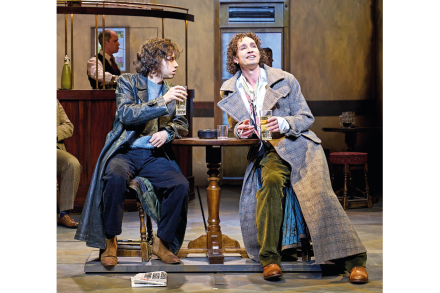
An amusing playlet buried in 150 minutes of rhetoric: Mates in Chelsea, at the Royal Court, reviewed

Theatre

Theatres outside London like to produce shows that appeal to their local communities. Inside London, where cultural attitudes are strangely warped, theatres are happy to disregard the neighbourhoods they serve, and they show little interest in the lives of their customers. But the Royal Court Theatre and Hampstead Theatre have both chosen to stage shows that feature characters who live nearby. Mates in Chelsea, at the Royal Court, stars a bone-idle superbrat, Tuggy, whose inheritance is threatened when his snooty mother (who is brilliantly played by Fenella Woolgar) decides to flog the family castle in Northumbria. An offer is received from a Russian billionaire, Oleg, and Tuggy promptly has a meltdown. After an elaborate farce, the play ought to peter out.

Embarrassingly addictive: Channel 4’s The Couple Next Door reviewed

Television

For years now, lots of TV thrillers have begun with a terrified woman running through some woods. But not The Couple Next Door. Instead, the first episode opened with the sight of an isolated cabin and the sound of a gunshot – and only then did a terrified woman run through some woods. Why the woman was terrified we haven’t yet learned, but we do know who she is – because in the next scene, her pre-terrified self and her partner were moving into their new house in a quiet, well-heeled Leeds cul-de-sac where every adult not mowing a lawn was washing a car. ‘Hello, suburbia,’ said her partner, perhaps unnecessarily.

Britain’s forgotten female pop artist 

Exhibitions

T o describe Pauline Boty as a ‘pioneer’ is a bit like calling someone a ‘one-off’. It’s not an adequate description of her in any way. Pauline was the only female British pop-art painter of the early 1960s. You may not know of her. She died in 1966, aged 28, and her name has remained very much in obscurity ever since. Pauline, in her youth, appeared to have it all. She had movie-star looks, a provocative intelligence and a magnetic personality. ‘She was beautiful, with this marvellous laugh: clever, very bright, very much the early feminist,’ says designer Celia Birtwell, who lived with her. Male interviewers would ask: ‘What’s a pretty girl like you doing in a place like this?