Culture

Culture

The good, the bad and the ugly in books, exhibitions, cinema, TV, dance, music, podcasts and theatre.

In Monet’s garden

Arts feature

We owe Giverny to the generosity of Americans Whoever coined the famous aphorism ‘When good Americans die, they go to Paris’ didn’t tell the full story. For American plein-air painters, Paris was never more than limbo. Heaven, they eventually discovered, was Giverny, presided over by the Impressionist deity Monet. It was 1887 when the first American scouts came to reconnoitre the small Normandy village 80 kilometres down the Seine. They reported back to Paris, and within a few summers Monet’s rural retreat was infested with artists’ studios and the fields around were sprouting clumps of painters’ white umbrellas.

Saturday Morning Country: Elvis Presley

Sure, you don't necessarily think of Elvis as a country singer. But then you remember his gospel roots and the rockabilly and it all makes sense. How could such a great American ever escape the greatest American musical genre of them all? He never did. Or, if you prefer, he just often returned to it.

A hole-hearted Siegfried

Opera

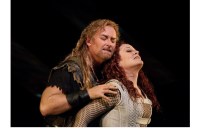
Everything is there – except the central character English Wagnerians really can’t complain about what they’ve been offered this year, so long as they can get around the country, and particularly around the countryside. In London we have only had ENO’S Parsifal, but that was musically magnificent. Many of us found Glyndebourne’s Meistersinger tremendous both musically and as a production, and in the north there have been acclaimed performances, with more to come, of Das Rheingold in concert, a treat I have still in store; and a memorable Walküre, also in concert, in Manchester three weeks ago, which introduced a potentially great Wotan, Egils Silins.

Musical mockery

Music

They’re back. In August the capital fills with bored, dim-witted, half-naked semi-vagrants who have nothing to do here but get in the way of Londoners who do have things to do here. Tourism is an invitation to robbery. If you aren’t going to a place to work, you’re going there to get worked over. The rites of mob travel invert all the natural obligations of xenophilia. Natives become swindlers and their victims happily connive in the evacuation of their own purses. No one objects because it’s understood that a tourist isn’t a visitor in the proper sense. He’s in London but not engaged with it. He’s half here and half at home.

Mariinsky Ballet

More from Arts

It is 50 years since what was formerly known as the Kirov Ballet — now Mariinsky Ballet — paid its first, legendary visit to London. Thanks to the commendable efforts of Viktor Hochhauser, the impresario who made that first visit possible, the company has become a familiar focal point of the London summer dance season. This year is no exception, with a rich programme of both classical and modern ballets. For its opening last week, the celebrated Russian company chose the work it is traditionally associated with: Swan Lake. Konstantin Sergeyev’s 1950 production might not be everyone’s cup of tea, but it remains a classic in the ballet’s performance history.

Sporting Witness

Radio

It took just ten minutes for the secret of Nadia Comaneci’s extraordinary success at the 1976 Olympic Games in Montreal to be revealed. Comaneci achieved the first-ever perfect score when she was given a clean sweep of 10s from all the judges for her performance on the uneven bars. ‘What I remember is the dead silence in the stadium,’ recalls Vera Atkinson, a champion gymnast herself who was reporting on the Games for Bulgarian national television. ‘She flew between the bars, performing so many different things with the human body, before landing perfectly still...Yet the routine took barely 30 seconds.

Dare to be dull

Television

After rootling in the BBC archives on the internet recently I started thinking, wouldn’t it be good if more programmes from the past were shown in full? The online archive contains less than a tenth of the total footage stored by the BBC (which would amount to nearly 70 years of TV if you watched non-stop), and only a few hundred complete shows out of so many thousands. The same thing occurred to me again while watching Great Thinkers: In Their Own Words, the first in a series of three, which went out on BBC4 on Monday. There is a segment of the episode devoted to a Horizon presented by Stanley Milgram about his notorious electrocution experiment, and a clip in which he speaks about five consecutive sentences to camera without it cutting away to anything else.

Culture notes: The Beauty Queen of Leenane

Theatre

Take one chip pan full of cooking oil, one crippled old lady and one strong-framed Irishwoman in her prime. Let the younger one heat the oil till it’s scalding, and pour it on to the older one’s trapped hand so she screams and screams (make the older one her mother, for good measure...). When she has the information she needs, have the torturer casually toss the remaining oil in her victim’s face and walk away. Now get every soul in the auditorium rooting for the daughter. Not possible? Go to see The Beauty Queen of Leenane (Young Vic, until 3 September) — and think again. In Martin McDonagh’s tightly woven little masterpiece, the hilarious and the spine-chilling are uncomfortably well blended.

A new ending

“What passing-bells for these who die as cattle?” lamented Wilfred Owen in his Anthem for Doomed Youth. When RC Sherriff wrote his play Journey’s End just a decade after the Great War, he never set out to answer this haunting question or justify what he had witnessed at Passchendaele. But he was the first to bring the horrors of trench warfare to the stage, and by so doing he spawned a genre that would be satirised and appear a generation later as Oh, What a Lovely War!, and a generation after that as Blackadder Goes Forth. With their "simply topping" humour, "ra-ther" eccentricity, and "thanks most awfully" irony, they serve to remind us of the futility of war: they ensure that we will remember.

Show of wonders

Exhibitions

One of the art books purchased in recent months that I’ve most enjoyed has been Arthur Boyd: Etchings and Lithographs, published in 1971. Boyd was an Australian painter, potter and printmaker, born in 1920 in Melbourne, who came to England in 1959 and made his home in this country. A deeply interesting image-maker, he came from a dynasty of artists, was largely self-taught, and evolved a powerful style that owed much to surrealism and expressionism, but was entirely his own vision. Boyd created a beguiling world of mythical beasts and figures, many of them involved in events of unusually potent religious or sexual drama. At one point we saw a lot of his work in this country, and it was a great enlivening force.

Seeking closure

Arts feature

What makes an appropriate encore? And when should they be performed? Michael Henderson on the art of finishing well After a recital at Wigmore Hall earlier this year András Schiff performed an encore, as pianists often do. Normally a Bach prelude or a Schubert impromptu will round the evening off. It is part of the unspoken contract between performer and listener, to prove that both parties have been paying attention. On this occasion, however, Schiff played the arietta that closes Beethoven’s last — and greatest — sonata, the Op. 111 — all 18 minutes of it! It made thematic sense, because he had devoted the concert to sets of variations by five composers. So, he clearly thought, I shall conclude matters with the most famous variations of them all.

The great unknown

Features

Who was Carlos Kleiber, and why has he been voted the best conductor of all time? Carlos Kleiber — the name evokes both Hispanic and German spheres — cancelled performances, never gave interviews, claimed he only conducted when the fridge was empty, and told Placido Domingo he’d prefer to devote his time to drinking wine and making love. He only conducted 96 concerts in his life (does Valerie Gergiev notch up more in a year?). Yet, according to Claudio Abbado, Kleiber was the most important conductor of the 20th century. He scarcely even wanted to be ‘a contender’, yet staggeringly, he was recently voted the most inspiring conductor of all time by a BBC survey of 100 conductors. Who was this remarkable man?

Chaotic mishmash

Cinema

Horrid Henry (3D, like we care) is the first big-screen adaptation of Francesca Simon’s bestselling children’s books, and if you would like to save yourself a trip to the cinema you can recreate the experience at home by tuning into some super-noisy, busy, brightly coloured Saturday-morning kids’ TV programme while simultaneously bashing your head between a pair of cymbals and wishing you were dead. This film is an agony from beginning to end. The plot is a chaotic mishmash of several others via a number of nonsensical detours, plus all the characters, without exception, are appallingly drawn. There is not a scintilla of truth in any of them. Not a sniff.

Spellbound | 30 July 2011

Opera

Die Walküre (Bridgewater Hall, Manchester) What is the best way to introduce someone to Wagner, granted that, for assorted reasons, his art is thought to be exceptionally forbidding? I have always found that it’s enough to provide a few dates, to place him in respect of his forebears and contemporaries; to say a few things about his artistic aims — which involves saying a little about how he thought art, opera in particular, relates to society — give a brief outline of the plot of whichever opera is to be performed, and make sure that the tyro follows the words. And that is all. Anyone who takes to Wagner’s music-dramas is likely to want, in the first place, to hear and see more of them, and then to find out more about the man who wrote them.

Double sensation

Theatre

Loyalty at Hampstead is two sensations in one. First, it’s a sensational drama written by the partner of a key Blair aide, Jonathan Powell, about the build-up to the invasion of Iraq in 2003. Second, it’s a sensational finale to Mr Powell’s career. The author, Sarah Helm, records events unfolding in London and Washington from her unique perspective at the epicentre of world politics, in her bedroom. Overheard phone conversations and a single visit to Downing Street form the entire corpus of her research. To make the thing larky and good fun she splices the tense international negotiations with domestic jinks, flooded pipes, broken burglar alarms, toddlers with bashed bonces, and so on.

Spreading the word | 30 July 2011

Radio

Sometimes the simplest ideas are the best. Take Dolly Parton’s Imagination Library. She wanted ‘to do something nice for the folks in my home county [Tennessee]. I wasn’t thinking on a larger scale,’ she says. But her idea to send a free book every month to every child enrolled in her scheme from the moment of birth right up until the age of five has now taken off and is reaching children across Australia, America and Canada. Four years ago she arrived in the UK to launch it in Rotherham, south Yorkshire, at the invitation of the local council. From sending out just 2,300 books each month when the scheme began 12 years ago, 700,000 children are now part of Dolly’s library.

Power and influence

Television

Hold on to your seats, everyone, and grab yourselves a stiff drink. I’ve got a story gleaned from this week’s Dispatches: How Murdoch Ran Britain (Channel 4, Monday) so shocking that it will completely change your views on government, the media, everything. OK, here goes: in 2004 Tony Blair wanted Britain to sign up to an EU constitution. When Rupert Murdoch discovered this, he personally intervened by running a Sun front-page story headlined ‘TRAITOR’. The effect was almost instant. Within days, Tony Blair had offered the people of Britain a referendum on the EU. Yep, sorry about that. What you were doing was waiting for the exciting revelation. And what I was doing was taking the piss out of presenter Peter Oborne.

Sublime timelessness

Exhibitions

The Fry Art Gallery is housed in a Victorian Gentleman’s Gallery of two main rooms, built in 1856 for the Quaker banker Francis Gibson. The Fry Art Gallery is housed in a Victorian Gentleman’s Gallery of two main rooms, built in 1856 for the Quaker banker Francis Gibson. It was first intended to accommodate his own collection, but was always open to the public, and in 1985 it was taken over by the Fry Art Gallery Society, a charity set up to create the North West Essex Collection, of work by artists of the locality. The focus is primarily on the remarkable group of painters and printmakers who settled in nearby Great Bardfield from the 1930s to the 1970s, and which included Edward Bawden and Eric Ravilious, John Aldridge, Michael Rothenstein and Kenneth Rowntree.

Magical mystery tour

Arts feature

Jane Feaver goes behind the scenes with Kneehigh, a theatre company with an international reach that remains resolutely close to its Cornish roots These days, when Mike Shepherd appears on stage in Cornwall he is greeted as a local hero, the boy in the playground everyone most wants to play with. Some 30 years ago he founded the theatre company Kneehigh, where he remains associate artistic director.

Tim Rice: a hard graft to success

Music

When one thinks of Tim Rice, one doesn’t exactly picture a man who has had a tremendous struggle to make it to the top. When one thinks of Tim Rice, one doesn’t exactly picture a man who has had a tremendous struggle to make it to the top. He met Andrew Lloyd Webber in 1965, wrote several world-conquering hit musicals with him, and later moved on to Disney where he got a slice of the action on Beauty and the Beast and The Lion King, among others. Unlike his former colleague, who has so often appeared driven and troubled, Rice has always given every impression of enjoying life greatly. But it wasn’t always plain sailing as a fascinating CD makes clear.

Tudor sensibilities

Theatre

Kafka, I was informed at school, was a genius. Now that I’ve grown up a bit I can see that my teachers were being typically overgenerous in their estimate of moderate abilities. Kafka was a cartoonist. He’s the Magritte of literature. His outlandish surrealism is so potent that it has succeeded in occupying the imaginations of people who’ve never encountered the work in person. Much of his mystique rests on his name. If he were called King, not Kafka, and Stephen, not Franz, he’d attract far less pious adulation. But he’s all right, Kafka, if you fancy an hour or two of Tremulous Significance. His short story, In the Penal Colony, has been regularly adapted for the stage and at the Young Vic a Palestinian troupe, ShiberHur, is having a crack at it.

Present imperfect

Music

Handel’s Rinaldo, the product of a composer of 25, we should remind ourselves, is not thought, nowadays, to be a masterpiece even by the most fervent Handelians, though when it was first produced in 1711 it was wildly successful, thanks to acres of coloratura and some very elaborate scenic effects. Handel’s Rinaldo, the product of a composer of 25, we should remind ourselves, is not thought, nowadays, to be a masterpiece even by the most fervent Handelians, though when it was first produced in 1711 it was wildly successful, thanks to acres of coloratura and some very elaborate scenic effects.

The divine spark

Radio

‘You have to live. ‘You have to live. You have to find a way to live,’ a Japanese woman told the 15 elderly people who were trapped on the third floor of a concrete building in one of the small towns worst affected by the natural disaster in March. She had gathered them together after the earthquake, and in fear of a tsunami she kept urging them to struggle up the stairs to the third floor: ‘Move up. Move up.’ Then suddenly she saw that the telegraph poles were ‘popping’ out of the ground and a sea of black water was surging towards them. ‘Am I going to die now?’ she thought.

Barking mad

Television

The latest series of The Apprentice (BBC1, Sunday) had, I gather, its best ratings ever. God knows why. All those ghastly people! Lord Sugar! His sidekicks! The stupid, infuriating, boring contestants! The last episode in the current series consisted of interviews with the four finalists, all of whom, in their own different ways, were barking. One young man was asked how he answered the criticism that he always talked in clichés. His reply, delivered without obvious irony, was, ‘I am what it says on the tin.