Oliver Gilmour

The great unknown

From our UK edition

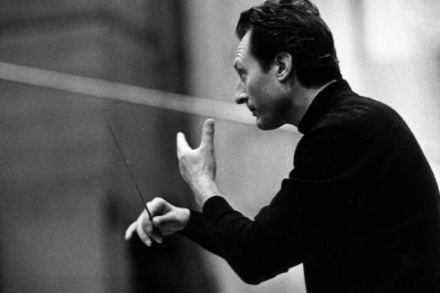
Who was Carlos Kleiber, and why has he been voted the best conductor of all time? Carlos Kleiber — the name evokes both Hispanic and German spheres — cancelled performances, never gave interviews, claimed he only conducted when the fridge was empty, and told Placido Domingo he’d prefer to devote his time to drinking wine and making love. He only conducted 96 concerts in his life (does Valerie Gergiev notch up more in a year?). Yet, according to Claudio Abbado, Kleiber was the most important conductor of the 20th century. He scarcely even wanted to be ‘a contender’, yet staggeringly, he was recently voted the most inspiring conductor of all time by a BBC survey of 100 conductors. Who was this remarkable man?
An aura of sanctity

From our UK edition

According to Arturo Toscanini, ‘any asino can conduct, but to make music is difficile’. According to Arturo Toscanini, ‘any asino can conduct, but to make music is difficile’. The technical side of conducting did not appeal to Carlo Maria Giulini, the subject of Thomas Saler’s highly illuminating biography. He was an immensely spiritual man, ‘an old-fashioned poet in a world of ego- maniacs and prosaic technicians’ in the words of Martin Bernheimer. In many ways the two maestri were polar opposites, Giulini (who died in 2005) being a gentle aristocratic in demeanour, while Toscanini behaved like an irascible bulldog.

Wit and brio

From our UK edition

Thomas Beecham: An Obsession with Music, by John Lucas Damn awful thing, what! [The Ring] — Barbarian load of Nazi thugs, aren’t they? ‘No one can honestly maintain that the lives of musicians make exciting reading’, claimed Beecham in his autobiography, A Mingled Chime. If you were to have a wager, you would put it on Tommy Beecham to defy the odds. He was kaleidoscopic. He described his own book as ‘demi-semi-autobiographical’, and said that ‘it’s mingled because it concerns everything under the sun’. He might have added that it is also mangled. Beecham was an embroiderer, ‘a natural dissembler’ in John Lucas’s phrase, and many familiar stories do not feature in this impeccably researched biography.

A career in the West

From our UK edition

Was Sergey Prokofiev a better diarist than a composer? We embark on this new volume with the 23-year-old enfant terrible living in St Petersburg. We are there during the ten days that shook the world, and although initially unshaken, Prokofiev escaped the turmoil of revolution and in 1918 headed for San Francisco. The following years take us to most of the rest of America, as well as to Paris, London, Barcelona and Tokyo. Both volumes of diaries — the previous one, Prodigious Youth, covering 1907-1914 — are beautifully presented and meticulously annotated, representing an extraordinary achievement by their translator Anthony Phillips.

The call of the wild

From our UK edition

Jean Sibelius was an epic figure: an orignal who never strove for originality. Not for him the frippery of a Stravinsky (‘with his stillborn affectations’) or the artificial contrivances of Arnold Schönberg. Sibelius was his own man, and a deeply human one, moved and moulded by the harsh Finnish landscape. This gave his music a rugged and austere quality, prompting the composer to reflect, ‘My orchestration is better than Beethoven’s and I have better themes than his. But he was born in a wine country — I in a land where surmjölk [curdled milk] is in charge.’ Sibelius was not an arrogant man. As Andrew Barnett reveals in this fine biography, he was full of contradictions and self-doubt.

The unromantic approach

From our UK edition

John Worthen, a D.H. Lawrence specialist, approaches Robert Schumann’s tormented life without any apparent musical or medical expertise. His aim is ambitious: to prove that Schumann was not the quintessential Romantic figure of folklore and that he died of tertiary syphilis. He attempts to argue that Schumann was not manic-depressive, schizophrenic, unbalanced or even unstable. His publishers, meanwhile, claim that this book ‘frees Schumann from 150 years of myth-making and unjustified psychological speculation’. Worthen hardly covers the music, so nor do I. In 1985, Peter Ostwald, professor of psychiatry at the University of California, published Schumann: Music and Madness.

Ten men went to mow

From our UK edition

Sitting at Stamford Bridge at the weekend, Chelsea trailing Bolton 0-1, I reflected on the nature of 11 brilliant players and their manager. After Mourinho’s half-time talk, Chelsea scored four goals in 10 minutes. There are inspiring and uninspiring gaffers. If he were a conductor, José Mourinho would be a virtuoso, but what does this imply? Passion, charisma, sensitivity, psychological insight and a spiritual dimension are all vital, but perhaps Otto Klemperer, one of the subjects of this impressive book, succeeded in subsuming all this into a simple phrase, ‘the power of suggestion’, in a 1969 interview: ‘The art of conducting lies, in my opinion, in the power of suggestion that the conductor exerts — on the audience as well as on the orchestra.