Adrian Hilton

Good riddance (or not) to George Abaraonye

From our UK edition

It was rather sly of George Abaraonye to move the motion of no confidence in himself as president-elect of the Oxford Union. He said it was an act of ‘true accountability’, but it seemed to me more a sense of false virtue. The ballot question was: ‘Should George Abaraonye, President-Elect, be removed as an Officer of the Society?’ The franchise wasn’t limited to current students or those in the environs of Oxford who could conveniently vote in person, but was extended extraordinarily to potentially thousands of life members all over the world who could vote by proxy. This was at the request of the standing committee – at quite short notice – and has been the cause of considerable confusion and chronic delay.

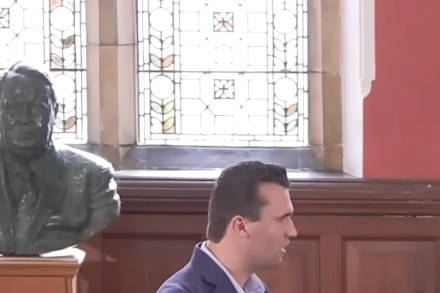
The Oxford Union and the shameful response to Charlie Kirk’s killing

From our UK edition

George Abaraonye was elected in June to be the Oxford Union president for Hilary term 2026. He is a PPE student at University College and was the Union’s director of press when he became president-elect. The Oxford Student reported that he ran independently ‘under the #RESET slate and endorsed by the #HOPE slate’. He has certainly called into question his suitability for the role of president, given his comments on the Charlie Kirk assassination this week. His response to the murder of Kirk on the Utah Valley University campus has been published and circulated widely. Screenshots from WhatsApp and Instagram show him writing ‘Charlie Kirk got shot, let’s fucking go’ and ‘Charlie Kirk got shot loool’.

The rise of ‘censory smearing’

From our UK edition

Every now and again a new phenomenon emerges in human communication or social behaviour which everyone recognises but none can name, because there is no term for it. There’s a sense that a word or phrase needs inventing. ‘Virtue signalling’ was one such development, and it came in the pages of The Spectator in 2015 from James Bartholomew. ‘Luxury beliefs’ is another, coined by Rob Henderson in the New York Post in 2019.  I watched Peter Kyle MP being interviewed recently by Wilfred Frost on Sky News about the Online Safety Act, and the name of Nigel Farage came up (quite a lot) because he had announced that he would repeal the act in order to protect freedom of expression. This, according to Kyle, put Farage firmly ‘on the side’ of Jimmy Savile.

In praise of the Church of England

From our UK edition

The Church of England, like all churches, has always struggled with the tension between the affirmation or assimilation of culture, and the call of the gospel to confront and transform it. Its raison d’etre – its social vocation – is to mediate between the extremes. This was originally between Wittenberg and Zurich (not Wittenberg and Rome, as some believe, though it may have come to be seen as that during the 17th century as anti-Catholicism in the state was incrementally dealt with by statute, and religious liberty increased). But now the CofE’s mediating role is between scepticism and faith, between belief and doubt, pomp and satire, a longing for the sacred combined with a sense that we create the sacred for ourselves.

Kirill’s crusade against Ukraine is more jihadi than Christian

From our UK edition

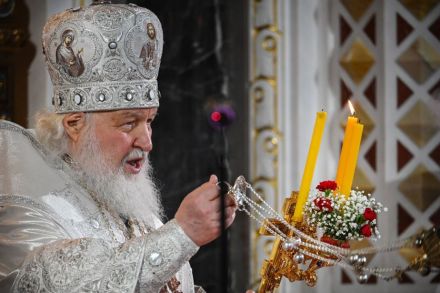
Patriarch Kirill, the leader of the Russian Orthodox Church, has again preached to the faithful of the Russian world. He told them that if they heed their president’s call to arms, they shall be absolved of their sins and avoid any possibility of Hades. ‘The Church realises that if somebody, driven by a sense of duty and the need to fulfil their oath… goes to do what their duty calls of them, and if a person dies in the performance of this duty, then they have undoubtedly committed an act equivalent to sacrifice,’ he told his national congregation earlier this week.

A School of Anti-Semitism?

From our UK edition

As a teacher and lecturer, I’ve had a fair amount of indirect contact with Soas — the School of Oriental and African Studies at London University. I first met one of its doctoral students in 2001, around the time I began to send my A-level students to join its impressive list of alumni, which includes government ministers, ambassadors, diplomats, judges and a Nobel laureate. It has also produced impressive research tomes of international renown and is always high up in the university league tables. A sea of diversity under one scholastic sky, with so much to learn through intercultural exchange. For many, the Soas library is a place of pilgrimage. But I’d now think twice before writing a Ucas reference to send one of my young students there.

No, David Lidington: EU subsidiarity is not a ‘new principle’

From our UK edition

David Lidington’s letter to Conservative Party members on ‘reform in Europe’ tells us not very much about almost nothing at all. It is measured, upbeat and polite, but that is the essential optimism and generous disposition of the man himself. The only interesting glimpse it offered into current thinking was confirmation of his ignorance of the Maastricht Treaty. Perhaps, like Kenneth Clarke, he hasn’t bothered to read it. The Europe Minister wrote: ‘I’m sure [members] will be pleased to know that in their Subsidiarity Review, the Dutch Government proposed a new principle: ‘at European level only when necessary, at national level whenever possible’.

Revd Dr Alan Clifford’s ‘homophobic’ comments referred to the CPS

From our UK edition

You’re at home, enjoying a summery Saturday afternoon with the bees and nasturtiums on the patio, when the doorbell intrudes. You’re greeted by an impeccably courteous, fresh-faced police officer from the Norfolk Constabulary – ‘Dedicated to this neighbourhood’, according to their website – and he’s come to speak to you because there’s been a complaint. Not, you understand, about the troubling number of burglaries, rising car thefts, incidences of property vandalism or madhouse music accompanying balmy barbeques. No, someone has reported you for sending them two gospel tracts by email, one entitled ‘Christ Can Cure – Good News for Gays’; and the other ‘Jesus Christ - the Saviour we all need’.

Spotify Christmas: Joy to the World

From our UK edition

We normally run these Spotify playlists on Sundays, but, as it's Christmas tomorrow, we thought we'd make an exception for Adrian's selection of festive music. Don't forget Pete Hoskin's selection of more recent Christmas songs, from a couple of weeks ago, too. Distilling your Christmas favourites into a succinct playlist is like trying to cram the creator of the universe into a manger – not entirely impossible, but it needs a bit of thought and planning. Just as the Christ-child had to surrender aspects of divinity, a playlist must compromise somewhere. But kenosis is traumatic. What goes? The Pogues? That’s easy enough. Mariah Carey? That’ll upset Fraser. Cliff? Oh, steady on.

A new ending

From our UK edition

“What passing-bells for these who die as cattle?” lamented Wilfred Owen in his Anthem for Doomed Youth. When RC Sherriff wrote his play Journey’s End just a decade after the Great War, he never set out to answer this haunting question or justify what he had witnessed at Passchendaele. But he was the first to bring the horrors of trench warfare to the stage, and by so doing he spawned a genre that would be satirised and appear a generation later as Oh, What a Lovely War!, and a generation after that as Blackadder Goes Forth. With their "simply topping" humour, "ra-ther" eccentricity, and "thanks most awfully" irony, they serve to remind us of the futility of war: they ensure that we will remember.

Cutting the arts and decimating culture

From our UK edition

Rationing Mammon emaciates the Muses. Plato knew it, and so does Polly Toynbee: it’s just simple cause and effect. And government cuts tend to be cyclical: seven fat years of abundance are invariably followed by lean years of famine. Unlike health and overseas development, the arts seem to have no divine right of exemption from the fiscal straitjacket presently being strapped around other departments of state: it is undeniably politically easier to cut Northern Ballet than hospital beds or malaria nets. But the suggestion that a reduction of £150 million amounts to little more than a slight nip‘n’tuck in a very fleshy sector is a little misleading.

Everything but the inspiration

From our UK edition

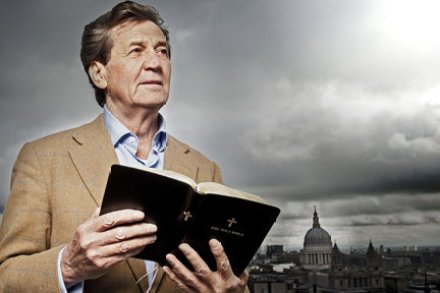
Whenever the BBC broadcast a major national celebration or royal event, they wheel out a Dimbleby to maintain the hereditary principle. If they want a probing political interview, they sacrifice the victim to the snarls of Paxman or the claws of Humphries. If they want election night gravitas, up pops the psephologically effervescent Peter Snow. They are all Auntie’s heavy hitters; sans pareil when it comes to pomp, circumstance, inquisition and exposition. The Corporation has never really nurtured a broadcasting aristocracy for the arts and culture. So perhaps it comes as no surprise that they poached Baron Bragg of Wigton (aka Melvyn) from ITV to present their flagship documentary to commemorate the 400th anniversary of the King James Bible.

Render unto the Pope…

From our UK edition

This realm of England is an Empire ...governed by one Supreme Head and King.' So proclaimed Thomas Cromwell in his most critical piece of legislation, the Act in Restraint of Appeals in 1533. By calling England an empire, he designated it a sovereign state, with a king who owed no submission to any other human ruler and who was invested with plenary power to give his people justice in all causes. Interestingly, the Act's critics in Parliament were not so much concerned by its doctrinal corollaries, as by the fear that the Pope might retaliate by organising a European trade embargo against England. The Pope, of course, laid claim to the ultimate divine right.