Culture

Culture

The good, the bad and the ugly in books, exhibitions, cinema, TV, dance, music, podcasts and theatre.

Heart of the matter | 28 December 2012

Radio

Looking back can be fatal and is usually ill-advised, inducing a nostalgia that can only blight what lies ahead. Let’s risk it, though, reliving those radio moments of 2012 (avoiding the Jubilee and the Olympics) when words took shape and became visceral. Most memorable (perhaps because most recent) was John Humphrys’s grilling of his boss George Entwistle on the Today programme on Radio 4. The air crackled with pent-up feeling, as Humphrys, like one of Eddie Grundy’s ferrets, went after Entwistle. ‘You should go, shouldn’t you?’ says Humphrys, after we had heard the then DG admit that he hadn’t seen the newspaper story which exposed the flawed Newsnight investigation.

Age limit

Theatre

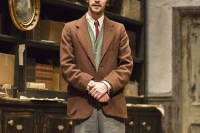
Michael Grandage is homeless. After a near-faultless decade in charge of the Donmar Warehouse, he now reinvents himself as a roving thesp, a buskined vagabond, a theatrical mendicant wandering the byways and the turnpike lanes and ushering his troupe of all-stars into any pen that will accommodate them. It’s a medieval conception. The strolling players. His team of celebrity vagrants has taken a 15-month lease on the Noël Coward theatre where its residency kicks off with Privates on Parade, a 1977 play by Peter Nichols, examining life in an army concert party in Malaya in 1948. In shorthand, it’s the BBC sitcom It Ain’t Half Hot Mum  without the spitting bullies and the pouting misfits. Everything is tremendous fun.

Trading places | 28 December 2012

Cinema

The trouble with this adaptation of Salman Rushdie’s Booker prize-winning Midnight’s Children, aside from the fact it is a mess and a muddle, is that it goes on and on and on and on. And on. And on. And then, just when you think it has to be over, it goes on some more. If it were up to me, I would charge film-makers for every minute — £1, say; let’s not be greedy — over 90 minutes that I’m kept in the cinema for no good reason. In this instance, as the film comes in at two and a half hours, I think I’m owed £60 (plus VAT and expenses) and I will be invoicing Mr Rushdie directly, as we cannot let him off the hook. Rushdie has no one to blame for this but Rushdie. Rushdie wrote the script. Rushdie is the executive producer.

Talk of the devil

Opera

In one of his finest essays, Gore Vidal recalls that when he worked as a scriptwriter for MGM the Wise Hack always used to advise his toffee-nosed team that ‘shit has its own integrity’. If crap is what you’re producing, make sure there are no signs in it that that’s what you think it is. Meyerbeer’s Robert le diable fails that test, I think, as do the rest of his operas. And at the Royal Opera, where a new production by Laurent Pelly, shared with Geneva, is on display, there are plenty of indications that no one involved takes it seriously either.

A flock of bells…

More from Books

A flock of bells takes the air and you come to me, out of nowehere and I smile, knowing you’ll visit me always, that this is how it will be till the last thread of an island slips through a bell-ringer’s hands and they put me in the listening earth.

The art of Christmas

Arts feature

One of the most important and enjoyable Christmas decorations in our house is the profusion of Christmas cards. I am fortunate to number quite a few artists among my friends, and a good percentage of them make and send their own Christmas cards. Most of these tend to the secular and celebratory, but the range of image and technique is what really stands out. Literally, in the case of the sculptor Ann Christopher (born 1947), who makes wonderful little constructions of flexed and frayed silver card often decorated with stars, which balance three-dimensionally on the mantelpiece, like geometric Christmas trees.

Turkeys

More from Books

emerge from the orchard. There now Aunt Kit says, pouring us lemonade. It’ll be another scorcher. The bronze birds drop wing, shake caruncle and snood engorged with purple blood, and rattle in full barding. My prize cock’s gone lame! He lifts each ringed foot singly, slowly — to shoot the short film frame by frame. In rue Ortolan I hear the chorus of gobbles roll across the mossed cobbles from distant Ophir.

Men’s Wear

More from Books

From the Woolrich Elite Concealed Carry line Shawn Thompson bought two shirts. He wrote on his blog: ‘The clothes I used in the past to hide my sidearm looked pretty sloppy and had my girlfriend complaining.’ The line includes the sort of vest that includes a stealth compartment. The wearer can appear to be warming his hands while gripping a pistol in a holster. Says a spokesman for Woolrich: ‘The bad guy gets a glimmer of fear wondering “Are they packing, or not?” ’ Not everyone is a fan. Howard Walter, 61, a salesman, said he preferred to carry his colt and a couple of knives and two extra magazines in a durable pair of work pants. Said Mr Walter: ‘They don’t shout “gun”, they shout average guy in the street. Dress for the gun.

London’s high life

More from Arts

You can take a five-minute flight across the Thames on something called the Emirates Air Line. It’s a cable-car ride between North Greenwich and the Royal Docks that’s sponsored by the Gulf carrier. Much else on the ride simulates a plane trip — the tickets are called boarding passes, and when you ‘take off’ from either side of the river there’s a large digital screen showing cheery people waving you off, as at an airport. As I embark from the southern bank, a bunch of ‘Butchers from South London’ bid me goodbye. The cable cars, however, are called gondolas rather than, say, ‘cockpits’ or ‘cabins’ — and once up in the air the whole of London unfolds.

Food, glorious food

Television

Despite a wet summer, the recent crop of food programmes has been prodigious: six episodes of Nigellissima, eight of Nigel Slater’s Dish Of The Day, six of Lorraine Pascale’s Fast, Fresh and Easy Food, 40 of Jamie’s 15-Minute Meals and 25 of Hugh’s Three Good Things — truly a basket of plenty. Two cooking competitions (The Great British Bake Off and Masterchef: The Professionals) have dished up a total of 34 episodes; Heston Blumenthal has hand-reared seven bloated and inedible turkeys (Heston’s Fantastical Food), and Yotam Ottolenghi (Ottolenghi’s Mediterranean Feast) has concocted, in the kitchens of Morocco, Istanbul, Tunisia and Israel, four unexpectedly delicious treats.

Male bonding

Theatre

Both these plays are about concealed sexuality. Straight, by D.C. Moore, is based on an American indie flick named Humpday. The play has one of the funniest openings you’ll ever see. We’re in a flat occupied by suburban nonentity Lewis and his wife Morgan. Lewis’s old college mucker, Waldorf, has come home after seven years in Mongolia and he cheekily decides to announce his return to western civilisation by inserting his unsheathed tumescence through the letterbox. Lewis doesn’t see it. His wife does and she has to persuade him that she isn’t hallucinating. The gate-crashing phallus symbolises the play’s theme of male eroticism thrusting itself uninvited into soporific domesticity.

Jumping the gun

Opera

2012 has been an undistinguished year in opera, at any rate in the UK. A combination of cutbacks and the promise of stops being pulled out next year for the bicentenaries of Verdi’s and Wagner’s births and the centenary of Britten’s has led to the big companies counting on our anticipation. Except that, in the case of Wagner, though oddly not of Verdi, the gun has been jumped. We have already had the Royal Opera’s Ring, four cycles of it in just over a month, so that there will be no staged Ring in London next year, only a concert version. It will be left to Longborough, for those who have the money, the time and the transport, to see it on stage, and judging from the individual parts that have been mounted in the past four years, the results should be tremendous.

Chorus of approval

Music

Is there anything more essential to one’s well-being than the sound of an English choir at evensong? Is there, for that matter, any word in our language more beautiful than ‘evensong’, with its evocation of architecture, music and the Anglican liturgy? This is the season to reflect on such matters. On Christmas Eve, Cambridge once again becomes the centre of the world for two hours as the choristers of King’s College celebrate the famous festival of carols and lessons and two days before, in St John’s, Smith Square, the choir of Trinity College will perform Bach’s Christmas Oratorio with the Orchestra of the Age of the Enlightenment. Moreover, they will be singing from memory.

In the worst possible taste

More from Arts

What are the rules of taste at Christmas? How might the fastidious chart a neat path through this garish and cluttered carnival of unreflective consumption? How might dignity be maintained in this tinselled and glitter-balled waste of space? Actually, how might we design it better? Nicky Haslam once and quite correctly, without a flicker of irony, advised me that ‘coloured lights are common’. There is value in such advice and we will return to this refreshing idea a little further down the page. Germans and Americans have a peculiar historic hold over our imaginations at this time of year. It was Victoria’s earnest German Prince, Albert of Saxe-Coburg and Gotha, who first imported the hitherto pagan Christmas tree.

Tiger feat

Cinema

Wow! Just: wow! Life of Pi may be the most ravishingly beautiful film I have ever seen. It’s stunning. It’s gorgeous. Its visual inventiveness made me want to weep for joy. It is magical realism made magical and realistic. The palette of colours is extraordinary. You will feel you are in the sea and above the clouds and as if you are on a boat with a Bengal tiger too. Wow! Just: wow! But, weirdly, while enraptured by its look, its emotions never seemed especially pressing, and as for the spiritual journey, it didn’t exactly float my own particular boat. Is it saying a belief in God always makes life a better story than one without a God? That this is why we require faith? Is it advocating a Life of Pi-ety?

Heavenly hands

Arts feature

The Hepworth has been garnering plaudits right and left as a new museum to be welcomed to the fold, and my first visit to this monolithic structure with its feet in Wakefield’s River Calder exceeded all expectations. Designed by David Chipperfield Architects, the ten linked blocks that make up this new suite of galleries are spacious and light-filled with excellent views out to the river and town. Restaurant, education centre and offices are on the ground floor, and upstairs the art comes into its own. At the top of the stairs is a room of six classic sculptures by Barbara Hepworth (1903–75), whose name the museum has taken since this significant figure of British Modernism was born in Wakefield.

Imperialist ambitions

Exhibitions

In 1997, the Russian Academy of Sciences gave the names Hermitage 4758 and Piotrovsky 4869 to two small planets discovered 500 million kilometres from earth. The signal honour paid to the State Hermitage Museum and Boris and Mikhail Piotrovsky— its dynastic succession of directors — heralded a new era of post-Soviet expansionism for the former Imperial museum: from now on, the sky would be the limit. Since then, the Hermitage has opened branches in London, Las Vegas, Amsterdam, Kazan, Ferrara and Vyborg. More than a goodwill gesture, the St Petersburg museum’s overseas expansion has been a way of getting its collections seen.

The quiz biz

Music

Come December, I often find myself writing a lot of quizzes. Not that I’m complaining: I love writing quizzes, and I really love being paid for writing quizzes. There’s a definite skill in crafting a decent question, and therefore considerable satisfaction in getting it right, tempered only by the unceasing fear of getting it completely wrong. (Like all writing, therefore.) All of us who toil in the quiz mines are naturally aware that we have our favourite subjects, our home territories if you like. I could go on writing increasingly abstruse questions about cricket or pop music far into the night, but I don’t, because the audience simply isn’t as interested in those subjects as I am. If you are a quizmaster, your job is to entertain people.

Field Marks

More from Books

The bulk of what I retain I learnt through him, from that trek to Flanders Moss in the hope of seeing a grey shrike on a blackened tree-fork, to a pair of hen harriers whose upward glide made him beam with pleasure. His first ringing-trap dismantled (it attracted vermin), he designed and built one that bears his name on the Isle of May; while in the cottage we shared, coffee-mugs and cigarette-butts cleared, and like as not whisky glasses from chess the night before, he’d set up his carousel of colour-slides to display the field marks of various species — pointing out such features as eye-stripes and wing-bars, nesting habits and flight-patterns — or draw lightning sketches, his profile more and more that of a raptor.

Selling secrecy

More from Arts

In the ‘psychotherapy ward’ of a secret venue somewhere in east London, watercolour portraits of troubled male faces line the wall. Nearby in the ‘court-room’ a sound installation broadcasts an ominous tick-tock into the airy acoustics of a large hall, while the ‘Warden’s Office’ below is furnished by quilts handmade by inmates. This is Secret Gallery, the latest venture from the company behind Secret Cinema, which stages immersive screenings of celluloid classics (kept secret until the screening itself) that have so far included Blade Runner, The Red Shoes and now The Shawshank Redemption, Frank Darabont’s cult tale of prison injustice.

Sounds in silence

Radio

Two really scary programmes this week, and not a vampire or psychopath to be heard. Both gave personal accounts of catastrophic hearing loss. Not something you’d expect to work on radio, the aural medium. How can you explain what it’s like to stop hearing when there’s no pictures, no other way to explain the absence of sound except through sound? But that’s what made them both such terrifying programmes. All the time I was listening, I kept on thinking: what would it be like if I suddenly couldn’t hear these voices, that piece of music they’re playing, this discussion of ideas. Hearing loss doesn’t mean, of course, that you actually stop hearing. It’s far worse than that, as both programmes illustrated, to alarming effect.

I love Michel Roux Jr

Television

For the past month I have been glued to the BBC’s Why Poverty? season — ‘part of an unprecedented collaboration between public service media in which 37 EBU members have been dedicating multiplatform programming on the theme of poverty’. No, I jest. What I’ve actually been watching is MasterChef. Served with a MasterChef reduction, a smear of MasterChef purée, MasterChef shavings, MasterChef pickles and MasterChef tapenade and pommes, style Masterchef. With more MasterChef for pud, obviously. Does this make me a bad person? Well, possibly. But it also makes me a normal person.

Battle of the sexes | 6 December 2012

Theatre

Tough play, The Taming of the Shrew. Uniquely among Shakespeare’s comedies, it moves audiences to pity and fear. It’s a video-nasty in the garb of a marital farce, an uncomfortable romance whose closing reconciliation scene invariably draws lusty hisses from female play-goers as Kate renounces her autonomy and bows to the will of her brutal husband, Petruchio. Directors prefer to approach this squirm-inducing parade of sexual violence through the comforting distortions of a veil. Single-gender productions are popular. In a Gujurati version, Kate is portrayed as an immigrant and the title had been coyly changed to A Foolish Foreign Woman Comes to Her Senses. Cole Porter goes for the vegetarian option by taking us backstage during a tour of the play.

Grape expectations

Cinema

Five minutes into You Will Be My Son (or Tu seras mon fils in its original French), I expected a very different film from the one that eventually emerged. The first scene takes place in a crematorium, as a coffin and its occupant are cooked to ashes. A relative of the deceased picks at a flower, and asks whether the ashes of the man and of the wood will mix. At which the funeral attendant leans over like a great crow to say, ‘It’s all just carbon.’ The whole thing seems very poised, quite refined and a little bit clever. But then the film turns into something else entirely. Its location switches to a vineyard in Saint-Émilion, where we are properly introduced to the owner, Paul de Marseul (Niels Arestrup), and his son Martin (Lorànt Deutsch).

Scandal at court

Opera

The way the director James Conway sees it, Monteverdi’s last opera L’incoronazione di Poppea is about that most delicate of subjects, adult abuse by youngsters. That isn’t what he says in his programme note for his production at the Royal College of Music, where he claims that the opera is about power, ‘love, yes, but love’s power’. That is tendentious: you might as well say that Otello is about the power of jealousy, which is true, but that doesn’t make it ‘really’ about power; or that Wozzeck is about the power of powerlessness, etc. Poppea is about several things, power among them, but also love, jealousy, ambition, ruthlessness, the abuse of power.

Fourth Floor

More from Books

I reason with the crown of the tree. Surely from this fourth floor window, we are equals now. I calculate the trajectory, whether it would catch me if I threw myself at it. I comb for clues from the uneasy rocking of the branches, the slow swimming of its fingers stirring the air. There must be something in the moth flutterings of the mylar balloon trapped between the twigs; a pincered ghost, failing to tear itself away even with the wind as an ally. You can’t blame the Poplar for wanting to hoard it, the only fruit it has ever held onto or is capable of bearing.