Culture

Culture

The good, the bad and the ugly in books, exhibitions, cinema, TV, dance, music, podcasts and theatre.

La Donna del Lago, Met Opera, review: Colm Tóibín on a night of masterful singing

This is an extract from this week’s magazine, available from tomorrow. La Donna del LagoMetropolitan Opera, New York, in rep until 14 March La Donna del Lago, based on a poem by Sir Walter Scott, is one of the nine serious, dramatic operas that Rossini wrote for Teatro San Carlo in Naples between 1815 and 1822. At the time the opera was produced he had at his disposal not only a great soprano, for whom he wrote with considerable flair, but two expert tenors and a contralto taking the part of the young male lover. In the first-ever production at the Met in New York that has just opened, the colours move from the sultry sky of Scotland in the first act to the starkness of a field after battle and then the sumptuous golds in King James V’s palace in the second act.

Iolanta/Duke Bluebeard’s Castle, Met Opera Live, review: enterprising take on two masterpieces

Iolanta / Duke Bluebeard's Castle  Met Opera Live The Met's antepenultimate relay of the season was an enterprising pairing of two operas, one of which we should see more often, and both of them done with intelligence and care. Tchaikovsky's Iolanta, his last opera, inconveniently lasts about 100 minutes, so is especially hard to find a partner for. It is a strange, touching piece, though it has few of the characteristics we associate with him. There is hardly a memorable melody in it, and little that is overwrought, indeed the colours are pastel. Iolanta is a princess, blind from birth, but skilfully kept in ignorance of her condition, and surrounded in this production by bored maids who treat her sweetly and otherwise bitch.

Where Van Gogh learned to paint

Arts feature

In December 1878 Vincent Van Gogh arrived in the Borinage, a bleak coal- mining district near Mons. He was 25 years old. He’d failed to become an art dealer. He’d failed to become a schoolteacher. Drawing was just a hobby — an artistic career was the last thing on his mind. He’d come here as a preacher, full of evangelical fervour, yet he proved a failure at that too. The problem was, he was far too pious. He gave away everything he owned. These miners didn’t know what to make of him. They called him ‘the Christ of the coal mines’. After six months, he was fired. With nowhere else to go and nothing else to do, during the next 18 months Vincent taught himself the rudiments of draughtsmanship, anatomy and perspective.

The future of the album lies in the gallery

Exhibitions

The album is not what it was. It still exists, in record collections, as part of the torrential streaming of everything, and in the sentimental memories of those who lament the loss of what once seemed a permanent fixture and the most exciting, unimpeachably authentic way of capturing and keeping music. Many musicians refuse to relinquish the idea — length, number of songs, conceptual framework, illusory two sides, solidity, sound — of the album. It remains worth hearing what a musician like PJ Harvey might have to say about the album, because it is where she has worked for 20 years, and so she has built up enough momentum to make her next one intriguing. She’s one of the last rock artists where this is truly the case.

Bolivia

Poems

for Lucy Dallas Because they wanted to go home and some bit part, a rat in deep cover, raised the alarm (he had done harm himself, but legally, and hid his shame) or, falling in slow motion, the cashier, shot through the heart for moving a finger, reached with his last breath for the dead guard’s Peacemaker and returned fire – because of this taped riot I’m here watching the sun dance to our own live show, few words between us and the telling air, the sum of what was not but is now clear, how Redford in his larcenous prime loved Katharine Ross the schoolteacher and there was time to come for them beyond the frozen fusillades of blame as secretly we bless bad breaks, like “Bolivia?

Better Call Saul review: the box set equivalent of a (very) well-made play

Television

I lost count long ago of the number of dinner parties and pub conversations where I’ve had to utter the humiliating words, ‘Actually I haven’t seen Breaking Bad.’ The social isolation became even more shaming when my 81-year-old mother rang to ask me if I’d heard of the show and to explain how much she loved it. (‘But isn’t it very violent, Mum?’ I said. ‘Yes,’ she replied.) All of which means that I can approach Better Call Saul (Netflix) with what I like to think of as stern critical neutrality — rather than, say, ignorance.

Love Is Strange review: subtle and nuanced in ways which, I’m assuming, Fifty Shades is not

Cinema

You will be wondering why I haven’t seen Fifty Shades of Grey as this is very much Fifty Shades of Grey week and although I’m as curious and excited as anybody — how has Sam Taylor-Johnson filmed a book which, let’s face it, is quite a bit shit? — there were no UK media screenings prior to going to press. This means I will now have to pay and see it at the cinema, which is something, I know, you little people do all the time, but still, who does one go with? As it happens, my mother (86) expressed an interest, but I had to tell her: no way. ‘Mum,’ I said, ‘I love you and would do anything for you but, in the words of Meatloaf, “I won’t do that.”’ Who do you go with? Tell me, please.

A tatty new theatre offers up a comic gem that’s sure to be snapped up by the BBC

Theatre

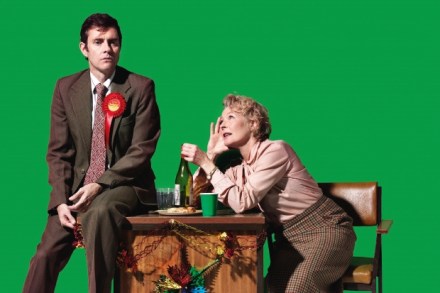
New venue. New enticement. In the undercroft of a vast but disregarded Bloomsbury church nestles the Museum of Comedy. The below-stairs space wears the heavy oaken lineaments of Victorian piety but the flagstones have been smothered with prim suburban carpeting, wall-to-wall. There’s a bar in one corner. Yes, a bar in a church. With prices high enough to make you take the pledge. The ecclesiastical shelves are crammed with books, magazines, scripts and photographs that summon up the ghosts of our comedy heroes. A big carved pew, centrally plonked, invites the worshipper to sit and read, let us say, the autobiography of Clive Dunn or the diaries of Kenneth Williams. The sheer incongruity of this arrangement causes palpitations in the brain.

Mastersingers of Nuremberg, ENO, review: ‘a triumph’

Opera

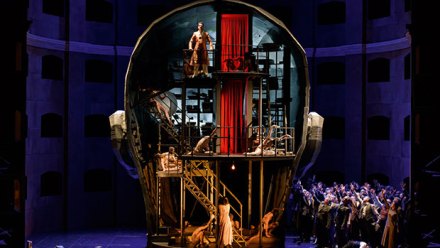
ENO’s new production of Wagner’s The Mastersingers of Nuremberg is a triumph about which only the most niggling of reservations can be set. Every aspect — orchestral, vocal, production — works in harmony to effect one of the richest, most intensely absorbing, energising and delightful afternoons and evenings I have ever spent in the theatre. It is above all a team effort, and since individuality and teamwork are very much what Mastersingers is about, that made it still more satisfying. However, two people must be singled out: Richard Jones for the finest of all the productions of his I’ve seen. This one comes from Cardiff, where it was unveiled almost five years ago.

Classical music’s greatest political butt-kissers: Dudamel, Gergiev and Rattle

Music

On 8 March 2013, Gustavo Dudamel stood by the coffin of the Marxist autocrat Hugo Chavez and conducted the Simon Bolivar Symphony Orchestra in the Venezuelan national anthem. He assumed, like everyone else, that the coffin contained a fresh corpse: the president of Venezuela was reported to have died from cancer on 5 March at the age of 58. Not so, it is now claimed. According to his former head of security, Chavez died on 30 December 2012. The news was kept secret while his lieutenants panicked. The funeral — covered with ludicrous sycophancy by the BBC — was, at least in part, a masquerade. Whatever the truth, Dudamel — who’d recently taken up residence in America as music director of the Los Angeles Philharmonic — had to be there.

The Associates at Sadler’s Wells reviewed: another acutely inventive work from Crystal Pite

More from Arts

The prodigious streetdancer Tommy Franzén pops up everywhere from family-friendly hip-hop shows by ZooNation, Boy Blue and Bounce to serious contemporary ballet by Russell Maliphant and Kim Brandstrup, but he’s a bit of a Macavity. He ought to be recognised as a star, but he effaces himself award-winningly in others’ work. That chameleon quality is a problem with his venture into the solo limelight, a Charlie Chaplin tribute, SMILE, on the Sadler’s Wells triple bill of associate choreographers last week. Franzén’s mercurial moves are always thrilling to watch, and his creative extension of Chaplinesque capering into some acrobatic popping and b-boying does OK in making the Little Tramp a street brother of hip-hop’s outsiders.

Results

More from Books

The school holidays in the final furlong and the next new phase and term in clear sight. This is when the thousands receive their plain envelopes informing them whether they have made the grade, precisely. And we look on, remembering or not remembering a future built on hopes and inadequacy, not knowing what is right about our work and knowledge, and what is wrong, aware too of us in them and how things fade. We kiss them out the door and wait until they ring with hard facts that bring five years to a close.

David Baddiel criticises Bafta for ‘working class’ Bob Hoskins snub

It was the night of Eton versus Harrow at the Baftas as Eddie Redmayne faced off competition from Benedict Cumberbatch to take home the Best Actor gong. Now, Bafta are under fire for leaving out the late Bob Hoskins in their tribute montage to actors who have passed away. David Baddiel, the comedian, took to Twitter to claim that the omission of the Who Framed Roger Rabbit actor was a sign of the demise of the working class actor. The omission of Bob Hoskins in the BAFTA remembrance montage seems symbolic of the erasure in modern times of the working-class actor. — David Baddiel (@Baddiel) February 9, 2015 One working class actor did at least triumph on the night, with Jack O'Connell winning the Rising Star Award.

Spectator competition: ‘I really like Ed Miliband. Am I normal?’ Agony uncle Dan Brown responds (plus: a Samuel Pepys’-eye view of 21st-century London)

The Japanese novelist-turned-agony uncle Haruki Murakami is currently dishing out advice to fans on topics that range from cats and hate speech to parenting and infidelity. The call to cast a well-known writer, living or dead, in a similar role was an opportunity to check out the counselling skills of other literary greats — and not-so-greats. The standard was high. Mark Shelton’s Ted Hughes begins his reply to the question ‘how can I be more confident with girls?’ thus: ‘Stoat does not ask. Forefoot poised, he holds the crosshairs on his victim. The wicked waiting eyes glitter like wet berries. He is a cocked crossbow.

The art of Coke

Arts feature

In 1915 D.W. Griffith’s Birth of a Nation was premièred, Henry Ford manufactured his millionth Model-T (‘a million of anything is a lot’, he said), Kafka’s Metamorphosis was published and so, too, was one of Einstein’s critical contributions to his own general theory of relativity. Mixed into this modernist cocktail of extreme achievement and harrowing perceptions was something more banal, but just as enduring: the Coca-Cola ‘contour’ bottle. A century old this year, it is, in a disputed field, an undisputed ‘design classic’. And, like any classic in any genre, it can be read in many ways. Long before Apple and the Messianic Steve Jobs, Coca-Cola developed a business model that was the proxy of a larger belief system.

Marlene Dumas at Tate Modern reviewed: ‘remarkable’

Exhibitions

‘Whoever wishes to devote himself to painting,’ Henri Matisse once advised, ‘should begin by cutting out his own tongue.’ Marlene Dumas — whose work is the subject of a big new retrospective at Tate Modern — has not gone quite that far (and neither, of course, did Matisse). On the other hand, she does not hand out many clues as to what her work is all about. On the contrary, when Dumas says anything about her painting, it is inclined to be a self-deprecating paradox. ‘I paint because I am a woman,’ she states on her website. ‘(It’s a logical necessity.) If painting is female and insanity is a female malady, then all women painters are mad and all male painters are women.

Arabian Motorcycle Adventures review: enthralling and constantly surprising

Television

There were great numbers of young men who had never been in a war and were consequently far from unwilling to join in this one.(Thucydides, 5th century BC) I love that quote, inscribed on the walls of the Imperial War Museum, because it tells you so much both about the reason wars happen and about the nature of men. Most of us go through a phase where we think it would be terribly exciting to ‘see the elephant’. And for a lucky few, it’s everything they hoped it would be and more. One of those lucky few is an extraordinarily jammy sod called Matthew VanDyke. By rights this young American filmmaker from Baltimore ought to be dead a thousand times over.

Selma review: rich, nuanced, heartbreaking

Cinema

Selma, the civil rights film that stars David Oyelowo as Martin Luther King, undoubtedly contains the best and most powerful performance of the year as not nominated for an Oscar. Oyelowo has said this is because Hollywood prefers black actors when they play ‘subservient roles’ and aren’t ‘the centre of their own narrative, driving it forward’, which, alas — and before I could help myself — immediately made me think of Driving Miss Daisy (nine nominations, and winner of Best Picture over Spike Lee’s Do the Right Thing). So, a useful reminder that, in congratulating ourselves on how far we have come, we should not forget how far we still have to travel. (And that is your lesson for this week.

Why we should say farewell to the ENO

Opera

It’s easy to forget what a mess of an art form opera once was. For its first 100 years it had no name, it had no fixed address, it didn’t really know who it was or what it was doing. You’d find it at schools, at weddings, at political functions. It was an artistic whore for hire. Embroiled in an epic tug-of-war as to which of the three art forms — word, music or dance — should be primary, it was also lithe and experimental. In fact, it was more like performance art than anything you’ll witness in a modern opera house. Why this historical detour?

James Blunt’s sense of entitlement is so palpable you could wear it as a hat

Music

Only a fool would mess with James Blunt. As his Twitter followers know, he has a sharp wit, and, as befits a former officer in the Life Guards, he is always ready for a fight. Indeed, the grievous suffering around the world caused by his greatest hit, ‘You’re Beautiful’, has been offset to some extent by his snappy tweets, several widely disseminated photographs of him looking a prawn, and a general sense that he can take a joke. Not long ago someone else tweeted as follows: ‘If you receive an email with a link to the new James Blunt single, don’t click on it. It’s a link to the new James Blunt single!’ The singer promptly retweeted it. Even so, he may have overreached himself with his open letter to Chris Bryant the other day.

Approaching America

More from Books

Our pilot on the Delaware offers to show you his laptop. These are the buoys, he says; I know exactly where I am to within a metre. This is the same way we track our missiles and drones. You stare for a moment and say oh. Then remembering your manners add thank you for showing me.

Ignore the naysayers: these Fitzwilliam bronzes are by Michelangelo (probably)

A bronze sculpture by Michelangelo is one of the lost Holy Grails of art history. We know he made them, but the most important – an over life-size figure of Pope Julius II – was destroyed by the enraged citizens of Bologna (who had a grudge against the pontiff) a few years after it was made. A bronze David by Michelangelo vanished during the French Revolution. So that, it has always been concluded, was that. Now the Fitzwilliam Museum has unveiled not one but two bronzes attributed to the great man: athletic naked men mounted on slightly weird feline beasts. It seems too good to be true, but I am more than half persuaded that these are, as the art world says, 'right'.

Night Will Fall review: the Hitchcock film they didn’t want you to see

At the synagogue where I happened to be singing last Saturday, the rabbi wrapped up her regular notices with a timely exhortation to her congregants to try to watch the André Singer documentary Night Will Fall. In 1945, as the Allied forces fought their way across Europe, in the process uncovering the hideous network of Nazi death and slave-labour camps, film producer Sidney Bernstein was despatched by the Ministry of Information to lead a few dozen army cameramen tasked with documenting the astonishing extent of the German atrocities.

Les Contes d’Hoffmann, Met Opera Live, review: ‘superlative’

Les Contes d'Hoffmann Met Opera Live This was another excellent performance from the Met, though that house's addiction to enormously elaborate scenery - most of which could be sold off to Las Vegas - reaches lunatic proportions, robbing the work of its dream-like or hallucinatory quality, though that must surely have been a large part of Offenbach's intention. The paradox of Les Contes d'Hoffmann is that the finer the performance, the more frustrating the piece itself becomes. Perhaps it has that in common with its near-contemporary Carmen, another work that succeeds only on a superficial level.

Chris Bryant: I am not James Blunt’s sex toy

After Mr S revealed that Chris Bryant has broken two ribs getting out of bed, speculation is rife that his nemesis James Blunt could be to blame for the incident. The duo fell out after the Labour MP claimed that British culture should not be dominated by the likes of privately educated crooners such as Blunt. The You're Beautiful singer swiftly replied in an open letter in which he called Bryant a 'classist gimp'. Keen to avoid any confusion about the cause of his injury, Bryant took the opportunity at a mock leader election debate at King's Place to clear the singer's name: 'Just to clarify – James Blunt played no part in my injury. He called me a gimp, which I believe is some sort of sex toy. Well I’m not his sexual toy, and never will be. He’s gutted.

How Japan became a pop culture superpower

Arts feature

There is an island nation, just off the main body of a continent. It gained an empire from the force of its military and the finesse of its trading contracts. The empire withered, as they all do, under the gaze of history. But that didn’t finish the island nation off. It simply took over the world in a different way, with something greater than arms and economics: popular culture. Its territory is now the television in your lounge, and the headphones in your ears. Sounds like Britain, doesn’t it? We often boast of how, from the Beatles to this year’s Oscar nominations, our country punches above its weight culturally. But I had another island nation in mind. One with twice as much weight, in terms of population, and a hell of a lot more punch: Japan.

Rubens and His Legacy at the Royal Academy reviewed: his imitators fall short of their master miserably

Exhibitions

The main spring offering at the Royal Academy, Rubens and His Legacy: Van Dyck to Cézanne, teaches two useful lessons. One — not much of a surprise — is that Peter Paul Rubens (1577–1640) was a protean giant of a painter, expending sufficient artistic invention and energy to power other artists for centuries to come. The other conclusion is how hard compare-and-contrast exhibitions of this kind are to pull off. The basic idea — that Rubens was a towering figure in European culture — is plainly valid (the best riposte to the tired observation that there are so few famous Belgians is that there are plenty of celebrated Flemings, among whom Rubens is pre-eminent).