Culture

Culture

The good, the bad and the ugly in books, exhibitions, cinema, TV, dance, music, podcasts and theatre.

The lying game | 14 May 2015

Television

My favourite scene in the first episode of the new series of Benefits Street (Mondays, Channel 4) — now relocated to a housing estate in the north-east, but otherwise pretty much unchanged — was the one where the street’s resident stoner and low-level crim Maxwell has to attend a court summons. Really, if the whole thing had been scripted and faked by the film-makers (as I’m sure it wasn’t: no need), it couldn’t have worked out better. With just 15 minutes to go before Maxwell’s court hearing seven miles away, his brother turns up to give him a lift on his motorbike. But there’s one small problem. Maxwell’s brother is still under the influence of the vast quantities of diazepam he’s carrying with him in his bag.

Shakespeare’s duds

More from Arts

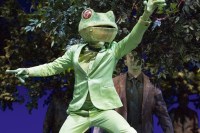
I love Shakespeare. But when he pulls on his wellies and hikes into the forest I yearn for the exit. A Midsummer Night’s Dream has a moonlit, sylvan location populated by a syrupy crew of hectic fairies, humourless bumpkins, panting maidens and swooning aristocrats in disguise. Shakespeare wrote it during his apprenticeship and he had yet to learn that several romances are far less interesting than just one. The result is a cloying, over-busy fantasy whose highlight is a love potion that makes a sprite called Titania fall in love with a donkey called Bottom. If you find the passion that flowers between a Sloane-y dryad and a pack animal hilarious then poor you.

Lacan Appeals to the Patient

More from Books

Since you remain reluctant, let us imagine that one’s selfhood is a work of art — a maquette in clay, as may be, and each life event enacted by the sculptor. In he creeps to the damp-room on his crepe-soled shoes again and again. In time the work proceeds via a series of flukes and inspirations: the sculptor warms to his task; the clay responds with little sucking sounds until it is wrapped and laid for next time on its wooden shelf. Nothing is done in that place that is not reparable. Beyond the clayey dark your helpmeet is waiting. And though his feet in the stiff grass ache with cold he keeps, while he can, his faith; his night lamp lifted.

The Best View in England

More from Books

that’s what she said. Of course, I begin to find fault: a shrub partly obscures the view, there’s a glint of car windows and, if I listen hard enough, I sense the thrum of traffic. I’ll admit the colours are strong, mid-summer: yellows of wheat-fields, oaky greens, and the hills’ hazed blue. A single cloud hovers off-centre, elders waft, sheep bleat, swallows jaunt. Yes, it’s lovely. But the Best View?     It’s like someone telling you their top three films. You’ll disagree. Instantly. Plus, there isn’t a river, the valley could be deeper, the blue bluer.

What you could buy for the price of a $179million Picasso

This article was first published on Apollo magazine's blog Picasso’s Les Femmes d’Alger (Version ‘O’) was the star lot at Christie’s ‘Looking Forward to the Past’ sale on 11 May, smashing the record for the most expensive work of art ever sold at auction. What else could you have paid for with $179.4 million in the art world? 1) Three 5-year renovations of the Picasso Museum in Paris (at €52 million a pop). 2) At least 252 versions of the painting that fetched the lowest price in the ‘Looking Forward to the Past’ auction; Francis Picabia’s Sans Titre (Visage de Femme) (price realised: $701,000).

Messy genius

Arts feature

Orson Welles would have been 100 this month. When he died in 1985, aged 70, the wonder was that he had lasted so long. His bulk was so immense, his productivity so prodigious in so many areas, his temperament so exorbitant, that he seemed to have been part of the landscape for ever. Never was ruined greatness so visible. The other great auteurs maudits of this century, Abel Gance and D.W. Griffith, disappeared into silence and oblivion. Eisenstein simply died young. Not Welles. Every time he trundled insincerely through some commercial for cheap liquor (he, the great bon viveur; he, for whom the very word commercial was an insult when applied to film), he sent a pang through the world’s heart.

Tribes of one

Exhibitions

The British painter Nina Hamnett recalled that Modigliani had a very large, very untidy studio. Dangling from the end of his bed was a web inhabited by an enormous spider. ‘He explained that he could not make the bed as he had grown very attached to the spider and was afraid of disturbing it.’ This anecdote — in its combination of Bohemian squalor, fin-de-siècle strangeness, whimsical humour and delicacy of feeling — gives a few clues to the art of the man who slept in that bed. More are provided by a nicely focused little exhibition at the Estorick Collection, Modigliani: A Unique Artistic Voice. It is made up of 30 drawings — many from the earlier part of the painter’s short career, plus one painting, a portrait from 1918.

Boys on the march

More from Arts

In dance, it’s usually the moment the boys start fighting that challenges your suspension of disbelief. Synchronised fencing (MacMillan’s Romeo and Juliet), unison goosestepping (Grigorovich’s Spartacus), even the Sharks and Jets in Robbins’s West Side Story, are formation set-pieces designed to arouse us. Last year there was a bunch of ballets made by British choreographers to mark the first world war centenary, which artfully focused on sorrow. But high tension, apprehensiveness, emotional denial — what’s really in the fighter’s head — these are physically antipathetic to dance’s expansive language. This is why Rosie Kay’s 5 Soldiers: The Body is the Frontline is so powerfully striking and bold a dance work.

Pinter without the bus routes

Theatre

David Mamet is Pinter without the Pinteresque indulgences, the absurdities and obscurities, the pauses, the Number 38 bus routes. American Buffalo, from the 1970s, is one of Mamet’s early triumphs. Don is a junkshop owner who believes a customer cheated him over a rare nickel so he gets his young pal Bob to steal it back. An older friend, Teach, persuades Don to ditch Bob and let him commit the burglary. That’s it. That’s all that happens in this narrow, gripping thriller, which takes the brutal male culture of the Wild West and imports it to the Chicago slums where three lonely outcasts fight desperately for scraps of cash and friendship. On paper it all sounds grey, miserable and petty. On stage it’s magnificent, multicoloured, vast and tragic.

Rock bottom

Cinema

The oeuvre of Chris Rock may not be fully known in this parish. He was the African-American stand-up who made a packet out of saying the unsayable about race. Richard Pryor kicked down the door, but it was Rock who stamped a registered trademark on the N-word. He also had a rapper’s sensibility in the area of gender politics: his breakthrough set had much to say about — and I merely quote — dick and pussy. And what about the movies? For children, Rock voiced a jive-talking zebra in the Madagascar mega-franchise, perhaps a quadrupedal hommage to Eddie Murphy’s donkey in Shrek. Alas Rock’s own pet projects have a tendency to misfire. Head of State posited the cockamamie notion of a black dude running for POTUS and winning.

And then there were four

Music

Where were you when you heard that Zayn Malik had left One Direction? No, me neither, but as my teenage daughter reports, an entire generation of female youth appears to have been traumatised by the event. Not that she gives a monkey’s herself, of course, but she says that everyone she knows knows someone who knows someone who really cares, sometimes to the point of genuine distress. We can laugh, and indeed we have laughed, rather a lot, but for these sufferers, the flavour of life itself has been tainted and a Lake Baikal of tears has been shed. One Direction, once the perfect five, are now an eroded four. And the rest of the world looks on and wonders, which one will go next? And can it be soon, please? For there is equilibrium in all things, and especially in boybands.

Not much cop | 7 May 2015

Television

With Clocking Off, Shameless and State of Play among his credits, Paul Abbott is undoubtedly one of the most respected TV writers in Britain. Not even his biggest fans, though, could argue that he’s one of the subtlest. On the whole, whatever his characters are thinking, they’ll also be saying — and generally in a way that proves what no-nonsense salt-of-the-earth types they are. Nor do his dramas ever suffer from a shortage of incident, much of it pitched somewhere between the bracing and the lurid. It’s an approach that Abbott evidently felt no need to change now that he’s writing a cop series. No Offence (Channel 4, Tuesday) began with DC Dinah Kowalska coming back in a taxi from a disappointing evening out with her boyfriend, who was on crutches.

Home and away | 7 May 2015

Radio

An extraordinary black-and-white photograph of a young black boy taken on the Isle of Wight by Julia Margaret Cameron in 1868 shows him in exotic clothes and a heavy silver-bead necklace, like a chain-of-office or a prisoner’s collar. He looks so sad, reminding me of the caged lions in London Zoo, his eyes heavy-laden, his listless body lacking the restless energy you would expect of a seven-year-old. He is Prince Alemayehu of Ethiopia, brought to England after his father, the emperor, committed suicide in his palace at Addis Ababa having just been defeated by the British.

What a Day

More from Books

The blue sky is Sunni. The white clouds are Shia. The sun is happy. The shops are crowded. The planet is healthy. The oceans are healthy. The oceans have recovered. The economy has recovered. Long ago, when I could sleep the night through Without having to get up to pee, I’d wake at a very early hour in the French countryside, In my bed in New York, with sweet birds singing oui-oui. Those days of having a car in the city And looking for places to park, And drinking martinis at lunch, When New York was a lark Of drink and anger and glamour, Are gone now—and New York is so much better! And, incredibly, nothing has got worse!

Spectator competition: write a poem for the new royal baby (because the Poet Laureate won’t)

Carol Ann Duffy, the Poet Laureate, has again refused to write a poem to commemorate the birth of the new royal, Charlotte Elizabeth Diane. Rod Liddle has written his own poem about Duffy, asking why she took the job of Poet Laureate if she doesn't like writing verse about royals. But this still leaves no one around to write a verse befitting the occasion. So we are inviting Spectator readers to do so, and will make this the Spectator Literary Competition: it will be formally announced in next week's magazine. Please email entries of up to 16 lines to lucy@spectator.co.uk by midday on 20 May.

Carol Ann Duffy won’t write a poem for the royal baby, so I have

Our wonderful bisexual poet laureate, Carol Ann Duffy, has decided once again not to write any of her doggerel to commemorate the latest royal birth. I suppose this is a mercy, really. However, here is what she might have written, if she could have been arsed to do so. I can’t abide the Royals, They bring me out in hives, And I would hate to celebrate, Their parasitic lives. You see – I am a leftie, It’s those CUTS that make me sob, So you might cry – “I wonder why, “She took the bloody job?

Why you should listen to the great pianist who gave in to the Nazis

Alfred Cortot (1877-1962) was in my opinion the greatest pianist in recorded history. If I had to give one reason – and there are many – it would be the spontaneity of his playing. Above all you hear it in Chopin. His twists of rubato and infinitely subtle shading of phrases sound as if they've just occurred to him. There's no better demonstration of that art than the first few minutes of his 1935 Chopin Second Piano Concerto with an uncredited orchestra (probably the LSO) and John Barbirolli. Not only is Cortot on top form, but the orchestra plays a delicious but naughty trick – at one point the violins decorate the melody with a little leap that isn't in the score. Once heard, never forgotten. Today brings great news for everyone who loves that recording.

State of play

Arts feature

Writers and producers have shown little appetite for putting the coalition on stage. Several reasons suggest themselves. In 2010 wise pundits assured us all that the Rose Garden duo would squabble and part long before the five-year term expired, and theatre folk were persuaded not to gamble on a ship that might sail at any moment. And the conduct of parliamentarians has been pretty unhelpful to dramatists. Chastened by the expenses scandal, MPs have reinvented themselves as models of probity and self-restraint. The Commons has been all but free of sin. Eric Joyce cracked a few skulls. Nadine Dorries bunked off for a fortnight in the jungle. The occasional ex-minister has been caught hustling undercover hacks for a day or two’s work. Even the cabinet have behaved like nuns.

He’s got rhythm

Exhibitions

One evening before the first world war, Henri Gaudier-Brzeska, fired by drink, tried out such then-fashionable dances as the cakewalk and the tango, ‘his eyes burning — his hair wild’. What was funny about this spectacle, his companion Sophie Brzeska confided to her diary, was not so much the dances as the sight of the dancer himself, ‘the young bear like nothing on earth with his seven league boots jumping in the air like an extraordinary buffoon’. It is a description that evokes many works displayed in a delightful little exhibition, New Rhythms, at Kettle’s Yard, Cambridge. This marks the centenary of Gaudier-Brzeska’s death; he was killed in action on 5 June 1915, aged 23. But it is not exactly a memorial show.

This is May

Poems

The soot sunk clouds have gone — to blacken someone else’s landscape. The tugging, ripping, girl-fight wind that stole the weekend’s peace has been abracadabra’d away as though life’s difficult days never even happened. Sometimes the stirred world stills. The trees refitted and re-greened appear overslept and drowsy. How long have you been sleeping? How long in life wintering? Only the rustling get-to-it birds seem to have understood the new year is well and truly in, beyond beginning. Full of early summer’s song; watch the paired up love-struck teenagers career and chase crazily all over the place.

Losing the plot | 30 April 2015

Theatre

Enter Rufus Norris. The new National Theatre boss is perfectly on-message with this debut effort by Caryl Churchill. Her 1976 play about inequality screams, ‘Vote Ed’ at triple-klaxon volume. Not that anyone in the audience was won over. They’d made up their minds long ago. Which is just as well because the play is hopelessly ineffective on every level. Churchill must be the most over-rated writer the English theatre has produced. She has virtually no dramatic skills. She can knock out humourless preachy rhetoric by the yard but as for the rest of it she hasn’t a clue. She can’t write a plot. She can’t create a human individual or differentiate one character from another with quirks of thought, word or deed.

Triple triumph | 30 April 2015

Opera

Three staples of the Italian repertoire, performed and seen in very different circumstances, have confirmed my view that they deserve their place in the repertoire, however many other works by their composers or contemporaries may be unearthed. I saw OperaUpClose’s version of Donizetti’s The Elixir of Love in the Mumford Theatre Cambridge, an underused venue that has the advantage of being 200 yards from my house. It is by far the best thing I have seen OUC do, and I regret catching only the last of many performances, but the only one here, where there is almost no interest in opera.

Aussie rules | 30 April 2015

Television

Some years ago I paid a visit to the site of the Gallipoli landings because I was mildly obsessed with the Peter Weir movie and wanted to gauge for myself how horrible it must have been. En route I met up with a young Australian who was training to be an actor (in my false memory it was the unknown Russell Crowe) and together we clambered up the near-cliff-like slopes in the blazing sun, imagining the Turks sniping and rolling grenades at us from the trenches on top. That anyone could have survived at all, we agreed, was a miracle.

Presence of mind

Radio

‘It’s hard to know how to tell this story,’ she said as she began. ‘Because it’s so loaded. It’s so heavy-duty.’ Lore Wolfson was talking about the death of her husband, Paul, or rather about the onset of the illness that led him a year later to take an overdose of heroin, aged 61. He had been diagnosed with early-onset dementia, in a peculiarly aggressive form, rapidly losing his words, his memory, his capacity to work or function independently. Lore began recording her conversations with Paul very soon after they knew for sure why he was having word-finding difficulties. ‘It was the natural thing to do,’ she said, because she’s a radio producer and, for her, keeping an audio diary was more natural than writing things down.

Mexican wave

Music

Tours that start in Mexico have a nasty habit of repeating on one. Of all the British groups touring in the United States at the moment, we were the only one to launch our efforts there. But the upshot is that, two weeks later and safely in New York, I am still directing a sea of unnaturally white faces. I am often asked what happens when someone falls ill on stage. The answer is that they leave it, while trying to give the impression that this is all part of the evening’s entertainment. The resulting sense of unease can be felt by everyone in the room, but is perhaps worst for the conductor, whose job it is to fashion an interpretation out of people whose minds are surely elsewhere.

The rudeness of John Eliot Gardiner

More from Arts

Sir John Eliot Gardiner is talented almost beyond measure. His Monteverdi Choir, English Baroque Soloists and stupidly named Orchestre Révolutionnaire et Romantique have notched up one triumph after another over the decades: benchmark recordings of the Monteverdi Vespers and Bach B minor Mass, the finest period-instrument Beethoven symphony cycle and a cantata pilgrimage of live performances of all the Bach sacred cantatas. His recordings of Mozart operas are dazzling. At 72, Gardiner is at his artistic peak. His live re-recordings of the Beethoven Fifth, Seventh and Missa Solemnis eclipse their predecessors and in its second account of the Bach motets the Monteverdi Choir sings with such eerie precision, infused with the spirit of dance, that its rivals must despair.