Culture

Culture

The good, the bad and the ugly in books, exhibitions, cinema, TV, dance, music, podcasts and theatre.

Cold frames

Cinema

A Little Chaos is a period drama directed by Alan Rickman and starring Kate Winslet as a woman charged to design and build a grand fountain garden for Louis XIV at Versailles. The film is, I noted from the poster, ‘the official film of RHS Gardening Week’, which may or may not be a hotly contested title, I just don’t know. All I can tell you is that it is, in fact, more of a love story than a horticultural story, and while it has occasional pleasing moments, and is lavishly costumed, it manages to do what I do whenever I try my hand at gardening. That is, despite my best intentions, and slogging my guts out, I somehow kill everything stone dead.

Falling down

Opera

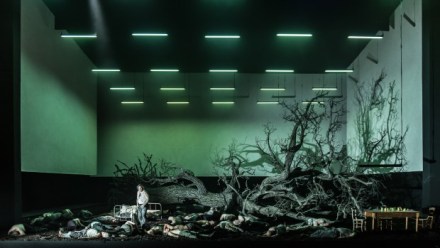
This week, some 200 years since Goya’s ‘The Disasters of War’, almost 80 years after Picasso’s ‘Guernica’, and over 50 since Malcolm Browne won a Pulitzer for his photograph of a self-immolating Buddhist monk, the British media found itself questioning whether art should, or even could, ever represent the horrors of recent history. It was a conversation that picked minutely over the ethical responsibilities of an opera based on the events of 9/11 — was it too soon? how would the families feel? would it exploit tragedy for drama? — but one whose ceaseless moral whys and wherefores prevented it ever arriving at the only real artistic question: how?

Turtle

Poems

As if a turtle you have laid your eggs in a bowl of sand. Unlike the turtle you sit next to your own heap overlong considering the wondrous thing    you’ve done, the babies wrestling in the gritty dark. And all the while the land cools steadily, a small white light somewhere over    the sea, over the sea out there and finally, deeply and slowly you remember it. You’re setting off now. Here are your    paddles, this is the pale underneath of your shell scraping the pebbles beneath the    moon’s glare. Yourself, one thing alone now. Can    you feel the water’s lift? You are already there.

The legend returns

Music

Daniel Barenboim is back in town: the South Bank is mounting a ‘Barenboim Project 2015’ in which he’s playing the Schubert piano sonatas and conducting his magnificent Berlin Staatskapelle in Elgar’s Second Symphony and Beethoven’s First Piano Concerto, with Martha Argerich as soloist (if she doesn’t cancel yet again, in which case I assume Barenboim will do it himself). As usual, the arts luvvies are wetting themselves. I remember being at a newspaper morning conference when he was about to play the Beethoven piano concertos at the South Bank. The arts editor — who knew zilch about the respective merits of classical pianists — announced this as if it were the Second Coming. Everyone else made noises of awe and reverence.

Words

More from Books

Late afternoon I speak to Mum on the phone; she’s sorting through her past, four hundred or so odd-sized photographs. ‘Well, you won’t want to do it,’ she says, ‘when I’m gone, I won’t leave you that task.’ We switch tack, not from fear, from silent truth, what can’t come back. We talk of mulish rough weather, April squalls, the wind’s choking embrace of a newly dressed willow, bringing it down, its road wreckage near her place. Dad’s death was like that tree. She talks in tangents. Is this what she means?

By Air

More from Books

Astonishing to think That not so long ago First the Brothers Wright Then Louis Blériot Initiated flight. And strapped into a seat Now we can choose a drink, Tomato juice, red wine, Some music or a film At 30, 000 feet. Remarkable to know That aviation fuel, Once vegetable remains, Comes from the earth as oil And energises planes. Comforting to presume The cabin’s pressurised And instruments of flight Are skilfully devised To navigate the night. Consoling to believe The forces that can heave The weight of this machine Above the ocean waves And alpine mountain scene. Strange to be conscious of The distant sea below And absent sky above Where cloud formations flow Detached from all we love.

Benjamin’s Into The Little Hill is a masterpiece: Speech Acts at Shadwell Opera reviewed

Speech Acts Shadwell Opera, Courtyard Theatre Election time is upon us again. But before we arrive at the main event there are the warm-up acts – televised debates, broadsheet profiles and daytime television interviews – to be endured. Making this political stand-up more bearable are the intelligent heckles coming from the arts. London’s theatres are filled with issue-plays talking about all the topics the politicians aren’t – the housing crisis, NHS, life on the dole – but despite a rich seam of politically-charged works at its disposal (The Marriage of Figaro, Don Carlo, Boris Godunov among them), the main UK opera houses aren’t following suit.

The dreamer

Arts feature

Federico Fellini’s La Dolce Vita was a box-office triumph in Italy in 1960. It made $1.5 million at the box office in three months — more than Gone With the Wind had. ‘It was the making of me,’ said Fellini. It was also the making of Marcello Mastroianni as the screen idol with a curiously impotent sex appeal. No other film captured so memorably the flashbulb glitz of Italy’s postwar ‘economic miracle’ and its consumer boom of Fiat 500s and Gaggia espresso machines. Unsurprisingly, the Vatican objected to the scene where Mastroianni makes love to the Swedish diva Anita Ekberg (who died earlier this year at the age of 83) in the waters of the Trevi fountain. Sixties Rome became a fantasy of the erotic ‘sweet life’ thanks in part to that scene.

Light fantastic

Exhibitions

The most unusual picture in the exhibition of work by Eric Ravilious at Dulwich Picture Gallery, in terms of subject-matter at least, is entitled ‘Bomb Defusing Equipment’. In other ways — crisp linear precision, a designer’s eye for the melodious arrangement of shapes — it is typical of Ravilious. Characteristic, too, is the way he has given these implements associated with warfare and high explosives an almost jaunty air, shading into melancholy mysteriousness. That’s the Ravilious note, and I must admit I find it irresistible. Ravilious (1903–42) was one of the most beguiling of mid-20th-century British artists. Yet it is still not quite clear what position he has in art history: high or low, important or insignificant.

James Bond

More from Arts

For fans of the franchise who remain unconvinced by Daniel Craig’s time on her majesty’s secret service, the stories leaking from the production of the latest film Spectre are further evidence that the time has come to hand 007 a glass of scotch and a revolver. Craig’s Bond always had less of an air of an expense-account gentleman spy and more the demeanour of a spornosexual plumber. This is a Bond who’d sooner take photographs of his abs in the bathroom mirror than go bird-watching. Stumbling after the surefooted remake of Casino Royale, there is no disguising the tedious drivel that was Quantum of Solace, nor that Skyfall borrowed heavily from the Home Alone franchise.

Keeping the faith | 9 April 2015

Radio

There was no shortage of Easter music and talks across the BBC networks with a sunrise service on Radio 4 followed by much fuss and fanfare for the ‘live’ relay of Libby Lane’s first Easter sermon as Bishop. A significant milestone for the C of E as women are at last allowed to don mitres and wield a bishop’s crozier. Three, not to be outdone, invited the Revd Lucy Winkett (who had to outride the brouhaha caused by her appointment as the first woman priest at St Paul’s Cathedral) on to Private Passions, where she proved herself an insightful musician and theologian.

All that glitters is not gold

Cinema

Woman in Gold feels rather like a Jewish version of Philomena as this too is about an older woman seeking justice for what has been stolen from her in the past but, unlike the Jewish version of almost everything, this is not in any way superior, and may even be a dud. It is based on a true story, which is an excellent and fascinating story, but it’s the storytelling that counts, and the storytelling here is not only familiar and pedestrian, but so emotionally manipulative that it doesn’t come with one sentimental ending, but several in quick succession. ‘Oh good, it’s over,’ you will think to yourself, as you make to rise from your cinema seat, but what’s this coming at you? Yet another sentimental ending? Every character gets their own?

Ayckbourn again

Theatre

Experts are concerned that Alan Ayckbourn’s plays may soon face extinction. Fewer than 80 of these precious beasts still exist in their natural habitat, so theatre-goers will be cheered to know that the National Theatre has created a genetically identical replica and released it into the wild. Rules for Living, fashioned by Sam Holcroft from the Acykbourn blueprint, is a bourgeois natter-fest in which bickering couples meet for a fractious Christmas summit. The characters are a bit nice and a bit nasty. Stephen Mangan plays a failed cricket star married to a soak in a frock. They have an only child who suffers from this year’s must-have mental disorder.

Crossing cultures

More from Arts

For an Indian woman to make a dancework about La Bayadère is a promising prospect. This classical ballet of 1877 by Russia’s French-born genius Marius Petipa tells the simple story of an Indian temple dancer — essentially a religious sex slave — whose potential salvation by an amorous young soldier is dashed when he expediently marries the rajah’s daughter. Death and transfiguration ensue in some addictively gorgeous balletic poetry, along with all sorts of improbable exotica to please the tsar’s eye. Londoner Shobana Jeyasingh, born in India, trained as a traditional Bharatanatyam dancer, and is a contemporary dance choreographer of keen intelligence, if sometimes letting her brain get the better of her choreographic imagination.

Beauty and the bleak

Opera

The Ice Break is Michael Tippett’s fourth opera, first produced at Covent Garden in 1977 and rarely produced anywhere since, though there is an excellent recording of it. Its brevity (75 minutes) rather took the wind out of the Royal Opera’s sails, since they had envisaged a full evening’s piece. So, I imagine, did its wackiness, though more extreme things in that line were to follow from Tippett. There are numerous ingredients in The Ice Break, but it gives the impression that its composer was so fascinated by all of them that he restlessly moves from one to another, leaving his audience to see whether they can make sense of them. As with his previous opera, The Knot Garden, almost all the characters have strange names — Lev, Yuri, Olympion, Astron etc.

End of the Rainbow

Music

The golden age of pop music may be long gone, but the golden age of pop musicians’ obituaries is definitely with us. Soon I shall have to start apologising for returning to this subject with such regularity, but barely a week now seems to pass without some rock legend turning his or her eminent toes up. Last week it was John Renbourn, gruff beardy guitarist for Pentangle, and the week before Daevid Allen, who founded Soft Machine and about 73 different manifestations of Gong. On social media Nick Hornby asked us to name which dead people we had seen live (when they were alive, obviously). His list included Bobby Womack, Luther Vandross, Bob Marley, Joe Strummer, the Ramones, Rory Gallagher and Lee Brilleaux of Dr Feelgood (a lot). Hundreds of people responded.

Too Many Poets

More from Books

Too many poets pack a line with thought But melody refuses to take wing. It’s not that meaning has been dearly bought: It has been stifled, by a hankering For portent, as if music meant too much. Sidney called this a want of inward touch. True poets should walk singing as they weep, As Arnaut Daniel once epitomised; But nothing written will be worth its keep Composed by one who has not realised This to be true, and tested his own song On others, seeing if they listen long Or turn away. Verse is a public act To that extent at least. As cruel as love, The wished-for gift declines to be a fact Except for the elect. The gods above Loll on their clouds and lazily look down To choose who gets the laurels of renown Even if deaf.

Who will be the next head of the British Museum? Here are the runners and riders

The hunt for the next head of the British Museum is not going to be easy. The director needs to have the confidence of his trustees, to inspire his curators and to convince the government to maintain the grant. In all of those areas MacGregor has been exceptional. The Standard reports that the internal candidate Joanna Mackle, deputy director, is unlikely to put her name forward. So who's name is in the ring? One of the most prestigious jobs in the museum world, it suffers a handicap when it comes to salary. As such it is extremely unlikely that the most obvious candidate Thomas Campbell, currently director of the Metropolitan Museum (salary over $1m) could be persuaded to apply for Neil MacGregor's job (salary under £200,000).

The audio anoraks bringing the great vintage recordings back to life

Arts feature

If there’s one thing people find annoying about classical music anoraks, it’s our passion for vintage recordings. ‘Listen to that ravishing rubato,’ we gush, as an elderly soprano swoops and scoops to the accompaniment of what sounds like a giant egg-and-bacon fry-up. And if non-anorak listeners do manage to ignore the pops, scratches and static, what do they hear? Wrong notes. Plenty of them. Is that really Artur Schnabel murdering the mighty fugue of Beethoven’s ‘Hammerklavier’ Sonata or is it Les Dawson? There are actually two problems here — a disconcerting style of performance and crappy recorded sound. It’s important to distinguish between them.

Max Hastings’s diary: The joys of middle age, and Prince Charles’s strange letters

Diary

I am living in rustic seclusion while writing a book. Our only cultural outing of the week was to Newbury cinema to see, transmitted from the National Theatre, Arthur Miller’s A View From the Bridge, object of rave reviews. We respected the piece but did not enjoy it. Granted, appreciation of all major works of art requires an effort by the viewer, listener, reader. But a pleasure of getting older is to be unafraid of waving the white flag. We resist modern-dress Shakespeare or worse, opera. We will cross continents to avoid the music of Harrison Birtwistle or the art of Damien Hirst. We are ardent Trollopeians, incorrigibly middlebrow.

Eight remastered classical recordings you need to hear

In the magazine this week I've written about spectacular new advances in the art of remastering vintage classical recordings. Many restoration engineers are removing hiss and correcting pitch so that historic performances are no longer muffled or distorted. But one of them stands out from the rest: Andrew Rose, whose Pristine Classical label is more interventionist than others. In particular it uses something called ambient stereo to spread the mono output between speakers. This yields a more lifelike sound than the original microphones were able to capture. In many cases the results are astonishing. The Spectator and Pristine have put together a terrific offer for our existing and new subscribers – visit new.spectator.co.

The Heckler: down with the actor-commentariat!

More from Arts

I’ve never been terribly keen on actors. I prefer hairdressers and accountants. And teachers and builders and lawyers. I may even prefer politicians and footballers to actors. It’s a modesty thing. No profession demands more attention. And no attention is less warranted. Everywhere you look, there they are pouting and grimacing on billboards and TV screens, like oversized teenagers. How have we come to this? These people dress up and pretend to be other people — for a living! It wouldn’t be quite so bad if that were all they did. But these days actors are taking over our public space in a way that is unsettling and impossible to ignore.

Did Radio 4 have to deal with the Germanwings disaster as it did?

Radio

‘You can hear pretty clearly the sound of one of the helicopters and you can see it in the darkness,’ yelled James Reynolds over the noise of helicopters, police sirens, vehicles on the move. It was 8.10 a.m., the Today programme on the morning after the fatal Airbus A320 crash in southern France last week. Reynolds, a fine reporter, had been sent off to the crash site for an on-the-spot report, ‘live’ action, high-octane drama, tension so taut it’s almost visible. ‘I can see a convoy of police vehicles coming up the road with blue sirens,’ he continued. ‘There goes the police helicopter...’ Huge noise of rotors whirring. ‘It’s almost passing overhead.’ No doubt about that as the noise boomed around the kitchen.

Why James Delingpole is addicted to Pointless

Television

Ever since Boy got back from school my work schedule has fallen to pieces. Every few minutes, just when I’ve got my concentration back after the last interruption, Boy will burst into the office and say, ‘Dad, Dad. How good are you on obscure New Zealanders?’ Or, ‘Quick, Dad, it’s your subject: reptiles!’ Or, ‘Dad, this is ridiculous. Only four people recognised Johnny Marr.’ And so on and on it goes. If I were a stricter parent or a more self-disciplined worker, I wouldn’t let this happen. Problem is, the programme we’re talking about here is Pointless (BBC1, Mondays) and I’m afraid I’m just as addicted as Boy is.

Bad Jews at the Arts Theatre reviewed: strange, raw, obsessive and brilliant

Theatre

Bad Jews has completed its long trek from a smallish out-of-town venue to a full-scale West End berth. Billed as a ‘hilarious’ family comedy it opens on a low-key note in a New York apartment where three cousins have gathered for grandpa’s funeral. Daphna is a puritanical vegan Jewess, training as a rabbi, who wants to move to Israel, marry a soldier and serve in the IDF. She’s insanely jealous of Jonah and Shlomo, whose parents have bought them a flat before either has found a job. Shlomo (who calls himself Liam) is a ‘bad Jew’ obsessed with Japanese culture who intends to marry out.